When most people admire a finished building, they notice the architecture.
They see the glass.
They see the lights.
They see the finished product.
What they rarely see is the months—or years—of work that happened before a single person ever walked through the front door.
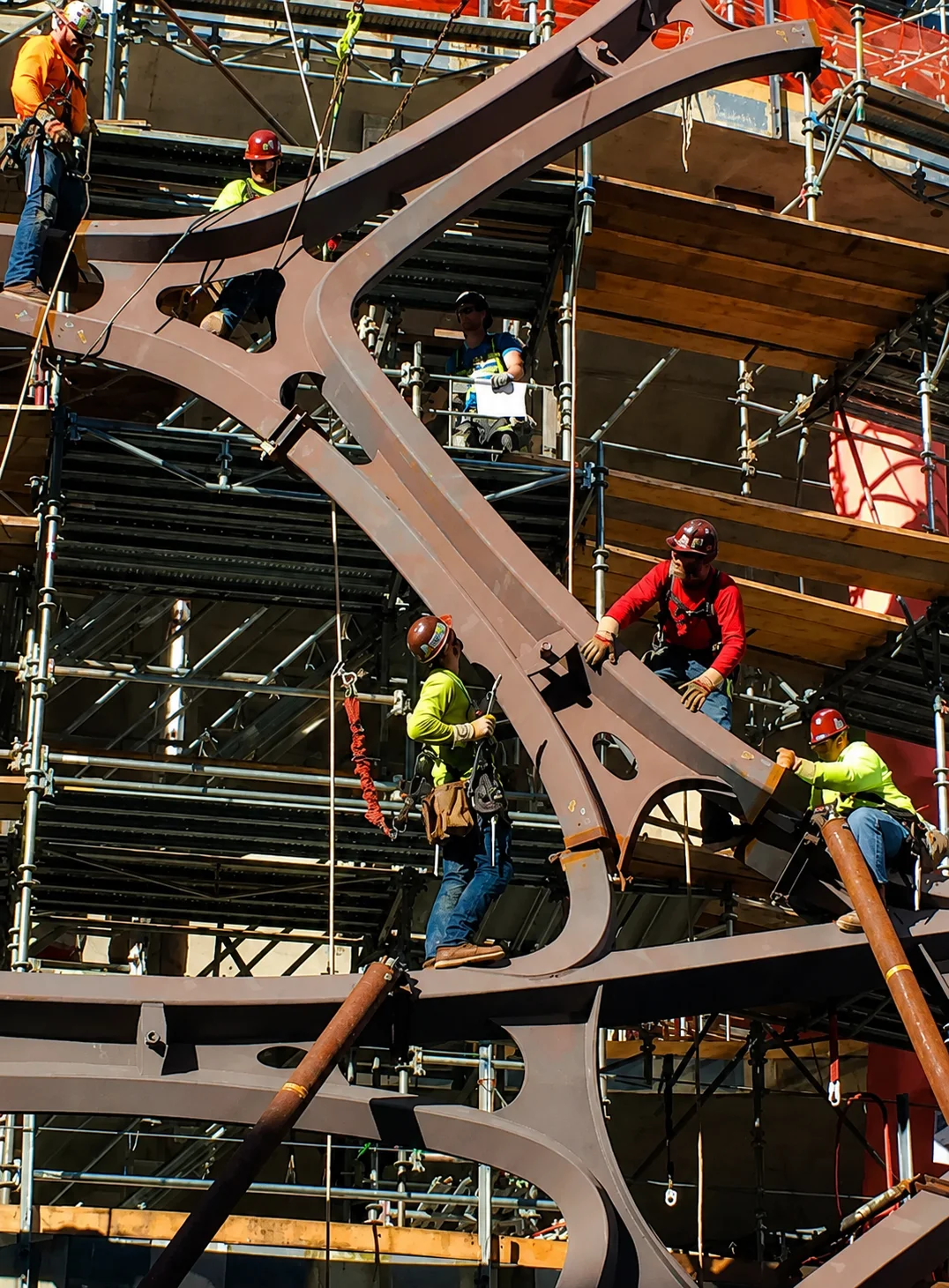
The image above captures one of the most demanding stages of construction: steel erection. Massive structural members are being positioned high above the ground while skilled workers coordinate every movement with precision.
This isn’t simply construction.
It’s engineering happening in real time.
Every Piece Has a Purpose
The steel members shown in the image weren’t randomly fabricated.
Each piece was engineered months before arriving at the jobsite.
Every hole, connection plate, bevel, and weld preparation was designed to fit a specific location within the structure.
Many of these members weigh several tons.
If even one component is fabricated incorrectly, it can delay an entire project.
That’s why fabrication shops work to incredibly tight tolerances before steel is ever shipped.
A Lift That Lasts Only Minutes Takes Days to Prepare
The public often sees a crane lifting steel and assumes that’s the difficult part.
In reality, the lift itself is often the easiest stage.
Before the crane operator ever touches the controls, crews have already completed:
- Lift planning
- Engineering reviews
- Rigging inspections
- Weather evaluations
- Communication plans
- Load calculations
- Connection sequencing
- Safety briefings
- Fall protection planning
- Equipment inspections
By the time steel leaves the ground, everyone already knows exactly what they’re expected to do.
Teamwork Is the Real Heavy Equipment
No single person builds a structure like this.
Every successful lift depends on specialists working together.
The project may include:
- Ironworkers
- Crane operators
- Riggers
- Welders
- Bolt-up crews
- Surveyors
- Engineers
- Safety professionals
- Project managers
- Inspectors
Every trade has a role.
When communication breaks down, mistakes happen.
When everyone works together, thousands of pounds of steel move with remarkable precision.
Why Structural Steel Still Dominates Modern Construction
Despite advances in concrete, composites, and engineered wood, structural steel remains one of the world’s most important building materials.
Steel offers several advantages:
Exceptional Strength
Steel supports enormous loads while maintaining relatively slim structural members.
Speed of Construction
Fabricated components arrive ready to assemble, allowing projects to progress rapidly.
Precision
Computer-controlled fabrication produces highly accurate components that fit together with minimal adjustment.
Sustainability
Steel is one of the most recycled construction materials in the world.
Adaptability
It performs well in stadiums, bridges, refineries, power plants, airports, industrial facilities, and high-rise buildings.
Every Connection Matters
The strongest beam in the world is only as good as its connections.
Depending on the project, crews may install:
- High-strength structural bolts
- Full-penetration welds
- Moment connections
- Shear connections
- Bracing systems
- Gusset plates
Inspectors verify every critical connection because each one contributes to the overall integrity of the structure.
Safety Is Built Into Every Step
Working at elevation introduces significant hazards.
Professional crews reduce risk through:
- Full-body harnesses
- Engineered anchor points
- Retractable lifelines
- Certified rigging
- Controlled access zones
- Daily equipment inspections
- Continuous communication
- Weather monitoring
- Lift plans
- Toolbox talks
Safety isn’t something added at the end of the day.
It’s part of every decision made before work begins.
The Importance of Reliable Workwear
Projects like this place extraordinary demands on clothing.
Workers spend long hours exposed to:
- Sharp steel edges
- Grinding sparks
- Welding operations
- Wind
- Rain
- UV exposure
- Heavy lifting
- Constant movement
Workwear must provide comfort without restricting mobility while standing up to repeated use in harsh conditions.
That’s why many professionals choose durable flame-resistant apparel designed for industrial environments where reliability matters.
The Human Side of Construction
Every steel member represents more than engineering.
It represents people.
Workers who leave home before sunrise.
Families waiting for them to return safely.
Craftsmen whose names may never appear on the building—but whose work will remain for decades.
Most people will never know who installed the steel supporting their office, stadium, or hospital.
Yet those skilled tradespeople make modern life possible.
Lessons Every Professional Can Learn From Steel Erection
Building steel structures teaches lessons that apply far beyond construction:
- Great projects begin with careful planning.
- Precision saves time later.
- Communication prevents costly mistakes.
- Every team member matters.
- Preparation creates confidence.
- Safety is never accidental.
- Quality lasts longer than shortcuts.
Final Thoughts
The next time you see a skyscraper, refinery, stadium, bridge, or industrial facility, remember that it all started with moments like the one captured in this image.
Massive steel sections suspended in the air.
Highly trained professionals working together.
Years of engineering coming to life one connection at a time.
It’s a reminder that America’s infrastructure isn’t built by machines alone.
It’s built by skilled men and women who combine knowledge, craftsmanship, teamwork, and determination to create structures that will serve generations.
At Næxon, we’re proud to support the workers who make these projects possible by designing workwear built for demanding industrial environments—because behind every great structure is a crew that deserves gear engineered to work as hard as they do.