Your refrigerator did not suddenly become ten times larger.
Your air conditioner did not turn into an industrial machine.
Your house did not install 50,000 GPUs.
Yet across America, electric utilities and grid operators are preparing for something the country has not dealt with at this scale for years: rapidly rising electricity demand.
One major reason is sitting inside enormous windowless buildings filled with servers.
Data centers.
Artificial intelligence, cloud computing and the continued expansion of the digital economy are creating extraordinary demand for computing power. But computing power ultimately requires something much more physical.
Electricity.
Lots of it.
The U.S. Energy Information Administration says electricity demand has been rising steadily since 2020 after more than a decade of relatively little growth, and identifies data centers as an important driver. The EIA currently forecasts U.S. electricity load increasing another 1.9% in 2026 and 2.5% in 2027. (U.S. Energy Information Administration)
The Department of Energy has previously cited estimates suggesting data centers could consume as much as 9% of U.S. electricity generation annually by 2030, compared with roughly 4% in 2023. (The Department of Energy’s Energy.gov)
That creates an uncomfortable question.
If some of the wealthiest technology companies on Earth need new power plants, substations, transmission infrastructure and electrical distribution systems to support their AI expansion, who should pay for it?
The technology companies?
The utilities?
The taxpayers?
Or millions of ordinary Americans through their electric bills?
That debate is rapidly becoming one of the biggest infrastructure questions created by the AI boom.
AI Isn’t Really in “The Cloud”
The word cloud makes computing sound almost weightless.
Your photos are in the cloud.
Your company’s software runs in the cloud.
Artificial intelligence operates in the cloud.
But there is nothing weightless about the infrastructure behind it.
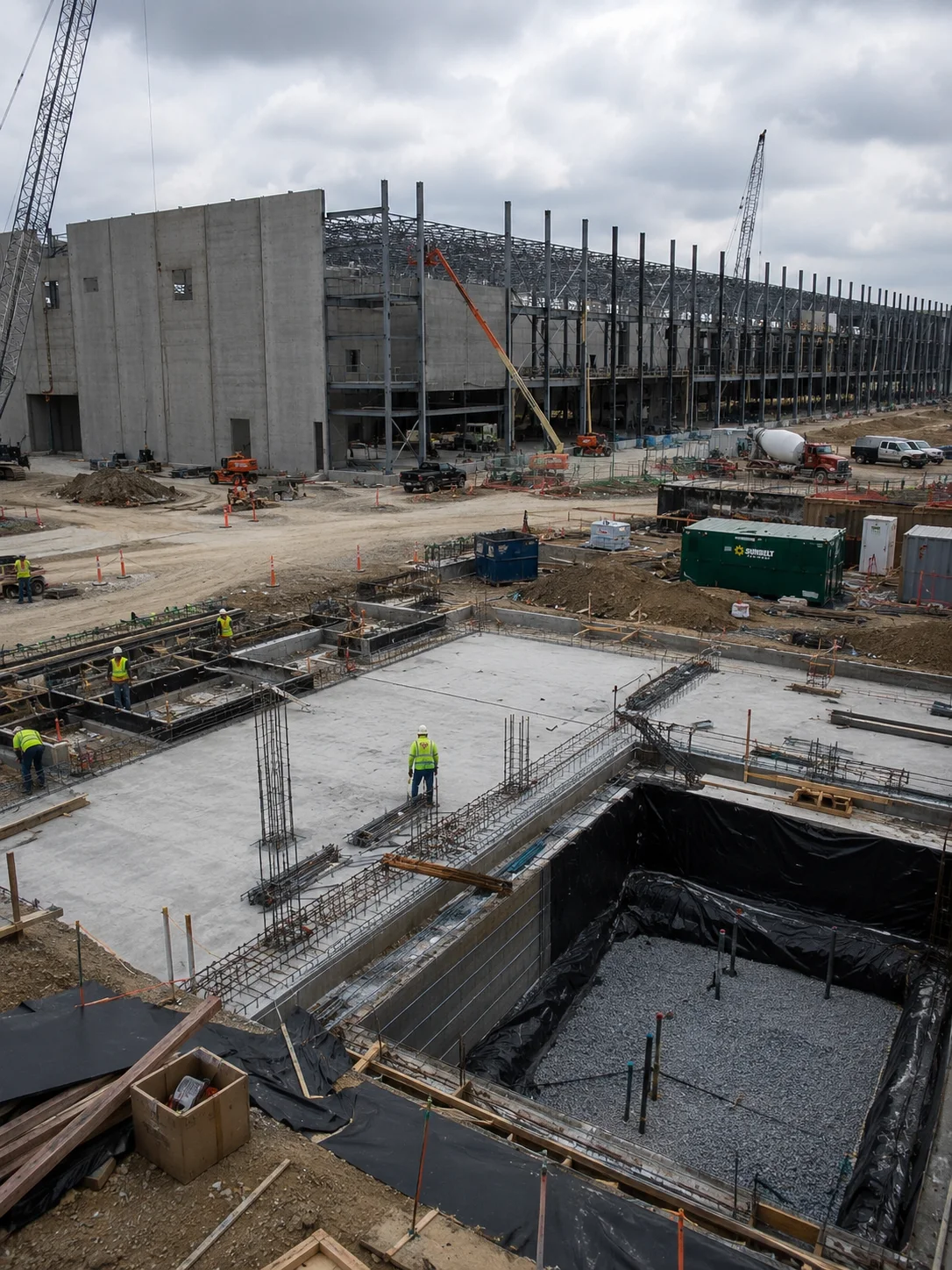
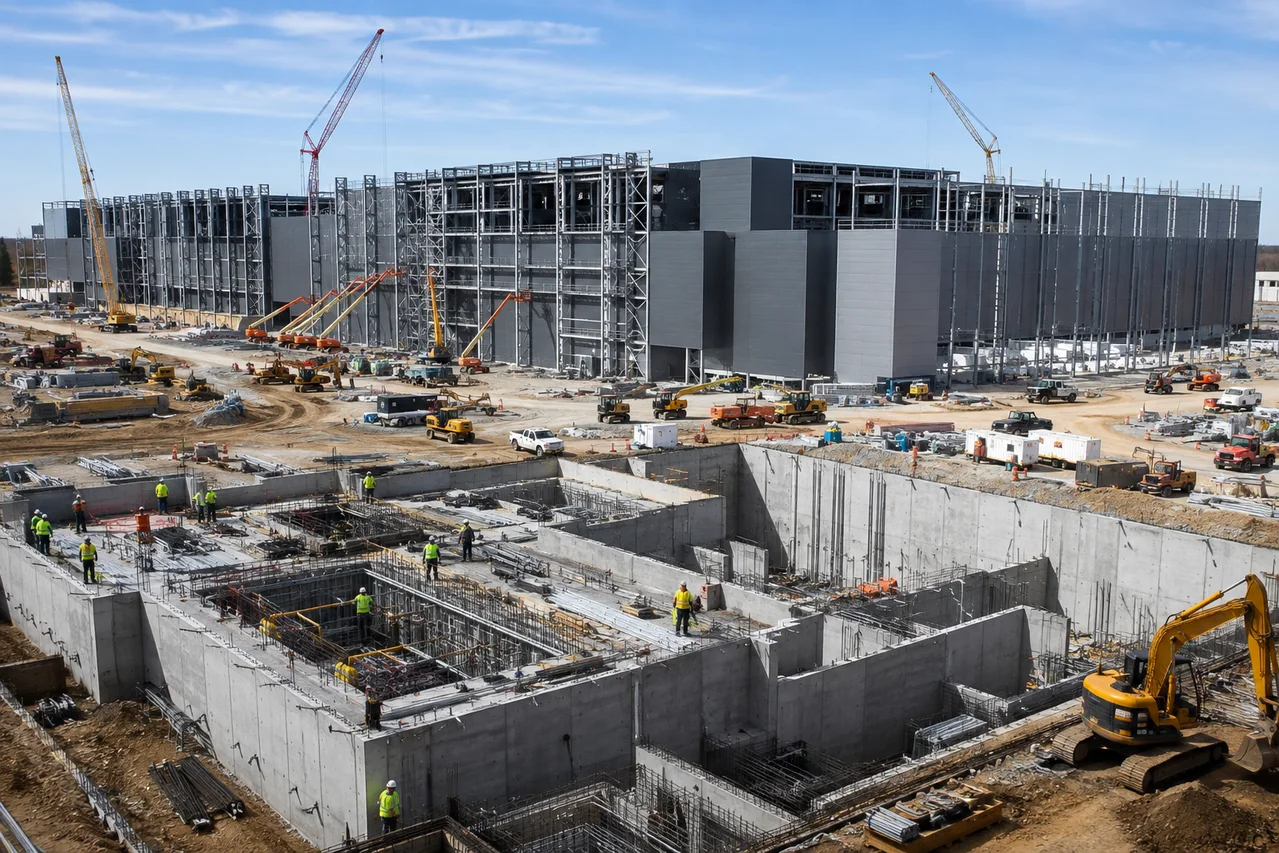
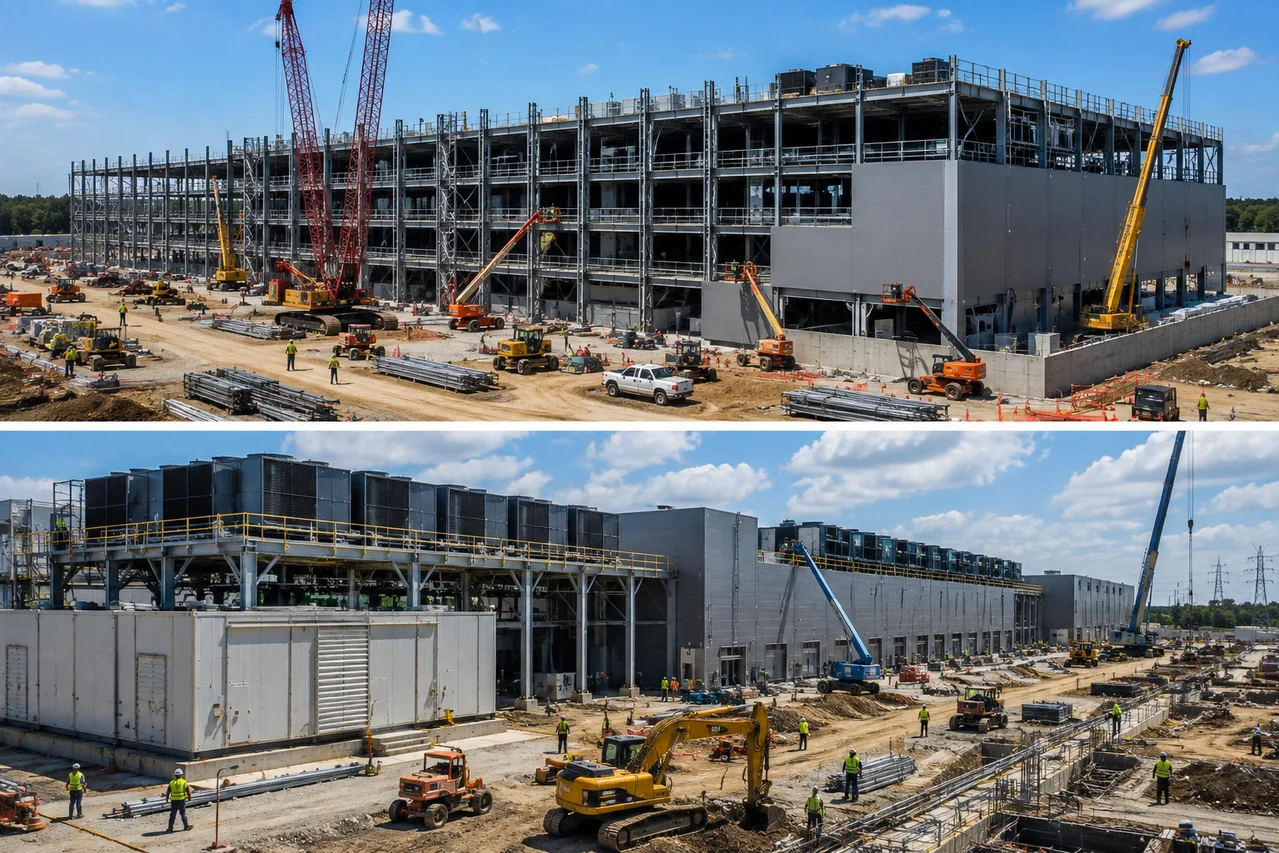
A hyperscale data center can be an enormous industrial complex containing servers, transformers, switchgear, generators, batteries, chillers, pumps, cooling systems, miles of electrical cable and sophisticated controls.
Some campuses require electrical loads comparable to significant industrial facilities.
That electricity has to be generated somewhere.
Then it has to be transmitted.
Then transformed.
Then distributed.
And all of the physical infrastructure required to accomplish that has to be engineered, manufactured, transported, constructed, commissioned and maintained.
AI may be digital.
The infrastructure supporting AI is industrial.
America Suddenly Needs More Electricity
For much of the previous two decades, U.S. electricity demand changed relatively slowly.
Utilities could plan around comparatively predictable growth.
That environment is changing.
Data centers are expanding at the same time the United States is adding new manufacturing facilities and electrifying portions of transportation, buildings and industry.
The EIA reported that U.S. electricity demand grew about 1.7% annually between 2020 and 2025, compared with only about 0.1% annually between 2005 and 2019. (U.S. Energy Information Administration)
That is a major shift for an industry accustomed to long periods of nearly flat demand.
Power infrastructure also cannot appear overnight.
A software company can potentially order servers relatively quickly.
Building generation and transmission infrastructure can take much longer.
That difference between the speed of computing investment and the speed of industrial infrastructure construction is becoming increasingly important.
A Data Center Cannot Just Plug Into the Wall
Imagine a technology company announcing a massive new AI data center campus.
The company buys the land.
Construction begins.
Thousands of servers eventually arrive.
But those servers cannot simply be connected to the existing neighborhood electrical system.
Large facilities can require enormous new electrical infrastructure.
Depending on the project and location, that can mean new substations, transformers, transmission upgrades, distribution infrastructure and potentially new generation.
The power system may need to be strengthened simply to accommodate the additional load.
Someone has to pay for those improvements.
And that is where the argument begins.
Should Ordinary Ratepayers Finance Infrastructure for AI?
Utilities recover many infrastructure investments through rates paid by customers.
Traditionally, this model makes sense.
Everybody uses the grid.
Everybody benefits from a reliable electrical system.
But data centers introduce a more complicated situation.
Suppose one enormous customer creates the need for hundreds of millions—or potentially billions—of dollars in new infrastructure.
Should those costs be spread across the utility’s entire customer base?
Critics argue that ordinary households and small businesses should not subsidize infrastructure primarily required by enormously profitable technology companies.
Supporters of data center development counter that large new customers can increase utility revenue, expand the tax base, stimulate generation investment and potentially spread fixed grid costs across more electricity sales.
Both arguments matter.
And emerging research suggests the relationship between data centers and household electricity rates may be more complicated than the most dramatic headlines imply.
Have Data Centers Actually Increased Electric Bills?
This is where the debate becomes particularly interesting.
A 2026 research paper examining U.S. electricity rates between 2015 and 2024 estimated that data center growth actually caused modest reductions in average retail electricity rates during that historical period.
The researchers pointed to economies of scale and the ability to spread large fixed electricity-system costs across greater demand.
But they also cautioned that future supply constraints could reverse that effect. (arXiv)
That distinction is critical.
Past data center growth does not automatically tell us what happens when future AI campuses arrive at unprecedented scale.
If electricity supply and transmission infrastructure expand quickly enough, additional demand could potentially improve utilization of existing infrastructure.
If demand grows faster than supply, however, the economics can change dramatically.
What Happens When Electricity Demand Outruns Supply?
Electricity is unusual because supply and demand must remain closely balanced.
When demand rises faster than available generation and transmission capacity, the system becomes stressed.
Wholesale electricity prices can rise.
Grid operators may need more expensive generation.
Reliability concerns can increase.
In an EIA modeling scenario examining higher-than-expected electricity demand, the agency found particularly dramatic effects in Texas.
Under that scenario, average ERCOT wholesale electricity prices in 2027 were $37 per megawatt-hour higher—79% above the baseline forecast. (U.S. Energy Information Administration)
That does not mean data centers will automatically increase Texas electricity prices by 79%.
It was a modeled high-demand scenario.
But it demonstrates something extremely important:
Electricity demand can grow faster than the infrastructure needed to serve it.
That is the problem policymakers are trying to prevent.
Texas Just Demonstrated How Serious the Issue Has Become
Texas has become one of America’s biggest battlegrounds over data center electricity demand.
In August 2026, Texas Governor Greg Abbott ordered a pause on approvals for new data center projects requiring grid connections while regulators audit proposed projects and their potential effects on the state’s electricity system. (Reuters)
The scale of proposed demand is remarkable.
According to reporting on the Texas action, roughly 90% of 474 gigawatts of proposed electricity demand being reviewed was associated with data center projects—an amount several times larger than the state’s current peak load. (Reuters)
Not all proposed projects will necessarily be constructed.
Developers can submit overlapping or speculative requests.
But the numbers demonstrate how extraordinary the current development pipeline has become.
Texas—the state synonymous with energy production—is effectively asking how quickly enormous new computing loads can safely connect to its power system.
The Federal Government Is Paying Attention Too
This debate has moved far beyond city councils and utility commissions.
In June 2026, the Federal Energy Regulatory Commission ordered the six regional grid operators under its jurisdiction to justify or reform the rules governing how data centers and other extremely large electricity users connect to the grid.
FERC explicitly described the challenge as balancing faster large-load integration with consumer protections. (Federal Energy Regulatory Commission)
That alone tells us something.
Data center electricity demand is no longer a niche technology issue.
It has become national energy policy.
The New Principle: Bring Your Own Power
One potential solution is straightforward.
If a technology company wants to build an enormous data center, require it to help bring the electricity needed to support it.
In March 2026, Amazon, Google, Meta, Microsoft, OpenAI, Oracle and xAI signed the federal Ratepayer Protection Pledge.
Under the pledge, participating companies agreed to build, bring or buy new electricity generation and cover power-delivery infrastructure upgrades required by their data centers rather than passing those expenses to ordinary households. (The White House)
The companies also agreed to negotiate separate rate structures and pay for committed electricity and related infrastructure under those arrangements even if they ultimately use less power than anticipated. (The White House)
In July 2026, the initiative was expanded to include additional participation from states, developers and power providers. (US EPA)
The principle behind the policy is difficult to misunderstand:
If your project creates an extraordinary new electricity requirement, your project should shoulder the extraordinary cost of serving it.
Why “Pay Whether You Use It or Not” Matters
Imagine a utility spends billions preparing for several proposed data centers.
New substations are constructed.
Transmission systems are upgraded.
Generation is added.
Then technology changes.
One developer cancels.
Another downsizes.
A third decides to build somewhere else.
The infrastructure investment does not magically disappear.
Someone still has to pay for it.
That creates what regulators sometimes describe as stranded-cost risk.
Long-term contracts and minimum payment requirements can help shift that risk toward the large customer creating the need for the infrastructure.
Without those protections, ordinary customers could potentially become responsible for infrastructure built around projects that never reached their expected electricity demand.
But Data Centers Could Also Help Build a Stronger Grid
The argument should not become one-sided.
Massive electricity demand creates enormous incentives to build electricity supply.
Technology companies have the financial resources to support new generation projects.
Long-term electricity contracts can make major power projects financially viable.
Data centers can also potentially provide flexible load under certain arrangements, reducing consumption during periods of extreme grid stress.
If structured correctly, data center investment could help finance infrastructure that eventually benefits a wider region.
New transmission capacity may serve other customers.
New generation increases electricity supply.
Grid modernization can improve reliability.
The real question is therefore not simply whether data centers are good or bad for the grid.
It is how the financial structure is designed and who carries the risk.
AI Could Trigger a New Power Plant Construction Boom
There is another side of this story that matters enormously to the industrial workforce.
America may need considerably more power generation.
That could mean natural gas plants.
Nuclear power.
Solar.
Wind.
Battery storage.
Transmission projects.
Substations.
Generator facilities.
Potentially new technologies such as small modular reactors in the longer term.
Every one of those projects creates physical industrial work.
AI companies may employ software engineers, but building the energy infrastructure supporting AI requires an entirely different workforce.
The Workers Who Will Actually Build the AI Power Boom
If America’s electricity infrastructure expands dramatically, the skilled trades will be standing in the middle of it.
Industrial electricians will install power distribution equipment.
Linemen will build and maintain transmission infrastructure.
Pipefitters and welders will construct piping systems at new generation facilities.
Millwrights will install pumps, turbines, compressors and rotating equipment.
Boilermakers will work on pressure equipment.
Ironworkers will erect structural steel.
Crane operators and riggers will position transformers, generators and heavy equipment.
Instrumentation technicians will install controls.
Commissioning technicians will test everything before startup.
The infrastructure boom could involve:
- Electricians and linemen
- Pipefitters, welders and boilermakers
- Millwrights and turbine technicians
- Ironworkers, riggers and crane operators
- Instrumentation, controls and commissioning specialists
- Equipment operators, civil crews and concrete workers
For America’s skilled trades, AI could become one of the biggest indirect industrial construction drivers of the coming decade.
Natural Gas May Become Part of the AI Story
The enormous electricity requirements of data centers are also creating renewed interest in dispatchable generation.
Natural gas plants can provide electricity regardless of whether the sun is shining or the wind is blowing.
That reliability can make gas generation attractive for facilities requiring continuous power.
The EIA has modeled scenarios where unexpectedly strong electricity demand growth would increase fossil-fuel generation, particularly natural gas. (U.S. Energy Information Administration)
That creates another unexpected connection.
The future of artificial intelligence may partially depend on natural gas producers, pipelines, compressor stations, power plants and the industrial workers who construct and maintain them.
A programmer writing AI software may be thousands of miles from a pipeline welder.
Economically, however, their industries may increasingly become connected.
Nuclear Power Could Get Another Opportunity
Data center demand is also changing the conversation around nuclear energy.
Nuclear plants can provide large amounts of continuous electricity with low operational carbon emissions.
For data centers seeking around-the-clock electricity, that characteristic is attractive.
Growing electricity demand can strengthen the economic case for maintaining existing nuclear plants, restarting facilities or eventually constructing new nuclear generation.
That creates opportunities across another enormous skilled-trade ecosystem.
Millwrights.
Pipefitters.
Boilermakers.
Electricians.
Instrumentation technicians.
Radiation protection personnel.
Nuclear operators.
Turbine technicians.
Welders.
NDT inspectors.
Planners.
Engineers.
AI could indirectly contribute to a new generation of power-sector employment.
Transmission May Be the Bigger Problem
Generating electricity is only part of the equation.
Power also has to reach the data center.
America’s transmission infrastructure was not originally designed around the sudden arrival of clusters of enormous computing facilities.
Building new transmission lines can take years.
Projects face permitting, land acquisition, environmental reviews, engineering and construction challenges.
Substations require transformers and specialized electrical equipment.
Some major electrical components have long manufacturing lead times.
A data center can therefore be ready before the electrical system required to serve it.
This mismatch is becoming one of the defining infrastructure challenges of the AI era.
Data Centers Are Becoming Industrial Energy Projects
The traditional image of a data center needs to change.
These are no longer simply commercial buildings containing computers.
At hyperscale, they are major energy consumers surrounded by industrial infrastructure.
A large campus can require its own substations, backup generation, cooling plants, water systems and extensive electrical distribution.
Some future campuses may effectively become integrated energy-and-computing complexes.
That means the boundary between technology and heavy industry is beginning to disappear.
The AI industry needs the energy industry.
The energy industry needs industrial construction.
Industrial construction needs skilled trades.
The chain eventually leads from a server rack back to workers wearing welding hoods, harnesses and hard hats.
The Question Isn’t Whether America Should Build Data Centers
Data centers support services millions of Americans and businesses use every day.
Cloud computing, financial systems, communications, healthcare systems, entertainment, government operations and artificial intelligence all depend on computing infrastructure.
Simply declaring data centers unnecessary ignores how deeply digital infrastructure has become integrated into modern society.
America also has strategic reasons to maintain leadership in computing and artificial intelligence.
But recognizing those benefits does not require giving technology companies a blank check.
Communities can support technological development while still asking legitimate questions about electricity, water, taxes, land and infrastructure.
And perhaps the simplest question is also the most important:
Who pays?
If AI Needs the Power, AI Should Help Build the Power
There may be a much bigger opportunity hidden inside this controversy.
Imagine the AI boom does not simply consume America’s remaining electrical capacity.
Imagine it finances the next generation of it.
Technology companies need electricity.
Utilities need customers willing to commit to long-term demand.
Power developers need financing.
America needs more generation and transmission capacity.
Industrial workers need long-term projects.
Those interests do not necessarily have to conflict.
But the deal matters.
If a billion-dollar AI campus requires a new substation, the household down the road should not automatically inherit the cost.
If new generation is required primarily because of massive computing demand, the companies creating that demand should have substantial responsibility for bringing that generation online.
And if billions of dollars are going to be invested anyway, America should use the opportunity to build infrastructure that lasts longer than the current AI boom.
Because underneath all the arguments about algorithms, GPUs and artificial intelligence lies something remarkably old-fashioned.
Somebody has to generate the electricity.
Somebody has to build the transmission line.
Somebody has to set the transformer.
Somebody has to weld the pipe, align the turbine, pull the cable, erect the steel and commission the equipment.
The future may run on artificial intelligence.
But somebody still has to build the power behind it.