Spend enough time around a refinery, fabrication shop, pipeline spread, power plant, or shutdown, and you start noticing something about welding caps.
They’re rarely just welding caps.
A welding cap gets folded a certain way. Turned to one side. Pulled down low. Covered in soot. Worn backward. Stuffed in a lunchbox. Sometimes it looks brand new. Sometimes it looks like it survived six turnarounds, three drag-ups, two divorces, and a boiler outage.
And whether anyone wants to admit it or not, you can occasionally make a pretty good guess about what kind of hand you’re dealing with just by looking at the cap.
This isn’t science. It isn’t a qualification test. And a welding cap certainly doesn’t tell you whether somebody can actually fit or weld.
But jobsite culture has never required scientific evidence to judge somebody.
So here it is.
The Brand-New Welding Cap
You already know this one.
The colors are perfect. The bill hasn’t developed a permanent bend yet. There’s no grease around the edge. No welding smoke. No sweat stains. Not even a pencil mark.
This hand might be brand new to the trade.
Or worse, he’s been welding for ten years and somehow owns 47 welding caps.
Either way, somebody is going to ask:
“First day?”
The funny thing is that every legendary welding cap started exactly like this. Give it a few weeks of grinding dust, sweat, hood time and being thrown onto the dashboard of a truck, and it’ll develop some character.
Until then, everybody knows it’s new.
The Welding Cap That Looks 15 Years Old
This is the opposite end of the spectrum.
You can’t even tell what color it originally was.
There are burn marks on the bill. The fabric has faded into a completely new color. There’s grease around the sweatband, a couple of suspicious holes, and enough welding smoke embedded into it that washing it might actually destroy the structural integrity.
The owner refuses to throw it away.
Ask why and you’ll probably hear:
“Nothing wrong with it.”
This is often the same guy whose toolbox contains a wrench manufactured before half the crew was born.
Old hands don’t necessarily replace something because it looks bad.
They replace it when it stops working.
That mentality applies to welding caps, tools, boots, trucks and occasionally knees.
The Perfectly Folded Cap
This person has a system.
The cap comes out of the lunchbox already folded correctly. The bill sits exactly where it’s supposed to. Nothing is crooked.
The same hand probably knows exactly where every tool is.
Two-hole pins? Same drawer.
Center punch? Same pocket.
Wraparound? Rolled correctly.
Soapstone? Somehow always has one.
These are dangerous people to borrow tools from because they will know immediately if you put something back in the wrong place.
The Sideways-Bill Welder
Now we’re getting somewhere.
The sideways welding cap is practically its own category of industrial worker.
Usually the bill has one job: keep sparks, slag, sweat or light from getting somewhere annoying while the hood is down.
But over time, the angle becomes permanent.
Even during lunch.
Even walking through the parking lot.
Even at the gas station after work.
At some point it stopped being an adjustment for welding and simply became the way the cap is worn.
This hand has probably spent enough time under a hood that wearing a welding cap normally would feel strange.
The Backward Welding Cap
There are two possibilities.
The first is completely practical.
The second is that this guy thinks he looks extremely good.
Sometimes both are true.
Either way, the backward cap usually belongs to someone who has worn welding caps long enough that nobody is going to convince him there’s a “correct” direction anymore.
He’ll turn it whichever direction works for what he’s doing.
That’s actually one of the advantages of a traditional welding cap. The short bill and fitted construction make it adaptable beneath welding hoods and around the jobsite.
The Deep-Crown Cap Guy
This hand knows exactly how he wants his cap to fit.
Not “medium.”
Not “probably large.”
Not “whatever you’ve got.”
He knows his head circumference.
He knows how deep he wants the crown.
He knows where the bill needs to sit.
And if the cap fits differently than his favorite one, he’s going to notice immediately.
There is a reason experienced workers become particular about fit. When you’re wearing something for ten or twelve hours at a time, small annoyances become big annoyances.
The same principle applies to workwear in general. Proper fit affects comfort and mobility throughout a long industrial shift. Næxon goes deeper into that subject in The Importance of Proper Fit in Workwear and How It Improves Productivity on the Jobsite.
The Guy With 30 Welding Caps
Nobody knows why this happened.
At some point welding caps stopped being PPE-adjacent workwear and became collectibles.
Paisley.
Camo.
Black.
Blue.
Red.
Skulls.
Money.
One for every possible mood.
Open the back seat of this guy’s truck and there are probably six more.
Ask him how many welding caps he owns and he’ll say:
“I don’t know.”
That’s how you know the number is serious.
There are workers who own two welding caps for ten years and workers who rotate them like shoes.
Neither group understands the other.
The One-Cap-for-Everything Hand
Then there’s this guy.
One welding cap.
That’s it.
Welding? Same cap.
Grinding? Same cap.
Fitting? Same cap.
Lunch? Still wearing it.
Driving home? Still wearing it.
Stopping at the grocery store? Apparently still wearing it.
Eventually the cap becomes less of a piece of workwear and more like part of the person’s head.
If he ever loses it, production may stop temporarily.
The Cap Under the Hard Hat
This is common across industrial work, but anyone doing it needs to remember an important point: head protection has to be worn according to the hard-hat manufacturer’s instructions and the employer’s PPE requirements.
Comfort never overrides the protection system.
That said, workers are constantly trying to make long shifts more comfortable. A properly fitting welding cap can help manage sweat and transition between fitting, welding and other tasks when its use is permitted.
Industrial workers already carry enough equipment. Anything worn for an entire shift needs to fit properly and work with the rest of the required PPE.
That broader relationship between clothing and protective equipment is covered in Næxon’s Ultimate Guide to Industrial Workwear.
The Cap That’s Somehow Always Clean
Suspicious.
Very suspicious.
Everyone else has been crawling through pipe racks, climbing scaffold, grinding, fitting, welding and sweating for ten hours.
This guy’s cap still looks like it came out of the package.
There are explanations.
Maybe he brought a fresh one.
Maybe he’s unusually clean.
Maybe he’s extremely careful.
Or maybe the crew needs to investigate exactly what he’s been doing all day.
Jobsite court is now in session.
The Cap Covered in Burn Holes
This one tells a story.
Probably several stories.
Small sparks and hot debris are part of welding environments, which is exactly why workers need to take their clothing and protective equipment seriously. A welding cap should never be treated as a substitute for required PPE, and damaged protective equipment or workwear should be inspected and replaced when necessary.
The same principle applies to the rest of what a welder wears. If you work around hot work regularly, it’s worth understanding what FR clothing actually does and doesn’t do. See What Every Welder Should Know About Flame-Resistant Apparel for a deeper explanation.
But culturally?
A cap with a couple of scars definitely looks like it’s been to work.
The Matching-Everything Hand
Cap matches the shirt.
Shirt matches the hood.
Hood matches the gloves.
Even the sticker colors somehow coordinate.
The crew will absolutely give this person a hard time.
Then half of them will quietly ask where he bought everything.
There is nothing wrong with taking pride in how your gear looks. Industrial workwear has always had a cultural side to it. Hard-hat stickers, welding hoods, boots, belt buckles, caps and even the way someone rolls their sleeves become part of a worker’s identity.
The trades have their own language and culture, too. If you’ve spent any time on industrial jobs, you’ll recognize plenty of it in The Language of the Blue Collar: 250 Funny Words, Phrases & Jobsite Lingo.
The Cap With a Story Behind It
These are the best ones.
Maybe somebody gave it to him on his first welding job.
Maybe it came from an old partner.
Maybe his wife made it.
Maybe it’s from a company that disappeared twenty years ago.
Maybe he wore it on the project where he finally broke out.
To everyone else, it’s just an old welding cap.
To him, it represents a piece of his career.
That’s something people outside the trades don’t always understand about work gear.
A beat-up hood isn’t necessarily junk.
An old pair of two-hole pins isn’t necessarily obsolete.
A faded welding cap isn’t necessarily ready for the trash.
Sometimes these things become reminders of where you’ve worked, who you worked beside and what it took to get where you are.
The Guy Who Doesn’t Even Weld
This deserves its own section.
Pipefitter.
Boilermaker.
Ironworker.
Millwright.
Helper.
Maybe even the foreman.
And there it is.
Welding cap.
Does he weld?
“Nope.”
Why the welding cap?
“Because I like it.”
Fair enough.
Welding caps escaped the welding booth a long time ago. They’re part of industrial work culture now, particularly around fabrication shops, refineries, pipelines and shutdowns.
You don’t necessarily have to burn rod all day to appreciate a cap that fits well and keeps sweat under control.
What Your Welding Cap Actually Says About You
Probably less than your coworkers claim.
A clean cap doesn’t make somebody a rookie.
A destroyed cap doesn’t make somebody a journeyman.
A sideways bill doesn’t mean somebody can pass an X-ray.
And owning twenty welding caps definitely doesn’t improve your welds.
But welding caps are one of those small pieces of industrial culture that workers make their own.
That’s what makes them interesting.
The trades have uniforms without really having uniforms. Workers start with roughly the same basic equipment, then personalize everything.
Hard hats get stickers.
Welding hoods get painted.
Tools get engraved.
Rig trucks get modified.
FR shirts get broken in.
And welding caps develop personalities.
After enough years in the trades, you can sometimes recognize somebody from fifty feet away without ever seeing their face.
You recognize the hood.
The walk.
The hard hat.
And yes, sometimes the welding cap.
The Cap Doesn’t Make the Hand
At the end of the day, there’s only one thing that actually determines what kind of hand you are.
Your work.
Can people depend on you?
Can you do your job without somebody constantly watching you?
Do you help the crew?
Do you take pride in what you build?
Can you admit when you don’t know something?
Do you teach the next hand instead of trying to make him look stupid?
Do you show up when things get difficult?
That’s what earns respect.
The welding cap just gives everyone something to make fun of while you’re doing it.
If you’re working long refinery turnarounds or maintenance outages, your cap is only one small part of the gear you’ll live in for weeks at a time. Næxon’s guide to What to Wear During Refinery Turnarounds and Maintenance Outages covers the bigger picture.
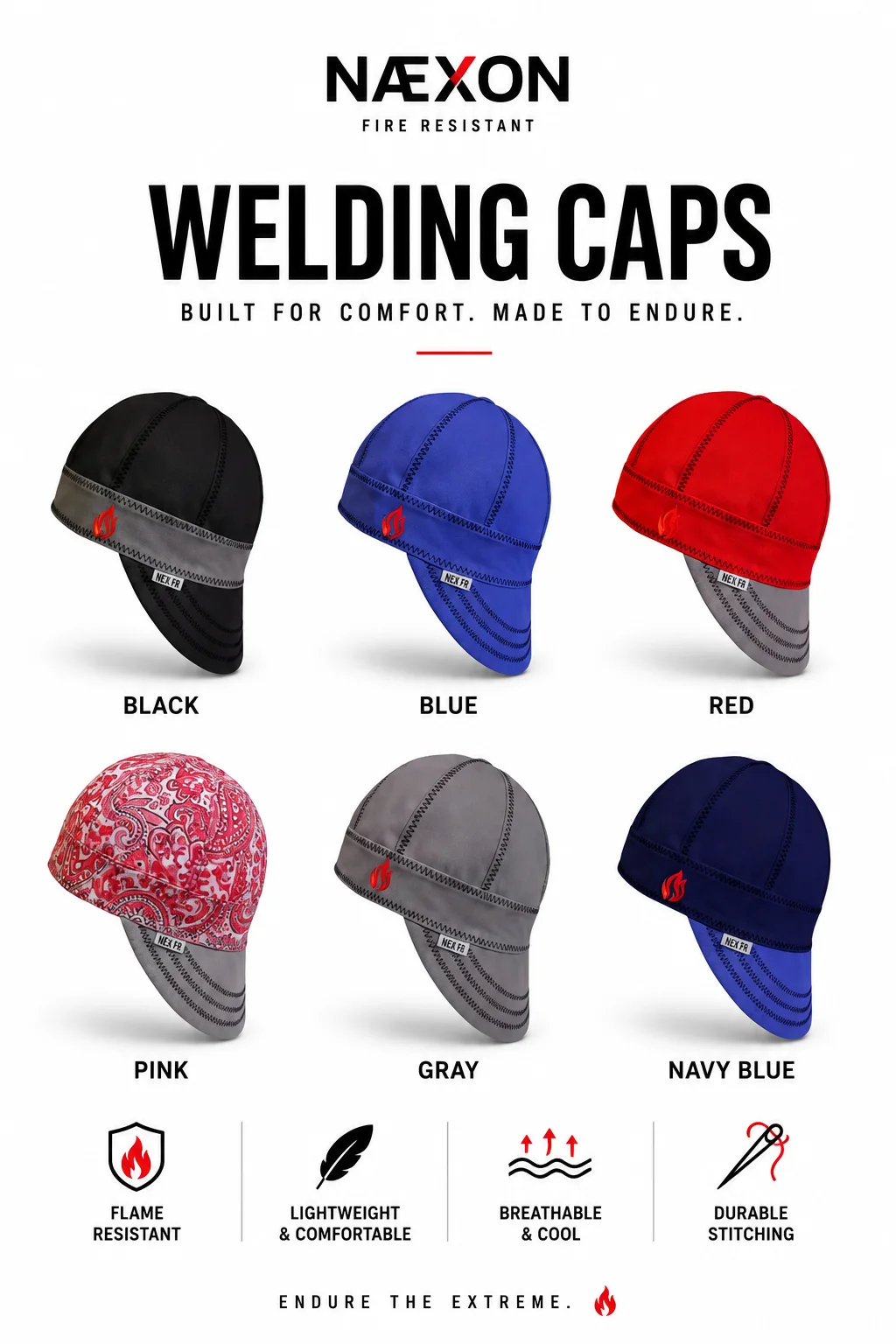
And if you’re looking for a new cap to develop a few stories of its own, explore the Næxon FR Welding Caps.
Because eventually every clean welding cap becomes an old welding cap.
You just have to put it to work.