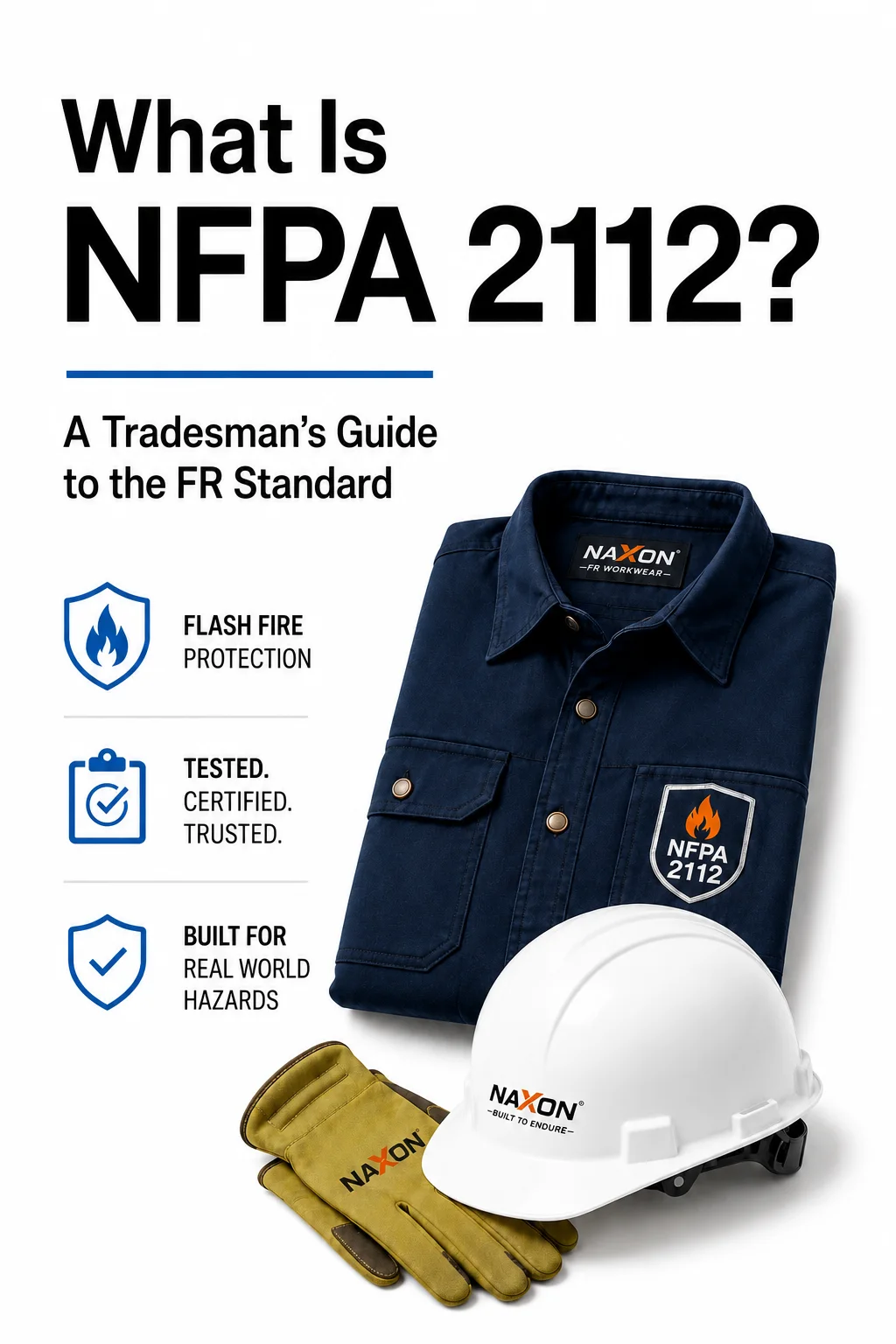
If you work in a refinery, petrochemical plant, oil and gas facility, or another industrial environment where flash fire is a recognized hazard, you have probably seen NFPA 2112 printed on the label of flame-resistant clothing.
But what does NFPA 2112 actually mean?
The short answer is that NFPA 2112 is a standard for flame-resistant clothing designed to help protect workers from short-duration thermal exposures from fire. It establishes requirements for the design, construction, evaluation, certification, and manufacture of garments intended for workplaces where a flash-fire hazard exists.
That definition matters because NFPA 2112 is not simply another piece of wording manufacturers put on an FR shirt. It represents a specific protective-clothing standard, and understanding what it covers—and what it doesn’t—can help workers make better decisions about the clothing they wear on industrial jobsites.
What Is NFPA 2112?
NFPA 2112 is published by the National Fire Protection Association (NFPA) and is titled Standard on Flame-Resistant Clothing for Protection of Industrial Personnel Against Short-Duration Thermal Exposures from Fire.
The standard applies to protective garments intended for workers who could potentially encounter a short-duration thermal exposure such as a flash fire.
That includes environments commonly associated with oil and gas production, refining, petrochemical processing, chemical facilities, and certain other industrial operations.
A flash fire is different from simply standing near something hot. It is a rapidly moving flame front through a diffuse fuel, such as a combustible gas or vapor, without the damaging pressure associated with an explosion.
The event may last only seconds, but the heat transferred during those seconds can cause severe burns.
FR clothing exists partly to prevent the worker’s clothing from becoming an additional fuel source during such an event.
What Does NFPA 2112 Clothing Actually Do?
One of the biggest misunderstandings about FR clothing is that it somehow makes the person wearing it fireproof.
It doesn’t.
NFPA 2112-compliant clothing is designed to reduce the severity of burn injury during the specific thermal hazards addressed by the standard. A critical characteristic of flame-resistant material is that it resists ignition and flame propagation and is designed to self-extinguish after the ignition source is removed.
This is important because ordinary clothing can continue burning after exposure to flame.
When conventional fabric ignites and continues burning against the body, the clothing itself can significantly increase the worker’s thermal exposure.
Proper FR clothing is designed to reduce that secondary hazard.
That does not mean a worker cannot be burned while wearing it. The heat from a flash fire can still transfer through the garment.
Think of FR clothing as damage reduction—not invincibility.
What Is a Flash Fire?
Understanding NFPA 2112 requires understanding the hazard it was created around.
Imagine a combustible gas or vapor being released into an area. If the concentration falls within its flammable range and finds an ignition source, the flame can travel rapidly through the fuel cloud.
The worker may suddenly be surrounded by intense heat.
That is the type of short-duration thermal event associated with flash-fire protection.
In refineries and petrochemical facilities, combustible hydrocarbons can exist throughout processing systems. Pipes, vessels, pumps, compressors, valves, flanges and process equipment can contain flammable products.
Facilities use engineering controls, operating procedures, gas detection, isolation procedures and numerous other safeguards to prevent releases and ignition.
FR clothing is another layer of protection when the hazard assessment requires it.
How Does Clothing Become NFPA 2112 Compliant?
A garment isn’t legitimately NFPA 2112 compliant simply because the fabric is advertised as “FR.”
The standard addresses the complete garment and establishes requirements involving materials, components, garment design, testing, labeling, quality assurance and third-party certification.
Testing can evaluate characteristics such as flame resistance, heat transfer, thermal shrinkage and performance during simulated flash-fire exposure.
One of the best-known evaluations associated with NFPA 2112 is instrumented-manikin testing.
A complete garment is placed on a specially instrumented manikin equipped with thermal sensors. The garment is then subjected to a controlled flash-fire exposure. Sensor measurements are used to estimate predicted body burn.
This gives researchers and certification organizations a way to evaluate the performance of the garment system under standardized laboratory conditions.
It should not be interpreted as a promise of what will happen during an actual industrial incident. Real events can vary enormously in fuel, heat flux, duration, clothing condition, garment fit, additional PPE and countless other factors.
NFPA 2112 Is About More Than the Fabric
This distinction is important when buying workwear.
You may encounter fabric that possesses flame-resistant characteristics, but FR fabric and a certified NFPA 2112 garment are not automatically the same thing.
A garment is a system.
Its fabric matters, but so do components and construction. Depending on the garment and applicable requirements, elements such as sewing thread, closures, hardware, labels and garment configuration can affect compliance.
That is why workers should look at the actual certification and labeling of the finished garment instead of assuming that anything marketed as “FR” meets every industrial standard.
If you’re new to flame-resistant workwear, start with Næxon’s guide to what FR means on clothing and then learn the difference between flame-resistant and flame-retardant clothing. Those concepts make NFPA 2112 much easier to understand.
What Does the NFPA 2112 Label Mean?
When purchasing FR clothing for a job that specifically requires NFPA 2112, don’t rely solely on the product title, color, appearance or a salesperson saying that something is “fire resistant.”
Check the garment labeling and documentation.
Properly certified products carry markings identifying their compliance/certification according to the applicable standard and certification program.
This is particularly important when an employer or facility specifically requires NFPA 2112-certified garments.
A shirt looking like refinery workwear doesn’t make it compliant.
The label matters.
NFPA 2112 vs. NFPA 70E
These two standards are frequently confused.
They address different hazards.
NFPA 2112 is associated primarily with short-duration thermal exposures from fire, including flash-fire hazards.
NFPA 70E addresses electrical safety in the workplace and includes requirements related to arc-flash hazards.
That difference introduces another important distinction in protective clothing: FR versus AR.
AR means arc rated.
Arc-rated clothing has been evaluated for exposure to an electric arc and assigned an arc rating, typically expressed in calories per square centimeter (cal/cm²).
An FR garment is not automatically arc rated merely because it is flame resistant.
This distinction becomes especially important for electricians and electrical workers. The protective clothing selected must correspond to the actual hazard identified by the employer’s risk assessment.
Næxon’s separate guides to AR vs. FR clothing and what an ATPV rating means go deeper into electrical arc protection.
What Does ATPV Have to Do With NFPA 2112?
You may see something such as:
ATPV: 8.7 cal/cm²
on certain protective clothing.
ATPV stands for Arc Thermal Performance Value.
It relates to arc-flash performance.
NFPA 2112 compliance and an arc rating are therefore not interchangeable concepts. A garment may have characteristics or certifications relevant to more than one hazard, but workers should never assume one designation automatically satisfies another.
This is why reading the garment label is so important.
Instead of asking only, “Is this FR?” the better question is:
What hazard is this garment designed and certified to protect against?
Who Typically Wears NFPA 2112 Clothing?
NFPA 2112 garments are commonly encountered in industries where flash-fire hazards may exist.
That can include oil and gas production, refineries, petrochemical facilities, chemical processing operations and certain industrial maintenance and construction environments.
Depending on the facility and task, workers wearing FR clothing may include pipefitters, welders, boilermakers, millwrights, operators, instrumentation technicians, electricians, scaffold builders, laborers, supervisors and other personnel.
But your trade alone doesn’t determine whether NFPA 2112 clothing is required.
The workplace hazard does.
A pipefitter working in one environment might be required to wear NFPA 2112-certified clothing while another pipefitter performing a different job may operate under different PPE requirements.
Employers determine required PPE through hazard assessment, applicable regulations, facility policies and the work being performed.
Does Wearing NFPA 2112 Clothing Mean You’re Completely Protected?
No.
This may be the most important point in the entire article.
NFPA 2112 clothing does not eliminate the hazard.
It does not make someone fireproof.
It does not replace atmospheric monitoring, isolation, lockout/tagout, hot-work procedures, respiratory protection, gas detection, permitting, engineering controls or safe work practices.
And it cannot guarantee that someone exposed to a flash fire will escape injury.
FR clothing is one component of a larger protection system.
Industrial safety works through layers. The first goal is preventing the release or hazardous event from occurring. The next layers help prevent workers from being exposed. PPE is generally one of the final protective layers when hazards cannot otherwise be completely eliminated.
Why the Condition of Your FR Clothing Matters
Even properly certified clothing needs to remain serviceable.
A garment that was appropriate when purchased can eventually become damaged, heavily worn or contaminated.
Holes, tears, missing closures, damaged seams and contamination by combustible substances can potentially affect protection.
This is why workers should inspect FR clothing instead of treating it like ordinary casual clothing.
A shirt shouldn’t stay in rotation forever simply because the label still says FR.
Næxon’s guide to how long FR clothing lasts explains the warning signs that indicate a garment may need repair or replacement, while our FR clothing washing guide covers laundering and care.
Can You Wash NFPA 2112 Clothing at Home?
Whether and how a particular garment can be home-laundered depends on the garment manufacturer’s care instructions, workplace requirements and the type of contamination involved.
The important rule is simple:
Follow the garment manufacturer’s instructions and your employer’s procedures.
Don’t assume every stain or industrial contaminant can safely be handled in a household washing machine.
Some workplace contaminants require specialized handling.
Workers should also avoid improvising laundry treatments that contradict the garment’s care instructions.
The goal isn’t merely making an FR shirt look clean. It is maintaining the garment in a condition consistent with its intended protective performance.
Does FR Clothing Expire?
There isn’t one universal expiration date that applies to every FR garment.
Service life depends on the material, garment construction, use, laundering, physical wear, contamination, damage and manufacturer guidance.
That’s why the question “How many years does an FR shirt last?” doesn’t have one responsible answer.
A frequently worn shirt used during shutdowns, welding, grinding and industrial maintenance may experience very different wear from a garment used occasionally.
Condition matters.
What Workers Should Check Before Buying FR Clothing
Don’t judge protective workwear by appearance alone.
Determine what your employer or facility actually requires. Check the garment’s labels and certifications. Confirm sizing and proper fit. Read the manufacturer’s care instructions and understand what protection the garment is—and isn’t—designed to provide.
That is especially important today because “FR” is sometimes treated like a general marketing category.
For industrial workers, those letters mean considerably more.
The goal isn’t simply to own an FR shirt.
The goal is to wear the correct protective clothing for the hazard you’re actually facing.
Understanding NFPA 2112 in Plain English
If you remember only one thing from this guide, remember this:
NFPA 2112 is a protective-clothing standard intended for industrial personnel who may be exposed to short-duration thermal hazards from fire.
It establishes performance, design, testing, labeling, certification and manufacturing requirements for protective garments.
It does not mean the garment makes you fireproof.
It does not automatically mean the garment is arc rated.
And it doesn’t replace safe work practices.
For refinery, oil and gas, petrochemical and industrial workers, understanding that distinction is far more useful than simply recognizing the NFPA 2112 logo on a tag.
Because PPE works best when the person wearing it understands what it was designed to do—and where its protection ends.
Related Næxon Resources: What Does FR Mean on Clothing? · Flame-Resistant vs. Flame-Retardant Clothing · How to Wash FR Clothing · How Long Does FR Clothing Last? · AR vs. FR Clothing · What Is an ATPV Rating?