If you work in oil and gas, refining, electrical, pipeline, power generation, petrochemical, or heavy industrial construction, you’ve probably noticed something happening to FR clothing: there are brands everywhere. New FR shirts show up on social media. Small workwear companies launch seemingly overnight. Influencers promote brands you’ve never heard of. Online marketplaces have more choices than ever. Western-style FR is growing, lightweight FR is growing, and companies that previously had little to do with industrial workwear suddenly want a piece of the market.
Ten or fifteen years ago, most workers could probably name the same handful of FR manufacturers. Today, the market looks completely different. There’s a reason for it: FR clothing isn’t just required workwear anymore. It has become an industry, a culture, and increasingly a lifestyle category. That change has opened the door for a new generation of companies. But starting an FR brand and building an FR brand that industrial workers actually trust are two very different things. That’s exactly where Næxon intends to separate itself.
The FR Market Changed
For years, flame-resistant clothing was treated almost entirely as PPE. The priorities were straightforward: Does it meet the requirements for the hazard? Does the employer approve it? Does it provide the necessary coverage? Can it survive the job? Style wasn’t necessarily the priority. Fit wasn’t necessarily the priority. Brand identity wasn’t necessarily the priority. Workers often wore whatever their employer issued or whatever was readily available from established industrial suppliers.
That market still exists, and compliance must always come first. But today’s industrial worker expects more. A welder can want protection and a better-fitting shirt. A pipefitter can care about durability and how the shirt looks. An electrician can need appropriate FR or arc-rated clothing while still wanting something that doesn’t feel like an oversized uniform. Industrial workers didn’t suddenly stop caring about safety. They simply started asking: Why can’t workwear perform properly and look good at the same time? That question created an enormous opportunity.
Social Media Changed Industrial Workwear
Industrial trades used to be largely invisible to mainstream culture. Not anymore. Welders post their work. Pipefitters post fabrication. Ironworkers post structural steel. Electricians post installations. Millwrights post equipment work. Operators show refinery life. Traveling hands document shutdowns and turnarounds. Millions of people now see industrial workers, their tools, trucks, hard hats, welding hoods—and their clothes.
Once workwear became visible, it stopped being purely functional. It became another part of a worker’s identity. That’s one of the biggest reasons you’re seeing so many new FR companies. Brands realized something the traditional workwear industry may have underestimated: blue-collar workers care about what they wear.
The Western FR Boom
Walk through many refineries, chemical plants, pipeline projects, fabrication shops, or industrial jobsites and you’ll see another major influence: Western workwear. Pearl snaps, Western yokes, boot-cut jeans, welding caps, bandanas, and work boots have been around the trades for decades. What’s changing is how intentionally those elements are being incorporated into modern FR clothing.
This is an area where Næxon FR Pearl Snap Shirts fit naturally into the changing market. Rather than treating an FR shirt as a generic button-up that happens to meet an applicable requirement, Næxon approaches it as part of the worker’s complete identity. Modern fit, industrial durability, recognizable pearl snaps, and details inspired by industrial culture aren’t afterthoughts—they’re part of the product.
It Has Never Been Easier to Look Like a Clothing Brand
Online marketplaces and social media completely changed distribution. Historically, launching a serious workwear company required significant infrastructure: distributors, catalogs, sales representatives, warehouses, dealer relationships, and access to industrial supply networks. Today, a new company can potentially reach workers nationwide almost immediately.
That’s a tremendous opportunity for legitimate new brands, but it also means the barrier to looking like a brand has become much lower. A logo can be created quickly. A website can be launched quickly. Product photography can be produced quickly. Advertising can start tomorrow. None of those things automatically create a great FR garment.
There’s a huge difference between launching a T-shirt company and building a company around flame-resistant protective clothing. FR garments can form part of a worker’s protection against serious thermal hazards, so specifications, construction, materials, labeling, testing, certification claims, care instructions, and applicable standards matter. Terms such as NFPA 2112, ASTM F1506, arc rating, ATPV, ELIM, and PPE Category aren’t decorative marketing language. They have specific meanings, and brands have a responsibility to accurately represent what their products are—and what they aren’t.
The Logo Isn’t What Protects You
A famous logo doesn’t make a garment appropriate for a hazard, and a new logo doesn’t automatically make a garment unsafe. The actual product matters. Workers should look at the garment labeling and documentation appropriate to their job, including applicable standards, arc ratings where relevant, fabric information, care instructions, manufacturer information, and certification information where applicable.
The correct garment also depends on the hazard. An FR shirt appropriate for one industrial application isn’t automatically the correct protection for every electrical or thermal exposure. Employer requirements, hazard assessments, applicable standards, and site-specific PPE rules still control. FR should never become fashion first and protection second.
Are All These New FR Brands a Bad Thing?
Not necessarily. Competition can be extremely good for industrial workers. New companies force established manufacturers to pay attention. Better fits emerge. Different fabrics become available. More colors and designs appear. Prices compete. Customer service improves. Companies have to listen more closely to the people actually wearing their products.
The real question isn’t whether new FR brands should exist. It’s which ones will still matter ten years from now? Anybody can launch a product. Building trust takes years. Workers eventually figure out which companies stand behind what they sell. They notice whether snaps hold up, whether stitching fails, whether sizing changes between orders, whether the company understands industrial work, whether safety claims are precise, and whether the brand disappears after making the sale. Industrial workers also talk. A recommendation from another welder, electrician, fitter, ironworker, or operator can carry more weight than an advertisement. That reputation compounds.
Where Næxon Fits Into This
Næxon is part of this new generation of industrial workwear, but the goal isn’t to become another logo that briefly appears in someone’s social-media feed. The goal is bigger: build an industrial brand around the worker, not simply around the garment.
That starts with the products. Næxon FR Pearl Snap Shirts bring industrial workwear together with a cleaner, more modern silhouette. Pearl snaps, Western influence, reinforced construction, purposeful details, and designs created around industrial culture are deliberate. But clothing is only one piece of what Næxon is building.
An Industrial Workwear Company Should Know the Trades
Næxon isn’t trying to talk to industrial workers only when it’s time to sell them something. The Næxon Learning Center is being built around knowledge workers actually use: pipefitting, welding, electrical, instrumentation, rigging, millwright work, industrial mathematics, blueprint reading, piping isometrics, equipment, and safety.
The idea is straightforward: if you’re going to build products for the industrial trades, contribute something back to the industrial trades. A worker might discover Næxon because they need to understand a rolling offset, conduit bend, tank-volume calculation, piping symbol, thermal-expansion formula, or another technical problem. They may discover the clothing later. That’s a fundamentally different relationship from simply putting another FR shirt advertisement in someone’s feed.
Næxon Careers Is Part of the Same Idea
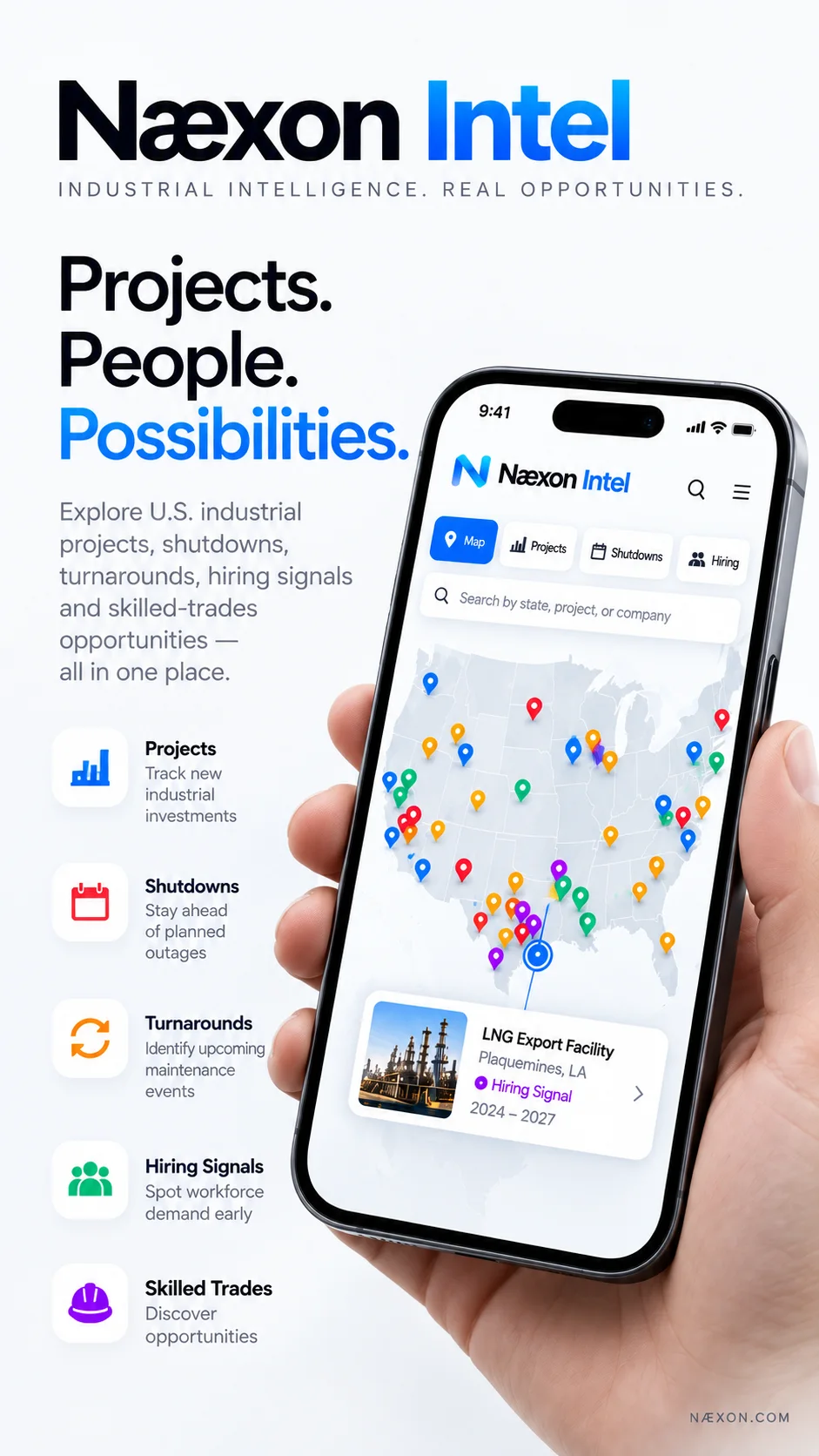
Industrial workers constantly move between projects. Shutdown ends. Turnaround ends. Construction finishes. People drag up. Crews split apart. Everybody starts looking for the next one. Næxon Careers is being developed around that reality: creating another useful destination for skilled tradespeople while strengthening the connection between workers and industrial employers.
Think about what that can eventually mean. A worker comes to Næxon to learn the trade, understand the industry, find the next opportunity, and discover workwear and gear built around the same industrial world. That’s much bigger than selling shirts.
Building an Industrial Ecosystem
This is where Næxon’s strategy can become fundamentally different from the flood of new FR startups. The long-term model isn’t simply FR shirt → advertisement → sale. It’s Learning Center → Careers → Industrial Community → Workwear & Gear → Næxon.
Educational content earns attention. Career resources create utility. Products solve physical needs. Industrial culture creates identity. Trust connects everything. That’s how a workwear company can become an industrial platform rather than simply another clothing label.
None of that matters, however, if the products don’t earn their place. Brand storytelling cannot compensate forever for poor construction. Marketing cannot fix bad fit. Social-media popularity cannot replace accurate product documentation. Næxon has to earn its position every time a worker spends their own money on a product. That means continuously improving materials, fit, construction, consistency, documentation, customer experience, and design.
The objective shouldn’t be for somebody to buy one Næxon shirt because an advertisement looked good. The objective is for that worker to wear it on an actual job, put it through real industrial work, and decide they want another one.
The New Generation Wants More From Workwear
Traditional industrial workwear has often been designed generously, and for some workers and applications that’s exactly what’s wanted. Others are looking for something different. A growing number of industrial workers want clothing that still functions properly on the job without feeling excessively oversized or boxy.
That doesn’t mean turning PPE into restrictive fashion clothing. Workwear still needs appropriate mobility, coverage, comfort, layering ability, and suitability for the task. But there’s a huge amount of room between tight fashion clothing and a shirt that feels two sizes too large. That’s where Næxon can continue carving out its position: industrial first, modern second.
And industrial workers notice the details. How the cuff closes. How the collar sits. Whether the shirt stays comfortable while reaching overhead. Whether the snaps feel substantial. Whether stitching survives repeated washing. Whether it works tucked or untucked. Whether the pockets are actually useful. Whether the garment still looks good after months of work. Those details don’t always show up in an advertisement. They show up after hundreds of hours on the job.
FR Clothing Is Becoming Personal
The old model was often simple: the company tells you what shirt to wear. Today, many workers also purchase their own preferred garments when their employers permit it and when those garments satisfy the applicable workplace requirements.
That introduces something powerful into industrial PPE: personal preference. One worker wants traditional styling. Another wants Western. Another prioritizes lightweight clothing. Another wants a modern fit. Someone else cares about pockets, pearl snaps, colors, or how the garment feels after a twelve-hour shift. As workers gain choices, they develop favorite brands just as consumers do in virtually every other mature apparel category.
That’s why FR brands are popping up everywhere. Industrial workers became visible online. Blue-collar culture became commercially important. Workers started demanding better-fitting workwear. Western style became increasingly influential. Online marketplaces gave smaller companies national reach. Social media gave them direct access to highly specific audiences. And workers realized they didn’t have to accept the same handful of choices forever.
Most New FR Brands Won’t Become Major Brands
That’s normal. Every growing industry attracts competitors. Some companies will build excellent products. Some will find a niche. Some will disappear. A few will build genuine communities and survive for decades.
The companies that last will probably understand one fundamental truth: industrial workers can tell when you’re actually part of their world. You can’t manufacture that connection with a photoshoot alone.
That’s ultimately Næxon’s opportunity. Thousands of companies can sell a shirt. The harder thing to build is a place industrial workers intentionally return to when they’re not shopping. They return because they need an answer. They return because they’re learning something. They return because they’re looking for work. They return because an article sounds exactly like something their crew has been arguing about for years.
Then, when they need workwear, Næxon isn’t an unfamiliar clothing company anymore.
It’s already part of their industrial life.
Næxon Doesn’t Need to Be Another FR Brand
The FR market is getting crowded, but that validates something bigger: industrial workers have been underserved as consumers for a long time. They want protection. They want durability. They want better design. They want education. They want career opportunities. And they want brands that understand industrial culture without pretending to be something they’re not.
Næxon doesn’t need to become another FR company popping up everywhere. The opportunity is to become a company workers think about when they think about the industrial trades themselves.
FR clothing can introduce the brand. The Næxon Learning Center can teach. Næxon Careers can connect workers with opportunities. Næxon gear can go to work with them. The community can connect everything.
That’s the difference between launching another FR shirt and building Næxon.