Walk onto a refinery turnaround, power plant outage, industrial construction project, or major maintenance job and eventually somebody is going to start talking about double bubble.
“Sunday is double bubble.”
“We’ve got four hours of double bubble tonight.”
“Don’t drag up yet. They’re going double bubble this weekend.”
For somebody new to industrial construction, that can sound like another piece of jobsite slang nobody bothered to explain. But once you understand what double bubble means, you’ll understand exactly why those words can get a crew’s attention.
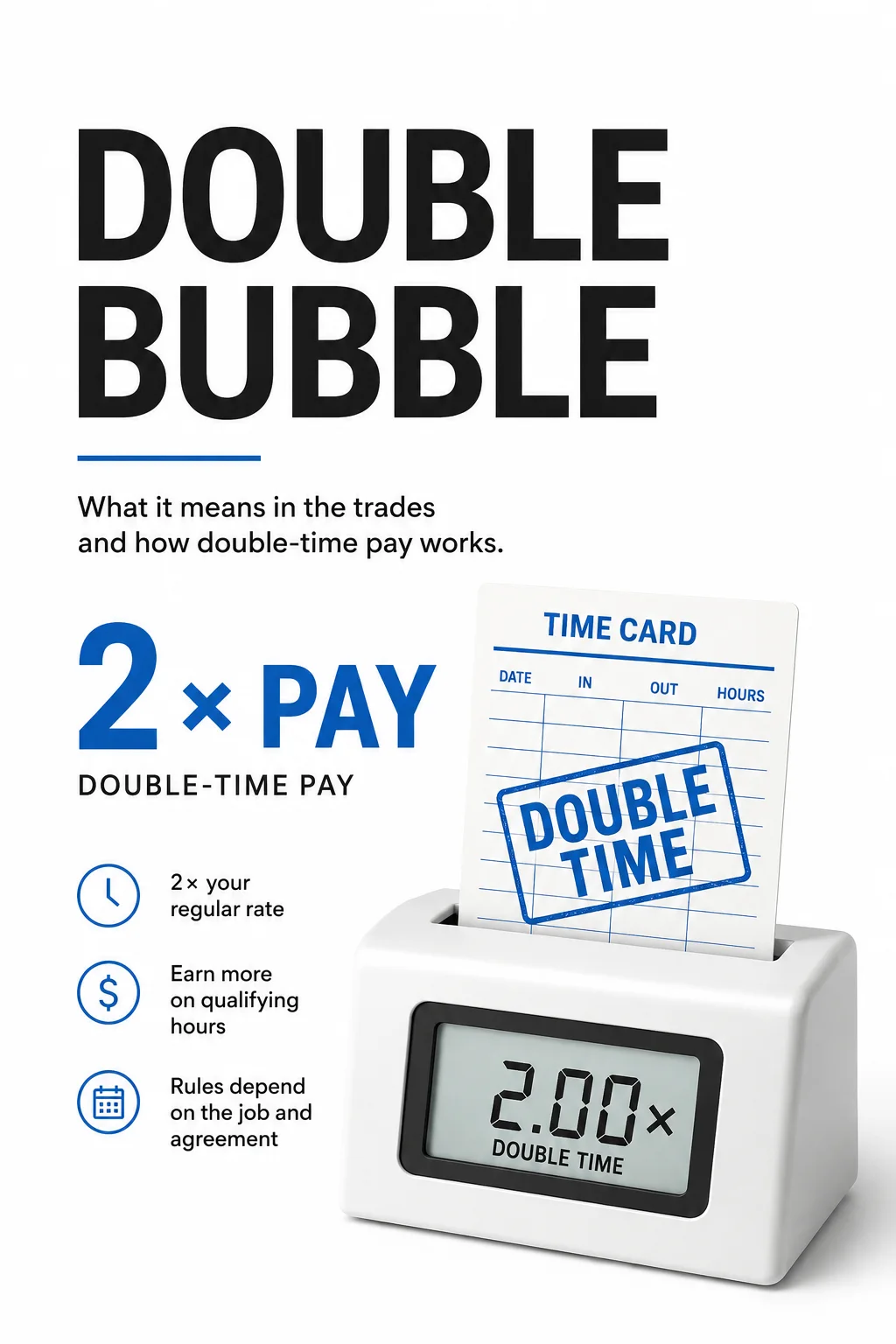
Double bubble generally means double-time pay — twice your regular hourly rate.
If you’re making $40 an hour straight time, double bubble means $80 an hour. If you’re making $45 an hour, double time would be $90. At $50 an hour, you’re looking at $100 an hour.
And when you’re already working a heavy shutdown schedule, those hours can make a serious difference in a paycheck.
Why Tradesmen Call It “Double Bubble”
Industrial construction has its own language.
Pipefitters, welders, boilermakers, ironworkers, electricians, millwrights, scaffold builders, operators and other crafts develop terminology that gets passed from project to project and generation to generation.
“Double bubble” is simply a colorful way of saying double time.
You probably won’t see “double bubble” printed on an official payroll document. The paperwork will normally say something like DT, double time, or another payroll designation.
But out in the field?
Double bubble.
It’s the kind of phrase you’ll hear at the lunch table, in the gang box area, walking through the parking lot after shift or when somebody finds out the upcoming schedule.
Straight Time vs. Time-and-a-Half vs. Double Bubble
Understanding double bubble starts with understanding the three pay rates workers commonly talk about.
Straight time is your normal hourly rate.
If your regular rate is $40 per hour, straight time is $40.
Time-and-a-half means 1.5 times the applicable regular rate.
Using that same $40 example:
$40 × 1.5 = $60 per hour
Then comes double time.
$40 × 2 = $80 per hour
That’s double bubble.
Here’s another example using a $48 hourly rate.
Straight time: $48/hour
Time-and-a-half: $72/hour
Double time: $96/hour
Once those hours start stacking up on a turnaround schedule, the difference becomes significant.
Workers interested in understanding more of the calculations behind industrial work can continue into the Næxon Learning Center, where we break down pipefitter math, measurements, field calculations and other practical skills used on industrial jobsites.
When Do You Actually Get Double Time?
This is where an important distinction needs to be made.
There is no universal rule that every industrial worker automatically receives double time after a particular number of hours.
The answer depends on the job.
Double-time provisions can come from a collective bargaining agreement, employer policy, project labor agreement, employment agreement, specific project rules or applicable state law.
One project might pay double time on Sunday.
Another might pay time-and-a-half.
Another could have different rules based on consecutive hours worked.
A union agreement might establish completely different overtime conditions than an open-shop project.
That’s why experienced travelers don’t rely entirely on what somebody in the parking lot says.
They verify the actual pay package.
Why “Sunday Is Double Bubble” Is So Common
Sunday and double time have become closely associated in parts of the industrial trades because some labor agreements and project pay structures historically provide premium rates for certain Sunday work.
That’s where you’ll hear:
“Sunday is double bubble.”
But don’t assume that’s true everywhere.
A Sunday shift isn’t automatically double time simply because it’s Sunday. The actual compensation depends on the rules governing that particular job.
Still, when a project genuinely does pay double time on Sunday, you’ll probably notice something interesting.
Attendance tends to be pretty good.
There’s a reason for that.
What Double Bubble Can Do to a Paycheck
Consider a tradesman earning $45 per hour.
Eight hours at straight time:
$45 × 8 = $360
Eight hours at time-and-a-half:
$67.50 × 8 = $540
Eight hours at double time:
$90 × 8 = $720
That’s $360 more than eight straight-time hours.
Now imagine those premium hours appearing repeatedly during a major turnaround.
That’s why experienced shutdown workers pay close attention not only to the advertised hourly wage, but also to the schedule and overtime structure.
A $42-per-hour job with substantial overtime and favorable premium-pay rules can sometimes produce a larger weekly gross paycheck than a $50-per-hour job working primarily straight time.
You have to look at the entire package.
Why Shutdowns Can Create So Much Overtime
Industrial facilities don’t schedule major outages because they enjoy shutting production down.
Downtime can be extremely expensive.
When a refinery, chemical plant, power facility or other industrial operation takes equipment offline for planned maintenance, there may be an enormous amount of work that has to happen inside a limited window.
Pipe gets replaced.
Valves get changed.
Exchangers get opened.
Vessels get inspected.
Welds get repaired.
Instrumentation gets serviced.
Electrical systems get maintained.
Scaffolding goes up and comes down.
Equipment gets aligned.
Insulation gets removed and replaced.
Thousands of individual tasks may have to come together before systems can safely return to service.
That’s one reason turnaround schedules can become aggressive.
Six 10s.
Seven 10s.
Six 12s.
Seven 12s.
Night shift.
Day shift.
And sometimes premium overtime.
For traveling industrial workers, understanding those schedules can be nearly as important as knowing the hourly rate.
Don’t Judge an Industrial Job by the Hourly Rate Alone
Newer travelers often make this mistake.
They see:
$47/hour
and immediately compare it with another job paying:
$44/hour
The $47 job looks better.
Maybe it is.
Maybe it isn’t.
Suppose the $47 job offers 40 hours per week with limited overtime.
Meanwhile, the $44 job is working a heavy turnaround schedule with overtime opportunities and premium-pay provisions.
The second job could potentially generate substantially more gross income during the project.
That doesn’t automatically make it the better job either. Long schedules mean more time away from home, greater fatigue and less recovery.
The point is that hourly wage alone doesn’t tell you what an industrial job is worth.
You need to understand the schedule, overtime rules, per diem if offered, project duration, travel costs and expected weekly hours.
That’s also why Næxon Careers focuses on presenting industrial opportunities with the details tradespeople actually care about instead of reducing a job to a position title.
Double Bubble Doesn’t Mean Per Diem Doubles
Another distinction worth understanding is the difference between wages and per diem.
If your hourly wage moves into double time, that does not automatically mean your per diem doubles.
They’re separate parts of a compensation package.
For example, a hypothetical job might offer:
$45/hour wages
$100/day per diem
If certain hours qualify for double time, your wage rate for those qualifying hours could become $90/hour.
That doesn’t automatically turn the $100 per diem into $200.
Always read the actual job terms.
The Double-Bubble Trap
There’s another side to premium overtime that experienced industrial workers understand.
When you’re staring at a double-time rate, it’s easy to think:
I can’t afford to miss this shift.
That’s understandable.
But industrial work is already physically demanding, and long turnaround schedules can compound fatigue quickly.
A paycheck isn’t worth ignoring jobsite safety, fatigue or your ability to perform your work correctly.
A tired pipefitter can make a bad measurement.
A tired rigger can miss something during a lift.
A tired welder can lose concentration.
A tired operator can make the wrong move.
Premium pay should never become an excuse to work unsafely.
Learn the Language Before You Hit the Road
“Double bubble” is only one piece of industrial jobsite vocabulary.
If you’re entering refinery, power plant, petrochemical or heavy industrial construction, you’ll hear hundreds of expressions that rarely appear in a textbook.
Drag up.
Money hours.
Seven twelves.
Per diem.
Show-up time.
Call-out.
Turnaround.
Outage.
Tool list.
Hot work.
Fire watch.
Bottle watch.
Rat hole.
Bull rigging.
Fit-up.
Breakover.
Some describe money. Some describe tools. Some describe work. Others describe situations that every experienced tradesman immediately recognizes.
Understanding that language helps a new worker understand the culture around the work — but understanding the actual craft behind it matters even more.
That’s why Næxon is building the Learning Center alongside Næxon Careers: one helps industrial workers understand and improve the skills behind the work, while the other helps them understand where those skills can take them.
So, What Does Double Bubble Mean?
On an industrial jobsite, double bubble generally means double-time pay — 2× the worker’s applicable regular hourly rate for qualifying hours.
A $35 rate becomes $70.
A $45 rate becomes $90.
A $50 rate becomes $100.
Simple enough.
The important part is knowing when those hours actually qualify for double time.
Don’t assume Sunday automatically means double bubble. Don’t assume every hour after a certain point becomes double time. Don’t assume the rules from your last turnaround apply to your next one.
Check the actual compensation terms for the project.
Because when somebody walks into the break area and says:
“Tomorrow’s double bubble.”
Now you’ll know exactly why everybody suddenly wants to work.