Industrial jobsites have their own unofficial ranking system. It has nothing to do with certifications, seniority, pay scale, or who has the fanciest title.
It comes down to one question:
How easy is your trade to make fun of?
Every craft has a stereotype. Some earned it decades ago. Some probably started because one guy did something stupid on night shift in 1997 and somehow the entire trade has been paying for it ever since.
Work enough shutdowns, turnarounds, outages, refinery projects, power plants, pipelines, chemical plants, or big industrial construction jobs and you’ll hear the same accusations everywhere. Electricians don’t know what a broom is. Pipefitters are never wrong. Welders will fight you over a grinder they haven’t touched all day. Ironworkers think gravity is optional. And safety can somehow spot your glasses sitting on top of your hard hat from the other side of the plant.
So we’re settling absolutely nothing today.
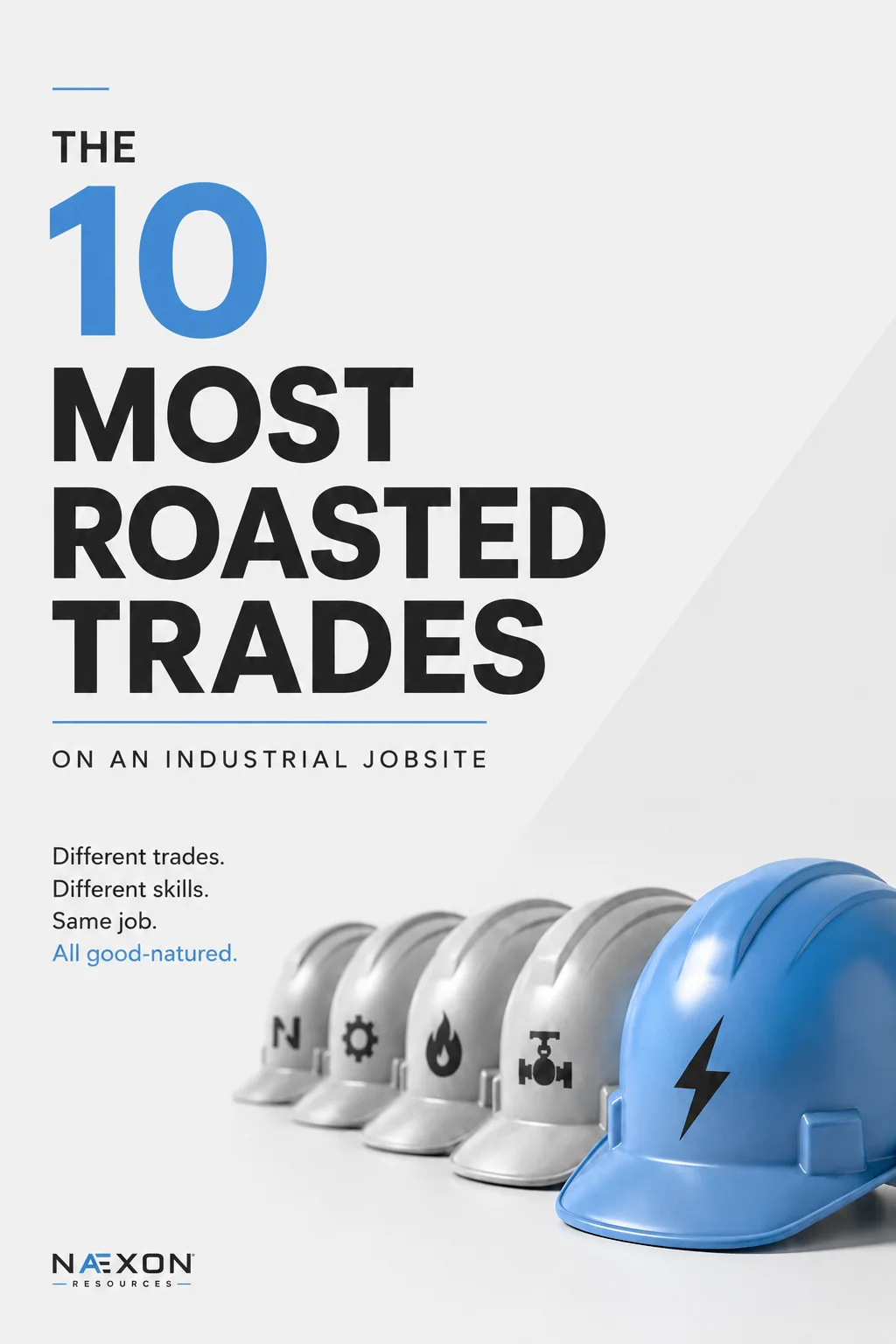
Here are 10 of the most roasted trades on an industrial jobsite.
1. Electricians
Let’s get the obvious one out of the way.
Electricians may be the most universally roasted people on a construction site.
According to every other craft, electricians are physically incapable of sweeping, anything over 25 pounds requires a material-handling plan, and their definition of “heavy construction” is carrying two bundles of conduit at once.
They’re also suspiciously clean.
You can put an electrician and a boilermaker on the same shutdown for 12 hours. By lunchtime, the boilermaker looks like he survived an underground mining accident while the electrician looks ready for family pictures.
And then there’s this:
Fun fact: Electricians ask AutoZone to change their wiper blades.
We’re starting strong.
2. Pipefitters
There are two things you’ll rarely hear from an experienced pipefitter:
“I don’t know.”
And:
“I measured it wrong.”
If the pipe doesn’t fit, something else happened.
Engineering gave the wrong dimension. The steel is off. The flange came from the fab shop rotated. The equipment moved. The survey point is wrong. The drawing isn’t accurate. The welder pulled it.
Anything is possible.
Except the pipefitter making a bad measurement.
That’s not a mistake anyway.
That’s a field-discovered dimensional conflict.
Pipefitters can also spend 30 minutes looking for a tool because walking two minutes back to the gang box would apparently be admitting defeat.
3. Welders
There are nuclear facilities with less restricted access than a welder’s gang box.
Don’t touch the hood.
Don’t touch the stinger.
Don’t move the leads.
And under absolutely no circumstances should you borrow the grinder without asking.
A welder can ignore that grinder for half the shift. Pick it up once and suddenly you’ll hear:
“WHO’S GOT MY GRINDER?”
Nobody knows how they know.
Welders also have an incredible ability to spend 15 minutes adjusting their hood, body position, leads, ground, sleeves, gloves, and welding cap before making a weld that takes 90 seconds.
But if that weld shoots clean?
You might as well memorize the X-ray report because you’re going to hear about it until the next turnaround.
4. Ironworkers
Ironworkers will casually walk across a beam 150 feet above the ground like they’re walking through Walmart.
Then complain because the elevator is down and they have to climb four flights of stairs.
They’re also one of the few trades where carrying a giant pointed wrench around all day somehow seems completely normal.
Ironworkers communicate primarily through yelling, hand signals, radio chatter, and language that would get an entire television network fined.
And if you hear a piece of steel hit the deck followed by profanity echoing across three units?
You probably found the ironworkers.
5. Scaffold Builders
Nobody appreciates scaffold builders more than a craft that needs access.
Nobody complains about scaffold builders more than a craft that just received access.
The deck is too high.
The deck is too low.
The ladder is on the wrong side.
There’s a vertical exactly where the pipe needs to come out.
The handrail blocks the valve.
The toe board blocks the flange.
Somehow they can build 4,000 square feet of scaffold around a vessel and the exact bolt you need to reach will still be six inches outside the platform.
That’s almost impressive.
6. Boilermakers
Boilermakers have one of the simplest troubleshooting systems in industrial construction.
Step one: Hit it.
Step two: Hit it harder.
Step three: Get a bigger hammer.
If none of those work, somebody eventually says:
“Cut that shit out.”
Problem solved.
Everything about boilermaker work seems heavy, loud, dirty, hot, or some combination of all four.
After enough years in the trade, experienced boilermakers also develop their own dialect consisting of English, profanity, hand gestures, mumbling, and random noises that somehow every other boilermaker understands perfectly.
7. Millwrights
A millwright’s tool collection can look like a mobile machine shop.
Dial indicators. Precision levels. Laser alignment systems. Micrometers. Torque equipment. Pullers. Specialty sockets. Cases containing expensive equipment nobody else is allowed to breathe near.
Then comes the inevitable:
“Hey, you got a tape?”
Millwrights can align rotating equipment within thousandths of an inch but somehow their pickup truck looks like somebody shook a Snap-on truck upside down.
Still, when a pump starts screaming, a compressor won’t line up, or a piece of rotating equipment decides it no longer believes in vibration limits, everybody suddenly becomes very friendly with the millwrights.
8. Safety
Safety has supernatural powers.
You can work correctly for 11 hours and 57 minutes.
Harness tied off.
Gloves on.
Safety glasses on.
Barricade up.
Permit signed.
JSA completed.
Everything perfect.
Then you lift your safety glasses onto your forehead for three seconds to wipe sweat from your face.
“Hey, bud…”
Where the hell did he come from?
Nobody saw him walking over.
Nobody heard a radio.
He simply appeared.
Safety can detect PPE violations from distances normally requiring military-grade optics.
Of course, everybody jokes about safety until something actually happens. Then they’re suddenly some of the most important people on the entire project.
Funny how that works.
9. Operators
Operators know things about a plant that aren’t written on any drawing.
They know which valve sticks.
Which gauge lies.
Which pump sounds different.
Which line vibrates.
Which piece of equipment has supposedly been getting replaced “next turnaround” for the past 15 years.
They also possess an incredible ability to disappear until a contractor reaches toward something they’re not supposed to touch.
You haven’t seen an operator for two hours.
Your hand gets within six inches of the wrong valve.
Suddenly, from somewhere behind you:
“DON’T TOUCH THAT!”
Nobody knows where operators hide.
But they’re always watching.
10. Helpers
Helpers occupy the bottom of the jobsite justice system.
Anything that goes missing automatically becomes their fault.
Can’t find the tape measure?
Helper.
Water cooler empty?
Helper.
Extension cord disappeared?
Helper.
Gang box left open?
Helper.
Somebody used your Sharpie?
Probably the helper.
The funny part is that every journeyman laughing at this was once standing in exactly the same position.
A good helper eventually learns the tools, material, terminology, workflow, and the personality of everybody on the crew. Before long, they’re anticipating what the journeyman needs before they’re even asked.
Then one beautiful day, another brand-new helper shows up.
And the former helper finally gets to say:
“What the hell are they teaching you new guys?”
The transformation is complete.
So Which Trade Gets Roasted the Most?
Probably whichever one isn’t standing close enough to hear the conversation.
That’s how jobsite trash talk works.
Industrial construction puts welders, pipefitters, electricians, boilermakers, millwrights, ironworkers, scaffold builders, operators, safety professionals, helpers, and dozens of other crafts together for long shifts under difficult conditions. People work together, solve problems together, argue together, eat lunch together, and sometimes spend more waking hours with their crew than they do at home.
Naturally, everybody eventually becomes material.
The electrician jokes about the pipefitter.
The pipefitter jokes about the welder.
The welder jokes about the helper.
The ironworker jokes about everybody working on the ground.
And everybody waits until safety leaves before joking about safety.
But beneath all of it is something people outside the trades don’t always understand.
You can roast somebody’s craft all morning and still be the first person helping them when the job gets difficult.
Because when it’s time to work, every one of these trades matters.
So keep talking shit.
Keep defending your craft.
And remember the most important rule of industrial jobsite trash talk:
If your trade isn’t getting roasted, you’re probably not doing enough to get noticed.
— Næxon Resources