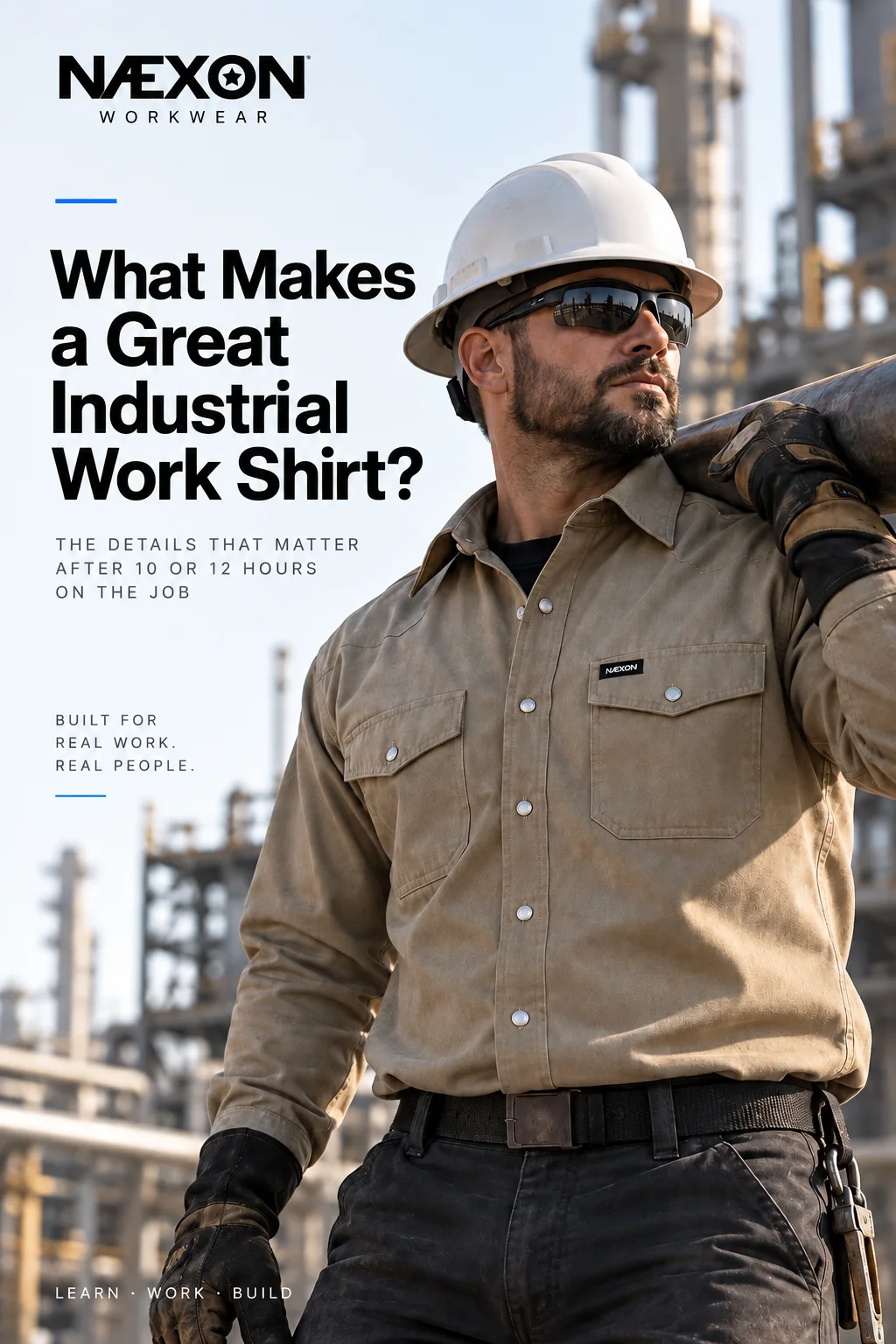
The Details That Matter After 10 or 12 Hours on the Job
A work shirt can look great hanging on a rack and still be a terrible shirt to actually work in.
The real test begins after you put on your hard hat, safety glasses, gloves and harness and start moving. You climb ladders. Reach overhead. Crawl underneath equipment. Carry material. Grind. Fit pipe. Weld. Rig loads. Sweat through the afternoon. Then you wash the shirt and do it again.
That environment exposes weaknesses that are easy to miss when buying workwear.
For industrial workers, a great work shirt is not defined by one feature. It is the combination of appropriate protection, durable construction, usable mobility, practical design, comfort and long-term performance.
Whether you are a pipefitter, welder, boilermaker, millwright, ironworker, electrician, operator or another industrial craft worker, here is what actually matters.
1. Start With the Hazards, Not the Shirt
Before discussing fabric weight, pockets or fit, there is a more important question:
What hazards will the worker be exposed to?
Industrial jobsites are not all the same. The clothing appropriate for general construction may not be appropriate where workers are exposed to arc-flash or flash-fire hazards. A welding environment creates different concerns than instrumentation work. A refinery turnaround may have different site requirements than a fabrication shop.
When flame-resistant or arc-rated clothing is required, workers should not choose a garment simply because the description says “FR.”
The garment needs to meet the applicable requirements for the work being performed, and workers should follow their employer’s hazard assessment, PPE program and site requirements.
The label inside the garment matters.
So does understanding what protection the garment was designed to provide.
A premium-looking shirt is not a substitute for correctly selected protective clothing.
2. Fabric Is the Foundation
Most people notice the color and style of a work shirt first.
Experienced workers tend to notice the fabric.
That makes sense because the fabric affects almost everything else: weight, breathability, flexibility, moisture management, durability, shrinkage and how the shirt feels several hours into a shift.
There is no single fabric that is perfect for every industrial environment.
A heavier material may provide excellent durability but feel uncomfortable during a humid Gulf Coast summer. A lighter material may feel excellent during hot weather but may not tolerate abrasion in exactly the same way as a heavier construction.
The goal is balance.
A good industrial shirt should provide the performance required for its intended environment without creating unnecessary bulk or restricting the worker.
This becomes particularly important with FR clothing, where protective performance and comfort have to coexist.
We will examine this subject more deeply in our upcoming Næxon Learning Center guide, Why Fabric Weight Matters in FR Workwear.
3. Mobility Is Part of Workwear Design
Stand upright and almost any properly sized shirt can feel comfortable.
Now reach above your head.
Bend over.
Squat.
Reach across your body.
Climb a ladder.
Extend both arms as if you’re pulling on a chain fall.
Get underneath a pipe.
Those movements reveal whether a shirt was designed around a human body actually performing work.
A good industrial work shirt should allow reasonable movement through the shoulders, back and arms without constantly pulling against the worker.
One of the most frustrating problems is excessive shirt lift.
You reach overhead and the entire shirt pulls upward. The cuffs move excessively up the forearms. The shoulders tighten. The bottom pulls out of position.
That may not matter much when someone is standing in front of a mirror.
It matters during a 12-hour shift.
4. Fit Should Allow You to Work
A work shirt should not fit like a fashion shirt.
That does not mean it needs to be excessively oversized either.
The goal is functional room.
There should be enough space through the shoulders, chest, back and arms to allow normal jobsite movement while avoiding unnecessary loose material that could create interference or become problematic around equipment.
The correct fit can also depend on how the garment will be used.
Will another layer be worn underneath it?
Will the worker frequently wear a harness?
Will the shirt normally be tucked?
Will the worker be welding?
Will the job involve frequent overhead work?
Will the worker be climbing throughout the shift?
These questions matter more than whether the shirt looks perfectly fitted while standing still.
We’ll break this subject down separately in How Should an FR Work Shirt Actually Fit?
5. The Shoulder Area Deserves More Attention
The shoulders are one of the places where a poorly designed work shirt becomes obvious.
Industrial workers constantly move their arms away from the neutral standing position.
Pipefitters reach around pipe.
Welders position themselves around joints.
Ironworkers reach overhead.
Millwrights work around machinery.
Electricians reach into cable trays and equipment.
Riggers manipulate hardware and taglines.
If the shirt binds across the shoulders every time the arms move, the worker fights the garment all day.
Good pattern design should accommodate realistic movement without requiring the entire garment to be excessively large.
This is one reason workwear should be evaluated while moving—not just while standing.
6. Sleeve Length Is More Important Than It Looks
Sleeves seem simple until you start working.
Too short and they constantly pull upward during normal movement.
Too long and excess material can interfere with gloves, cuffs and work.
The cuff design matters too.
A good cuff should be practical to operate, remain secure and work reasonably with the PPE and gloves appropriate to the task.
Workers who routinely wear welding gloves or other gauntlet-style protection may evaluate sleeve and cuff design differently from workers performing lighter tasks.
There isn’t one perfect configuration for every trade.
There should, however, be a reason behind the design.
7. Stitching Is Where Cheap Construction Often Reveals Itself
Fabric receives most of the attention, but a work shirt is only as useful as the construction holding it together.
Industrial clothing experiences repeated loading.
Every time you reach, bend, kneel, climb or pull, portions of the garment are placed under tension.
Then the shirt goes through another stress cycle in the washing machine and dryer.
And then another.
And another.
Look closely at areas that receive repeated stress:
Shoulder seams
Armholes
Side seams
Cuffs
Pocket attachment points
Plackets
Collar construction
High-movement areas
Good industrial clothing should use construction appropriate for its intended use, with reinforcement where it actually provides value.
Adding decorative stitching everywhere doesn’t automatically make something durable.
The construction needs to make sense.
8. A Pocket Should Be Designed Around What Workers Carry
Work-shirt pockets should not exist just because work shirts traditionally have pockets.
They should be useful.
Depending on the trade and job, a worker may carry a marker, pencil, soapstone, small notepad, earplugs or other lightweight items.
That means pocket position, depth, opening and retention matter.
A pocket can be too shallow.
It can sit too high.
It can sit too low.
The opening can be awkward.
The contents can fall out every time the worker bends forward.
More pockets aren’t necessarily better either.
Every additional pocket adds material and complexity.
Good design asks a better question:
What does the worker actually need this pocket to do?
9. Buttons vs. Pearl Snaps Is More Than a Style Decision
Traditional buttons are proven, simple and widely used.
Pearl snaps create a different experience.
They can be fast to operate and give a work shirt a distinctive appearance that has been associated with Western and workwear clothing for generations.
But neither closure automatically makes a shirt better.
Quality matters.
Placement matters.
Construction around the closure matters.
And for protective clothing, the complete garment design and applicable requirements matter.
This is an area particularly important to Næxon because pearl snaps are part of the identity of our FR work shirts.
We’ll examine the advantages and tradeoffs separately in Pearl Snaps vs. Buttons: Which Is Better for a Work Shirt?
10. The Collar Has a Job Too
A collar is easy to treat as a styling feature.
On industrial workwear, it also affects comfort and how the shirt behaves around the neck throughout a long shift.
A poor collar may collapse, curl excessively or become uncomfortable after repeated washing.
An overly stiff collar can become annoying when workers are sweating heavily or moving their head frequently.
Like the rest of the shirt, it needs balance.
It should hold its shape reasonably well without making the garment feel unnecessarily formal or restrictive.
11. Breathability Matters Most When the Job Gets Hard
Almost any shirt can feel comfortable inside an air-conditioned building.
The difference becomes obvious when the worker is outside in August.
Heat, humidity, physical activity and required PPE can make an industrial environment demanding very quickly.
Workers naturally care about breathable workwear because comfort affects the entire shift.
But when protective clothing is required, the solution is not simply choosing the thinnest garment available.
Protection requirements come first.
Within those requirements, fabric construction, garment design, fit, ventilation characteristics and layering can all affect perceived comfort.
This is why “lightweight” and “comfortable” should not automatically be treated as synonyms.
We will cover this subject extensively in What Makes FR Clothing Comfortable in Hot Weather?
12. Comfort at Hour One Doesn’t Tell the Whole Story
Trying on a shirt for two minutes tells you very little about how it will perform at work.
Industrial workwear should be judged after:
4 hours
8 hours
10 hours
12 hours
and eventually after dozens of wash cycles.
A shirt that initially feels soft may become uncomfortable when saturated with sweat.
A collar that looks perfect when new may deform.
A poorly constructed cuff may become irritating.
Seams may begin opening.
Fabric may shrink.
A shirt that was barely large enough when purchased may become restrictive after laundering.
This is why durability and comfort cannot be separated from long-term use.
13. The Washing Machine Is Part of the Test
Industrial workwear lives two lives.
One happens on the job.
The other happens in the laundry.
A worker may wear a shirt hundreds of times during its useful life, which means the garment may also experience a large number of wash-and-dry cycles.
Repeated laundering can expose poor construction through shrinkage, twisting, fading, seam deterioration, damaged closures and changes in fit.
For protective garments, care is especially important because workers need to follow the manufacturer’s care instructions and their employer’s requirements.
We cover proper maintenance separately in How to Wash FR Work Shirts Properly, because buying quality workwear and then caring for it incorrectly defeats the purpose.
14. Durability Should Be Measured in Cost Per Wear
A $40 work shirt that becomes unusable quickly isn’t necessarily cheaper than a $100 shirt that performs reliably for much longer.
That doesn’t mean expensive automatically equals good.
It means purchase price is only one part of value.
Imagine Shirt A costs $45 and delivers 40 useful wears.
That’s approximately:
$1.13 per wear
Now imagine Shirt B costs $100 and delivers 150 useful wears.
That’s approximately:
$0.67 per wear
The numbers are only examples, but the principle is useful.
Workers should evaluate clothing based on how well it performs throughout its usable life, not simply the number printed on the price tag.
15. A Great Work Shirt Should Become Forgettable
This may sound strange, but one of the best compliments you can give industrial workwear is:
You stopped thinking about it.
You aren’t constantly pulling the sleeves down.
You aren’t adjusting the collar.
You aren’t fighting the shoulders.
You aren’t pulling the shirt back into position.
You aren’t worrying about a pocket dumping its contents.
You aren’t thinking about the garment because you’re thinking about the job.
That is what functional workwear should accomplish.
The clothing supports the worker without constantly demanding attention.
16. Different Trades Need Different Things
There is no universal “best work shirt” for every worker.
A welder may care heavily about coverage, sparks, spatter exposure and how the garment interfaces with welding PPE.
A pipefitter may place greater emphasis on unrestricted movement because of climbing, fitting, rigging, measuring and working in awkward positions.
A millwright may spend significant time kneeling, reaching and working around equipment.
An ironworker may spend much of the day climbing and working at elevation.
An instrumentation technician may perform smaller, more precise tasks but still work inside the same industrial environment.
The best workwear starts by understanding the worker.
That is why we are developing dedicated guides including Workwear for Welders: What Actually Matters? and Workwear for Pipefitters: What Actually Matters?
17. More Features Do Not Automatically Make Better Workwear
There is a temptation in product design to keep adding things.
Another pocket.
Another zipper.
Another loop.
Another panel.
Another adjustment.
Eventually the garment becomes a collection of features rather than a good work shirt.
Great industrial design should be deliberate.
If a feature solves a real problem, it deserves consideration.
If it exists primarily to make the specification list longer, it probably doesn’t.
Sometimes better design means removing something.
18. What Should You Inspect Before Buying?
Before buying an industrial work shirt, look beyond the front photograph.
Consider:
Is the garment appropriate for the hazards and requirements of my job?
How does it fit through the shoulders and arms?
Can I reach overhead comfortably?
Does the shirt provide enough room for normal movement?
How is it constructed?
Are high-use areas built appropriately?
Are the pockets actually useful?
How does the cuff interact with my normal PPE?
What are the manufacturer’s care instructions?
How is the garment expected to perform after repeated laundering?
If protective clothing is required, also inspect the garment’s labeling and verify that it meets the requirements established for your work.
We’ll expand this into a complete buyer’s guide in What to Look for Before Buying an FR Work Shirt.
19. What Makes a Great Industrial Work Shirt?
After stripping away branding, marketing and styling, a great industrial work shirt comes down to a few fundamentals:
Correct protection for the work.
Fabric appropriate for the environment.
Enough mobility to perform the job.
Functional fit.
Durable construction.
Useful—not excessive—features.
Reasonable comfort throughout a long shift.
Proper performance through repeated care and use.
And perhaps most importantly:
It should be designed around the worker rather than expecting the worker to adapt to the shirt.
Built for the People Who Build Everything Else
Industrial workers operate in environments most clothing will never experience.
Heat.
Cold.
Steel.
Concrete.
Grinding dust.
Welding.
Confined spaces.
Pipe racks.
Ladders.
Scaffolds.
Equipment.
Shutdowns.
Turnarounds.
Long shifts.
And then they get up and do it again.
Workwear for these environments deserves to be designed with the same seriousness workers bring to their craft.
That philosophy is at the center of how we think about industrial clothing at Næxon.
Not clothing designed to look like workwear.
Workwear designed around actual work.
Næxon | Learn · Work · Build.