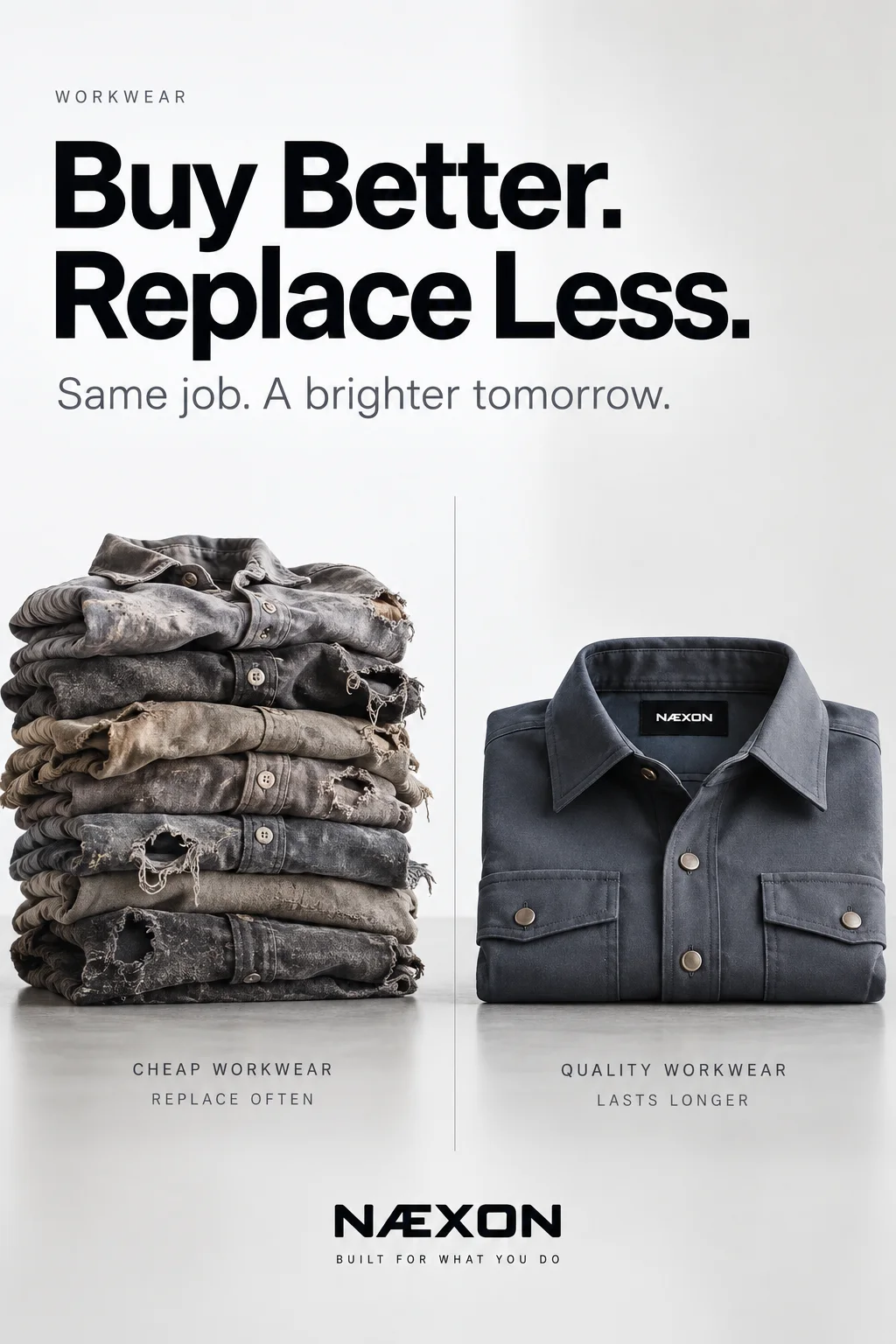
Buying the cheapest workwear available can feel like a smart decision—especially when you need several shirts, pants, gloves, or other pieces of gear at once.
But industrial workers don’t judge workwear by how it looks on the rack.
They judge it after months of sweat, washing, climbing, welding, grinding, crawling, bending, kneeling, and working twelve-hour shifts.
That is where the difference between cheap workwear and good-value workwear begins to show.
A lower purchase price doesn’t always mean a lower cost. If inexpensive workwear wears out faster, fits poorly, becomes uncomfortable, or needs to be replaced repeatedly, the worker may ultimately spend more money than if they had purchased better gear from the beginning.
The better question isn’t:
“How much does it cost?”
It’s:
“How much work am I going to get out of it?”
Workwear Is Equipment
For someone working in an office, clothing might primarily be about appearance and comfort.
For a welder, pipefitter, boilermaker, ironworker, millwright, electrician, refinery worker, operator, mechanic, or industrial construction worker, clothing has another job.
It has to survive the work.
A typical industrial shift may involve climbing ladders, squeezing between equipment, carrying material, working from scaffolds, kneeling on steel, reaching overhead, sweating in high temperatures, working outside in bad weather, and repeatedly contacting rough surfaces.
Then the garment gets washed.
And the process starts again.
That cycle might happen several times every week.
Good industrial workwear should therefore be treated more like equipment than disposable clothing.
The Price Tag Doesn’t Tell You the Real Cost
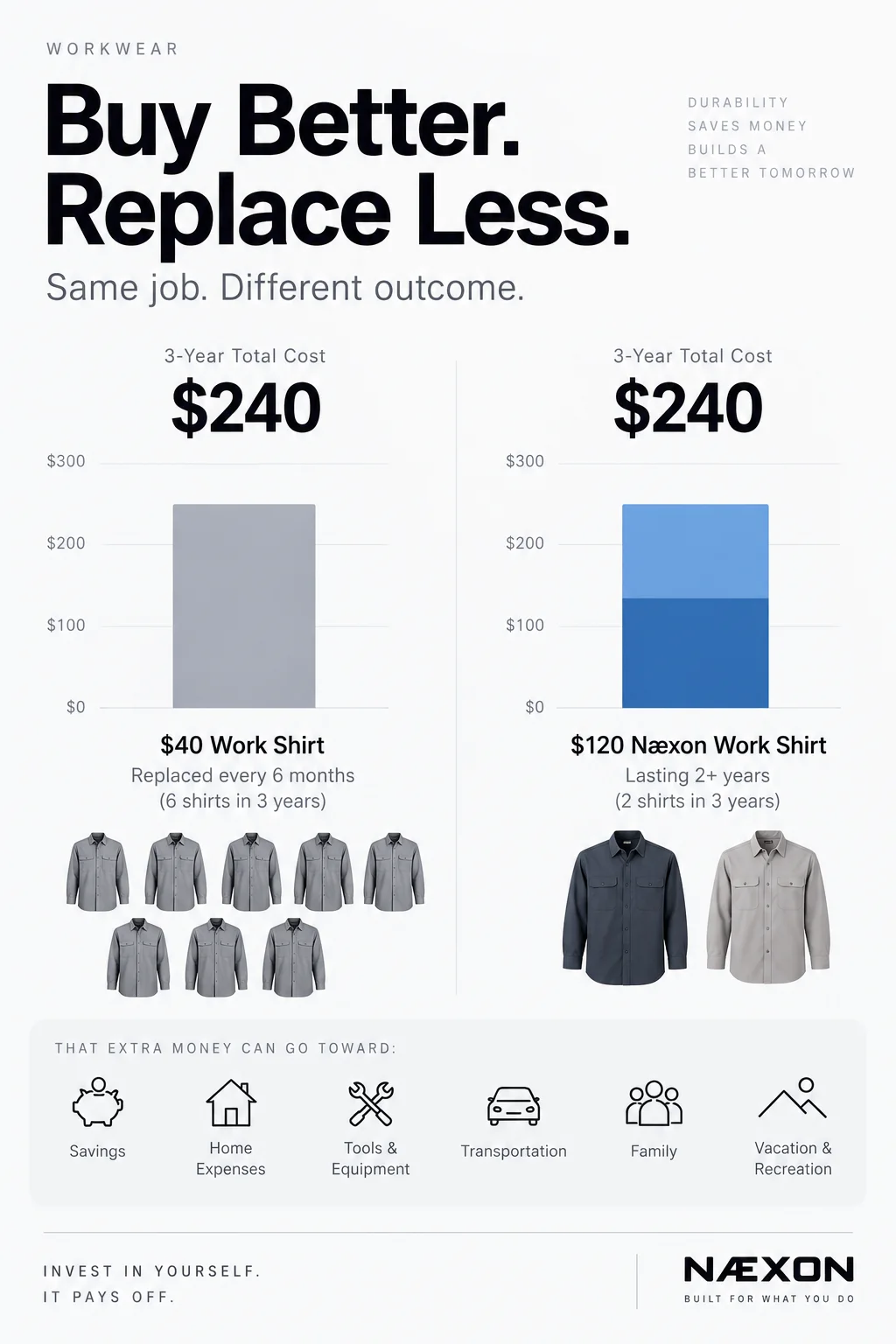
An illustrative comparison showing how investing in durable, higher-quality workwear can reduce replacement frequency over time—helping workers get more value from every dollar they earn.
Imagine two work shirts.
One costs $40.
Another costs $120.
Looking only at the purchase price, the $40 shirt appears to be the obvious bargain.
But suppose the cheaper shirt lasts six months under your working conditions while the $120 shirt lasts two years.
Over two years, you may need four $40 shirts.
That’s $160.
The more expensive shirt cost $120.
The cheaper shirt wasn’t actually cheaper.
This is the idea behind cost per wear.
Instead of asking only what something costs today, consider how many useful shifts you expect to get from it.
The basic idea is simple:
Cost Per Wear = Purchase Price ÷ Number of Times Worn
A $40 shirt worn 40 times costs approximately $1 per wear.
A $120 shirt worn 200 times costs approximately $0.60 per wear.
The more durable garment can therefore deliver better value even though its initial price is substantially higher.
That doesn’t mean expensive automatically equals better.
It means service life matters.
Industrial Jobs Expose Weak Workwear Quickly
Jobsites are unforgiving product testers.
A shirt might look excellent when it comes out of the package. That tells you almost nothing about how it will perform six months later.
Industrial work repeatedly stresses the same areas.
Common failure points include:
- Cuffs
- Elbows
- Shoulders
- Pocket corners
- Collar edges
- Side seams
- Underarm seams
- Buttons or snaps
- Belt-line areas
- Knees and seat areas on work pants
A weak garment often begins failing in these locations long before the rest of the material looks completely worn out.
Once a critical seam opens, a closure fails, or an important section of fabric becomes damaged, the useful life of the garment may effectively be over.
Construction Matters More Than Appearance
Two shirts can look almost identical when they’re new.
After months of industrial use, they may look completely different.
Fabric selection matters, but construction quality matters too.
Workers should pay attention to details such as:
- Stitch consistency
- Reinforcement in high-stress areas
- Seam construction
- Pocket attachment
- Cuff construction
- Closure quality
- Collar durability
- Fabric recovery after repeated wear
- Overall workmanship
These aren’t glamorous features.
They’re the details that determine whether a garment becomes an old reliable work shirt or ends up in the trash.
Washing Is Part of the Job
Industrial workwear doesn’t only take abuse while you’re wearing it.
Laundry creates another cycle of stress.
A worker who rotates through several shirts may wash them constantly throughout the year. Fabric is exposed repeatedly to water, detergent, agitation, drying, heat, and mechanical movement.
Over time, poorly constructed garments may experience:
- Excessive shrinkage
- Twisting seams
- Distorted collars
- Loose stitching
- Fading
- Damaged closures
- Fabric thinning
- Loss of shape
A shirt that fits correctly when purchased but becomes noticeably smaller after repeated washing isn’t delivering its full potential service life.
Proper garment care matters too. Even excellent workwear can have its life shortened by incorrect washing or drying practices.
For workers wearing flame-resistant garments, always follow the garment manufacturer’s care instructions and your employer’s PPE requirements. FR garments should also be removed from service when their condition no longer meets applicable safety requirements.
Cheap Workwear Can Become Expensive During a Shutdown
The economics become even more obvious during turnarounds, outages, and traveling industrial work.
Imagine you’re working twelve-hour shifts, seven days a week.
You’re several hundred miles from home.
Your work shirt tears badly.
Now you need another one immediately.
You’re not shopping carefully anymore.
You’re buying whatever suitable replacement you can find.
That might mean:
- Paying a higher local price
- Driving somewhere after work
- Ordering expedited shipping
- Buying a temporary replacement
- Purchasing something you don’t actually like
- Losing time that should have been spent resting
Suddenly the cost of a failed garment isn’t just the price of another shirt.
It’s inconvenience, time, and another expense during an already demanding job.
Comfort Has Economic Value Too
Durability isn’t the only measure of value.
Workers spend enormous amounts of time in their workwear.
A person working six twelve-hour shifts spends 72 hours per week inside those clothes.
Over a long project, small comfort problems become big ones.
Poorly designed workwear can create:
- Restricted shoulder movement
- Excess material around the torso
- Tightness when reaching overhead
- Poor airflow
- Irritation around seams
- Cuffs that interfere with gloves
- Shirts that constantly need adjustment
None of these problems necessarily destroys the garment.
But they can make every shift less comfortable.
That’s why fit should be considered part of value.
Næxon’s guide on The Importance of Proper Fit in Workwear and How It Improves Productivity on the Jobsite goes deeper into how fit, mobility, and comfort affect workers during demanding industrial shifts.
The Cheapest Option Isn’t Always the Best Value
There is an important distinction between cheap and affordable.
Affordable workwear can absolutely be good workwear.
A lower-priced garment that performs well for the job may provide excellent value.
The mistake is assuming price alone determines value.
A worker should evaluate the complete package:
- Purchase price
- Expected service life
- Construction quality
- Comfort
- Fit
- Wash durability
- Job suitability
- Replacement frequency
- Required protection
The goal isn’t to buy the most expensive gear.
The goal is to buy the right gear for the work.
Expensive Doesn’t Automatically Mean Better Either
A premium price tag isn’t proof of quality.
Marketing can be expensive.
Brand recognition can be expensive.
Fashion can be expensive.
None of those things necessarily make a garment better on an industrial jobsite.
Workers should evaluate workwear based on performance rather than prestige.
Ask practical questions.
Does it move properly?
Are high-stress areas constructed well?
Does it hold its shape?
How does it perform after repeated washing?
Is it comfortable after ten hours instead of ten minutes?
Does it meet the protection requirements for the work being performed?
Would you buy it again after actually working in it?
Those questions reveal far more than the logo on the tag.
Calculate the Cost Over a Year
Here’s another way to look at it.
Worker A buys inexpensive work shirts for $35 each and replaces each one approximately every four months.
That’s three shirts per year:
$35 × 3 = $105 per year
Worker B buys a $90 work shirt that lasts eighteen months.
Annualized cost:
$90 ÷ 18 months × 12 months = approximately $60 per year
Worker B spent much more at checkout but less over time.
Of course, actual garment life varies enormously depending on the worker, trade, environment, frequency of wear, laundering, garment construction, and exposure to jobsite hazards.
That’s why there is no universal number.
The principle is what matters:
Replacement frequency changes the economics.
Build a Workwear Rotation Instead of Wearing One Shirt to Death
One of the smartest approaches is maintaining a reasonable rotation.
Instead of buying one good shirt and wearing it continuously until it fails, rotate several garments.
A practical workwear rotation allows each garment to be washed, inspected, and rested between uses while ensuring you’re not dependent on one piece of clothing.
A rotation might include:
- Primary everyday work shirts
- Backup work shirts
- Cold-weather layers
- Hot-weather options where permitted
- Dedicated welding or fabrication clothing
- Cleaner travel or orientation clothing
- Emergency replacement garments
The exact rotation depends on the job.
A traveling pipefitter working a refinery turnaround has different requirements from a maintenance electrician working five eight-hour shifts close to home.
Build around your actual work.
Know When Workwear Has Reached the End
Good workwear isn’t indestructible.
Eventually everything used hard enough wears out.
Workers should regularly inspect clothing for deterioration rather than waiting for catastrophic failure.
Watch for:
- Open or damaged seams
- Holes or tears
- Excessively thin fabric
- Damaged cuffs
- Failed snaps or buttons
- Permanent contamination
- Severe shrinkage
- Significant distortion
- Damage that affects required protection
For ordinary workwear, some minor damage may be repairable.
For protective garments, especially FR clothing, repairs and retirement decisions must follow the garment manufacturer’s guidance, workplace requirements, and applicable safety procedures.
Never keep damaged protective clothing in service simply because it was expensive.
Buy for the Work You Actually Perform
There is no perfect workwear system for everyone.
A pipeline welder doesn’t work under the same conditions as an instrumentation technician.
A boilermaker crawling through equipment has different demands from an operator making rounds.
A refinery pipefitter working a summer turnaround in Texas has different priorities from an industrial electrician working outdoors in North Dakota during winter.
Before buying workwear, think about:
- Your trade
- Typical hazards
- Climate
- Shift length
- Physical movement
- Welding or hot-work exposure
- Employer PPE requirements
- Laundry frequency
- Travel schedule
- How often the garment will actually be worn
Næxon’s Ultimate Guide to Industrial Workwear provides a broader look at choosing workwear around the demands of industrial jobs, while The Complete Guide to FR Shirts goes deeper into flame-resistant shirts for workers who require FR apparel.
The Five-Minute Test vs. the Twelve-Hour Test
There are two ways to judge workwear.
The first happens in a store or when you open the package.
You put it on.
Look in the mirror.
Move your arms.
Looks good.
Feels good.
That’s the five-minute test.
The real test begins after you clock in.
How does it feel after you’ve climbed ladders all morning?
What happens when your arms are overhead?
Does the shirt stay where it should?
Does the fabric breathe?
Do the cuffs work with your gloves?
Does anything rub?
Does the pocket interfere with your harness?
How does it feel at hour ten?
How does it look after fifty washes?
That’s the twelve-hour test.
Industrial workers live in the second test.
Field Rule
Don’t judge workwear by what it costs on Day 1. Judge it by what it costs by the time you’re finished with it.
The best value isn’t necessarily the cheapest garment.
And it isn’t necessarily the most expensive.
It’s the piece of workwear that provides the right protection, fit, comfort, durability, and service life for the job at a reasonable total cost.
Final Thoughts
Industrial workers understand this principle better than most because they apply it to tools constantly.
A cheap tool that breaks repeatedly isn’t cheap.
A bargain tape measure that won’t stay accurate isn’t a bargain.
A pair of boots that has to be replaced twice as often may not actually save money.
Workwear deserves the same thinking.
Buy based on performance.
Take care of it properly.
Inspect it regularly.
Replace it when necessary.
And calculate value over the life of the garment rather than at the checkout counter.
Because when you’re wearing something through hundreds of hours of heat, steel, sweat, weather, washing, climbing, bending, welding, fitting, grinding, and working, the number that matters most isn’t always the price on the tag.
It’s how much work you got out of it.