A pipefitter hands a welder a joint.
Before the welder ever strikes an arc, one of the first things he may look at is the root opening.
Then comes the question:
“What did you gap it at?”
Or, if the welder already knows exactly what he wants:
“Give me a 1/8-inch gap.”
That little conversation can tell an experienced pipefitter quite a bit.
Not because there is one magical gap that separates good welders from bad welders. There isn’t. The correct root opening depends on the WPS, welding process, material, wall thickness, bevel geometry, root face, consumable, position, and other variables.
What matters is whether the welder understands why he wants the joint prepared a certain way.
A good welder isn’t simply asking for a gap.
He’s thinking about what is about to happen inside the joint.
The Gap Is Part of the Weld
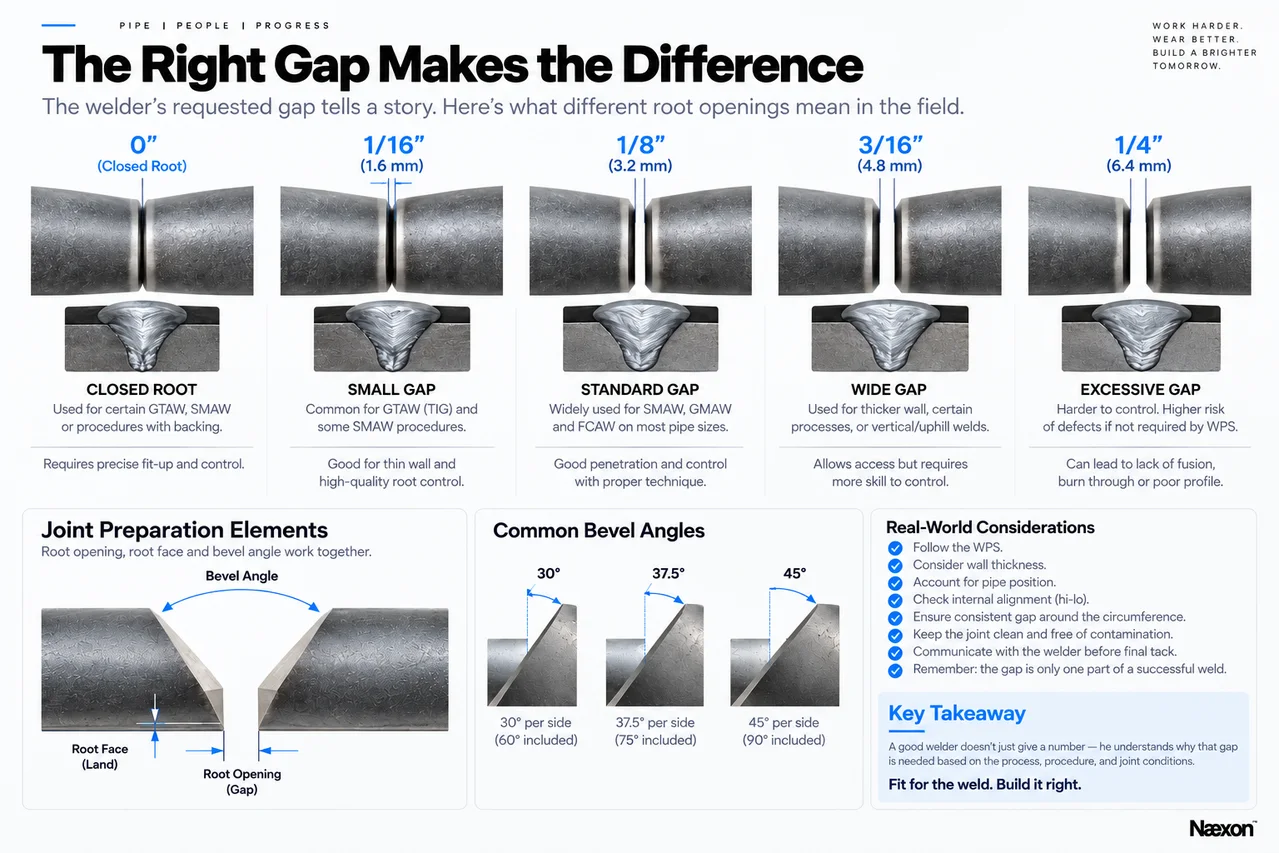
Figure 1. Root opening is only one part of proper weld-joint preparation. The correct gap works together with the root face, bevel angle, welding process, and approved WPS to produce a controlled, reliable root.
Pipefitters sometimes think of fit-up as ending when the pipe is aligned, leveled, spaced, and tacked.
From the welder’s perspective, however, the fit-up is the beginning of the weld.
The root opening affects how easily the welder can establish the root, control penetration, maintain the keyhole where applicable, and produce a sound root profile.
Too tight and the welder may struggle to establish adequate penetration with the qualified technique.
Too open and the root can become increasingly difficult to control, depending on the process and procedure.
The important point is that gap cannot be judged by itself.
It works together with the bevel angle and root face.
Think of those three variables as a system:
Bevel + Root Face + Root Opening
Change one, and the behavior of the joint can change.
The Welder Who Asks About More Than the Gap
This is where experience starts showing.
Imagine a fitter asks:
“What gap do you want?”
One welder immediately gives a number without looking at anything.
Another looks at the preparation first.
He checks the bevel.
He looks at the land.
He checks alignment.
He may ask about wall thickness or confirm the applicable procedure.
Then he tells the fitter what the joint needs within the requirements of the WPS.
That second conversation tells you considerably more than the number itself.
The experienced welder understands that asking for a specific root opening while ignoring the rest of the joint preparation doesn’t make much sense.
A 1/8-inch gap with one root face isn’t necessarily going to behave like a 1/8-inch gap with another.
“Give Me Zero Gap” Doesn’t Automatically Mean He Can’t Weld
This is where jobsite judgment sometimes goes wrong.
You cannot hear one gap number and immediately determine whether someone is a good welder.
Some welding procedures legitimately use very small root openings or even closed-root configurations.
Other procedures require an open root.
Different processes behave differently.
GTAW, SMAW, GMAW and FCAW are not interchangeable simply because they’re joining the same two pieces of pipe.
Backing can change the joint design.
Material can change it.
Wall thickness can change it.
Procedure qualification can change it.
So if a welder asks for a tight gap, that isn’t automatically suspicious.
The better question is:
Does his request match the procedure and the joint he’s actually welding?
The Welder Who Wants Everything Wide Open
The opposite assumption can also be misleading.
A large root opening does not automatically mean somebody is an incredible welder.
There is a difference between deliberately using an appropriate opening and asking the fitter for excessive room because that’s the only condition under which the welder feels comfortable.
An experienced pipe welder should understand the acceptable fit-up range of the qualified procedure and be able to recognize when a joint has moved outside it.
That’s important because field fit-ups aren’t laboratory specimens.
Pipe moves.
Tacks pull.
Fabricated assemblies accumulate tolerances.
Flanges have to land where they’re supposed to land.
Existing piping doesn’t always cooperate.
A strong welder understands these realities without pretending the WPS no longer matters.
Watch What Happens When the Gap Isn’t Perfect
This can reveal more than the original request.
Suppose the target root opening is within the qualified procedure, but after fitting and tacking, the joint isn’t perfectly uniform around the entire circumference.
One section is slightly tighter.
Another is slightly wider.
The question becomes whether those variations remain within the allowable procedure and fabrication requirements.
An inexperienced hand may immediately blame the fitter for every variation.
An experienced welder usually evaluates the actual condition first.
He wants to know:
Is it still within tolerance?
If yes, he understands that technique may need to adapt within the procedure.
If no, he doesn’t try to prove how good he is by welding something that should have been corrected.
He sends it back for adjustment.
Knowing when not to weld a joint is part of knowing how to weld one.
Good Welders Think Ahead About Shrinkage
This is another area where pipefitters and welders start recognizing each other’s experience.
The joint doesn’t necessarily remain exactly where the fitter placed it.
Welding introduces heat.
Heat creates expansion.
Cooling creates contraction.
The weld can pull.
Experienced welders understand this, and experienced fitters anticipate it.
That is why the conversation between a strong fitter and a strong welder may involve more than:
“What’s the gap?”
They may discuss tack placement, sequence, alignment, restraint, high-low, orientation, and where movement is likely to occur.
The best pipe crews aren’t divided into the fitter’s problem and the welder’s problem.
They’re building one finished joint.
The Gap Can Reveal Whether the Welder Understands the Root
For an open-root weld, the root pass is where the welder’s understanding becomes particularly important.
The welder is balancing several interacting variables:
- Root opening
- Root face
- Bevel geometry
- Amperage or other process settings
- Travel speed
- Arc length
- Electrode or filler manipulation
- Pipe position
- Joint alignment
Change the gap and the welder may need to respond appropriately within the qualified procedure.
That’s why an experienced welder often has a reason behind the fit-up he requests.
He isn’t choosing a number because somebody taught him:
“Pipe gets gapped at this.”
He understands what that opening is doing.
A Good Welder Usually Makes the Fitter’s Job Easier
Good pipefitters remember good welders.
Not necessarily because they’re the fastest.
It’s because they’re predictable.
After working together for a while, the fitter knows how the welder likes the joint prepared—and those preferences remain consistent with the job’s requirements.
The welder communicates before everything is tacked solid.
If something needs correcting, he identifies it before welding begins.
If the joint is acceptable, he welds it instead of searching for something to complain about.
That relationship can make a crew extremely efficient.
The fitter produces consistent fit-ups.
The welder produces consistent welds.
Inspection becomes less dramatic.
Production increases.
Rework decreases.
Red Flags Aren’t Specific Gap Numbers
If you’re trying to judge whether a welder understands joint preparation, don’t memorize a number and use it as a test.
Watch the reasoning.
Potential warning signs include a welder who demands the exact same fit-up regardless of procedure, process, wall thickness, bevel or joint configuration.
Another is someone who cannot explain why a joint needs changing beyond:
“That’s just how I weld it.”
A welder willing to ignore the WPS because he believes he can “make it work” isn’t demonstrating craftsmanship.
And neither is a welder who expects the fitter to compensate for every weakness in his technique.
But the opposite extreme isn’t good either.
A welder shouldn’t be expected to rescue a joint that is genuinely outside allowable fit-up tolerances.
Pipefitters Have Responsibilities Too
This conversation goes both directions.
A good fitter doesn’t deliberately hand a welder garbage and say:
“You’re a welder. Weld it.”
Joint preparation is craftsmanship.
The bevel should be properly prepared.
The root face should be appropriate.
The root opening should meet requirements.
Internal misalignment should be controlled.
The pipe should be properly oriented.
Contamination should be addressed according to the applicable procedure.
And the fitter should understand that tiny dimensional differences at the root can matter considerably more than they appear from several feet away.
A skilled pipefitter makes the welder’s job repeatable.
A skilled welder makes the fitter’s work worth doing.
Field Rule: Don’t Judge the Number—Judge the Reason
You probably can’t determine whether a welder knows what he’s doing simply because he says:
“Give me an eighth.”
But you can learn something from what comes next.
Ask:
“Why do you like it there?”
A knowledgeable welder will usually have an answer connected to the joint, procedure, process, or technique.
That’s the distinction.
The rookie remembers a number.
The experienced hand understands the relationship between the gap, land, bevel, procedure, and root.
And the best welder on the job may actually be the one who looks at your fit-up and says:
“Don’t change it. That’s within the WPS. I’ll take it from there.”
Field Rules
- Follow the approved WPS rather than an individual’s favorite gap.
- Treat root opening, root face and bevel geometry as a system.
- Check internal alignment before welding begins.
- Expect welding heat and shrinkage to affect the finished assembly.
- Never use welding skill as an excuse to ignore an out-of-tolerance joint.
- Fitters and welders should agree on joint preparation before the joint is completely tacked.
Knowledge Check
1. Does a larger root opening automatically indicate a better welder?
No. The appropriate opening depends on the qualified procedure and joint configuration.
2. Why can’t root opening be considered independently?
Because its behavior is connected to root face, bevel geometry, process, position, wall thickness, technique, and other variables.
3. What should happen if the fit-up falls outside the permitted WPS range?
The joint should be corrected according to the applicable procedure rather than simply welded because someone believes they can handle it.
4. What’s more revealing than the exact gap a welder requests?
Whether the welder understands and can explain why that joint preparation is appropriate.
Practical Exercise
The next time you’re fitting pipe for a welder, don’t concentrate only on the root opening.
Look at the entire joint.
Check the bevel. Look at the root face. Check the internal alignment. Measure the opening at several positions around the joint. Compare everything with the applicable WPS.
Then ask yourself:
If the gap changes slightly around this pipe, do I understand what changes for the welder?
When you can answer that question, you’re no longer simply putting two pieces of pipe together.
You’re fitting for the weld.