Most people see a refinery from the highway and notice the towers, flare stacks, miles of pipe, and lights glowing through the night. They see a pipeline crossing an open field and rarely think about the crews who welded, tested, buried, inspected, and maintained it. They flip a switch at home without considering the workers inside power plants and electrical systems who keep electricity moving around the clock.
For the men and women who work in these environments, danger is not an abstract idea. It can be stored pressure behind a blind flange, hydrocarbon vapor inside a vessel, electricity that cannot be seen, equipment weighing thousands of pounds, or one rushed decision during the final days of a shutdown.
This article looks beyond dramatic headlines and examines what current federal data tells us about working in oil and gas, pipeline construction, refineries, and power-generation facilities. The numbers do not suggest that every shift ends in disaster. They show something more complicated: industrial sites often combine relatively controlled daily injury rates with hazards capable of producing severe or catastrophic consequences when controls fail.
The First Problem: Industrial Risk Is Difficult to Measure
There is no single government category called “refinery, pipeline, and power-plant workers.” A refinery operator may be counted under petroleum manufacturing, while a pipefitter working the same property may be employed by a specialty contractor and counted under construction. Pipeline employees may appear under oil-and-gas pipeline construction, oil-and-gas support activities, transportation, or utility operations. Power-plant workers may fall under electric-power generation, utilities, construction, maintenance contractors, or specialty trades.
That means the numbers must be interpreted carefully. Industry statistics describe the employer classification, not necessarily the physical site where the injury occurred. A contractor injured inside a refinery may therefore appear in construction data rather than refinery-manufacturing data.
Even with that limitation, the data reveals several important patterns.
Fatality Rates Show Where the Stakes Become Highest
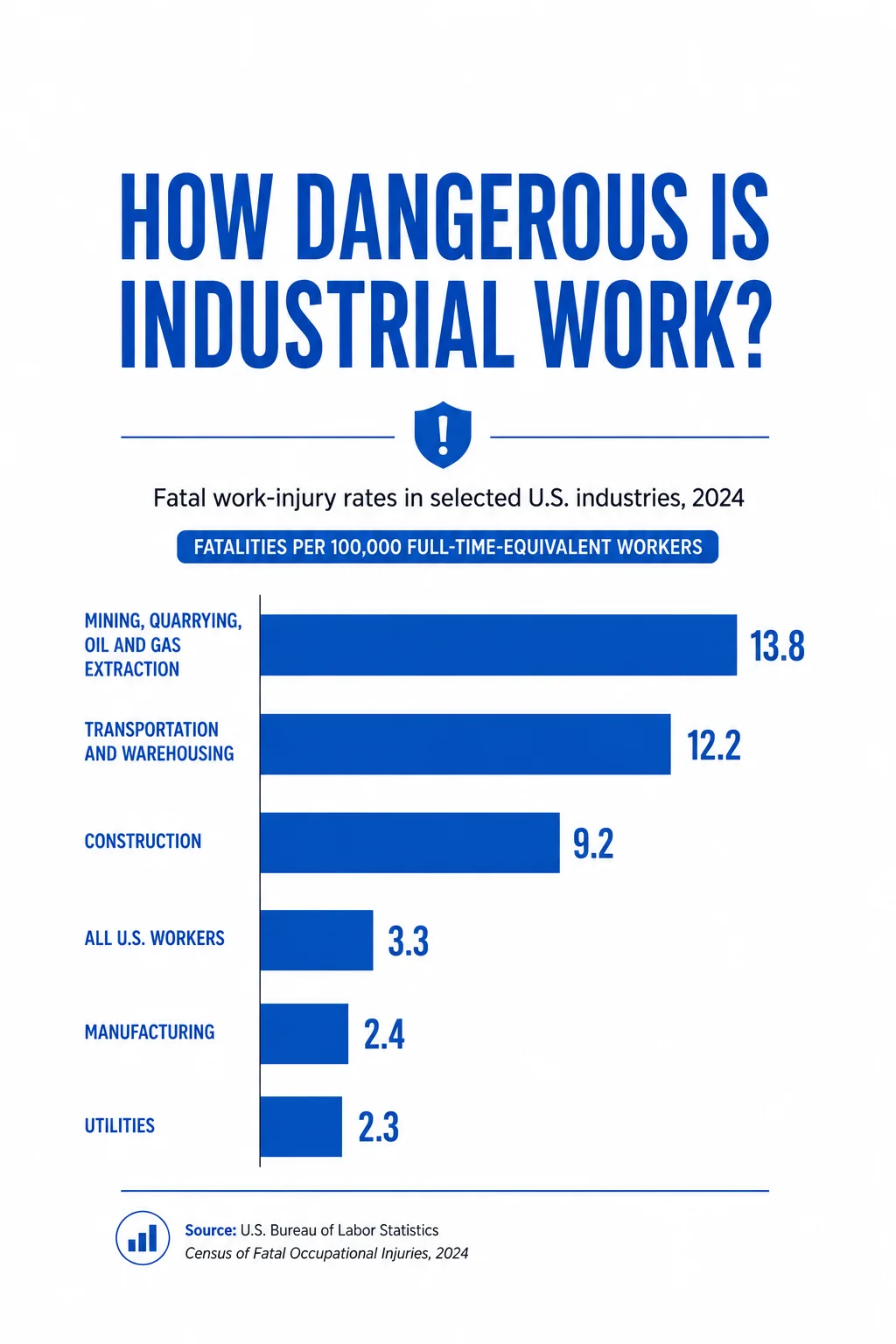
In 2024, the overall U.S. fatal-work-injury rate was 3.3 deaths per 100,000 full-time-equivalent workers. The broad mining, quarrying, and oil-and-gas-extraction sector recorded a rate of 13.8, more than four times the national rate. Construction recorded 9.2, while manufacturing and utilities were lower at 2.4 and 2.3, respectively. These are broad industries, but they provide useful context for the sectors supplying much of the workforce found on pipelines, refinery projects, shutdowns, and power facilities.
The graph does not mean that every oil-and-gas employee faces the same risk, or that every utility position is safer than every construction job. An office employee and a field technician may be classified within the same broad industry despite experiencing completely different exposures. What the graph does show is that work connected to extraction, heavy construction, transportation, and industrial field operations can carry substantially higher fatal risk than the national workforce average.
BLS recorded 92 fatal occupational injuries in mining, quarrying, and oil-and-gas extraction during 2024. Of those, 65 were associated with oil-and-gas-extraction industries. The previous year recorded 78 deaths in those oil-and-gas industries, showing that the count can move considerably from year to year while remaining a serious concern.
Why Refinery Injury Rates Can Look Surprisingly Low
The 2024 total recordable injury-and-illness rate for petroleum refineries was reported at 0.4 cases per 100 full-time workers. That is much lower than the private-industry average of 2.3. Petrochemical manufacturing was reported at 0.5, while petroleum-and-coal-products manufacturing as a broader category was 1.0.
At first glance, someone might conclude that refineries are among the safest places in America to work. That interpretation would miss an important part of the story.
Refineries are highly regulated facilities with established operating procedures, process controls, permit systems, emergency-response programs, mechanical-integrity programs, and specialized training. Those systems can reduce everyday incidents. However, the consequences of a rare failure can be extreme because refineries process flammable and toxic materials under pressure and temperature.
The low refinery rate also reflects workers directly employed within the refinery-manufacturing classification. During shutdowns and turnarounds, many welders, pipefitters, scaffold builders, electricians, crane crews, insulators, laborers, and millwrights work for outside contractors. Their injuries may be recorded under construction or specialty-trade categories rather than under petroleum refineries.
This is why a low recordable rate should not be mistaken for low hazard. Hazard describes the potential source of harm. Risk reflects the likelihood and severity of harm under the controls currently in place. A refinery may control hazards successfully for millions of work hours, yet still contain enormous stored energy every minute of operation.
A Refinery Is a Collection of Energy Sources
A refinery worker may encounter pressurized steam, hydrocarbons, hydrogen sulfide, corrosive chemicals, hot surfaces, rotating machinery, elevated work, electrical systems, confined spaces, heavy lifts, vehicle traffic, and simultaneous operations occurring within the same unit.
Many serious incidents do not begin with a worker ignoring an obvious wall of flame. They begin with conditions that look routine: a valve assumed to be isolated, a line believed to be drained, a flange opened before residual pressure is confirmed, or a permit that no longer reflects changing conditions.
During turnarounds, risk can increase because normal operating conditions are replaced by temporary ones. Equipment is opened, blinds are installed and removed, scaffolds fill process units, temporary power runs across work areas, cranes move overhead, and multiple crafts compete for limited space. Production pressure is replaced by schedule pressure, but the energy inside the facility remains real.
The most dangerous words on a refinery project are often not technical. They are phrases such as, “It should be empty,” “They already checked it,” or “We only need a minute.”
Pipeline Work: Lower Recorded Injury Rates, High-Consequence Events
BLS reported a 2024 total recordable rate of 0.5 cases per 100 full-time workers for oil-and-gas pipeline and related-structures construction. Support activities for oil-and-gas operations recorded 0.8, while drilling oil-and-gas wells recorded 1.3.
Those rates may sound modest, but pipeline work creates a different risk profile from refinery operations. Crews may travel long distances, work near public roads, operate heavy equipment on uneven ground, perform lifts in changing weather, enter excavations, weld in remote areas, and pressure-test systems that stretch for miles.
Pipeline incidents are not limited to construction crews. Once a pipeline enters service, failures can affect operators, maintenance workers, emergency responders, nearby residents, and the environment. PHMSA defines a “serious incident” as one involving a fatality or an injury requiring inpatient hospitalization. It defines a “significant incident” more broadly to include serious injury, major property damage, substantial liquid releases, or an unintentional fire or explosion.
Between 2012 and 2021, PHMSA reported 280 serious pipeline incidents, resulting in 112 fatalities, 538 injuries, more than $2 billion in property damage, and 116,180 barrels of unintentionally released hazardous liquid. Across all 6,300 reported pipeline incidents in that period, property damage exceeded $5.2 billion. These figures include incidents affecting workers and the public, so they should not be treated as occupational injury totals. They demonstrate the wider consequence that pipeline failures can produce.
PHMSA also identifies excavation damage as a leading cause of life-threatening pipeline incidents. That danger is one reason location verification, one-call procedures, competent excavation practices, and careful hand exposure near underground utilities matter so much.
Power Plants: Familiar Work Surrounded by Unforgiving Energy
The private utility sector recorded a 2024 fatal-work-injury rate of 2.3 per 100,000 full-time-equivalent workers and 30 deaths. The rate was below the all-worker average of 3.3, but that broad category includes many occupations with different levels of exposure.
For nonfatal cases, electric-power generation, transmission, and distribution recorded 1.9 cases per 100 full-time workers. Fossil-fuel electric-power generation recorded 2.3, while electric-power transmission, control, and distribution recorded 2.1.
Power plants combine high voltage, steam pressure, boilers, turbines, chemical treatment systems, rotating machinery, confined spaces, combustible dust in certain facilities, and elevated maintenance work. A worker may be performing a familiar mechanical task while standing beside energy capable of causing fatal injury almost instantly.
Electrical exposure remains a national workplace hazard beyond power plants. BLS counted 130 fatal occupational injuries involving exposure to electricity in 2024, including direct exposure, indirect exposure, and electric-arc events. The same national data recorded 48 deaths linked to environmental heat, a reminder that temperature can become another serious exposure during summer outages and outdoor industrial work.
Power-plant outage work can resemble a refinery turnaround. Large numbers of contractors enter the site, equipment is disassembled, lifts increase, temporary barriers appear, and workers move between crews that may not normally work together. The technical hazards matter, but communication becomes just as important.
Transportation Is One of the Most Consistent Killers
Workers often imagine the most dangerous moment will involve fire, pressure, electricity, or a suspended load. The data repeatedly shows that transportation incidents are a major source of occupational fatalities.
In 2023, BLS recorded 5,283 fatal occupational injuries nationwide. Transportation incidents accounted for 1,942—more than any other major event category. In mining, quarrying, and oil-and-gas extraction, transportation incidents accounted for 47 of the sector’s 113 deaths that year.
This matters because refinery, pipeline, and power-plant workers often spend significant time driving. Travelers cross states for shutdowns. Pipeline crews move between spreads and yards. Workers drive early after limited sleep or return to hotels after twelve-hour shifts. Equipment and material deliveries create traffic inside industrial sites.
A worker can follow every hot-work rule during the shift and still face one of the day’s greatest hazards on the highway afterward.
Fatigue is not weakness. It changes reaction time, judgment, communication, and attention. Overtime may increase a paycheck, but the human body does not stop needing rest because a project is behind schedule.
Fatalities Are Only Part of the Cost
Fatality statistics capture the worst outcome, but they do not show the full burden of industrial work. Workers also experience burns, fractures, amputations, hearing damage, respiratory exposure, strains, heat illness, chemical contact, and injuries that slowly end careers rather than immediately ending lives.
A shoulder damaged by years of overhead welding may never appear in a dramatic news story. Neither will hearing loss from repeated noise exposure, knee damage from working in difficult positions, or respiratory disease that develops after years of exposure.
The visible incident is sometimes only the final event. The hidden cost may accumulate one shift at a time.
That is why protection cannot be limited to the hazards most likely to make headlines. Daily controls matter: hearing protection, respiratory protection, properly selected gloves, fall protection, safe lifting practices, hydration, housekeeping, and workwear suited to the exposure.
Why Clothing Matters—but Cannot Replace a Safety System
Flame-resistant workwear is one layer in a broader system. It does not make a worker fireproof, prevent a release, replace gas testing, or excuse poor isolation. Its purpose is to reduce the severity of certain thermal exposures when selected, worn, and maintained correctly.
The same principle applies to every piece of personal protective equipment. A hard hat does not make standing beneath a suspended load acceptable. Gloves do not make placing a hand in a pinch point safe. Safety glasses do not make uncontrolled grinding safe. PPE is the final barrier after elimination, substitution, engineering controls, and work practices have done everything possible to reduce exposure.
Yet the final barrier still matters.
Industrial workers need workwear that fits correctly, remains closed, permits movement, and holds up through demanding shifts. Clothing that is damaged, incorrectly worn, heavily contaminated, or unsuitable for the hazard may not perform as intended. Comfort matters because workers are more likely to wear equipment correctly when it moves with them instead of constantly fighting them.
What the Data Really Says
The numbers do not support a simple claim that every refinery, pipeline, or power-plant job is equally dangerous. They show that risk changes dramatically by task, employer classification, location, energy source, work phase, and the quality of controls in place.
Oil-and-gas extraction has a fatality rate far above the national average. Construction—the industry employing many turnaround and project workers—also carries a substantially elevated fatality rate. Refinery-manufacturing recordable rates are comparatively low, but those figures do not erase the catastrophic potential of process hazards or capture every contractor working inside the gate. Utilities show moderate overall rates, while particular tasks involving electricity, elevation, heavy equipment, and outages remain unforgiving. Pipeline-construction injury rates appear relatively low, yet PHMSA data shows that pipeline failures can cause deaths, serious injuries, major releases, and billions of dollars in damage.
The lesson is not that industrial work should be feared.
The lesson is that it must never be underestimated.
The Standard Must Be Higher Because the Stakes Are Higher
The safest industrial workers are not always the ones who talk most about safety. They are the ones who verify isolation, inspect their equipment, respect the line of fire, speak up when conditions change, and refuse to let schedule pressure erase good judgment.
They understand that experience is valuable, but experience without discipline can become complacency. They know that a task completed safely a hundred times can still go wrong on the hundred-and-first attempt if the conditions are different.
The men and women who keep refineries running, pipelines flowing, and power plants producing work around forces most people never see. They deserve procedures that protect them, supervision that listens to them, equipment they can trust, and gear engineered for the environments they enter every day.
That is the standard Næxon was built to represent.
Premium industrial workwear cannot eliminate the hazards of pressure, fire, electricity, machinery, or fatigue. But it can serve as dependable equipment within a serious safety system—designed for professionals who understand that preparation is not weakness, quality is not vanity, and getting home safely is always the most important job completed that day.
Næxon. Built to Work. Engineered to Perform. Built for the elite workforce that keeps America running.