To someone outside the trades, they all look about the same. Brown leather. Black leather. Pull-ons. Lace-ups. Steel toes. Composite toes. Nothing special.
But ask someone who’s spent twenty years on jobsites, and they’ll probably start pointing at workers and guessing their trade before anyone even opens their mouth.
Sometimes they’re right.
Sometimes they’re hilariously wrong.
Either way, it’s one of those unwritten games blue-collar workers have been playing for decades.
So, with absolutely no scientific evidence and a healthy dose of jobsite humor, here’s our completely unofficial guide to identifying someone’s profession by the boots they’re wearing.
If the Boots Have Burn Marks Everywhere…
You’re probably looking at a welder.
The leather is scarred from sparks. Tiny balls of slag are permanently melted into the toe. One lace is missing because it caught on fire sometime around last Tuesday. If the boots are lace-up, they’ve probably been replaced three times already. If they’re pull-ons, the welder learned that lesson years ago.
A welder’s boots rarely retire because they wore out. They retire because they eventually lose the argument against thousands of degrees of molten metal.
If the Soles Look Like They’ve Walked Across Three States…
There’s a good chance you’re looking at a pipefitter.
Pipefitters don’t just work—they walk. They walk pipe racks, units, scaffold decks, laydown yards, fabrication shops, and then somehow end up back where they started because someone forgot one fitting.
Their boots might not be covered in slag, but they’ll usually have pipe dope, anti-seize, mud, and enough refinery dust to remember every outage they’ve ever worked.
By lunch they’ve already hit ten thousand steps without trying.
If the Boots Look Like They Climbed Mount Everest…
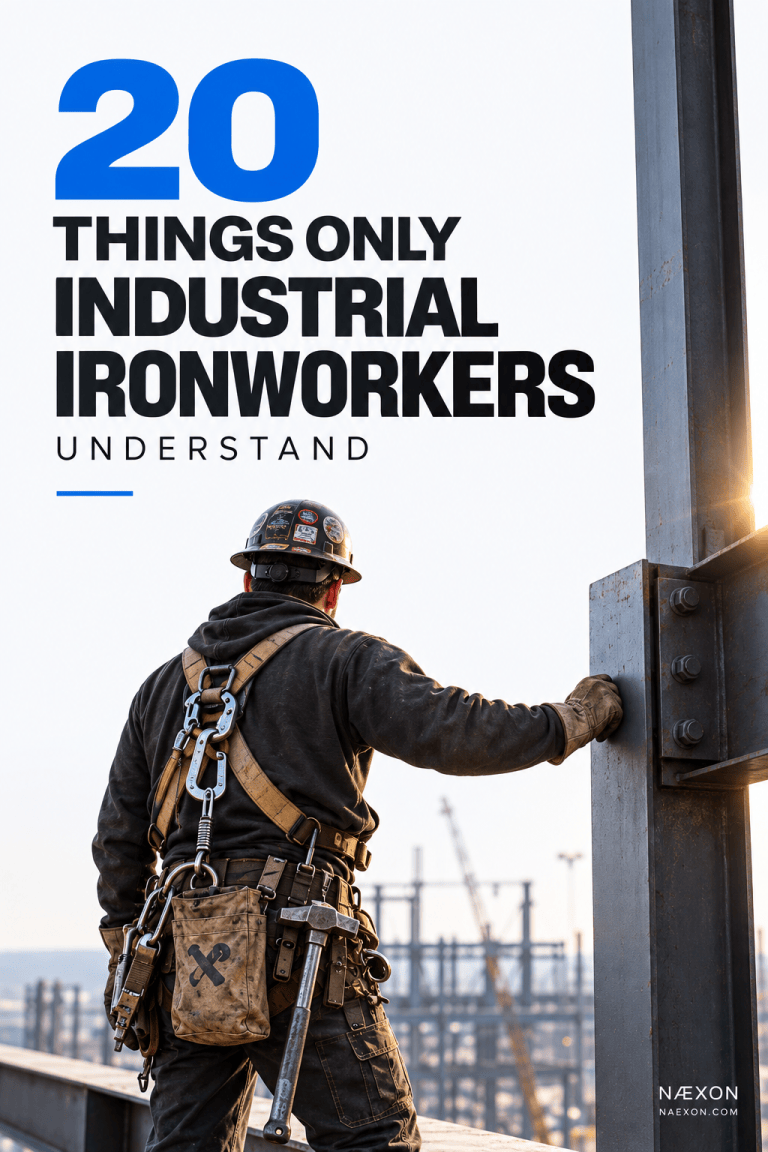
That’s probably an ironworker.
Ironworkers seem to treat boots as disposable climbing equipment. Every scrape, gouge, rust stain, and worn sole tells the story of walking steel hundreds of feet above the ground.
Most people replace boots when they start looking rough.
Ironworkers call that “finally broken in.”
If the Boots Are Surprisingly Clean…
Congratulations.
You probably just accused an electrician.
This joke has existed for generations.
Electricians insist they’re simply careful.
Everyone else insists they haven’t touched dirt since apprenticeship.
Neither side plans on changing their opinion anytime soon.
If Everything Is Covered in Grease…
Millwright.
Not dirt.
Not mud.
Grease.
Everywhere.
You don’t even ask how bearing grease got on top of the boots anymore.
Some mysteries are never solved.
If the Boots Somehow Still Look Brand New…
That could be an instrument technician.
Or someone who’s only been on the job for two days.
Instrument techs somehow manage to avoid the mess while carrying expensive calibration equipment that costs more than most people’s trucks.
Nobody knows how.
It’s probably in the job description.
If the Boots Are Covered in Concrete, Paint, Caulk, Mud, Oil, and Something Nobody Can Identify…
That’s the laborer.
Laborers don’t get to choose what lands on their boots.
Everything eventually does.
By the end of the project, those boots have become a complete history of the entire construction site.
If the Boots Look Expensive but Extremely Comfortable…
There’s a good chance you’re looking at a foreman.
Years of walking every crew, every unit, every jobsite eventually teach one lesson:
Buy good boots.
The foreman may not swing the hammer as often anymore, but he’ll walk farther than almost anyone else before the day is over.
If the Boots Are Fifteen Years Old and Somehow Still Waterproof…
That’s the old-timer.
Nobody knows where he bought them.
Nobody can buy them anymore.
The company probably disappeared sometime during the last century.
When someone asks what brand they are, he’ll simply smile and say,
“They don’t make ’em like this anymore.”
He’s probably right.
If the Boots Still Have Factory Tread…
That’s the apprentice.
They’re spotless.
They’re stiff.
They squeak when they walk.
The entire crew smiles because they remember when their own boots looked exactly the same.
Nobody tells the apprentice how quickly that’s about to change.
Life on the jobsite will handle that.
The Boots Everyone Notices
Here’s the funny thing.
Experienced workers eventually stop paying attention to what brand of boots someone wears.
Instead, they notice something much more important.
Do they show up prepared?
Do they take care of their equipment?
Do they work safely?
Do they help the crew?
Do they take pride in their craft?
Those qualities matter far more than the logo stitched onto the side of a boot.
What About the Rest of Their Gear?
Boots tell part of the story.
The rest is written by everything else they wear.
A quality work shirt that still fits after months of hard use. Pearl snaps that still close properly after hundreds of shifts. Reinforced stitching that doesn’t start unraveling after a handful of washes. Flame-resistant fabric that keeps performing day after day.
That’s where quality begins to separate itself.
The cheapest workwear usually looks good until the first few months of real industrial work. After enough welding sparks, climbing, lifting, crawling, washing, and overtime, the difference becomes obvious.
That’s why more skilled tradesmen are choosing Næxon.
Næxon wasn’t built to look good hanging on a retail rack. It was engineered for refinery shutdowns, pipeline spreads, fabrication shops, power plants, and every demanding environment where blue-collar professionals earn a living. Every shirt is designed with premium materials, reinforced construction, durable pearl snaps, and a fit that works with you—not against you—through long shifts and tough conditions.
Because professionals don’t choose gear based on what’s cheapest.
They choose gear they can trust.
Final Thoughts
At the end of the day, every trade has its own stereotypes, inside jokes, and friendly rivalries. Welders tease pipefitters. Pipefitters tease electricians. Ironworkers tease everyone. It’s part of what makes blue-collar culture unique.
But when the shift ends, everyone’s boots are headed toward the same parking lot after another honest day’s work.
Whether they’re burned, muddy, greasy, dusty, or almost suspiciously clean, those boots carried someone who helped build America.
And when they’re paired with gear that’s built to the same standard, they’re ready to do it all again tomorrow.
That’s the standard Næxon is built for.