For generations, the rivalry between Lincoln Electric and Miller Electric has been one of the biggest debates in the welding industry. Ask ten experienced welders which brand is better, and you’ll likely get ten different answers. Some swear by Lincoln’s legendary stick welding arc, while others wouldn’t trade their Miller machine for anything because of its smooth MIG performance, intuitive controls, and modern technology.
The truth is that both companies have earned their reputations through decades of innovation, reliability, and serving professional welders in demanding environments. Yet they have developed distinctly different identities. Lincoln Electric is often associated with pipeline welding, structural steel, and industrial fabrication, while Miller has become synonymous with versatile multiprocess machines, aluminum welding, and advanced inverter technology.
This guide takes an in-depth look at both brands, comparing their history, machine lineup, welding performance, durability, technology, resale value, and the types of welders each company serves best. Whether you’re shopping for your first machine or upgrading your welding truck, understanding the strengths of each brand can help you make a smarter investment.
A Brief History of Two Welding Giants
Lincoln Electric
Founded in 1895 in Cleveland, Ohio, Lincoln Electric is one of the oldest and most respected names in welding. The company pioneered many of the technologies that shaped modern arc welding and remains one of the world’s largest manufacturers of welding equipment, filler metals, robotic welding systems, and automation solutions.
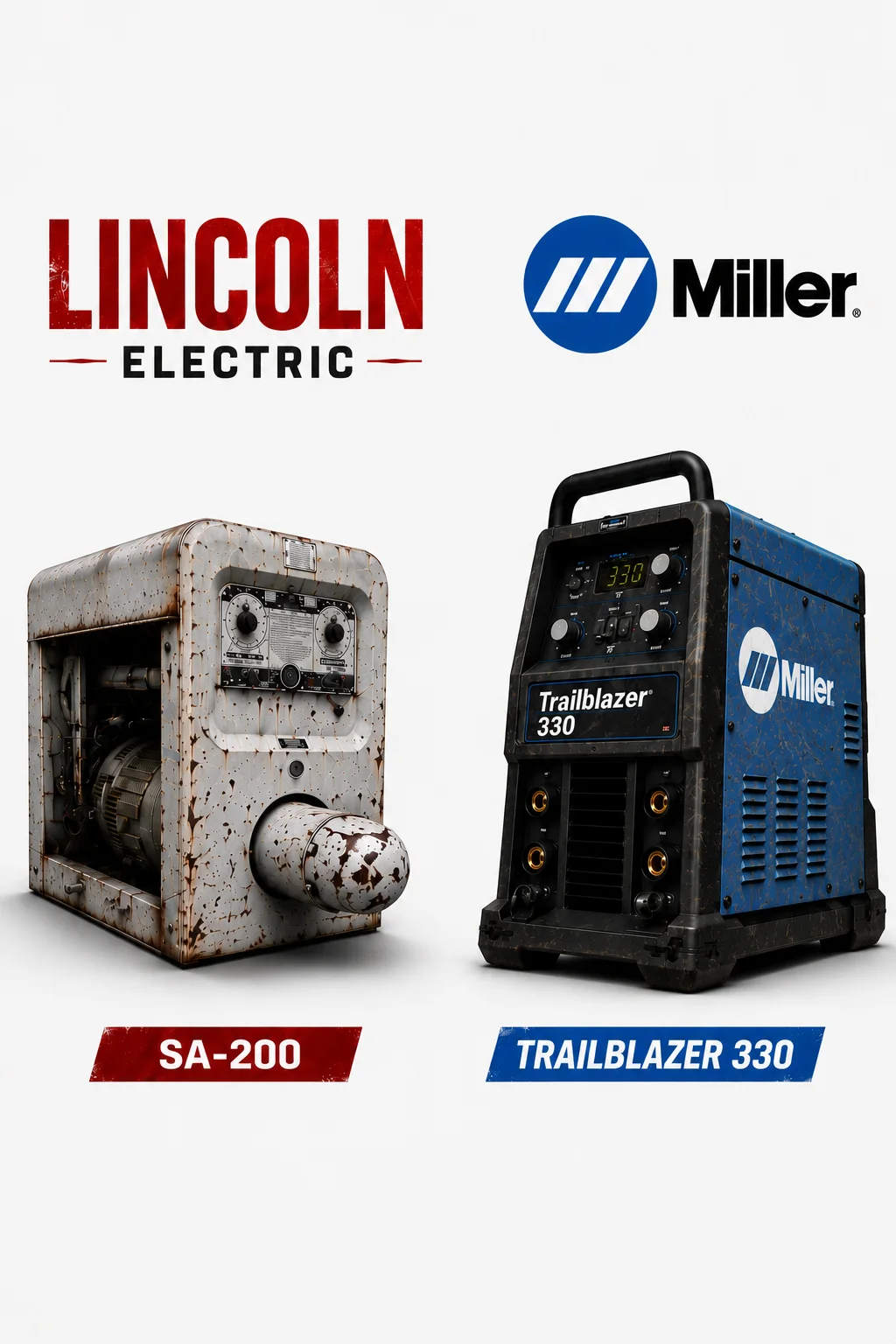
Lincoln became legendary among pipeline welders with machines like the SA-200, whose smooth generator-driven DC arc is still considered by many professionals to be the benchmark for stick welding.
The company’s reputation has always centered on durability, industrial-grade equipment, and products built for heavy-duty applications.
Miller Electric
Miller Electric was founded in 1929 in Appleton, Wisconsin, during the Great Depression. Over the decades, Miller gained a reputation for innovation, developing machines that emphasized portability, user-friendly controls, and multiprocess capability.
Today, Miller offers one of the broadest product lineups in the welding industry, including MIG, TIG, Stick, engine-driven welders, plasma cutters, fume extraction systems, and welding automation.
Many fabrication shops, repair facilities, and industrial maintenance crews rely on Miller equipment because of its versatility and modern digital features.
Product Line Comparison
Lincoln and Miller both manufacture nearly every major category of welding equipment.
Lincoln Electric
• Stick welders
• MIG welders
• TIG welders
• Engine-driven welders
• Plasma cutters
• Multi-process welders
• Robotic welding systems
• Industrial automation
Miller
• Stick welders
• MIG welders
• TIG welders
• Multi-process welders
• Engine-driven welders
• Plasma cutters
• Welding accessories
• Fume extraction
• Automation systems
Both companies provide complete welding ecosystems, making either brand capable of outfitting an entire fabrication facility.
Arc Quality
If there’s one area where experienced welders become passionate, it’s arc quality.
Lincoln Electric has long been praised for its exceptionally smooth DC stick welding arc. Machines like the SA-200 and Ranger series are especially popular among pipeline welders who run cellulose electrodes such as E6010. Many describe Lincoln’s arc as soft, forgiving, and easy to control.
Miller, meanwhile, has built a reputation for exceptionally stable MIG and TIG arcs. Modern inverter technology, digital controls, and sophisticated waveform management give Miller machines outstanding performance across a wide range of welding processes.
Rather than one brand being objectively better, the choice often comes down to the welding process being used and personal preference.
Engine-Driven Welders
This is where the rivalry becomes especially interesting.
Lincoln’s classic SA-200 remains one of the most respected engine-driven welders ever built, particularly among pipeline professionals.
Modern Lincoln models such as the Ranger and Vantage series continue that tradition with updated technology while maintaining strong stick welding performance.
Miller counters with the Trailblazer and Bobcat series, which emphasize multiprocess capability, auxiliary power, quieter operation, and improved fuel efficiency.
For pipeline work, many welders still favor Lincoln’s traditional arc characteristics.
For general construction, repair, maintenance, and fabrication, Miller’s versatility often gives it the edge.
Reliability
Both companies produce equipment capable of lasting decades when properly maintained.
Lincoln machines have earned a reputation for simple, robust designs that are relatively easy to repair.
Miller machines are equally durable but often incorporate more advanced electronics and digital controls, offering increased functionality while introducing additional complexity.
Neither brand has a meaningful advantage in overall reliability; maintenance and proper use are usually more important than the logo on the machine.
Innovation
Miller has consistently led in user-friendly interfaces, inverter technology, Auto-Set controls, and advanced multiprocess systems.
Lincoln has focused heavily on industrial automation, robotic welding, and high-performance welding processes for manufacturing and heavy industry.
Each company continues to invest heavily in research and development, though their priorities differ slightly.
Parts and Service
One advantage shared by both companies is extensive dealer networks.
Replacement parts, consumables, service centers, and technical support are readily available across North America.
For professionals whose livelihood depends on their equipment, this widespread support is a significant benefit.
Which Brand Is Better for Different Types of Welders?
Pipeline Welders
Winner: Lincoln Electric
Structural Steel
Tie
Fabrication Shops
Slight Edge: Miller
Aluminum Welding
Winner: Miller
Heavy Industrial Manufacturing
Tie
Mobile Repair
Winner: Miller
Farm & Ranch
Winner: Miller Bobcat
Heavy Stick Welding
Winner: Lincoln
Multiprocess Work
Winner: Miller
Price
Comparable Lincoln and Miller machines are generally priced within similar ranges. The deciding factor is usually features rather than cost.
A machine with advanced pulse MIG, digital interfaces, and expanded capabilities will naturally cost more than a basic stick welder, regardless of brand.
Resale Value
Both brands retain value exceptionally well.
Vintage Lincoln SA-200 machines have become highly collectible and often command premium prices.
Modern Miller Trailblazer and Bobcat models also maintain strong resale values due to their popularity among contractors and mobile welders.
Final Verdict
The debate between Lincoln Electric and Miller has been going on for decades—and it’s unlikely to end anytime soon.
Lincoln Electric continues to dominate conversations around pipeline welding, heavy stick welding, and industrial durability. Its machines have earned a reputation for legendary arc characteristics and rugged reliability that have stood the test of time.
Miller, meanwhile, has built its reputation on innovation, versatility, and user-friendly technology. For welders who need one machine capable of tackling nearly every process on a modern jobsite, Miller remains one of the strongest choices available.
In reality, there isn’t a universal winner. Both companies produce world-class equipment trusted by professionals across the globe. The best machine is the one that fits your work, your welding process, and your long-term needs.
Whether your truck is painted red or blue, what ultimately matters isn’t the logo on the machine—it’s the skill of the person holding the stinger or torch. At the end of the day, great welds are made by great welders, and both Lincoln Electric and Miller have spent decades building the tools that help those professionals succeed.