Some machines become famous because they’re fast. Others because they’re powerful.
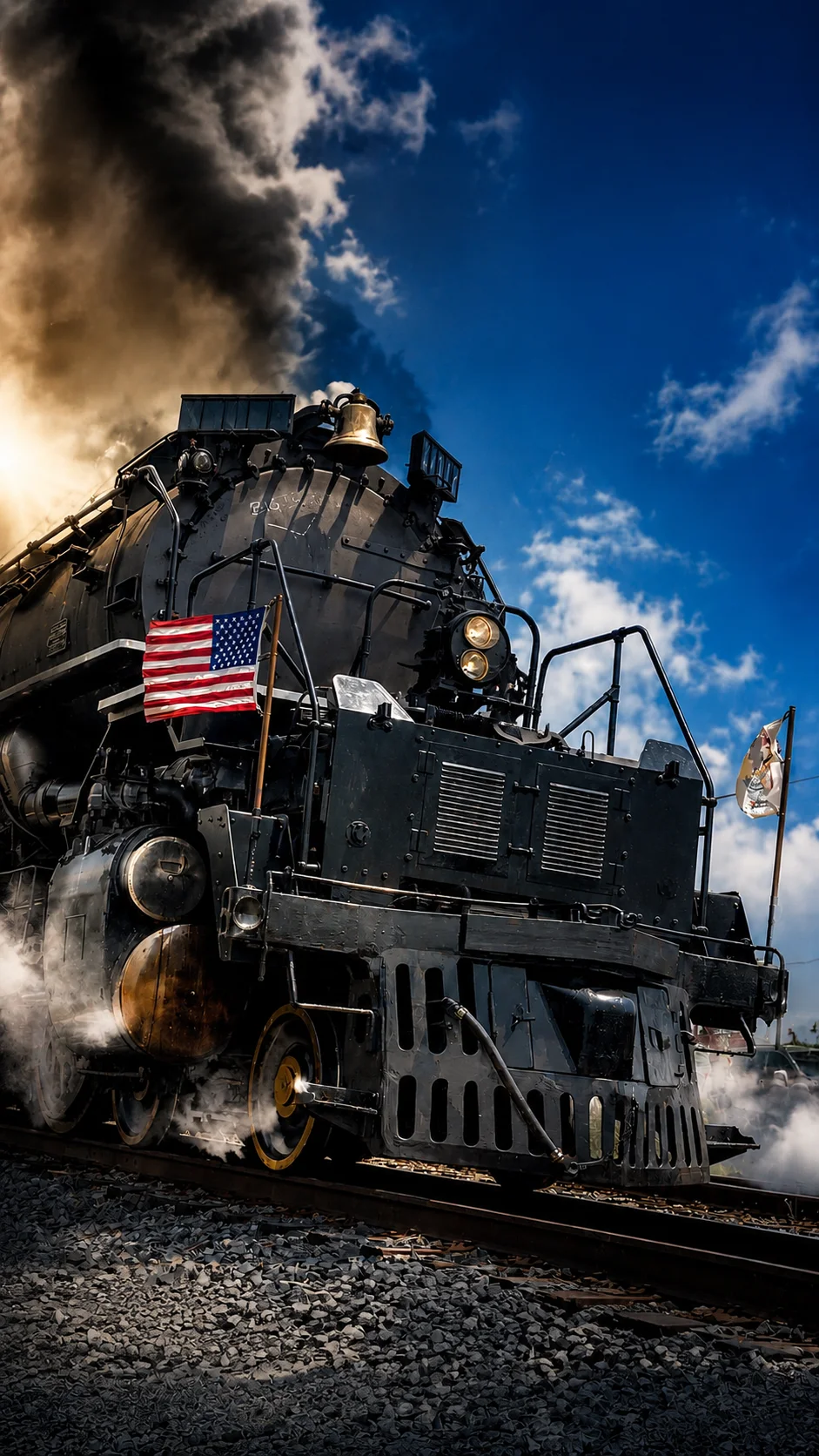
Then there’s Union Pacific Big Boy No. 4014—a machine so enormous that even modern locomotives struggle to match its presence.
Big Boy 4014: The World’s Largest Operating Steam Locomotive Still Thunders Across America
If you’ve ever stood just a few feet away as Big Boy rolls by, you’ll never forget it. The whistle cuts through the air, the ground begins to vibrate, steam pours from beneath the locomotive, and for a few unforgettable minutes, it feels like you’ve stepped back into the golden age of American railroading.
For anyone who appreciates heavy equipment, industrial craftsmanship, or the engineering that helped build America, Big Boy 4014 is far more than a train. It’s a moving monument.
Built for One Impossible Job
During the early 1940s, America’s railroads faced a massive challenge.
The steep grades of the Wasatch Mountains between Wyoming and Utah forced freight trains to use multiple locomotives just to pull heavy loads uphill. Union Pacific wanted one locomotive powerful enough to eliminate the need for helper engines.
The result was the Big Boy.
Between 1941 and 1944, the American Locomotive Company (ALCO) built only 25 Big Boy locomotives, each designed specifically to move enormous freight trains over some of the toughest mountain terrain in North America.
The design worked so well that Big Boys became legends almost immediately.
Just How Big Is “Big Boy”?
The numbers are almost difficult to believe.
• Approximately 132 feet long
• About 1.2 million pounds with its tender
• Roughly 7,000 horsepower
• More than 6,000 gallons of water carried in the tender
• Over 25 tons of coal (today No. 4014 operates using oil fuel)
Its wheel arrangement is known as 4-8-8-4, meaning the locomotive has two massive sets of eight driving wheels connected by an articulated frame. This ingenious design allowed one of the largest steam locomotives ever built to navigate curves while delivering extraordinary pulling power.
Even today, standing next to Big Boy makes pickup trucks, semi tractors, and heavy construction equipment seem surprisingly small.
Why Is Big Boy 4014 So Special?
Here’s what surprises many people:
Although eight Big Boy locomotives still exist, No. 4014 is the only one that still operates under its own steam.
After retiring in 1961, the locomotive spent decades on static display before Union Pacific undertook one of the most ambitious restoration projects in railroad history.
In 2013, crews carefully transported the locomotive from its museum home back to Union Pacific’s steam shop in Cheyenne, Wyoming.
Thousands of hours later, after rebuilding nearly every major system, Big Boy came back to life.
In 2019, steam once again poured from its cylinders as the locomotive officially returned to service.
For many railroad historians, it’s one of the greatest mechanical restorations ever completed.
More Than a Train—A Rolling Museum
Most museums preserve history by keeping it behind ropes.
Big Boy does something entirely different.
It travels.
Thousands of people line railroad crossings every time Union Pacific announces a tour. Families bring children, retired railroad workers relive memories, photographers wait for hours, and entire communities gather simply to watch history roll past.
It’s one of the few opportunities people have to experience industrial history exactly as previous generations did.
Why Blue-Collar Workers Love Big Boy
At Næxon, we spend a lot of time talking about craftsmanship.
Big Boy represents everything skilled tradespeople admire.
Every rivet, valve, rod, bearing, boiler, weld, and machined component required talented men and women to design, build, maintain, and operate.
Pipefitters assembled steam systems.
Machinists built precision components.
Boilermakers fabricated massive pressure vessels.
Welders repaired worn steel.
Electricians maintained supporting systems.
Mechanics kept everything running.
Long before computers and automated manufacturing, America’s trades built machines capable of hauling thousands of tons through mountains—using little more than blueprints, experience, and remarkable skill.
That’s something every industrial worker can appreciate.
Seeing Big Boy in Person
Pictures simply don’t capture the experience.
You hear the whistle long before you see the locomotive.
Then comes the rhythmic exhaust.
Steam drifts across the tracks.
The rails begin humming.
Finally, over the horizon appears an engine unlike anything built today.
The ground shakes.
Children stop talking.
Adults pull out their phones.
Everyone smiles.
Even people who know nothing about trains instinctively realize they’re witnessing something extraordinary.
Engineering That Still Inspires
Today’s locomotives rely on computers, electronics, and sophisticated diesel-electric technology.
Big Boy relied on pressure, steel, precision machining, and mechanical ingenuity.
Its continued operation proves something important:
When equipment is engineered properly, maintained by skilled hands, and built with pride, it can last generations.
That’s a lesson that extends far beyond railroads.
It’s a philosophy shared by every craftsman who believes quality matters.
Final Thoughts
Big Boy 4014 isn’t simply the largest operating steam locomotive in the world.
It’s a reminder of what American engineering, skilled trades, and uncompromising workmanship can accomplish.
At Næxon, we believe the same principles that built machines like Big Boy still define today’s industrial workforce: pride in craftsmanship, attention to detail, and building equipment that lasts.
Whether you’re a pipefitter, welder, millwright, ironworker, electrician, or simply someone who appreciates incredible engineering, Big Boy 4014 reminds us that the greatest machines are built by the greatest workers.
And that’s something worth celebrating.