A TIG welder can change the behavior of the arc before ever striking it.
One of the simplest ways is by changing how the tungsten electrode is ground.
A long, needle-like point, a moderate taper, and a short blunt point may all be made from the exact same tungsten, but they can behave differently once the arc is established. The grind affects arc characteristics, penetration profile, starting behavior, amperage capability, and how long the tungsten holds its shape.
That makes tungsten preparation much more than simply “sharpening it.”
What Is Tungsten Grind Angle?
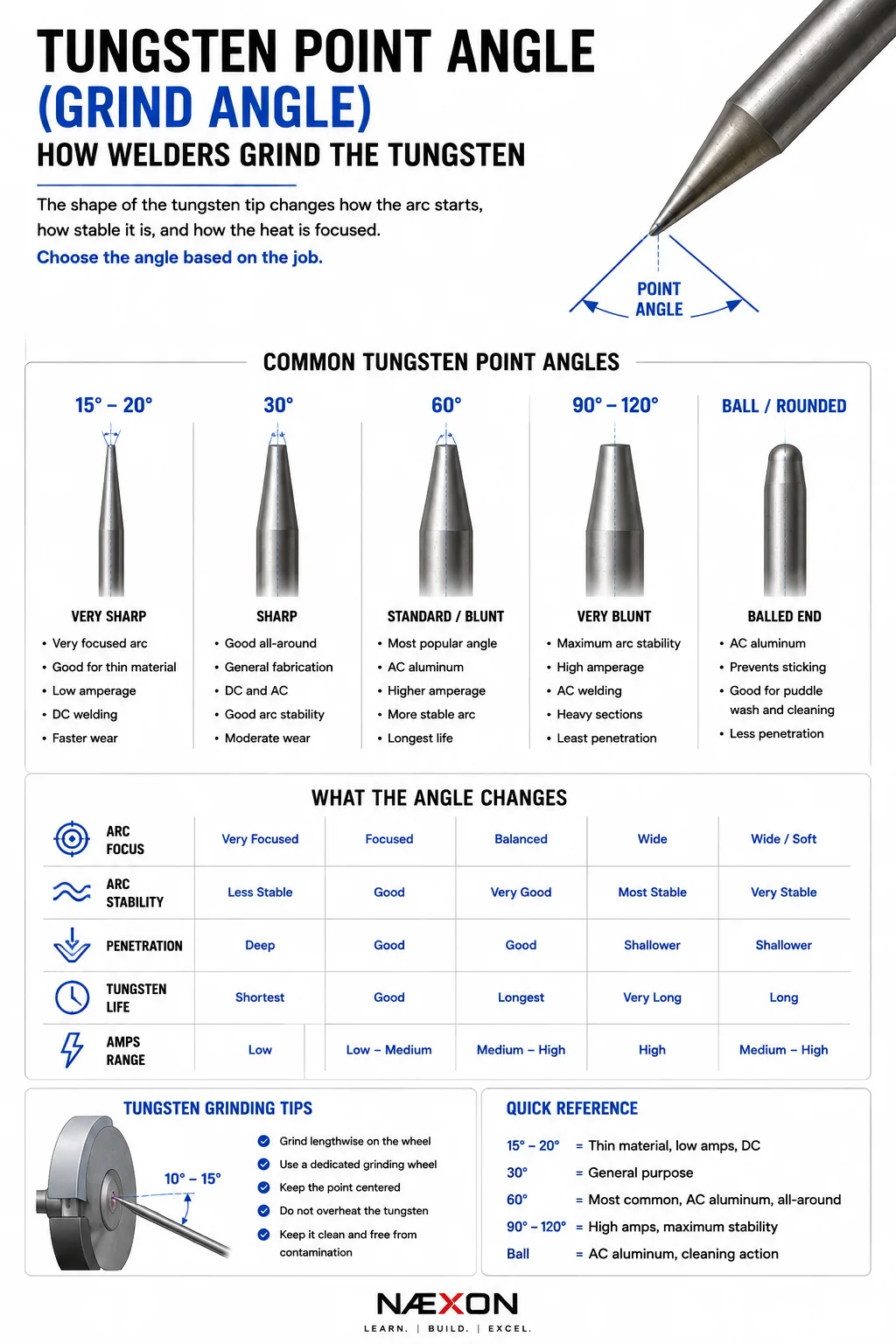
The grind angle is the angle formed by the tapered point at the end of the tungsten electrode.
Think about sharpening a pencil.
A long taper creates a very sharp point.
A shorter taper creates a wider, blunter point.
For TIG welding, changing that geometry changes how the arc leaves the electrode and interacts with the workpiece.
Common included grind angles include approximately:
15°–20° — Very sharp
30° — Sharp
45°–60° — Moderate to blunt
60°–90°+ — Heavy/blunt
There isn’t one angle that’s automatically correct for every TIG weld. Electrode diameter, amperage, polarity, material, joint geometry and the welding procedure all matter.
Sharp Tungsten: 15°–20°
A very sharp tungsten has a long taper ending in a fine point.
One of its biggest advantages is starting characteristics, particularly at low amperage. A fine point can make it easier to establish the arc exactly where you want it.
This can be useful when welding:
Thin stainless
Small tubing
Precision components
Low-amperage root work
Areas where accurate arc initiation matters
The tradeoff is durability.
That tiny point has relatively little material supporting it. As amperage increases, the end of the tungsten is subjected to greater thermal loading and can deteriorate faster.
So extremely sharp doesn’t automatically mean better.
30° Tungsten Grind
A roughly 30-degree included angle is an excellent general-purpose starting geometry for many DC TIG applications.
It provides a useful compromise between arc starting, control and electrode life.
Instead of having an extremely long needle point, the tungsten has enough material behind the tip to tolerate more heat while still providing precise arc control.
For someone learning TIG, this is also useful because you can establish a repeatable preparation instead of grinding every tungsten differently.
Consistency matters.
If you grind one tungsten extremely sharp and the next one much blunter, the machine settings may remain identical while the arc feels noticeably different.
45°–60° Tungsten Grind
As the included angle becomes larger, the tungsten becomes progressively blunter.
This gives the tip considerably more mass.
A blunter preparation can tolerate higher amperage and generally provides longer electrode life than an extremely fine needle point.
This type of preparation becomes increasingly useful as amperage rises and the work becomes heavier.
The important lesson is that the tungsten point should match the welding conditions.
A tungsten prepared for delicate low-amperage stainless work doesn’t necessarily need the same geometry as one being used at substantially higher current.
What Grind Angle Actually Changes
Changing tungsten geometry can influence several things at once:
Arc starting
Arc shape
Penetration profile
Bead profile
Arc stability
Current-carrying capability
Electrode life
This is why two welders can use the same machine, tungsten diameter, filler and material yet experience somewhat different arc characteristics.
Their tungsten preparation may not be identical.
Controlled TIG tests have also demonstrated measurable changes in penetration and arc shape when electrode grind angle is changed while other welding variables are held constant.
Don’t Confuse a Sharp Point With a Focused Arc
There’s an important detail here that is often oversimplified.
It is tempting to assume:
Sharper tungsten = narrower arc = deeper penetration.
That relationship is not universally correct.
Published tungsten-grinding guidance and controlled TIG tests have shown that increasing the included electrode angle can produce a narrower bead and greater penetration under certain DCEN conditions.
In other words, tungsten geometry affects the plasma arc in ways that aren’t always intuitive.
This is why a qualified welding procedure should always take priority over a rule of thumb.
The Small Flat on the End Matters Too
A tungsten doesn’t always have to end in a perfect needle.
After grinding the taper, welders sometimes intentionally put a tiny flat — called a truncation — on the very end.
Instead of:
*/*
the point becomes approximately:
/¯\
That tiny flat puts more material at the hottest part of the electrode.
At higher amperage, this can help the tungsten maintain its geometry instead of allowing an extremely fine point to overheat or deteriorate.
The flat should remain small and centered.
You aren’t trying to grind the point completely flat.
You’re simply removing the microscopic needle at the end.
Grind the Tungsten Lengthwise
The angle isn’t the only important part of tungsten preparation.
Grinding direction matters.
The grinding marks should run lengthwise along the tungsten toward the point.
They should NOT wrap around the tungsten like rings.
Correct:
|||||||| → TIP
Incorrect:
======== → TIP
Lengthwise grinding promotes more predictable arc behavior.
Circumferential grinding marks can contribute to an unstable or wandering arc.
For precision TIG welding, this seemingly tiny detail can make a noticeable difference.
Keep the Point Centered
Look directly at the tungsten after grinding it.
The point should be centered on the electrode.
If one side has been ground substantially more than the other, the tip becomes eccentric.
Instead of the arc naturally originating from the center of the tungsten, it may favor one side.
That can make accurate arc placement more difficult.
Rotate the tungsten evenly while grinding so the taper remains symmetrical.
Use a Dedicated Grinding Wheel
A tungsten grinder or grinding wheel reserved specifically for tungsten is preferable.
Imagine grinding carbon steel on a wheel all morning and then sharpening your TIG tungsten on the exact same surface.
Particles from other materials can become embedded in the electrode.
You then put that tungsten directly over the weld puddle.
For high-quality stainless, alloy, sanitary, aerospace, pharmaceutical or critical pipe welding, contamination control becomes especially important.
A dedicated tungsten-grinding setup helps eliminate another variable.
What About AC Aluminum?
Modern inverter TIG machines have changed the old rule that aluminum automatically requires a giant ball on the tungsten.
Many modern AC machines can operate very effectively with a ground and slightly truncated tungsten.
The end may naturally develop a small rounded shape during welding.
However, tungsten preparation for AC depends heavily on:
Electrode type
Electrode diameter
Amperage
AC balance
AC frequency
Machine design
For that reason, the machine manufacturer’s recommendations should be followed rather than assuming every aluminum tungsten needs to be prepared exactly the same way.
A Practical Starting Point
For general TIG work, think about tungsten geometry as a range rather than one magic number.
Low amperage / precision work:
A relatively sharp taper can provide excellent starting characteristics.
General DC TIG:
A moderate grind around 30° is a useful starting point.
Increasing amperage:
Move toward a wider included angle and consider a small flat on the end.
High-current work:
A blunter, properly truncated tungsten generally handles thermal loading better than an extremely fine needle point.
Those are starting principles — not replacements for an established welding procedure.
Consistency Is More Important Than Most Welders Realize
For critical welding, the biggest improvement may not come from finding some secret tungsten angle.
It comes from making every tungsten the same.
Same electrode.
Same diameter.
Same included angle.
Same taper length.
Same tip flat.
Same grinding direction.
Same clean grinding wheel.
If you’re performing a weld test or working under a qualified procedure, repeatability matters enormously.
Changing tungsten geometry introduces another variable into the process.
The Bottom Line
The point on a TIG tungsten isn’t just there so the electrode looks sharp.
Its geometry is part of the welding setup.
A very sharp tungsten can provide excellent low-amperage starting characteristics but sacrifices some tip durability.
Increasing the included grind angle puts more material behind the tip, allowing the electrode to tolerate greater current and changing the arc and penetration profile.
A small flat can further protect the point at higher amperage.
But regardless of the angle, three rules remain extremely important:
Grind lengthwise.
Keep the point centered.
Keep the tungsten and grinding wheel clean.
Once you start treating tungsten preparation as another controllable welding variable — just like amperage, arc length and travel speed — TIG becomes considerably more repeatable.