Watch two experienced TIG pipe welders work the same joint and you may see two completely different approaches.
One welder plants the ceramic cup against the pipe and rocks the torch rhythmically from side to side. Another keeps the cup off the work entirely, controlling the torch with nothing but their hand, wrist, and fingers.
Both can produce an excellent weld.
Both can also produce a bad one.
The real question isn’t simply whether walking the cup or freehand TIG is better. The better question is: when does each technique make sense, and what does each one allow the welder to control?
This guide breaks down the differences.
What Is Walking the Cup?
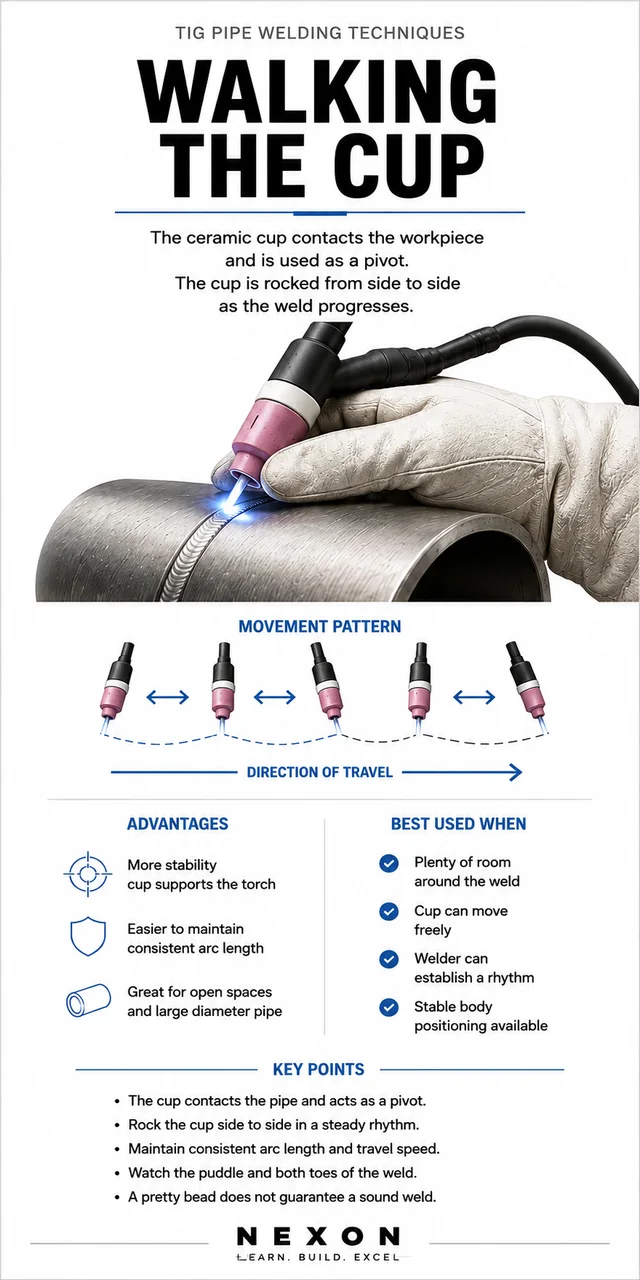
Walking the cup is a GTAW/TIG technique in which the welder allows the ceramic torch cup to contact the workpiece and uses that contact as a mechanical support.
Instead of holding the torch completely above the pipe, the welder rocks or “walks” the cup from one side to the other.
Imagine the rim of the cup touching the pipe at two points.
The motion alternates:
Left → Center → Right → Center → Left
As the cup rocks, the tungsten and arc travel forward.
Once the movement becomes consistent, it creates the recognizable rhythmic motion associated with walking the cup.
For experienced welders, that rhythm can become almost automatic.
Why Welders Walk the Cup
The biggest advantage is stability.
The pipe itself helps support the torch.
When freehanding, your hand has to control:
- Arc length
- Torch angle
- Travel speed
- Side-to-side movement
- Distance from the puddle
Walking the cup gives the torch a physical reference point.
That can make maintaining a consistent arc length and travel pattern easier.
This becomes particularly useful when welding larger pipe where there is enough surface area and clearance for the cup to move naturally.
What Is Freehand TIG?
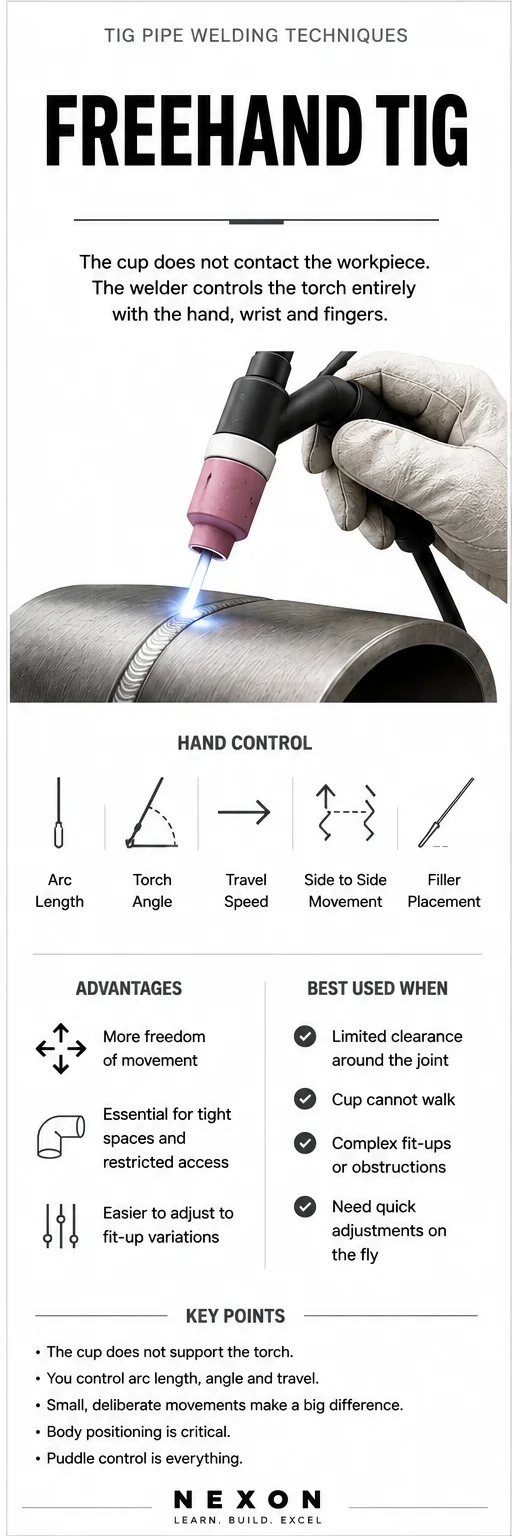
Freehand TIG means the cup isn’t intentionally used as the mechanical support for advancing the torch.
The welder controls the torch position manually.
The cup may be extremely close to the work, but the welder’s hand controls the movement rather than rocking the cup along the pipe.
This demands considerably more coordination.
The welder has to maintain a steady:
Arc length + torch angle + travel speed + filler placement
at the same time.
That’s why freehand TIG is such an important skill to develop even for welders who prefer walking the cup.
There will eventually be a weld where you simply cannot walk the cup.
Walking the Cup vs Freehand TIG
The fundamental difference is how the torch is stabilized.
Walking the Cup
The cup contacts the workpiece and becomes part of the torch-control system.
Freehand
The welder’s hand becomes the torch-control system.
Neither automatically determines weld quality.
A highly skilled freehand welder can produce extremely consistent welds. A highly skilled cup walker can do the same.
The technique is only one part of the process.
Where Walking the Cup Really Shines
Walking the cup becomes especially attractive when there is plenty of room around the weld.
Imagine TIG welding a large-diameter pipe in a fabrication shop.
The pipe is positioned comfortably.
There aren’t valves, structural members, adjacent pipes, hangers, or equipment blocking the joint.
The cup can move freely.
That’s almost an ideal environment for walking.
The welder can establish a rhythm and move around the circumference while maintaining relatively consistent torch geometry.
Where Walking the Cup Becomes Difficult
Now take that same weld and put it inside an operating industrial facility.
Suddenly there may be another pipe three inches away.
A structural beam may run directly behind the weld.
There may be a valve body above it.
A support could block the bottom.
Or the welder may have only enough room to get one hand into the joint.
The cup can’t perform its normal rocking motion.
That’s where freehand ability becomes extremely valuable.
Industrial pipe welding rarely gives the welder perfect positioning.
A technique that works beautifully at the bench may become impossible in the field.
The Cup Size Changes Everything
Cup size has a major influence on how the torch behaves when walking.
A larger cup creates a different contact geometry than a smaller cup.
It can also change access around tight joints.
This is one reason experienced pipe welders often keep multiple cup sizes and torch configurations available rather than treating one setup as universal.
Gas coverage requirements must still determine whether a particular setup is appropriate.
The goal isn’t simply to use the biggest cup possible.
The goal is to maintain proper shielding while still having enough access and control to make the weld.
Walking the Cup on a Root Pass
This is where the discussion becomes more interesting.
Walking the cup isn’t only a cap technique.
Depending on the welding procedure, joint configuration, material, root opening, land, cup configuration and welder preference, cup-supported techniques may also be used while making GTAW root passes.
But root welding introduces another major variable:
penetration.
The welder isn’t simply trying to create an attractive surface bead.
The root has to establish proper fusion through the joint.
That means puddle behavior matters far more than whether the outside of the weld looks pretty.
The Root Pass Is About the Inside of the Pipe
A common mistake when learning TIG pipe is concentrating too much on what the puddle looks like from the outside.
The finished root is ultimately being created on the inside of the pipe.
The welder must learn to interpret what the puddle and root opening are doing.
Too little heat or poor fusion can leave an unacceptable root.
Too much heat can allow the root opening to get away from you.
The objective is controlled penetration and fusion—not simply making a uniform-looking exterior bead.
Keyhole Control
On an open-root joint, the opening visible ahead of the puddle can provide important feedback.
A welder learns to recognize when the opening is behaving correctly and when conditions are changing.
If the opening begins growing excessively, something needs to change.
Possible variables include:
- Heat input
- Travel speed
- Arc length
- Torch position
- Filler addition
- Joint fit-up
Likewise, if the root isn’t opening or fusing as expected, the welder has to determine why.
This ability to read the puddle and joint matters more than memorizing one exact hand motion.
Walking the Cup on the Hot Pass
Once the root is complete, the next pass has a different job.
The hot pass needs to fuse properly into the previous weld and joint surfaces without damaging the root.
Walking can work very well here when the joint configuration and approved procedure allow it.
The cup gives the welder stability while moving across the groove.
But the welder still needs to watch both sides.
Simply rocking the cup back and forth doesn’t guarantee fusion.
The arc needs to go where the fusion is required.
Walking the Cup on Fill Passes
As the groove fills, walking the cup often becomes easier.
There is more weld surface available for supporting the cup, and the groove becomes progressively shallower.
This is where an experienced welder can establish a very smooth rhythm.
But there is a trap.
A beautiful walking pattern can make someone concentrate too heavily on bead appearance.
The weld still needs proper sidewall fusion and appropriate bead placement.
Appearance comes after sound welding technique.
Walking the Cup on the Cap
The cap is probably where most people recognize the walking-the-cup appearance.
A controlled walking motion can produce a consistent ripple pattern across the finished weld.
The welder normally watches several things simultaneously:
Left toe → puddle → right toe → puddle width → travel progression
The goal is to tie into both sides consistently without excessive overlap or undercut.
When everything works together, the result can be extremely uniform.
But remember:
A pretty cap does not prove that the weld underneath it is sound.
The root, hot pass, fills and cap all matter.
Freehand Root Welding
Freehand can give the welder exceptional control of the arc.
Because the torch isn’t dependent on the cup contacting the workpiece, small corrections can be made instantly.
This can be useful when the fit-up isn’t perfectly uniform.
For example, suppose the root opening begins changing as you travel around the pipe.
A freehand welder can alter torch position, travel rate and filler placement without being committed to a fixed walking rhythm.
That flexibility is one of freehand TIG’s greatest strengths.
Freehand in Tight Locations
This is arguably the biggest reason every TIG pipe welder should learn freehand.
Consider a field weld between existing piping.
You may have enough room for the torch—but not enough room to rock the cup.
Freehand lets you work within that restricted space.
You may shorten your tungsten extension, change cup size, reposition your hand, or approach the weld differently while remaining within the applicable procedure and shielding requirements.
Field welding rewards adaptability.
Torch Angle Matters With Both Techniques
Whether you’re walking or freehanding, torch angle affects where the arc directs its energy.
Excessive torch angle can cause problems with shielding and heat distribution.
The torch should generally remain positioned so the arc effectively reaches the area requiring fusion while shielding gas continues protecting the molten weld pool.
As the welder moves around a fixed pipe, maintaining useful torch geometry becomes increasingly difficult.
That’s part of what makes position pipe welding challenging.
Your body position keeps changing while the required relationship between the torch and weld joint remains comparatively consistent.
The 6G Test Shows the Difference
A 6G pipe test puts the pipe at approximately 45 degrees and keeps it fixed.
You cannot rotate the pipe to make the weld comfortable.
As you progress around the joint, you’re effectively dealing with changing welding positions.
At one point your hands may feel comfortable.
A few inches later, your wrist position changes.
Then your body position changes.
Then gravity begins affecting the puddle differently.
Walking the cup can provide additional stability where access permits.
Freehand gives you flexibility when the cup cannot walk naturally.
Being competent at both is a major advantage.
What About Filler Wire?
Torch technique and filler technique are separate skills.
A welder might walk the cup while using one filler technique and freehand while using another.
Two common approaches are:
Lay-Wire
The filler remains close to or in controlled contact with the puddle as the weld progresses.
Dab Feeding
The filler is repeatedly introduced into the leading portion of the puddle and withdrawn.
Different procedures, materials, joint configurations and welders may favor different methods.
Neither should be treated as universally correct for every TIG pipe weld.
Carbon Steel vs Stainless Steel
Technique also changes with material.
Carbon-steel pipe can be relatively forgiving in some applications.
Stainless requires particular attention to heat input, cleanliness, shielding and—where required—internal purging.
Excessive oxidation on the backside of a stainless root can indicate inadequate protection.
That means an otherwise impressive walking technique doesn’t matter if shielding conditions are poor.
Technique must always serve the metallurgy and welding procedure—not the other way around.
Tungsten Stick-Out
Another major variable is how far the tungsten extends beyond the cup.
Restricted joints sometimes require additional access, but greater tungsten extension can affect shielding and torch control.
This is where gas-lens configurations can be useful in appropriate applications because they can improve shielding-gas flow around the tungsten and weld area.
However, there isn’t one universal stick-out dimension appropriate for every pipe weld.
Cup size, joint geometry, gas flow, material, torch configuration and the qualified welding procedure all matter.
Why Beginners Often Like Walking the Cup
Walking can feel more stable.
Once the welder learns the rocking movement, the pipe provides a reference surface.
Freehanding removes that reference.
Suddenly every small movement of the hand changes the arc.
That’s why someone can become reasonably good at walking the cup yet struggle when asked to freehand.
The solution isn’t to abandon walking.
It’s to practice both.
A Better Way to Practice
Don’t begin by chasing beautiful ripples.
Learn puddle control first.
Practice holding a consistent arc length.
Then practice moving the puddle at a consistent speed.
Then introduce filler.
Then work on maintaining torch angle.
After those fundamentals become comfortable, practice walking the cup.
Then deliberately practice the same weld freehand.
The objective should be to reach the point where you’re controlling the puddle, rather than simply repeating a memorized torch movement.
Common Walking-the-Cup Mistakes
One of the biggest mistakes is making the walking motion too large.
More movement isn’t necessarily better.
Another is allowing the cup movement to dictate everything while forgetting to watch the actual puddle.
Other problems can include inconsistent travel speed, poor tie-in at the toes, excessive heat input, loss of shielding, tungsten contamination and allowing body position to disrupt torch control.
The puddle tells you what’s happening.
Watch it.
Common Freehand Mistakes
Freehand TIG exposes shaky torch control quickly.
One common problem is constantly changing arc length.
The tungsten moves closer to the puddle, then farther away, then closer again.
Another is allowing the torch angle to increase as the welder’s hand gets into an uncomfortable position.
Body positioning is therefore extremely important.
Before striking the arc, experienced welders often determine:
Where will my hand start?
Where will it finish?
Can I make that entire section without losing control?
Sometimes repositioning before starting the weld makes a major difference.
So Which Technique Is Better?
Neither wins universally.
Walking the cup is excellent when you have enough access to use the pipe or weld surface as a stable guide.
Freehand is excellent when you need maximum mobility, particularly around restricted joints.
A versatile TIG pipe welder should be capable of both.
The real skill isn’t being known as “a cup walker” or “a freehand welder.”
It’s being able to look at the joint, material, position, access, procedure and fit-up—and select an appropriate technique.
The Best TIG Welders Learn to Adapt
Pipe doesn’t always arrive perfectly fitted.
Field welds aren’t always sitting waist-high on a positioner.
Sometimes you’re underneath a pipe rack.
Sometimes you’re reaching around another line.
Sometimes you’re welding stainless.
Sometimes the joint is wide in one spot and tight in another.
Sometimes you can walk three-quarters of the weld and suddenly lose the clearance to walk the final section.
That’s where having both techniques matters.
A welder who understands why the puddle behaves the way it does can change technique without losing control of the weld.
That’s the bigger lesson behind walking the cup versus freehand TIG.
Don’t become dependent on a motion.
Learn to control the puddle.
Continue Learning With Næxon
TIG technique is only one part of producing quality industrial pipe welds. Fit-up, material identification, safety, joint preparation and understanding the work environment all contribute to the finished weld.
Explore the Næxon Resources & Learning content for more industrial welding, pipefitting and skilled-trade education.
Welders working around refineries, chemical plants and shutdowns should also understand the terminology used throughout these projects. The Næxon Refinery Turnaround Dictionary covers 100 common shutdown and maintenance terms.
Proper PPE remains just as important as technique. Read What Every Welder Should Know About Flame-Resistant Apparel and the Næxon Industrial Workwear Guide for more information about industrial workwear and welding environments.
For welding and fabrication equipment from Næxon, visit the Næxon shop.