There is a reason pearl snaps have survived generations of hard work.
They started as a practical closure, became an unmistakable part of Western workwear, and eventually found their way into oilfields, fabrication shops, pipelines, refineries, power plants, and industrial jobsites across America.
At Næxon, pearl snaps aren’t there just because they look good.
They make sense on workwear.
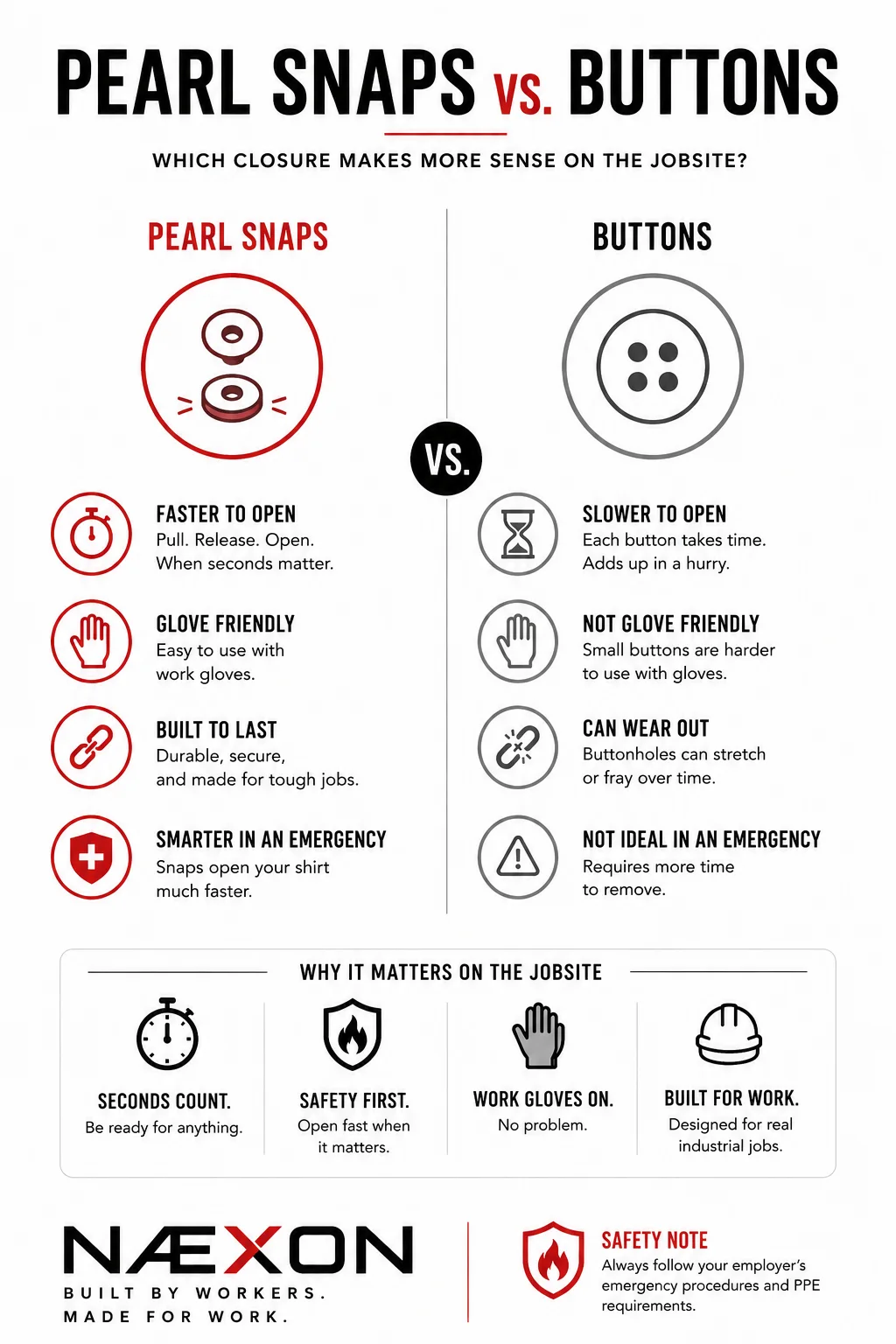
And one of their simplest advantages becomes especially apparent when something goes wrong: a snap-front shirt can generally be opened much faster than a traditional button-front shirt.
That matters when you’re building clothing for people who work around heat, sparks, machinery, chemicals, electrical hazards, and other demanding industrial environments.
The Problem With Traditional Buttons
Traditional buttons have been used on work shirts forever. They’re inexpensive, familiar, and when properly sewn, dependable.
But think about how a button actually works.
Every individual button has to be pushed through its buttonhole. Opening an entire shirt requires working your way down the front one button at a time.
That’s usually no big deal.
Until you’re wearing gloves.
Until your hands are dirty.
Until you’re exhausted after ten hours.
Or until something happens and you want that garment open right now.
A pearl snap works differently.
Grab the shirt correctly, apply enough separating force to the closure, and the snaps release individually without requiring each closure to be maneuvered through a buttonhole.
That simplicity is one of the reasons Næxon continues to build pearl snaps into our industrial workwear.
When Seconds Matter, Simplicity Matters
Imagine working a turnaround in a refinery.
You’re surrounded by hot work, welding, cutting, grinding, temporary equipment, electrical systems, piping, and hundreds—sometimes thousands—of other workers.
Nobody puts on workwear expecting an emergency.
But industrial PPE is designed around the reality that unexpected events can happen.
If a worker needs to remove a shirt quickly, a traditional button-front garment requires each button to be undone individually or the garment to be otherwise removed. A snap-front garment offers a much simpler opening mechanism.
Pull. Release. Open.
That’s an advantage worth considering.
It is also important not to exaggerate what pearl snaps do. A snap closure does not make a garment flame resistant, does not replace proper PPE, and should never be treated as an emergency-protection system by itself.
Workers must always follow their employer’s procedures, site-specific PPE requirements, garment instructions, and emergency protocols.
The snap is simply a smart mechanical feature incorporated into a larger piece of workwear.
This Is Where the Næxon Design Makes Sense
Næxon wasn’t built around the idea that industrial workers should have to choose between functional workwear and clothing they actually want to wear.
Our approach is to make the details earn their place.
Pearl snaps give an FR work shirt a distinctive appearance, but appearance is only part of the equation.
They’re quick to operate.
They’re easy to manipulate.
They’re practical when you’re wearing work gloves.
And compared with feeding conventional buttons through individual buttonholes, they can make opening the front of the garment significantly faster.
That philosophy extends beyond closures. Proper fit matters because workers climb, reach, kneel, crawl and weld in awkward positions. We explain that in our guide to why proper fit matters in industrial workwear.
Workwear should work with the person wearing it.
Pearl Snaps Are Especially Practical With Gloves
Here’s another situation every tradesman understands.
Try working tiny conventional shirt buttons while wearing heavy leather gloves.
It’s annoying.
Pearl snaps eliminate much of that fine finger movement. Opening or closing a snap doesn’t require feeding a small button through a precisely sized hole.
That becomes useful when you’re wearing welding gloves, utility gloves, cold-weather gloves, or when your hands are covered in the grime that comes with industrial work.
A closure seems like a tiny detail until you operate it thousands of times.
Then you realize good workwear is largely the accumulation of tiny details somebody actually thought about.
But What About Durability?
This is where construction quality matters.
A cheap snap poorly attached to lightweight material can fail.
So can a poorly sewn button.
The real comparison isn’t simply snap versus button. It’s the quality of the entire garment—the hardware, fabric, stitching, reinforcement, fit, and construction.
Industrial clothing gets abused.
It gets pulled underneath harnesses. It rubs against steel. It gets washed repeatedly. Workers climb ladders, crawl through pipe racks, squeeze through equipment, carry material against their chest, weld, grind, sweat, and do it again the following morning.
That’s why durable closures belong alongside reinforced construction and appropriate materials.
Our Ultimate Guide to Industrial Workwear goes deeper into what separates purpose-built industrial clothing from ordinary everyday apparel.
The Emergency Argument Is Important—but It Needs to Be Explained Correctly
You’ll sometimes hear workers say:
“I wear pearl snaps because I can rip my shirt off if something catches fire.”
There’s some practical logic behind the statement, but it shouldn’t be misunderstood.
If clothing is burning, contaminated, or involved in another emergency, the correct response depends on the specific hazard and the employer’s emergency procedures. Workers should never assume that ripping off a shirt is automatically the correct response in every situation.
What we can say is much simpler:
A snap-front garment can be opened rapidly because the wearer does not have to individually work traditional buttons through buttonholes.
That’s a legitimate mechanical advantage.
And in industrial clothing, easier operation is rarely a bad thing.
FR Protection Comes From the Garment—not the Pearl Snap
This distinction matters.
Pearl snaps themselves do not make a shirt FR.
Flame-resistant clothing is designed to resist ignition and help limit continued burning after the ignition source is removed. The garment’s materials, construction, certification, condition, proper use, and compatibility with the hazard are what matter.
Workers should inspect FR clothing regularly and replace garments that are excessively damaged, contaminated, or otherwise unsuitable for continued service.
If you’re new to FR clothing—or simply want a refresher—our Næxon Resources section includes additional information on industrial workwear, FR apparel, PPE and jobsite safety.
Why Not Just Use Pearl Snaps for Style?
We could.
Because they look damn good.
Pearl snaps have an unmistakable blue-collar character. They carry some Western DNA without turning a work shirt into a costume.
But that’s exactly what makes the design interesting.
The style came from function.
A great industrial product doesn’t need to look ugly to prove that it’s tough.
Næxon believes workwear can be durable enough for a turnaround, practical enough for a welder, comfortable enough for a 12-hour shift, and still look good when you walk into a restaurant afterward.
That’s the difference between putting decoration on workwear and actually designing workwear.
Buttons Still Have Their Place
Traditional buttons aren’t inherently bad.
A quality button-front work shirt can be durable, dependable, inexpensive to repair, and perfectly appropriate for countless applications.
For casual clothing, uniforms, office environments, and many types of workwear, buttons remain an excellent closure.
But when we’re designing shirts specifically around industrial workers, we believe pearl snaps offer an unusually good combination of:
- Fast operation
- Easy opening and closing
- Glove-friendly use
- Industrial practicality
- Distinctive appearance
- Blue-collar heritage
Few design elements give you that much function and character at the same time.
A Small Detail That Explains the Næxon Philosophy
Anybody can make a shirt.
The difficult part is deciding why every detail is there.
Why this material?
Why this fit?
Why this stitching?
Why this pocket?
Why this cuff?
Why pearl snaps instead of ordinary buttons?
For Næxon, the answer shouldn’t just be because it looks cool.
It should make sense for the people wearing it.
The refinery worker.
The welder.
The electrician.
The boilermaker.
The millwright.
The ironworker.
The operator.
The pipefitter.
The people climbing steel at 6:00 in the morning and walking back through the gate twelve hours later.
That’s why the pearl snap belongs on Næxon workwear.
It carries the heritage.
It looks right.
It operates easily.
And when you want the front of your shirt open quickly, you don’t have to fight a row of buttons to do it.
Sometimes the smartest pieces of workwear aren’t built around complicated technology.
Sometimes they’re built around one simple question:
Does this make the worker’s life easier?
With pearl snaps, we think the answer is yes.