A check valve has one basic job: allow flow in one direction and prevent it from coming back.
But knowing the flow direction is only half the installation.
With some check valves, you can point the flow arrow the right way and still install the valve incorrectly.
The reason is gravity.
Depending on the check valve design, gravity may help close the valve, help open it, or prevent the internal mechanism from operating correctly altogether. Other designs use springs or other mechanisms and are much less dependent on installation position.
Here’s how to tell the difference.
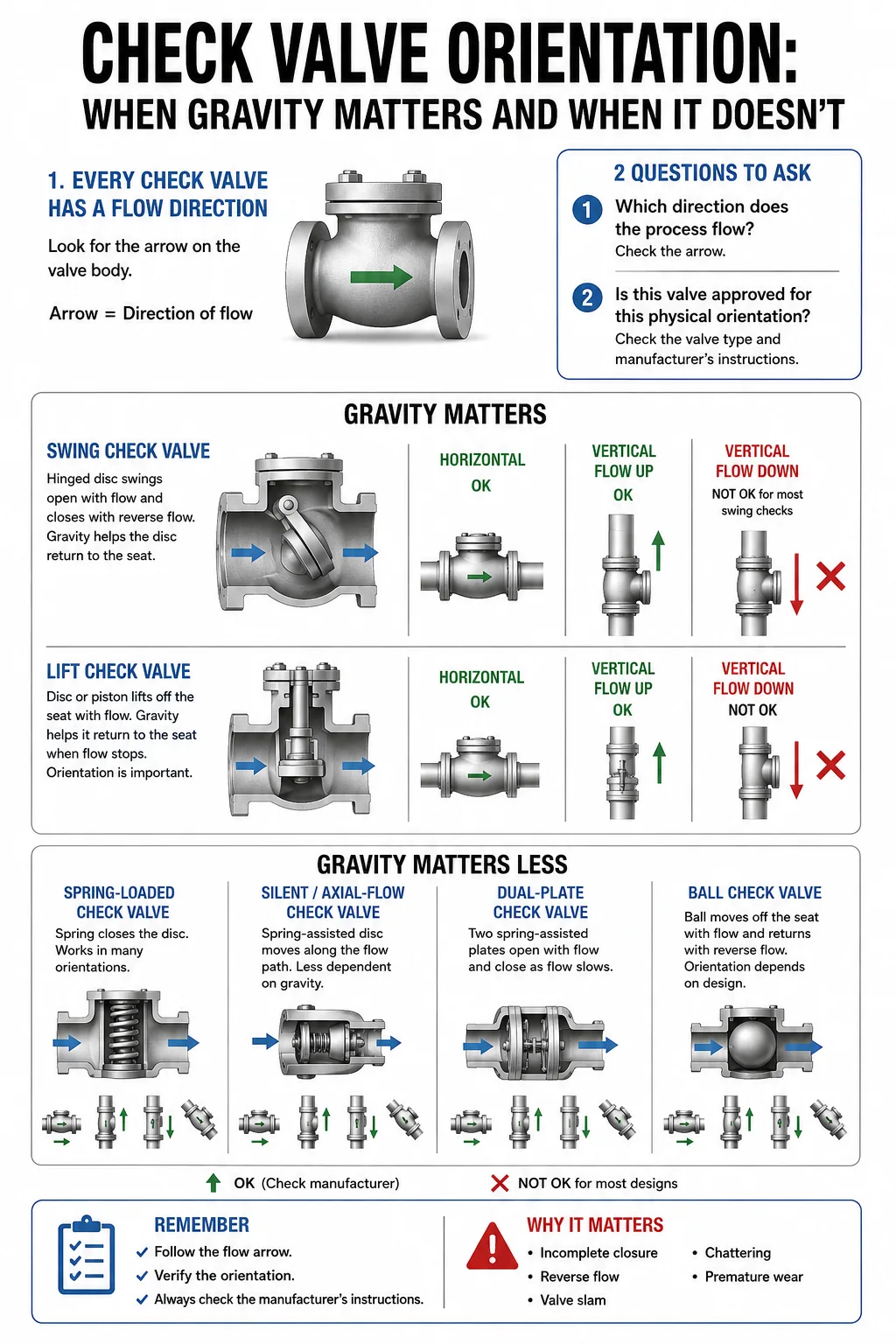
First: Every Check Valve Has a Flow Direction
Unlike a typical gate valve, a check valve is directional.
Look at the valve body and you will normally find an arrow cast, stamped, or marked into it.
That arrow indicates the intended direction of normal flow.
Arrow → Direction of flow
Install the valve backward and the valve will attempt to stop the flow you actually want.
But the arrow does not necessarily tell you whether the valve can be installed horizontally, vertically, or at another angle.
That depends on the design.
Swing Check Valves: Gravity Matters
A traditional swing check valve contains a hinged disc.
Forward flow pushes the disc away from the seat.
When flow stops or reverses, the disc swings back toward the seat.
Gravity can play an important role in getting that disc back into its proper position.
Horizontal installation
This is the classic installation for many swing check valves.
The hinge is positioned so the disc can swing upward as flow passes through the valve and then fall back toward the seat when flow stops.
Think of it like a door.
If you rotate the entire doorway into the wrong position, gravity begins acting on the door differently.
The same principle applies inside the valve.
Vertical installation
Some swing check valves can also be installed in vertical piping when flow travels upward.
Forward flow lifts the disc.
When flow stops, gravity helps the disc return toward the seat.
Vertical pipe + upward flow = acceptable for many swing checks.
But don’t turn that into a universal rule.
The manufacturer’s installation requirements always take priority because the internal design, hinge arrangement, disc weight, and service conditions can change the permitted orientation.
What About Vertical Flow Down?
This is where the problem becomes obvious.
Imagine a conventional swing check installed vertically with normal flow traveling downward.
Gravity is now trying to pull the disc in the same general direction as the flow rather than naturally helping it return toward its closed position.
Depending on the valve design, the disc may not close properly when flow stops.
That is why a standard swing check should never simply be assumed suitable for vertical downward flow.
If the system requires downward flow, verify that the specific valve is designed and approved for that orientation.
Lift Check Valves
A lift check operates differently.
Instead of a hinged disc swinging open, the closure element lifts away from its seat.
Forward pressure lifts the disc or piston.
When forward flow decreases, the closure element returns toward the seat.
Gravity can therefore be extremely important on traditional nonspring-loaded designs.
Many conventional lift checks are intended for horizontal piping with the bonnet or guide positioned vertically upward.
Rotate the valve incorrectly and the moving element may no longer travel the way it was designed.
Again:
Flow arrow correct ≠ installation orientation automatically correct.
Both must be checked.
Spring-Loaded Check Valves: Gravity Matters Less
Now add a spring.
Instead of depending primarily on gravity to return the closure element to the seat, the spring supplies the closing force.
Forward pressure must overcome the spring force to open the valve.
As flow decreases, the spring pushes the valve closed.
Because of this, many spring-loaded check valves can operate in a wider range of orientations than traditional gravity-dependent swing or lift checks.
They may be suitable for:
- Horizontal piping
- Vertical upward flow
- Vertical downward flow
- Other orientations specifically approved by the manufacturer
But spring-loaded does not mean:
“Install it however you want.”
The manufacturer’s specified installation orientation still controls.
Silent and Axial-Flow Check Valves
Silent check valves and axial-flow check valves commonly use a spring-assisted internal disc.
The disc moves along the direction of flow instead of swinging from a hinge.
That design reduces dependence on gravity and can also help the valve close quickly as flow velocity decreases.
Fast closure can reduce reverse velocity and, in properly engineered systems, help reduce check-valve slam and associated pressure transients.
These valves are commonly found in applications involving pumps and other systems where rapid, controlled closure is important.
For more fundamentals on industrial piping components, see the Næxon Learning Center.
Ball Check Valves
A ball check uses a ball as the closing element.
Flow pushes the ball away from its seat.
Reverse flow pushes it back.
Whether gravity matters depends heavily on the particular design.
Some ball checks are specifically designed for vertical service. Others have defined orientation requirements.
Don’t assume that because the internal component is simply a ball, the valve is automatically position-independent.
Dual-Plate Check Valves
A dual-plate or double-door check uses two semicircular plates, typically assisted by springs.
Forward flow opens the plates.
As flow slows, the springs begin driving them toward the closed position before substantial reverse flow develops.
Because the springs provide closing force, these valves generally depend less on gravity than a traditional swing check.
However, shaft orientation and piping position may still matter depending on the valve and service.
Always verify the manufacturer’s requirements.
The Field Rule to Remember
When you’re looking at a check valve in the field, ask two separate questions:
1. Which direction does the process flow?
Check the arrow on the body.
2. Is this valve approved for this physical orientation?
Check the valve type, internal mechanism, manufacturer’s instructions, and piping orientation.
Those are not the same question.
A valve can have its flow arrow pointed perfectly downstream while its internal mechanism is sitting in an orientation it was never designed to operate in.
Quick Check Valve Orientation Guide
Check Valve Type
Does Gravity Matter?
Typical Orientation Consideration
Swing Check
Yes
Commonly horizontal; some permit vertical upward flow
Lift Check
Yes
Often horizontal unless specifically designed otherwise
Spring-Loaded Check
Less
Often allows multiple orientations
Silent Check
Less
Spring-assisted; verify manufacturer
Axial-Flow Check
Less
Spring-assisted; orientation depends on design
Ball Check
Depends
Design-specific
Dual-Plate Check
Less
Spring-assisted, but installation requirements still apply
This table is a general field reference—not a replacement for the manufacturer’s installation instructions or project specifications.
Why Orientation Actually Matters
Incorrect orientation isn’t just a technicality.
A poorly oriented check valve can contribute to:
Incomplete closure. The disc may not return fully to its seat.
Chattering. The closure element can repeatedly open and close under unstable conditions.
Reverse flow. The valve may react too slowly or fail to close as intended.
Valve slam. Reverse velocity can drive the closure element violently against the seat.
Premature wear. Hinges, guides, discs, seats, and other internals can experience loads they weren’t designed to handle.
And in a large industrial piping system, a check valve that doesn’t behave correctly can become much more than a valve problem.
One More Thing: Orientation Isn’t the Only Factor
Even a perfectly oriented check valve can perform badly if it is improperly selected.
Check-valve behavior also depends on flow velocity, pressure differential, valve sizing, cracking pressure, piping configuration, pump operation, fluid properties, and transient conditions.
Bigger isn’t automatically better.
An oversized check valve may never reach a stable fully open position, allowing the disc to flutter or chatter.
Proper installation starts with orientation, but proper selection and sizing matter just as much.
The Simple Way to Remember It
Swinging or freely moving internals? Think about gravity.
Spring-assisted internals? Gravity usually matters less.
And regardless of design:
Follow the flow arrow. Verify the orientation. Check the manufacturer.
Those three checks take seconds in the field and can prevent a check valve from becoming a much bigger problem after startup.