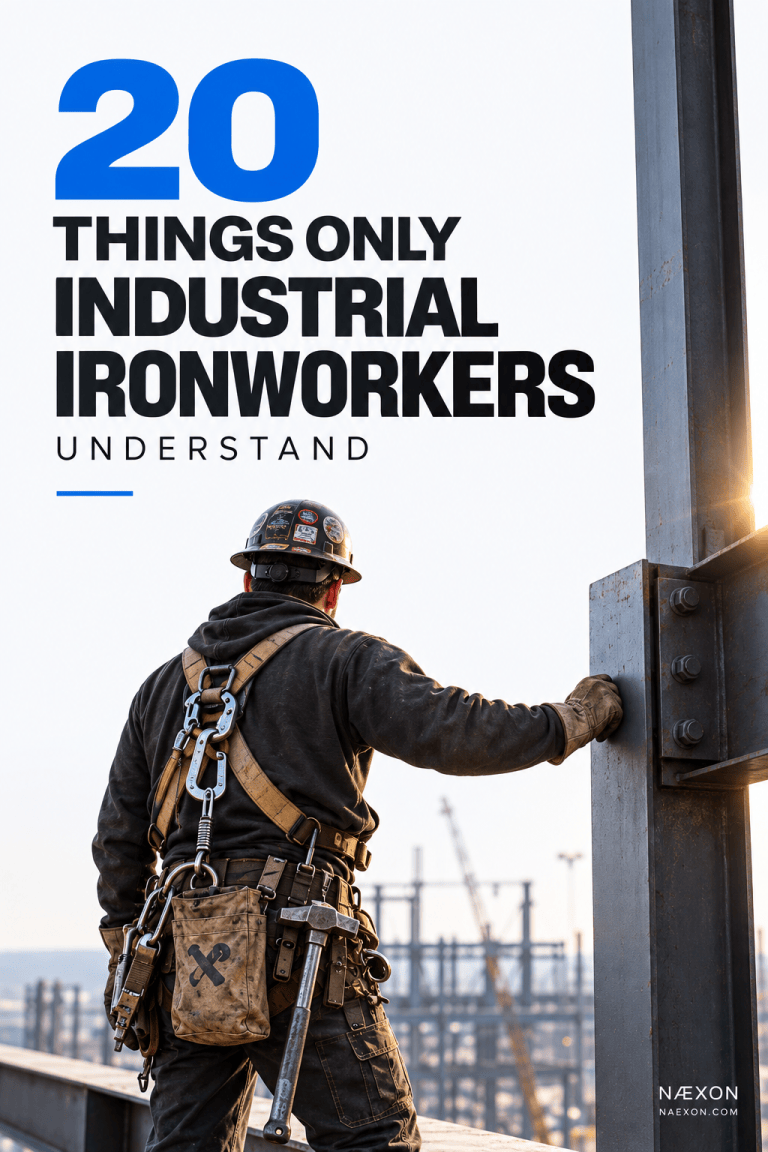
Walk onto almost any industrial jobsite and you can sometimes tell who has been around awhile before anybody starts working.
The new hand may arrive with a tool bag packed like he is preparing to rebuild the entire refinery by himself. Three pairs of pliers. Two tape measures. Every wrench he owns. Extra screwdrivers. Specialty tools he might use once every six months. Half the tool aisle hanging from his belt.
Then an experienced tradesman walks through the gate carrying considerably less.
At first, it can look backward. The person with more experience should know about more tools, encounter more problems, and therefore need to carry more equipment. In practice, experience often produces the opposite result.
A seasoned tradesman doesn’t necessarily own fewer tools. He has simply learned which tools deserve to come with him.
Experience Removes the “Just in Case” Tools
Early in a career, you don’t yet know exactly what the day will require. That uncertainty makes it tempting to carry everything.
Maybe you’ll need the big adjustable wrench. Maybe somebody will ask for a file. Maybe you’ll need three different channel locks. Maybe there will be something unusual buried in the work package that nobody mentioned during the morning meeting.
So you bring it all.
There’s nothing particularly wrong with that. In fact, being overprepared is usually better than constantly borrowing tools from everyone around you. But after years in the trade, something changes.
Patterns become obvious.
An experienced pipefitter looking at a job can usually predict what will end up in his hands. An electrician can look at the installation and make the same judgment. Welders, millwrights, ironworkers, boilermakers, instrument technicians, scaffold builders, and other experienced craftspeople develop their own versions of this instinct.
They stop preparing for every job that could happen and start preparing for the job that is actually in front of them.
That difference removes a surprising amount of weight.
Good Hands Look at the Work Before They Look at the Toolbox
Experience changes the order in which you think.
A newer worker often thinks about tools first.
“What should I bring?”
A seasoned worker tends to think about the work first.
What are we installing? Where are we working? How are we accessing it? What material is involved? What size is it? What does the drawing show? What equipment is already staged? What part of the operation could become difficult?
Once those questions are answered, the necessary tools become much easier to identify.
This is one reason learning to read piping isometric drawings and understand the work before fabrication or installation matters so much. The drawing isn’t merely telling you where the pipe goes. To somebody who understands it, the drawing begins revealing what the job is going to require before the first tool comes out.
That ability is worth more than carrying another 20 pounds of equipment.
The Tool Bag Gets Smaller While the Mental Toolbox Gets Bigger
This may be the biggest difference of all.
New tradesmen compensate for things they haven’t experienced yet by carrying physical options. Experienced tradesmen compensate with knowledge.
A veteran may know that one adjustable wrench can handle several situations where a newer worker brings three fixed tools. He may know how to take a measurement that eliminates repeated trips. He may recognize that a problem that appears to require a specialty tool can be solved another way.
That doesn’t mean improvising dangerously or using the wrong tool for the job. There is a major difference between resourcefulness and stupidity. Certain work requires the correct equipment, period.
The point is that experience teaches you where that line actually is.
A person who understands pipefitter math, offsets, measurements, and layout doesn’t need to compensate for uncertainty the same way someone still learning those skills does. Knowledge starts replacing unnecessary equipment.
You carry less in your hands because you’re carrying more in your head.
Every Extra Pound Eventually Becomes Your Problem
Carry a heavy tool bag 50 feet across a fabrication shop and it doesn’t seem like much.
Carry it across a refinery, climb stairs, walk pipe racks, climb scaffolding, get on and off lifts, work a ten-hour shift, and repeat the process six days a week.
Now every unnecessary pound matters.
Industrial workers already spend enormous amounts of energy simply moving through the workplace. Add FR workwear, boots, a hard hat, gloves, safety glasses, fall protection when required, radios, gas monitors, and whatever additional PPE the job requires. Your body is already carrying equipment before your personal tools enter the equation.
Experienced workers learn this through repetition.
That giant tool bag doesn’t make you more productive if half of it stays untouched all day. It just means you carried unused steel around for ten hours.
Efficiency isn’t laziness.
Efficiency is eliminating effort that produces nothing.
The Best Tool Setup Is Usually Built Around Frequency
Watch what experienced tradesmen keep closest to them.
It usually isn’t the most impressive tool they own. It’s the tool they reach for constantly.
The tape measure that comes out 50 times. The marker or soapstone that never seems to stay in the pocket long. The level used repeatedly during layout. The wrench that fits the hardware they’re actually working with. The pliers that solve several routine problems.
This is also why seemingly minor workwear details become important over time. A properly positioned shirt pocket, for example, matters because the things used constantly need to be accessible without becoming another piece of equipment hanging from your body. It’s something we explored in The Work Shirt Pocket: Why Something So Simple Matters So Much.
Experienced tradesmen unconsciously organize themselves around frequency.
Frequently used equipment stays close.
Occasionally used equipment stays nearby.
Rarely used equipment stays in the gang box, truck, tool room, or wherever it belongs until it’s needed.
That is a much different system from carrying everything everywhere.
Knowing What Not to Bring Is a Skill
Anybody can fill a tool bag.
Knowing what you can leave behind requires understanding the job.
That judgment becomes especially obvious during shutdowns and turnarounds. Work can move quickly, access can be terrible, crews may cover huge areas, and unnecessary trips back to the gang box can kill productivity.
The answer isn’t to carry the entire gang box on your shoulder.
The answer is anticipation.
An experienced shutdown hand starts thinking several moves ahead. If we’re removing this spool, what size hardware are we dealing with? If we’re installing the replacement, what will we need for alignment? Are the flange faces accessible? Is the work overhead? Will rigging already be there? Is there enough room to use the tool I normally use?
Those questions determine what comes along.
The tradesman isn’t carrying less because he expects everything to go perfectly.
He’s carrying less because he has a better idea of how things usually go wrong.
There’s Also a Difference Between Prepared and Decorated
Jobsites have always had a little peacocking.
A person can cover himself with tools until he looks like the walking version of a hardware store. It creates an immediate impression of preparedness.
But tools don’t establish competence.
The work does.
The same principle applies to nearly everything else on an industrial jobsite. You can wear the boots, welding cap, stickers, FR shirt, and every accessory associated with the trade. Eventually somebody hands you the work.
Then appearance stops mattering.
Experienced tradesmen usually become less interested in looking prepared because they’ve spent years learning how to be prepared.
There is nothing to prove with a 40-pound tool bag.
This Doesn’t Mean New Tradesmen Should Start Leaving Their Tools Behind
There is an important distinction here.
A first-year apprentice shouldn’t read this and immediately dump three-quarters of his tools into the truck because the old hand only carries five things.
The old hand earned that minimal setup through thousands of hours of experience.
He knows what he can leave behind because he knows when he’ll need it.
A newer tradesman is still discovering that.
In the beginning, carrying a little extra equipment can actually help you learn. You start noticing which tools come out every day, which ones occasionally save you, and which ones haven’t moved from the bottom of the bag in six months.
Over time, your setup evolves.
That’s the important part.
Don’t imitate somebody else’s small tool bag.
Develop the knowledge that eventually allows you to build your own.
Eventually, Everything You Carry Has a Reason
After enough years in the trades, unnecessary things have a way of disappearing.
The giant tool bag becomes smaller. The overloaded belt gets lighter. The collection of “might need this someday” tools stays in the gang box instead of riding around on your shoulder.
What remains tends to have a purpose.
The same thing happens with workwear. Experienced industrial workers become particular about the things they wear every day because small annoyances become big annoyances after thousands of hours. That’s part of the thinking behind Næxon workwear and gear: equipment should earn the space it occupies, whether it’s in your pocket, on your belt, or on your body.
There is a lesson in that beyond tools.
Experience isn’t always about adding more.
Sometimes experience is learning what you can remove.
The new hand often wants to be ready for everything.
The experienced hand wants to be ready for what matters.
And after enough years walking through refineries, power plants, fabrication shops, pipelines, data centers, and industrial projects, you eventually learn the difference.