A welder can look at E6010 or E7018 and immediately learn quite a bit about that electrode before ever striking an arc.
Those numbers aren’t random product names. The AWS electrode classification system tells you important information about the rod, including its tensile strength, welding positions, coating characteristics, and the type of current it is designed to run on.
Understanding that code makes electrode selection much easier—and it also explains why two rods that look almost identical can behave completely differently in the puddle.
Start With the “E”
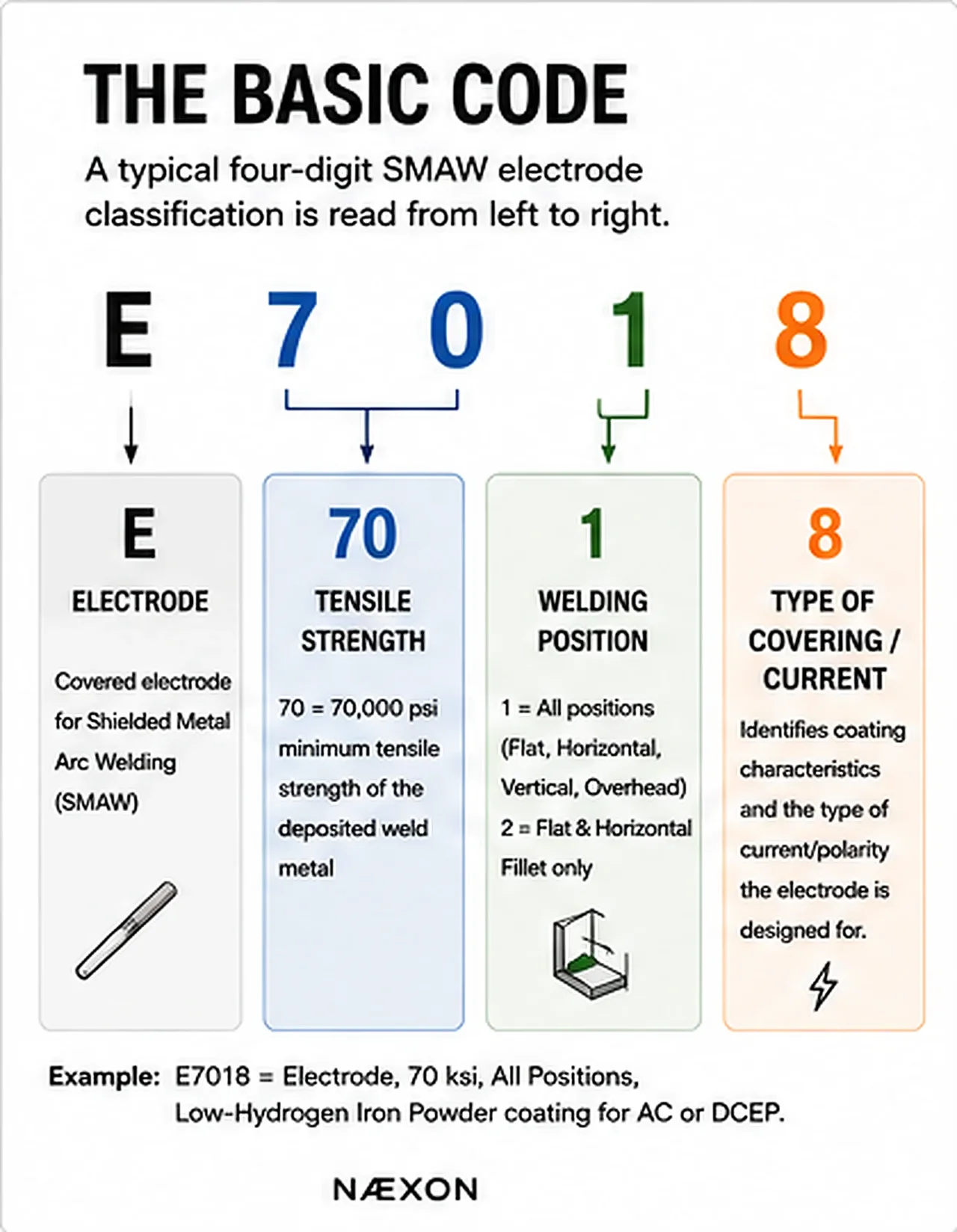
Take a common electrode:
E7018
The E simply means:
Electrode
It identifies the filler metal as a covered electrode used for Shielded Metal Arc Welding (SMAW)—what most hands simply call stick welding.
The useful information starts with the numbers.
The First Two Numbers: Tensile Strength
For the common four-digit classifications, the first two digits indicate the electrode’s minimum tensile strength in thousands of pounds per square inch (ksi).
E6010
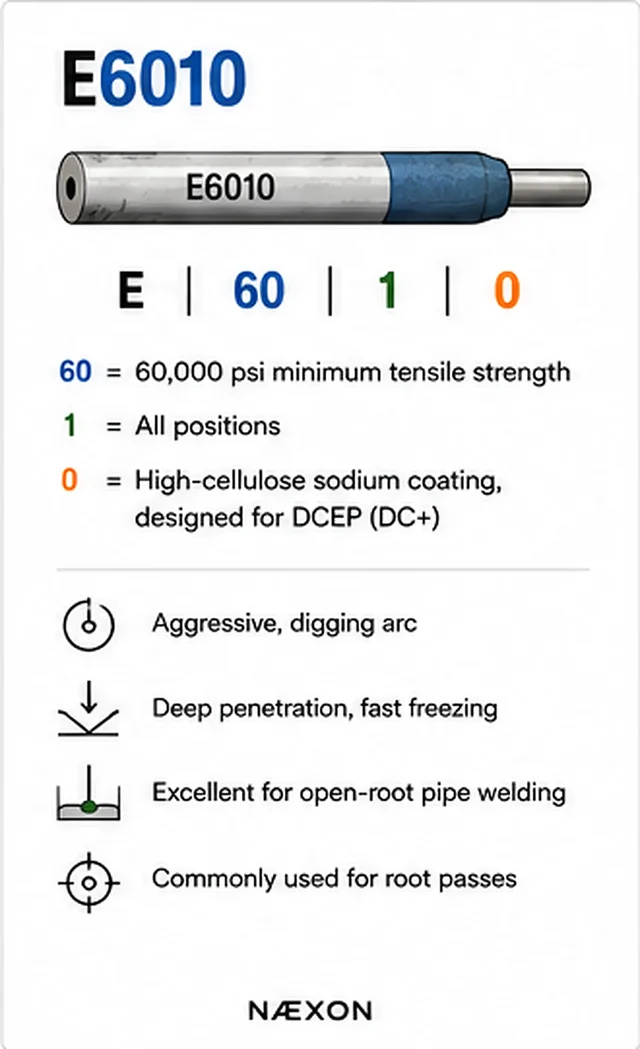
60 = 60,000 psi minimum tensile strength
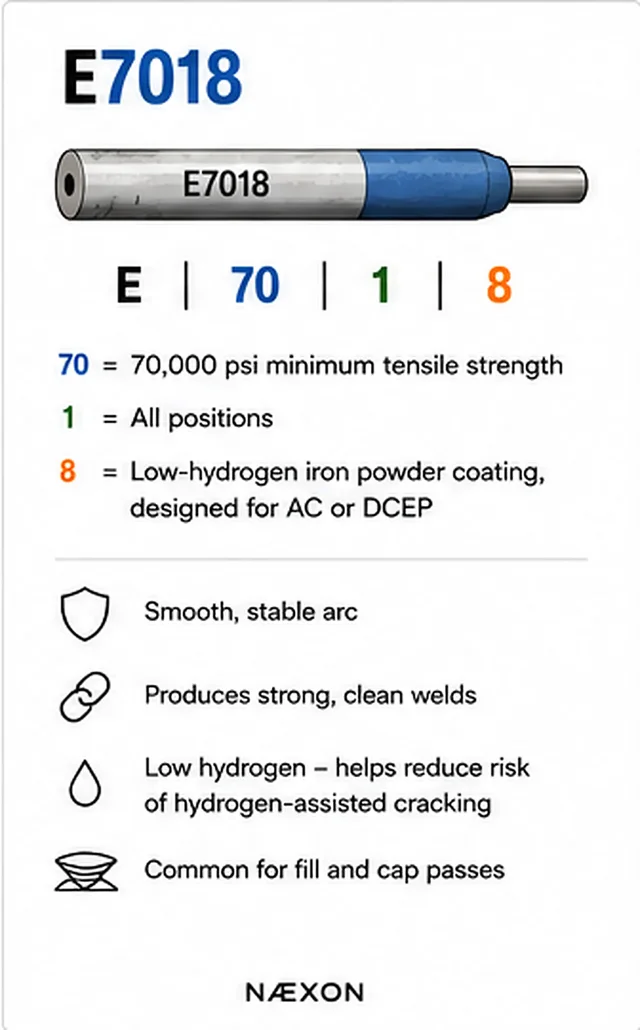
E7018
70 = 70,000 psi minimum tensile strength
So, at the basic classification level:
E6010 → 60,000 psi
E7018 → 70,000 psi
This does not mean a welder should automatically choose the electrode with the larger number. Electrode selection depends on the base material, welding procedure, joint configuration, service conditions, code requirements, and other factors.
Strength is only one part of the classification.
The Third Digit: Welding Position
Now look at:
E70 1 8
That 1 tells us the positions in which the electrode is classified for use. For the common SMAW classification system:
1 = All positions
2 = Flat position and horizontal fillet welds
That is why electrodes such as E6010 and E7018 are extremely useful in industrial construction. Both contain a 1 in that position. They can be used in:
- Flat
- Horizontal
- Vertical
- Overhead
Of course, being classified for all positions doesn’t mean every electrode behaves the same in those positions. Anyone who has run 6010 and 7018 vertically knows that immediately.
Their puddles behave very differently.
The Last Digit Is Where Things Get Interesting
The final digit helps identify the electrode’s coating characteristics and suitable welding current.
This is where a common misunderstanding happens.
It is tempting to memorize something like:
0 = DC
8 = AC/DC
But the classification is more specific than that.
The final digit works as part of the electrode classification to identify the type of covering and the electrical characteristics under which the electrode operates.
Let’s compare two rods every industrial welder knows.
E6010 Explained
Break it apart:
E | 60 | 1 | 0
E
Electrode
60
Minimum tensile strength of approximately 60,000 psi
1
All-position electrode
0
A high-cellulose sodium type covering, commonly associated with operation on DCEP (DC electrode positive).
E6010 is known for its aggressive, digging arc and strong penetration characteristics.
That makes it especially useful where the welder needs to drive the arc into the joint rather than simply lay metal over the surface.
It is famous in pipe welding for exactly that reason.
Why 6010 Feels So Aggressive
Strike a 6010 arc and it doesn’t feel like 7018.
The arc tends to be forceful and penetrating.
The electrode’s cellulose-based coating produces shielding gases as it burns. Combined with its arc characteristics, this gives 6010 the fast-freezing, penetrating behavior that welders use for techniques such as open-root pipe welding.
This is why you frequently see 6010 associated with:
Root passes.
The welder can manipulate the keyhole and establish penetration through the root opening.
But that same aggressive behavior means the rod requires control.
Too much heat, incorrect arc length, poor fit-up, or bad manipulation can quickly turn a controlled keyhole into a hole through the pipe.
E7018 Explained
Now take:
E | 70 | 1 | 8
E
Electrode
70
Minimum tensile strength of approximately 70,000 psi
1
All-position electrode
8
A low-hydrogen iron-powder type electrode classification designed for use with appropriate AC or DCEP power characteristics.
This is a completely different animal from 6010.
E7018 is known for producing strong, clean weld deposits with low-hydrogen characteristics when the electrodes are properly stored and handled.
That makes it one of the most important electrodes in structural steel, industrial construction, pressure work, power generation, heavy fabrication, and many other applications.
Why Is 7018 Called “Low Hydrogen”?
Hydrogen can create serious problems in certain welds.
Under the wrong combination of material, stress, temperature, hydrogen level, and weld conditions, hydrogen can contribute to hydrogen-assisted cracking.
This can be particularly important when welding:
- Higher-strength steels
- Thick material
- Highly restrained joints
- Certain structural applications
- Critical industrial components
E7018 electrodes are formulated to deposit weld metal with controlled hydrogen levels when handled according to the applicable requirements.
But there is an important catch:
A low-hydrogen electrode has to be treated like a low-hydrogen electrode.
Improper exposure to moisture can compromise the benefits you were trying to obtain by using it.
Why 7018 Rod Ovens Matter
You’ve probably seen electrode ovens on industrial jobsites. They’re not there because somebody wanted a warm place to store welding rods. Low-hydrogen electrodes have storage and exposure requirements.
Once electrodes are removed from their proper storage conditions, moisture exposure becomes a concern.
Exact storage, exposure, rebaking, and disposal requirements depend on the electrode manufacturer’s instructions, welding procedure, governing code, and project specifications. That’s why a critical job may have strict rules about:
how electrodes are stored, when they’re issued, how long they can remain exposed, and what happens to rods that exceed the permitted exposure time.
A rod may look perfectly normal and still no longer meet the requirements of the procedure.
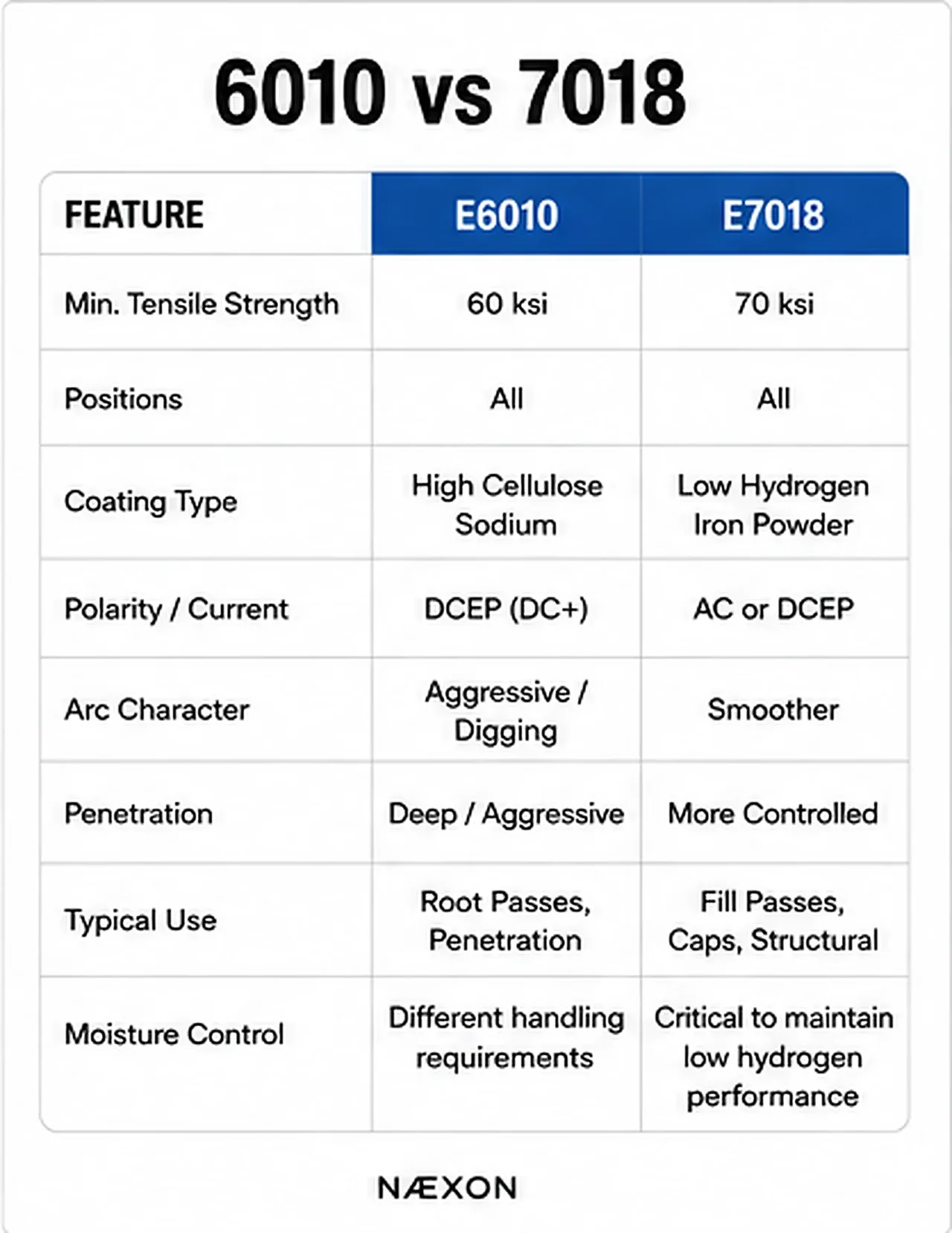
6010 vs. 7018
These two electrodes are often mentioned together because they can perform different jobs within the same weld. A simplified comparison looks like this:
If the welding procedure specifies a certain electrode, process, polarity, amperage range, preheat, interpass temperature, or technique, that’s what the welder follows.
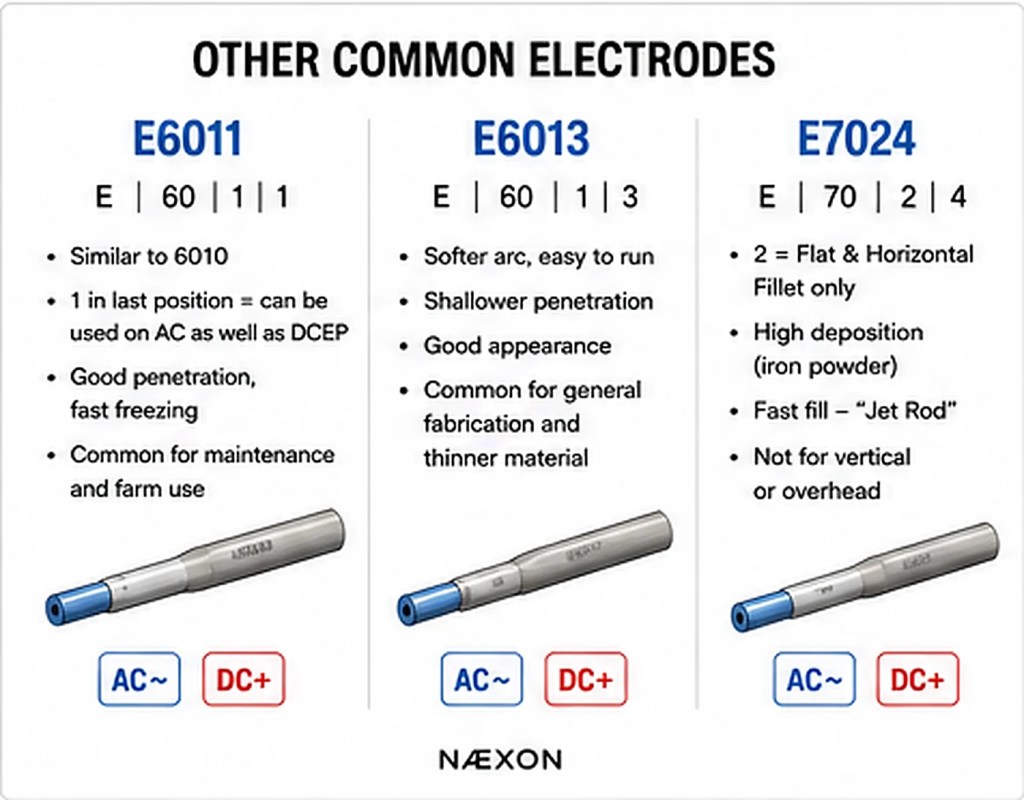
What About E6011?
E6011 is closely related to 6010 in the way it welds.
Break down:
E | 60 | 1 | 1
Again:
60 = 60 ksi
1 = all positions
The final 1 represents a different coating/current classification from 6010.
One major practical difference is that 6011 can be used with AC, in addition to appropriate DC operation.
That’s one reason 6011 is common around farms, repair work, maintenance, and machines where AC capability matters. It still provides the penetrating, fast-freezing characteristics associated with cellulose electrodes.
What About E6013?
Another extremely common electrode is:
E6013
Again:
60 = 60 ksi
1 = all positions
But the 3 identifies another coating/current classification.
6013 generally has a softer arc and shallower penetration than 6010.
It’s commonly encountered in:
- General fabrication
- Sheet and thinner material
- Light repair
- Maintenance
- Noncritical fabrication applications
A beginner may find 6013 easier to make visually smooth beads with, but that doesn’t make it a substitute for 6010, 7018, or another electrode specified by a welding procedure.
What About E7024?
Here’s where the position digit becomes obvious:
E7024
Break it down:
E | 70 | 2 | 4
The important number here is the 2.
Unlike E7018, this is not an all-position electrode.
E7024 is associated with flat welding and horizontal fillet applications and has a high-deposition iron-powder coating.
It’s sometimes nicknamed:
“Jet Rod.”
Where the joint and procedure allow it, the electrode can deposit metal quickly. But you wouldn’t grab a 7024 and expect it to behave like a 7018 while welding overhead.
The classification already gives you the warning.
Four Digits Aren’t the Whole Story
Once you move beyond basic electrode identification, AWS classifications can contain additional digits, suffixes, designators, and supplementary requirements.
For example, you may encounter classifications associated with additional requirements for things such as:
- Chemical composition
- Diffusible hydrogen
- Moisture resistance
- Impact properties
- Deposited weld-metal characteristics
So the familiar E7018 is really just the beginning of understanding filler-metal classifications.
A welder working under a qualified procedure should pay attention to the complete electrode classification, not simply recognize “7018” on the box.
The Numbers Don’t Tell You Everything
This is one of the most important lessons. Knowing how to decode an electrode does not automatically tell you whether you are allowed to use it. Imagine seeing:
E7018
You now know quite a bit about it. But you still don’t necessarily know: the exact base material you’re welding, whether that filler metal is permitted by the WPS, required preheat,
interpass temperature, amperage range, electrode diameter, joint preparation, welding progression, or project-specific requirements.
The electrode classification is information. The WPS is instruction. On code and critical industrial work, those are two very different things.
A Simple Way to Remember the Code
For a common four-digit SMAW electrode such as:
E7018
Think:
E = Electrode
70 = Strength
1 = Position
8 = Coating/current characteristics
Or simply remember:
E — STRENGTH — POSITION — TYPE
Once you understand that pattern, those numbers printed on electrode cans stop looking like random model numbers.
They become information.
And on an industrial jobsite, understanding exactly what you’re putting into a weld is every bit as important as knowing how to run it.