You finish a long shift, throw your dirty work clothes into the washing machine, and an hour later you’re standing in front of the dryer wondering whether your FR shirt can go in with everything else.
It sounds like a simple question:
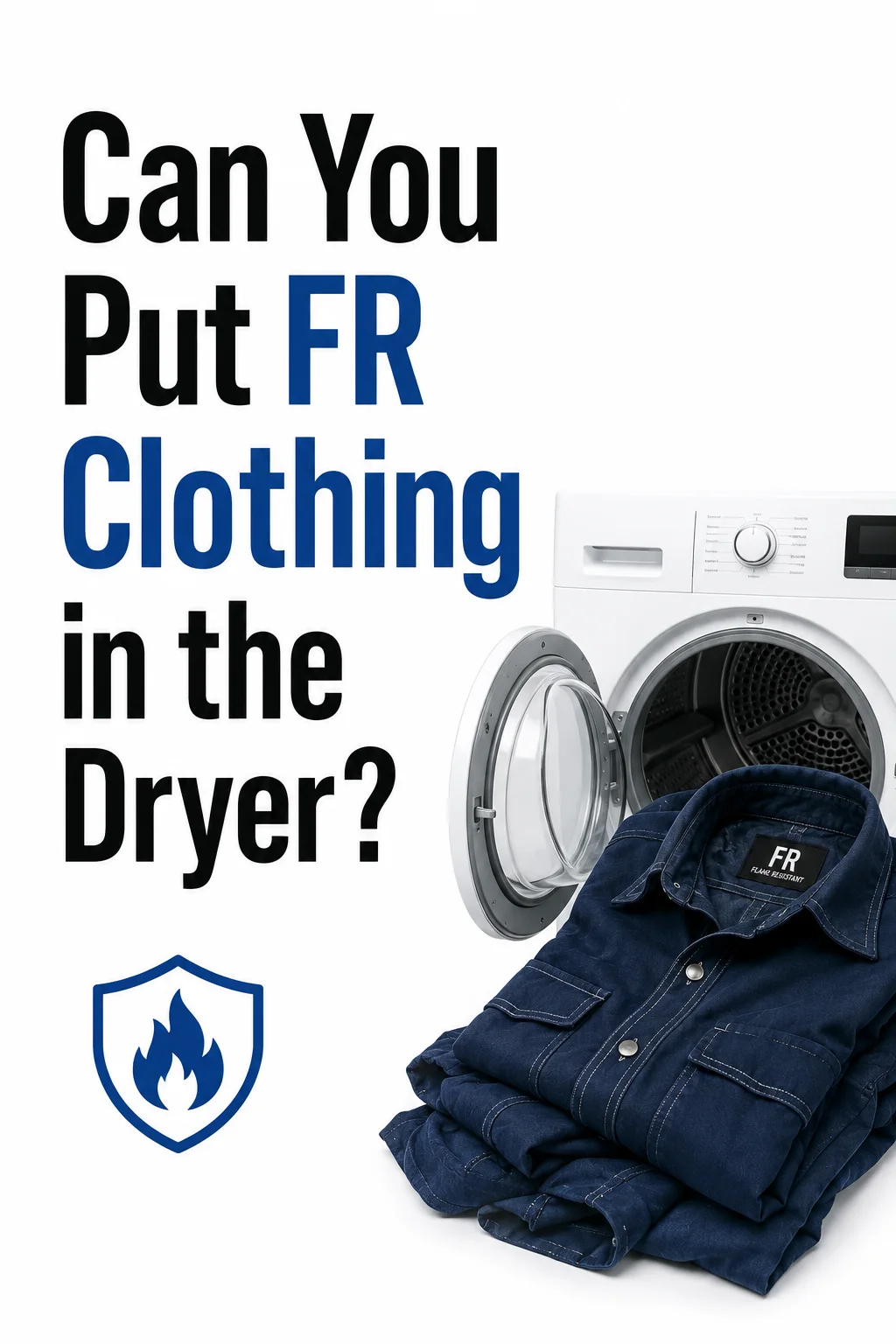
Can you put FR clothing in the dryer?
In many cases, yes—FR clothing can be machine dried when the garment’s care label allows it. But that doesn’t mean every FR garment should be dried exactly the same way, at any temperature, for as long as you want.
The correct drying method depends on the fabric, garment construction, manufacturer’s instructions, and care label.
For industrial workers who depend on flame-resistant clothing as part of their PPE, that little tag inside the shirt matters more than most people realize.
FR Clothing Is Workwear, but It’s Also PPE
A regular cotton T-shirt can shrink, fade, or get damaged in the dryer and the biggest consequence might be losing your favorite shirt.
FR clothing is different.
Flame-resistant clothing is designed to reduce the severity of burn injuries by resisting ignition and helping prevent continued burning after the ignition source is removed. Depending on the workplace hazard, the garment may also carry specific certifications, ratings, or markings.
That is why FR clothing should be treated as protective equipment rather than ordinary laundry.
You wouldn’t modify a safety harness because somebody told you it was probably fine.
The same thinking should apply to your FR workwear.
Follow the manufacturer’s care instructions.
The Care Label Comes First
Before worrying about internet advice, what another tradesman does, or what somebody told you at the laundromat, check the garment.
Read the care label.
The manufacturer knows the fabric, construction, treatments, components, and testing requirements associated with that specific garment.
If the label permits tumble drying, then follow the drying instructions provided.
If it specifies a temperature or drying method, follow it.
If it says not to use a particular method, don’t use it.
There is no reason to guess when the instructions are sewn directly into the garment.
Why Dryer Temperature Matters
Heat helps evaporate moisture, which is exactly why dryers work.
But more heat isn’t necessarily better.
Repeated exposure to unnecessarily high drying temperatures can contribute to shrinkage and general garment wear. Even when a garment is designed to tolerate machine drying, cooking it at maximum heat every time may not be the best way to preserve its fit and useful life.
This is particularly important with industrial workwear because fit matters.
An FR shirt that originally provided good coverage can become noticeably smaller if it experiences excessive shrinkage.
Sleeves can become shorter.
The body can tighten.
The shirt tail can become shorter.
The collar can feel different.
Suddenly the garment you bought for industrial work no longer fits the way it was intended.
That doesn’t mean the dryer is automatically bad for FR clothing.
It means follow the drying instructions instead of automatically choosing the hottest setting.
Does the Dryer Remove the FR Protection?
This is where the question becomes more complicated.
Not all FR fabrics achieve flame resistance in exactly the same way.
Some garments use fibers with flame-resistant properties inherent to the material. Other FR fabrics use engineered treatments or technologies designed to provide the required performance.
Because construction and fabric systems differ, it is a mistake to create one universal laundry rule for every piece of FR clothing.
Proper laundering and drying according to the manufacturer’s instructions are designed around the garment’s intended performance.
The better question isn’t:
“Does using a dryer destroy FR?”
It is:
“Am I caring for this specific FR garment the way its manufacturer says I should?”
That is the habit workers should develop.
For a deeper explanation of how FR fabrics work, the Næxon Learning Center covers flame-resistant clothing, protective workwear, welding PPE, and industrial safety topics in detail.
Overdrying Is Different From Drying
One mistake workers make is leaving clothes tumbling long after they’re already dry.
Drying removes moisture.
Overdrying continues exposing an already-dry garment to unnecessary heat and mechanical tumbling.
That can contribute to wear over time.
Think about what happens inside a dryer. The garment isn’t sitting still. It’s tumbling repeatedly while rubbing against itself and other clothing.
Do that hundreds of times throughout the life of a work shirt and the cumulative effect matters.
This is particularly noticeable around high-wear areas such as cuffs, collars, seams, elbows, and pocket edges.
The dryer isn’t the only thing wearing those areas out—the jobsite is doing most of the damage—but unnecessary laundering abuse doesn’t help.
What About Shrinkage?
Shrinkage is probably the most noticeable dryer-related problem for workers.
A shirt can fit perfectly when you buy it and feel completely different several washes later.
Some amount of dimensional change may occur depending on the fabric and garment. How the garment is washed and dried can influence that change.
This is why buying an FR shirt three sizes too large because “it’s going to shrink anyway” isn’t a good universal strategy.
Neither is buying one extremely tight and assuming it will never change.
Start with the correct fit and follow the garment’s care instructions.
We’ve discussed this further in How Should an FR Shirt Fit?, because proper industrial workwear fit is about more than appearance.
It affects mobility, coverage, comfort, layering, and the worker’s ability to perform the job.
Why Workers Notice Shrinkage in the Sleeves First
Sleeves make small dimensional changes obvious.
A worker may not immediately notice that the body of a shirt became slightly shorter, but when the cuffs suddenly sit farther above the wrists, the change becomes obvious.
That can be particularly frustrating for welders, pipefitters, electricians, ironworkers, and other trades who depend on long sleeves for coverage.
This is another reason quality construction and proper laundering matter.
FR workwear is expected to survive repeated industrial use.
A shirt doesn’t spend its life hanging clean in a closet.
It gets worn hard, washed often, dried, packed into suitcases, thrown into gang boxes or vehicles, and worn again.
Care practices become part of the garment’s real-world durability.
Can You Dry FR Clothing With Regular Clothes?
In many households, FR clothing ends up in the same laundry room as everything else.
Whether garments can be laundered together depends on the manufacturer’s instructions, workplace requirements, and the type of contamination involved.
The bigger issue is often not simply whether another shirt is present in the dryer.
It is what may be on the clothing.
Industrial garments can carry oil, grease, chemicals, welding debris, and other jobsite contaminants.
That should be taken seriously.
A heavily contaminated FR shirt shouldn’t simply be thrown into the family laundry without considering what contaminated it and how it should be cleaned.
Some employers use industrial laundering programs specifically because of the environments where their employees work.
Always follow your workplace procedure when one exists.
Never Assume the Dryer Removes Industrial Contamination
Heat does not magically make contamination disappear.
If an FR shirt is contaminated with oil, grease, fuel, or another combustible substance, properly clean the garment before treating it as ready for service again.
If contamination remains after laundering, additional action may be required according to the manufacturer’s instructions and your employer’s PPE program.
This connects directly to another important Næxon Resources topic: Can Oil and Grease Make FR Clothing Unsafe?
FR clothing is designed to provide specific protective characteristics.
Covering that garment with combustible material creates a completely different problem.
The Dryer Isn’t Usually What Destroys Work Shirts First
Walk around an industrial jobsite and look at where old work shirts actually fail.
Usually it isn’t some dramatic dryer-related event.
It’s the elbows.
The cuffs.
The collar.
The seams.
The pocket corners.
The forearms.
The shoulders where harnesses or equipment rub.
The front where welding sparks, grinding debris, steel edges, and work surfaces repeatedly contact the garment.
Industrial work slowly destroys clothing through abrasion.
A dryer adds another cycle of mechanical movement, but the jobsite is usually the real torture test.
That is why durable construction matters.
The Næxon FR Pearl Snap Shirts are designed around the reality that industrial workers don’t stand still wearing their workwear. They bend, climb, weld, fit, grind, crawl, lift, rig, and work long shifts in environments that punish clothing.
Should You Air-Dry FR Clothing Instead?
Air drying may be permitted for many garments and can reduce exposure to tumble drying, but again, the care label should control your decision.
Air drying isn’t automatically required simply because a garment is FR.
Some workers prefer it because they want to minimize shrinkage or dryer wear.
Others depend on machine drying because they work long schedules and need their clothes ready for the next shift.
Anyone who has worked 7/12s during a turnaround understands the reality.
You get back to the hotel.
You shower.
You eat.
You wash your clothes.
You sleep.
Then you do it again.
Nobody wants an FR shirt hanging wet over the hotel shower curtain when the alarm goes off at 4:30 in the morning.
Machine drying can be practical when the garment’s instructions allow it.
The key is doing it correctly.
What About Laundromat Dryers?
Traveling tradesmen frequently depend on laundromats and hotel laundry rooms.
Those dryers can be more difficult because you may not know how accurately their temperature settings operate.
Don’t automatically select the highest heat just because you’re trying to get back to the hotel faster.
Follow the garment instructions as closely as possible and remove the clothing when it is dry instead of letting it bake unnecessarily.
It may take a few extra minutes.
Your workwear costs more than those few minutes.
Why FR Shirts Need to Be Inspected After Washing
Laundry day is actually one of the best times to inspect your FR clothing.
The shirt is clean.
You’re handling the entire garment.
You’re already looking at the cuffs and sleeves while folding it.
Take another few seconds.
Check the elbows for thinning.
Look at the cuffs.
Inspect the seams.
Check the snaps or buttons.
Look for burn holes.
Inspect the collar.
Check whether stains or contamination remain.
A garment that went into the washer looking acceptable may reveal damage more clearly after cleaning.
This ties directly into Does FR Clothing Expire? When Should You Replace an FR Shirt?
The condition of the garment matters more than simply counting how many birthdays it has had.
Don’t Try to “Fix” FR Clothing With Random Laundry Products
Another mistake is assuming that more chemicals mean cleaner clothing.
Workers sometimes encounter a stubborn stain and start experimenting.
More detergent.
Bleach.
Fabric softener.
Stain remover.
Degreaser.
Whatever happens to be under the sink.
That is exactly when you need to stop and read the garment instructions.
FR clothing has specific care requirements, and some common laundry products may not be appropriate.
We cover this subject separately in Can You Use Fabric Softener on FR Clothing? and Why FR Clothing Should Never Be Washed With Bleach, because laundering mistakes deserve more attention than they usually receive.
A Simple Rule for Drying FR Clothing
You don’t need to memorize a complicated formula.
Remember this:
Read the label. Follow the manufacturer. Don’t automatically use maximum heat. Don’t unnecessarily overdry the garment. Inspect it afterward.
That simple habit will answer most everyday dryer questions better than jobsite rumors.
If your employer provides laundering procedures, follow those too.
If the garment manufacturer gives specific instructions, those instructions take priority over generic advice.
FR Workwear Is an Investment in Your Workday
A quality FR shirt isn’t something most industrial workers wear once.
It may see hundreds of shifts.
Thousands of hours.
Dozens or hundreds of wash-and-dry cycles.
Summer heat.
Winter layering.
Shutdowns.
Turnarounds.
Welding.
Grinding.
Climbing.
Travel.
That is why small decisions about care become important over time.
Buying durable workwear is only half of the equation.
Taking care of it correctly is the other half.
Workers looking to better understand flame-resistant clothing can continue through the Næxon Resources and Næxon Learning Center, where we break down FR care, fit, PPE, welding protection, refinery work, and the industrial trades without turning everything into a safety manual.
So, Can You Put FR Clothing in the Dryer?
Yes, many FR garments can be put in a dryer when their care instructions permit it.
But don’t assume every FR garment has identical drying requirements.
Check the care label.
Use the recommended settings.
Avoid unnecessary overdrying.
Pay attention to shrinkage.
Inspect the garment.
Follow your employer’s PPE requirements.
And remember that flame-resistant workwear should be treated like the protective equipment it is.
Your FR shirt spends enough time getting abused on the job.
There’s no reason to beat it up unnecessarily in the laundry room too.