Industrial scaffolding can look simple from the ground: steel going up, platforms going across, guardrails around the working level. But a properly constructed scaffold is a temporary engineered work-access system in which every component has a purpose. The base transfers loads to the supporting surface, vertical members carry those loads downward, horizontal members connect and support the structure, bracing controls movement, ties restrain the scaffold relative to the structure, platforms provide working surfaces, and guardrail systems help protect workers from falls.
For a new scaffold builder, one of the first challenges is learning the language of the trade. On an industrial jobsite, experienced builders may call for a standard, ledger, bearer, runner, brace, base plate, screw jack, plank, toe board, tie, rosette, wedge, or coupler without stopping to explain what each component does. Understanding those terms is the foundation for learning how scaffolds are erected, modified, inspected, and dismantled.
This lesson focuses mainly on supported industrial scaffolding commonly encountered around refineries, petrochemical plants, power plants, fabrication facilities, and major construction projects. Scaffold systems and terminology vary by manufacturer and scaffold type, so the project’s approved scaffold procedures and manufacturer requirements always control the actual installation.
What Is a Scaffold?
A scaffold is a temporary elevated platform and its supporting structure used to support workers, materials, or both. In industrial construction, scaffolds provide access to locations that would otherwise be difficult or unsafe to reach. A pipefitter may need access to a flange 40 feet above grade. A welder may need a platform around a pipe rack. Boilermakers may need access around a vessel. Electricians and instrument technicians may need to reach cable tray or field devices. Insulators and painters may need working platforms around large process equipment.
The scaffold builder’s job is therefore not simply to “stack scaffold.” The builder creates temporary access that other trades depend on to perform their work. The scaffold must have an adequate foundation, appropriate structural configuration, suitable access, proper platforms, required fall protection, and sufficient capacity for its intended loading. A problem near the bottom of a scaffold can affect everything built above it, which is why understanding individual components matters.
Standards, Uprights, and Posts
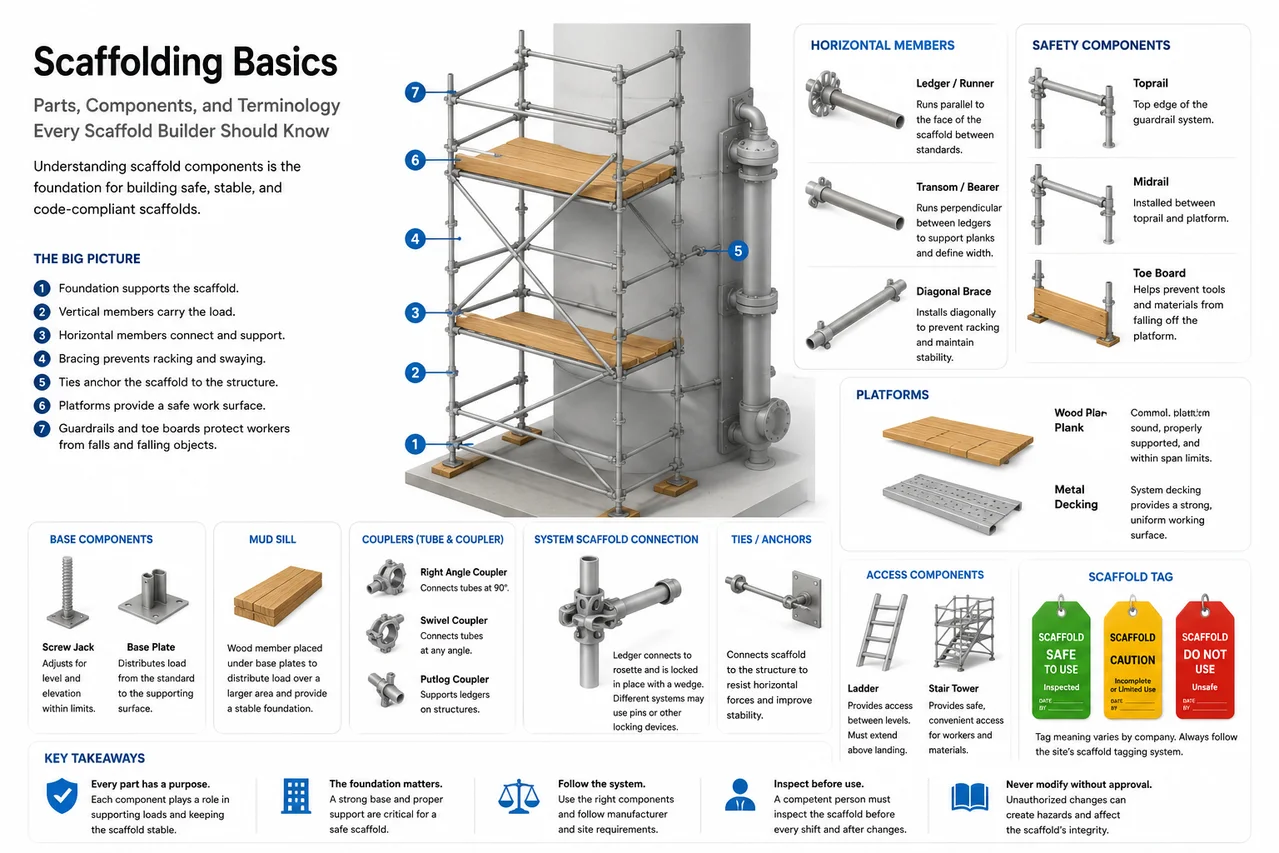
The primary vertical members of many supported scaffolds are commonly called standards, uprights, or posts, depending on the scaffold system and jobsite terminology. These members carry loads vertically through the scaffold toward the foundation.
Picture a scaffold tower as a temporary steel structure. The standards are similar in concept to columns. Platforms, workers, tools, and other permitted loads eventually transfer through the scaffold structure and downward through these vertical members.
On system scaffold, standards may contain connection points such as rosettes at regular intervals. Ledgers, transoms, braces, and other components connect at these locations using the manufacturer’s locking system. Other scaffold systems use different connection methods.
A standard should never be thought of as simply “another vertical pipe.” Its position, support, connection, and continuity affect the load path of the entire scaffold.
Base Plates
At the bottom of a scaffold standard is commonly a base plate. Its purpose is to provide a proper bearing surface and help distribute the load from the vertical member into the supporting foundation or sill arrangement.
Without adequate bearing, a concentrated scaffold load can cause the supporting surface to deform, settle, or fail. This is particularly important when scaffolding is erected over soil, gravel, asphalt, roofing, elevated structures, or other surfaces where bearing capacity must be considered.
A scaffold that is perfectly plumb during erection can become unsafe if its foundation settles after workers begin using it. That is why experienced scaffold builders pay close attention to what is underneath the scaffold before worrying about how high it will go.
Mud Sills
A mud sill is used beneath scaffold bases where necessary to distribute loads over a larger area of the supporting surface. Instead of concentrating the load at a small base plate, the sill helps spread that load.
The required sill arrangement depends on the scaffold, supporting surface, loads, and applicable design requirements. Builders should never assume that any random piece of lumber placed underneath a scaffold automatically makes the foundation acceptable.
The basic principle is easy to remember: the scaffold is only as dependable as the surface carrying it.
A 60-foot scaffold does not begin 60 feet in the air. Structurally, it begins at the ground.
Screw Jacks and Adjustable Bases
An adjustable screw jack, sometimes simply called a jack, can be used at the scaffold base to help establish the proper starting elevation and compensate for reasonable differences in the supporting surface within the scaffold system’s permitted adjustment limits.
The screw jack is not intended to compensate for a fundamentally unsuitable foundation. It also should not be extended beyond the manufacturer’s permitted limits.
This distinction is important. Builders sometimes think of the jack as a way to “make anything work.” It is not. The foundation must first be suitable for the scaffold. The adjustable base then helps establish a level starting condition within the limitations of the system.
Ledgers and Runners
A ledger is a horizontal scaffold member running between standards. Depending on the scaffold type and terminology being used, you may also hear horizontal members referred to as runners.
Ledgers connect vertical members together and help establish the scaffold bay. They also participate in transferring loads and maintaining the scaffold’s geometry.
If the standards are the vertical skeleton of the scaffold, ledgers form much of the horizontal framework tying that skeleton together.
Learning to distinguish vertical standards from horizontal ledgers is one of the first steps toward being able to look at a scaffold and understand how it is assembled.
Transoms and Bearers
Horizontal members running across the scaffold are commonly called transoms or bearers, depending on the scaffold system and terminology. These members can help establish scaffold width and support platform components.
A simple way for a beginner to visualize the relationship is to imagine a rectangular scaffold bay. Standards are vertical. Ledgers generally run along the length. Transoms or bearers cross between sides and may provide support for the working platform.
Exact terminology and structural function can vary between system scaffold, tube-and-coupler scaffold, frame scaffold, and manufacturer-specific systems. A professional builder learns the terminology used by the particular scaffold system rather than assuming every scaffold is assembled identically.
Scaffold Bays
The space between adjacent standards along the scaffold is commonly called a bay. Scaffold dimensions and allowable bay lengths are not arbitrary. They are affected by the scaffold system, intended loading, platform arrangement, design, and manufacturer requirements.
As scaffolds become larger, thinking in bays helps builders understand the structure. A long scaffold alongside a pipe rack might consist of multiple repeating bays connected together.
But those repeating rectangles are not enough by themselves. A structure composed only of vertical and horizontal members can still rack or sway. That is where bracing becomes critical.
Diagonal Braces
Diagonal braces help stabilize the scaffold and resist racking. Without adequate bracing, a rectangular framework can distort sideways even when its individual vertical and horizontal members appear properly connected.
Imagine a simple rectangle made from four hinged members. Push sideways on the top and it can deform into a parallelogram. Add an effective diagonal and the geometry becomes much more resistant to that movement.
Scaffold bracing works on the same fundamental structural principle.
Braces are therefore not optional pieces added because the scaffold “looks better” with them installed. They are structural components whose location and installation need to follow the scaffold system and design requirements.
The Næxon Learning Center article Scaffold Bracing Explained: Why Diagonal Braces Matter expands on this subject.
Ties, Guys, and Other Restraints
As supported scaffolds increase in height and complexity, they may require ties, guys, braces, outriggers, or other approved means of restraint according to the applicable scaffold configuration and requirements.
A scaffold tie connects the scaffold to an appropriate supporting structure at designated locations. The purpose is not simply to prevent the scaffold from visibly falling away from a building. Proper restraint helps control movement and maintain stability under the forces the scaffold is designed to encounter.
This becomes especially important around industrial structures where scaffolds may climb alongside vessels, columns, pipe racks, buildings, or other equipment.
A scaffold can feel solid when someone is standing on the first lift and still require significant restraint as its height increases. Stability needs to be considered for the entire scaffold, not judged by shaking one section with your hands.
Platforms, Planks, and Decking
The platform is the working surface used by the trades. Depending on the scaffold system, it may be constructed from approved scaffold planks, manufactured decking, metal decks, or another permitted platform system.
Platform installation involves much more than placing boards across scaffold members. Plank grade and condition, allowable span, overlap, support, securing requirements, platform width, openings, and component compatibility all matter.
Damaged planking can be dangerous even when the steel scaffold beneath it is perfectly constructed. Builders need to recognize splits, excessive damage, deterioration, deformation, missing components, or other conditions that could make platform materials unsuitable.
The Næxon Learning Center article Scaffold Planking Explained: Span, Overlap, Gaps, and Proper Support covers platform construction in greater detail.
Guardrails, Midrails, and Toe Boards
A scaffold platform may require a guardrail system consisting of components such as toprails, midrails, and supporting posts depending on the applicable requirements.
The toprail provides the upper barrier around an exposed platform edge. The midrail helps protect the opening below it. Toe boards are installed at platform edges in situations where required and can help prevent tools, materials, and other objects from being kicked or pushed from the platform.
Falling objects are a serious concern on industrial sites because several trades may be working at different elevations simultaneously. A small fitting, wrench, bolt, or piece of material dropped from an elevated scaffold can become a serious hazard to workers below.
Guardrails and toe boards should therefore be viewed as functional safety components rather than finishing touches added after the “real scaffold” has already been built.
Access Ladders and Stair Towers
A working platform is not complete simply because workers can somehow climb onto it. Scaffolds need an appropriate means of access.
Depending on the scaffold and project, access may involve approved ladders, ladder systems, stair towers, ramps, walkways, or other designated access methods. Workers should not create their own access by climbing scaffold components unless the system is specifically designed and approved for that purpose.
Good scaffold planning considers access early. Building a large scaffold first and then asking, “How are people going to get up there?” can create unnecessary modifications and poor access arrangements.
The Næxon Learning Center lesson Scaffold Access Explained: Ladders, Stair Towers, and Safe Entry goes deeper into this part of scaffold design.
Couplers and Clamps
Tube-and-coupler scaffolding uses scaffold tubes connected with approved couplers. Different couplers perform different functions. Some connect tubes at right angles, some allow other angles, and others join tubes end-to-end.
A scaffold coupler is a structural connection, not simply a clamp that holds two pieces of tubing in approximately the correct location. Correct coupler selection, placement, installation, and tightening are essential to the system’s performance.
System scaffolds use different connection methods. A ringlock-style system, for example, may use rosettes, ledger heads, and wedges rather than separate tube-and-coupler connections at every intersection.
Understanding which system you are working with is fundamental.
Rosettes, Wedges, and System Scaffold
Many industrial jobs use modular system scaffolding because components can be assembled into a wide variety of configurations efficiently.
In a common rosette-based system, standards contain rosettes positioned at regular intervals. Horizontal members and braces connect to the rosette through specially designed heads and wedges. When installed correctly according to the manufacturer’s system, these connections create a rigid scaffold framework.
The rosette provides multiple connection positions, allowing scaffold builders to create straight runs, corners, offsets, circular configurations, equipment access, and complex industrial structures.
This versatility is one reason system scaffold is common around refineries and process facilities where very little equipment is perfectly square or conveniently located.
Scaffold Tags
Many industrial sites use a scaffold tagging system to communicate inspection or use status. You may encounter green, yellow, red, or other tags depending on the site’s program.
Builders should never assume that a particular tag color has exactly the same meaning everywhere. The site’s scaffold program determines the meaning and requirements of its tagging system.
A tag may communicate whether a scaffold has been inspected, whether restrictions apply, whether fall protection is required, whether the scaffold is incomplete, or whether it must not be used.
The important rule is simple: understand the site’s scaffold-tagging procedure before using or modifying the scaffold.
The Næxon Learning Center article How to Read a Scaffold Tag: Green, Yellow, and Red Tag Systems will cover common systems and, importantly, why site-specific rules control.
The Competent Person
Scaffold work frequently involves the role of a competent person. In U.S. workplace-safety terminology, a competent person is not simply the worker with the most years in the trade. The role involves the ability to identify existing and predictable hazards and having authorization to take prompt corrective measures.
Competent-person responsibilities can include scaffold inspection and oversight required by the applicable rules and circumstances.
This distinction matters because experience and authority are both important. Someone might recognize that a scaffold condition is unsafe but lack the designated responsibility or authority associated with the competent-person role.
The Næxon Learning Center lesson Scaffold Inspection: What a Competent Person Looks For Before Every Shift will examine this subject in detail.
Load Capacity and Duty
A scaffold does not have unlimited capacity. Workers, tools, materials, platforms, and other permitted loads must remain within the scaffold’s designed capacity.
One of the biggest mistakes a scaffold user can make is thinking, “It’s steel. It’ll hold it.”
That is not how scaffold loading works.
The load must travel through platforms, bearers or transoms, ledgers, standards, connections, base components, and ultimately into the supporting surface. Changing one part of that system can affect the allowable loading elsewhere.
A platform built for workers performing light tasks should not automatically be treated as material storage simply because there is open space available.
The next Næxon Learning Center lesson, How to Calculate Scaffold Load Capacity and Duty Ratings, will explain scaffold loading in much greater detail.
Plumb, Level, and Square
Scaffold builders constantly work with three basic geometric conditions: plumb, level, and square.
Plumb means vertical. Level means horizontal. Square means the relevant members or layout are positioned at the intended right-angle relationship.
These basic conditions matter because errors multiply as the scaffold gets taller and longer. A small error at the first lift can become a much larger alignment problem several lifts higher.
This is why experienced builders spend time getting the foundation and first lift correct. Speed at the bottom means very little if the crew spends the rest of the build fighting the geometry created during the first few minutes.
Why Industrial Scaffolding Becomes Complicated
A simple scaffold built against a clear wall is one thing. Industrial scaffolding around process equipment is another.
A refinery scaffold may need to work around piping, valves, instruments, cable tray, structural steel, vessels, ladders, pumps, exchangers, insulation, operating equipment, and restricted areas. The scaffold still needs proper support, stability, access, platforms, clearances, and fall protection while navigating all those obstructions.
It also cannot simply block equipment that operations may need to access. Emergency equipment, operating valves, instrumentation, walkways, electrical equipment, ladders, and other critical features may require clearance.
This is where scaffold building becomes much more than assembling components. The builder has to visualize a three-dimensional structure before all of it exists.
Never Modify a Scaffold Because It Is in Your Way
This lesson is equally important for every other industrial trade.
If a ledger interferes with a pipe spool, a brace blocks access to a weld, or a guardrail makes a task inconvenient, that does not mean another trade should remove it.
A single component can have a structural or protective function that is not obvious to someone who did not build or design the scaffold.
Unauthorized scaffold modifications can change stability, platform support, fall protection, or the scaffold’s approved condition. Scaffold changes should be handled through the site’s authorized scaffold process.
For pipefitters, welders, electricians, boilermakers, millwrights, and other scaffold users, one of the most important rules is therefore extremely simple: if the scaffold is interfering with the work, get the scaffold crew involved.
Learn to See the Load Path
One of the biggest transitions from beginner to experienced scaffold builder happens when you stop seeing individual pieces and start seeing the load path.
A worker stands on the platform. The platform transfers the load into its supports. Those supports transfer load into the scaffold framework. The load moves through vertical members toward the base. Base components transfer it into the supporting surface.
At the same time, bracing and restraint help the scaffold resist movement and maintain its intended geometry.
Every component is part of a larger system.
That is why experienced builders look at a scaffold differently. They are not simply asking, “Is that ledger installed?” They are thinking, “What is this member doing, what is it supporting, and where is that load going?”
That mindset is the foundation of becoming a scaffold builder rather than simply someone who knows how to connect scaffold components.
The next lesson in the Næxon Scaffold Builder series is How to Calculate Scaffold Load Capacity and Duty Ratings, where we move from identifying the pieces to understanding how much load the scaffold is intended to support.