Learn | Pipefitting • Fabrication • Math & Layout • Intermediate
If you work around pipe, tanks, vessels, structural steel, or anything round, eventually you may need to answer a simple question:
How far does this curved surface stick out from a straight line?
That distance is called the sagitta, often shortened to sag.
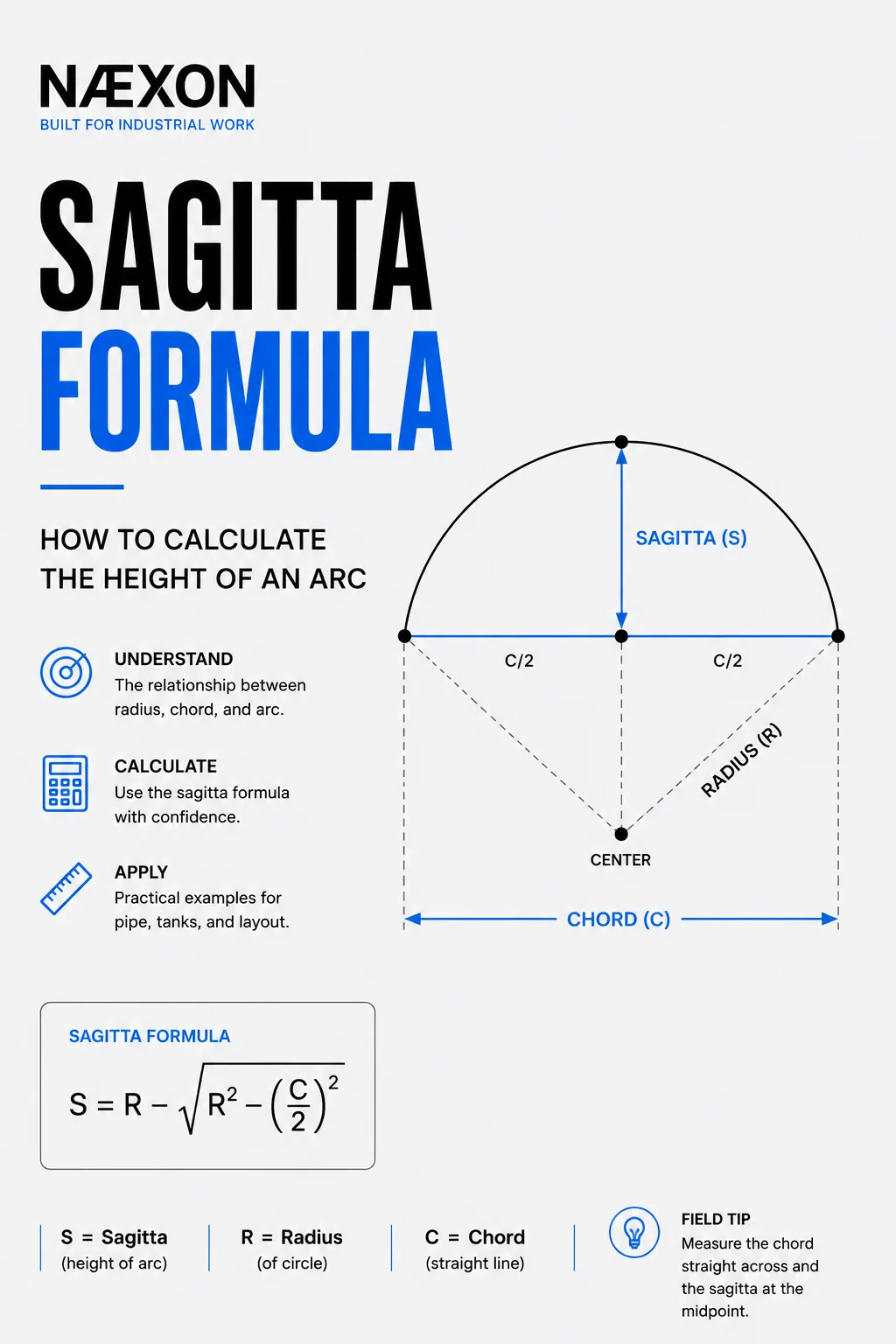
The name sounds complicated, but the idea is simple. Draw a straight line between two points on a circle. That straight line is the chord. Measure from the middle of that chord straight out to the curved surface. That measurement is the sagitta.
Once you understand those three parts—radius, chord, and sagitta—the formula becomes much easier to understand.
What Is a Sagitta?
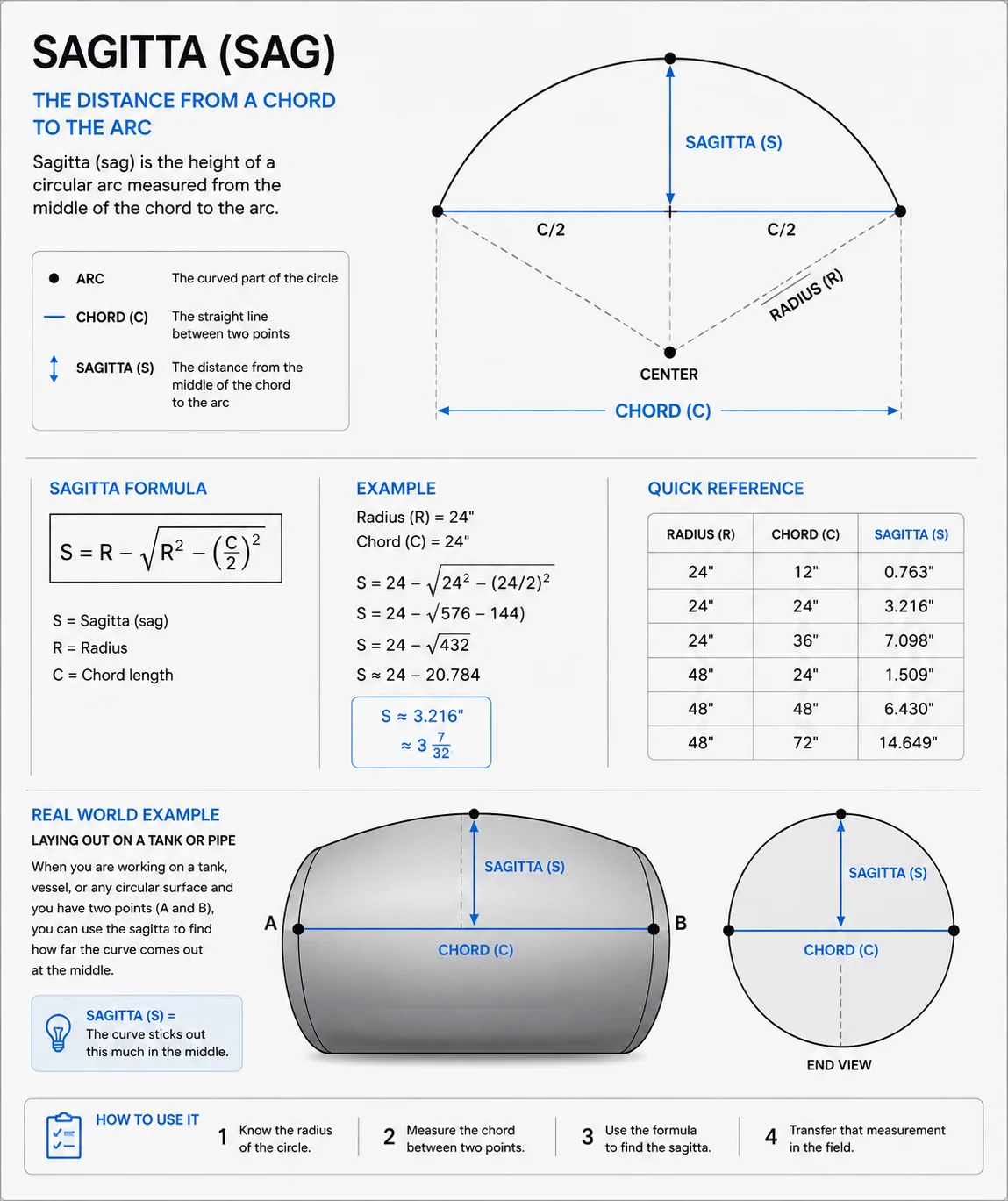
Sagitta (sag) diagram showing the relationship between the radius, chord, and arc. The sagitta is measured from the midpoint of the straight chord to the curved surface.
Imagine looking at the end of a large pipe or tank.
Pick two points on its curved surface and stretch a straightedge between them. The straightedge creates a straight line across part of the circle.
That line is the chord.
The surface between those two points remains curved. The distance from the middle of the chord to the curved surface is the sagitta.
In simple terms:
Chord = straight line between two points
Arc = curved surface between those points
Sagitta = how far the arc sticks out from the chord
You can think of it as the depth or height of the curve.
The Sagitta Formula
When you know the radius of the circle and the length of the chord, use:
\boxed{S=R-\sqrt{R^2-\left(\frac{C}{2}\right)^2}}
Where:
S = Sagitta
R = Radius
C = Chord length
It looks complicated at first, but we can break it down into a few simple calculations.
Understanding the Geometry
The reason the formula works comes from a right triangle hidden inside the circle.
Take the chord and divide it exactly in half. Draw a line from the center of the circle to the middle of the chord. Then draw another line from the center of the circle to one end of the chord.
You now have a right triangle.
The hypotenuse is the radius.
One side is half the chord.
The remaining side is the distance from the center of the circle to the chord.
This lets us use the Pythagorean theorem:
a^2+b^2=c^2
The distance from the circle center to the chord is:
\sqrt{R^2-\left(\frac{C}{2}\right)^2}
But we don’t want that entire distance. We want the little remaining distance between the chord and the outside of the circle.
So we subtract it from the radius:
S=R-\sqrt{R^2-\left(\frac{C}{2}\right)^2}
That’s the sagitta.
Simple Example
Suppose you have:
Radius = 24”
Chord = 24”
We want to find the sagitta.
Start with:
S=R-\sqrt{R^2-\left(\frac{C}{2}\right)^2}
Insert the numbers:
S=24-\sqrt{24^2-\left(\frac{24}{2}\right)^2}
First divide the chord by two:
24÷2=12
Now square the radius and half-chord:
24^2=576
12^2=144
Subtract:
576-144=432
Find the square root:
\sqrt{432}\approx20.784
Finally:
24-20.784=3.216
So:
\boxed{S\approx3.216″}
That’s approximately:
\boxed{3\frac{7}{32}”}
The curved surface therefore sticks out approximately 3 7/32” from the center of the chord.
Think About It in the Field
Imagine you’re standing beside a large round tank.
You place a straightedge across two points on the tank shell.
The straightedge touches the tank at both ends, but because the tank is round, there is a gap between the straightedge and the tank at the center.
That gap is the sagitta.
The longer your chord becomes, the deeper that center measurement becomes.
The larger the radius becomes while keeping the same chord, the flatter the surface becomes and the smaller the sagitta becomes.
That relationship is important.
Small radius = sharper curve = larger sag
Large radius = flatter curve = smaller sag
Diameter vs. Radius
Be careful when you’re given the diameter instead of the radius.
The sagitta formula requires the radius.
If you know the diameter:
R=\frac{D}{2}
For example, if a tank is 96” in diameter:
96÷2=48″
Your radius is:
\boxed{48″}
You would use 48”, not 96”, as R in the sagitta formula.
Another Example
Suppose you have a circular surface with:
Diameter = 96”
Chord = 24”
First find the radius:
96÷2=48″
Now:
S=48-\sqrt{48^2-\left(\frac{24}{2}\right)^2}
Half the chord:
24÷2=12
Square both:
48^2=2304
12^2=144
Subtract:
2304-144=2160
Square root:
\sqrt{2160}\approx46.476
Subtract:
48-46.476\approx1.524″
So the sagitta is approximately:
\boxed{1.524″}
That’s roughly 1 17/32” for practical field measurement.
Notice something important: the previous example used the same 24” chord but had a 24” radius and produced about 3.216” of sag. Increasing the radius to 48” made the same 24” section much flatter, reducing the sag to about 1.524”.
A Simple Field Method
When using sagitta in the field, think of the process as:
RADIUS → CHORD → HALF THE CHORD → FORMULA → SAG
First determine the radius of the circular surface. If you only have diameter, divide it by two.
Next determine the chord length. This is the straight-line distance between your two selected points.
Divide the chord by two.
Then plug the radius and half-chord into the sagitta formula.
The answer tells you how far the curved surface should be from the center of the chord.
Why Pipefitters and Fabricators Use Sagitta
Sagitta calculations become useful whenever you’re trying to establish or verify a circular shape without measuring the entire circle directly.
For example, imagine fabricating something that must follow the outside of a large vessel. You know the vessel diameter, and you know the width of the piece you’re fitting against it.
Instead of guessing the curvature, you can use the width as your chord and calculate how far the vessel should curve away from that straight line at its center.
The same principle can help when working with large pipe, tanks, vessels, curved structural members, templates, layout work, and circular fabrication.
Using Sagitta to Check a Radius
Sagitta can also work in reverse.
Suppose someone tells you a piece is supposed to have a certain radius. Instead of trying to find the physical center of a huge circle—which could be many feet away—you can measure a known chord across the curved surface and then measure the sag at its center.
If the measured sag agrees with the calculated sag, you have a quick way to verify that the curvature is close to the intended radius.
This can be especially useful when the center of the circle is inaccessible.
Why the Chord Must Be Measured Straight
The chord is not measured around the curved surface.
This is critical.
If you run your tape along the curve, you’re measuring arc length, not chord length.
The chord is the straight-line distance from one endpoint directly to the other.
Think:
Chord = straight across
Arc = around the curve
Those are different measurements.
The Sagitta Must Be Taken at the Middle
The maximum sag occurs at the center of the chord when the chord is positioned correctly across a circular arc.
If your chord is 24”:
24÷2=12″
Mark 12” from either end.
That is where the sagitta measurement should be taken.
Measuring several inches away from the midpoint will give you a different distance and will not match the calculated sagitta.
Common Mistakes
The most common mistake is using diameter when the formula requires radius. If you’re given diameter, divide it by two first.
Another mistake is using the entire chord where the formula requires half the chord. The formula contains C/2, so a 24” chord becomes 12” before it is squared.
Another common error is measuring the chord along the curved surface. Remember that the chord is a straight line.
Finally, don’t measure the sagitta from just anywhere along the chord. It is measured perpendicular from the midpoint of the chord to the arc.
Field Rule
Remember this picture:
Two points on a curve.
Straight line between them = CHORD.
Middle of that line to the curve = SAGITTA.
And remember the relationship:
The tighter the curve, the bigger the sag. The flatter the curve, the smaller the sag.
Once you understand that visually, you don’t have to memorize the formula blindly.
Knowledge Check
1. What is a chord?
A straight line connecting two points on a circle.
2. What is the sagitta?
The perpendicular distance from the middle of the chord to the circular arc.
3. Does the formula use radius or diameter?
Radius.
4. If the diameter is 120”, what is the radius?
120÷2=60″
5. If your chord is 30”, what value goes into the C/2 portion of the formula?
30÷2=15″
6. Do you measure the chord around the curved surface?
No. The chord is measured straight between the two endpoints.
Practical Exercise
You are working on a circular vessel with a:
Diameter = 72”
Your chord is:
24”
First find the radius:
72÷2=36″
Half the chord:
24÷2=12″
Now use:
S=36-\sqrt{36^2-12^2}
Square the numbers:
36^2=1296
12^2=144
Subtract:
1296-144=1152
Square root:
\sqrt{1152}\approx33.941
Subtract from the radius:
36-33.941\approx2.059″
So the sagitta is approximately:
\boxed{2.059″}
or about 2 1/16” for practical field measurement.
If you place a 24” straightedge between those two points on the 72” diameter circular surface, the curve should sit approximately 2 1/16” away from the straightedge at its midpoint.
Remember This
You don’t need to make sagitta complicated.
Radius tells you how big the circle is.
Chord tells you how far you’re spanning across the circle.
Sagitta tells you how much the circle curves between those two points.
For field work, remember:
\boxed{\text{CHORD → FIND THE MIDDLE → MEASURE TO THE ARC = SAGITTA}}
Once you can visualize those three pieces, the sagitta formula becomes another useful layout tool instead of just another equation to memorize.