Learn | Millwright • Rotating Equipment • Field Troubleshooting
A centrifugal pump can be aligned correctly, bolted down, and ready for service—and then suddenly show different alignment readings after the piping is connected.
One possible cause is pipe strain.
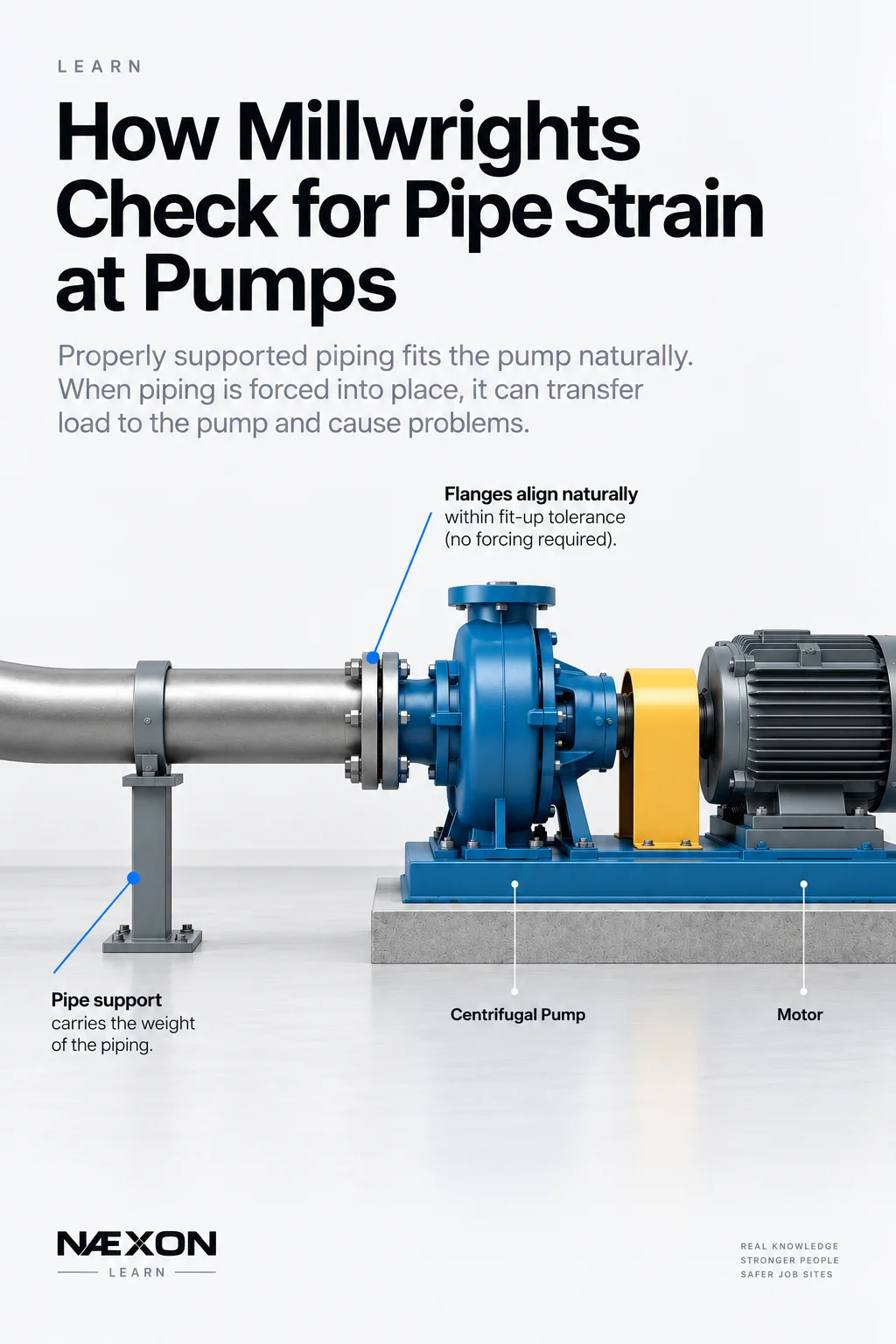
Pipe strain occurs when connected piping imposes unwanted forces or moments on a pump nozzle. Instead of the piping naturally meeting the equipment within the required fit-up tolerance, the piping has to be forced into position. Once the connection is tightened, that force doesn’t simply disappear. It can be transferred into the pump casing, base, supports, and connected system.
For a millwright, understanding this relationship is important because a problem that appears to be an alignment problem may actually originate several feet—or even much farther—away in the piping system.
What Pipe Strain Really Means
Picture a pump suction nozzle with the mating piping ready to connect.
Under the specified installation condition, the piping should arrive at the pump in the intended position and within the project’s allowable fit-up criteria. The flange bolts shouldn’t have to perform major corrective work to bring the two sides together.
If workers have to significantly pull, push, lift, twist, or force the piping into position, something deserves investigation.
The temptation is to say:
“Just pull it in with the bolts.”
That can hide the problem rather than solve it.
Once the joint is tightened, the piping may look perfectly normal from the outside while continuously applying load to the pump.
Why Pipe Strain Matters
Pumps and their drivers operate with relatively precise shaft relationships. Excessive external piping loads can potentially affect that relationship.
Depending on the equipment and severity of the condition, symptoms can include:
- Alignment readings changing after piping is connected
- Increased vibration
- Mechanical seal problems
- Coupling problems
- Bearing reliability issues
- Difficulty achieving repeatable alignment
- Unexpected movement during an approved pipe-strain check
- Repeated alignment problems after maintenance
One of the strongest clues is a machine that repeatedly aligns correctly until its piping is connected.
That doesn’t automatically prove pipe strain, but it gives the millwright a reason to investigate the piping connection rather than repeatedly moving the motor to compensate.
A Typical Field Situation
Imagine a pump and motor on a common base.
The millwright completes the required alignment checks and gets acceptable readings.
The suction and discharge piping are then connected.
Alignment is checked again.
Now the readings have changed.
Something affected the machine.
The pump hasn’t intentionally been moved. The motor hasn’t intentionally been moved. Yet the relationship between the shafts is different.
The connected piping becomes one of the conditions that must be evaluated.
If the piping is applying force to the pump nozzle, connecting that piping can influence the pump’s position or casing condition enough to affect the alignment readings.
How Pipe Strain Is Checked
A pipe-strain check must be performed according to the facility’s procedure, equipment manufacturer’s requirements, project specifications, and the approved work plan.
A process flange should never be loosened casually as a test.
Before any controlled disconnection, the system must have the required isolation, depressurization, drainage, decontamination, lockout/tagout, permits, and other controls applicable to that system.
Once the equipment is in the approved condition, millwrights may establish baseline measurements before the piping connection is changed.
Depending on the procedure, this can include shaft-alignment readings, flange position measurements, or other specified measurements.
The connection is then changed in the controlled manner required by the procedure.
The millwright watches the measurements—not just the flange.
If releasing the connection produces movement or causes a meaningful change in shaft alignment, the piping may be influencing the equipment.
The important point is that the acceptance criteria should come from the applicable engineering, manufacturer, or project requirements.
Don’t invent an allowable movement in the field.
Don’t Use Flange Bolts as Come-Alongs
This is one of the most important field principles in this lesson.
Suppose the piping flange sits noticeably low compared with the pump nozzle.
Someone installs the bottom bolts and starts tightening.
As the bolts are tightened, the pipe rises.
Eventually, the flange faces meet.
Problem solved?
Not necessarily.
The bolts may simply have forced the piping into position.
The pipe still wants to return toward its original position. The bolted connection is now restraining it, and some of that load may be transferred into the equipment.
The finished connection can look excellent while still containing unwanted stress.
A better question is:
Why didn’t the piping fit correctly before it was forced into position?
Look Beyond the Pump
The cause of pipe strain may not be at the flange.
Millwrights, pipefitters, and engineering personnel may need to examine the surrounding system.
Potential contributors include incorrectly set pipe supports, fabrication errors, improper support elevations, mislocated equipment, improperly adjusted spring supports, incorrect guide or anchor conditions, field modifications, settlement, or a piping configuration that isn’t in its intended installation position.
A support located well away from the pump can influence what happens at the nozzle.
This is why the solution shouldn’t automatically be:
“Move the pump until everything fits.”
That may compensate for the symptom while leaving the actual problem in the piping.
Watch the Suction Side
Large suction piping deserves particular attention because its weight and configuration can create substantial forces if it isn’t properly supported.
The pump nozzle is not intended to become a convenient pipe support.
Consider a large suction line approaching a pump horizontally. If the nearest support is incorrect, the piping may sag.
Workers may then lift the pipe into position and bolt it to the pump.
The connection fits.
But after the lifting equipment is removed, where does that load go?
If the piping support system isn’t carrying the load as designed, part of it may be transferred through the pump connection.
The same principle applies to discharge piping.
Cold Alignment and Operating Conditions
There is another important complication.
Industrial piping moves.
When temperature changes, piping expands and contracts. Equipment may also move as operating temperature changes.
Some systems are intentionally installed with specified cold positions so they move toward their intended operating position as temperatures change.
That means a worker cannot assume that every apparent offset, support gap, or unusual cold position is incorrect.
The piping design, support drawings, equipment requirements, and engineering specifications must be considered.
Never “correct” an intentional cold setting simply because it looks unusual.
Pipe Strain vs. Soft Foot
These problems can sometimes produce confusing alignment behavior, but they aren’t the same thing.
Soft foot concerns how the machine feet contact the base or mounting surface.
Pipe strain concerns external loads transmitted through connected piping.
A machine can have one, the other, or potentially both.
This is why good troubleshooting is systematic.
Instead of continuously moving equipment until the alignment numbers become acceptable, determine why the numbers are changing.
A Better Field Sequence
When the applicable procedure requires checking the effect of piping on a pump, think in terms of comparison.
Condition A: Establish the equipment condition and record the required baseline measurements.
Condition B: Connect or release the applicable piping connection according to the approved procedure.
Condition C: Repeat the measurements.
Then compare.
If the alignment remains essentially unchanged within the specified acceptance criteria, that’s useful information.
If the alignment changes beyond the applicable criteria, investigate what is loading the equipment before simply realigning around the problem.
Common Mistakes
Pulling piping into place with flange bolts
This can hide poor fit-up and introduce load into the equipment.
Realigning the motor every time the piping changes the readings
The alignment change may be a symptom. Moving the motor doesn’t necessarily correct the source.
Assuming the nearest pipe support is the problem
The actual cause may be elsewhere in the support system.
Adjusting supports without understanding their purpose
Guides, anchors, stops, spring supports, and other components have specific functions. Changing them without understanding the piping design can create a different problem.
Assuming every visible gap is wrong
Some systems have intentional cold settings or designed movement allowances.
Checking pipe strain without proper isolation
This is not simply an alignment exercise. Opening or loosening process connections can expose workers to serious hazards and must follow the facility’s approved procedures.
Field Troubleshooting Example
A maintenance crew replaces a pump.
The pump and motor are installed and aligned.
The readings are acceptable.
The suction piping is connected.
Alignment changes.
Instead of immediately repositioning the motor, the crew investigates the piping condition under the approved procedure.
They discover that the suction piping needs significant upward force to meet the pump nozzle.
The next question becomes:
Why is the suction line low?
Further inspection finds a support condition upstream that isn’t consistent with the required installation.
Now the crew is working toward the source of the problem rather than adjusting the machine to compensate for it.
That is the difference between simply obtaining good alignment numbers and understanding the mechanical system.
Field Rule
If connecting the piping changes the machine, don’t automatically move the machine. Find out what the piping is doing to it.
The best millwrights don’t just chase numbers on an alignment tool.
They ask why those numbers moved.
Knowledge Check
1. What is pipe strain?
Unwanted force or moment transferred from connected piping into equipment such as a pump.
2. Why shouldn’t flange bolts be used to correct major pipe misalignment?
Because forcing the piping into position can introduce external loads into the connected equipment.
3. If pump alignment changes after the piping is connected, does that automatically prove pipe strain?
No. It is an important clue that should be investigated systematically.
4. Can the source of pipe strain be located away from the pump?
Yes. Supports, anchors, guides, fabrication errors, equipment position, and other conditions elsewhere in the system can influence nozzle loading.
5. Why shouldn’t workers automatically adjust an unusual support position or flange offset?
Because some systems incorporate engineered cold settings and planned thermal movement.
Practical Exercise
Imagine you are aligning a motor to a centrifugal pump.
Before the suction piping is connected, the alignment meets the required tolerance.
After the suction flange is connected, the vertical alignment changes significantly.
You notice that workers had to lift the suction piping with a chainfall to install the flange bolts.
What should you investigate first?
Don’t immediately ask:
“How much should I move the motor?”
Ask:
“Why did connecting that pipe change the machine?”
That question is the beginning of proper pipe-strain troubleshooting.