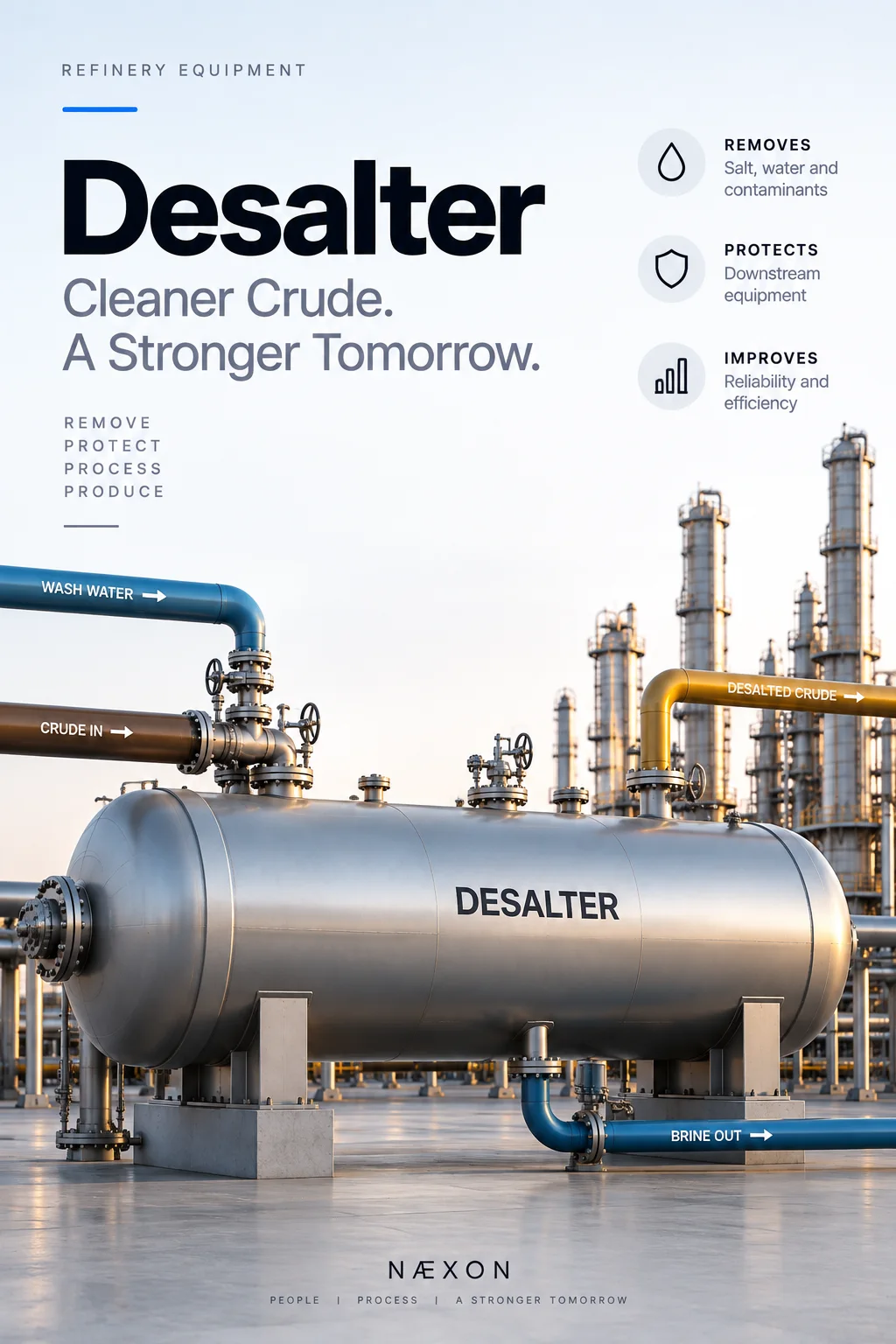
Before crude oil enters the main atmospheric distillation process, it normally passes through one of the refinery’s most important pieces of front-end protection: the crude oil desalter.
A desalter removes water, dissolved salts, sediment, and other contaminants from crude oil before the crude reaches downstream equipment.
The basic process is:
Raw Crude Oil → Heat → Wash Water → Mixing → Desalter → Cleaned Crude → Crude Unit
The contaminants removed by the desalter may seem small compared with the enormous amount of crude flowing through a refinery, but allowing them to remain can contribute to corrosion, fouling, deposits, plugging, and damage throughout the crude unit.
For pipefitters, operators, welders, instrument technicians, electricians, inspectors, and maintenance crews, the desalter is important because it sits near the beginning of the entire refining process.
What Is a Crude Oil Desalter?
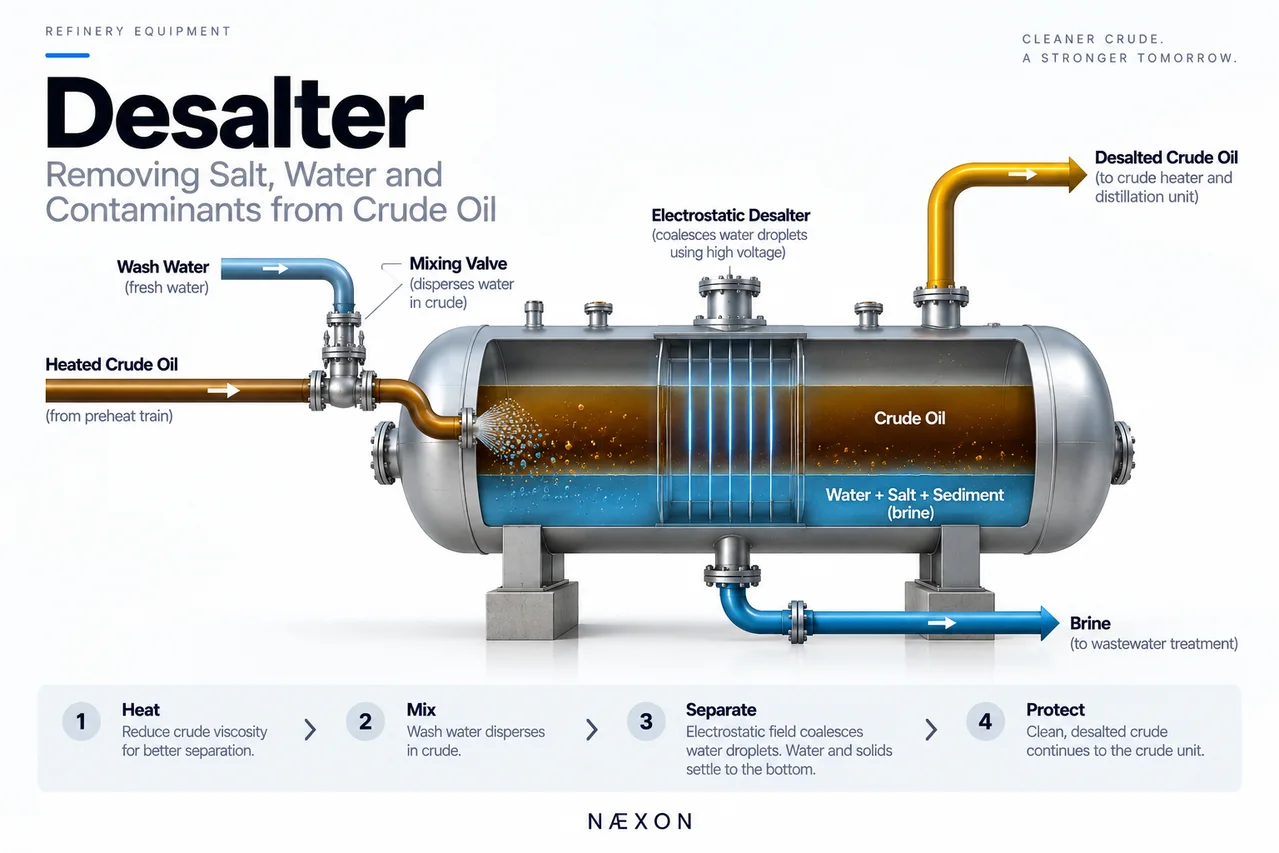
Figure 1. Crude Oil Desalter System. Simplified diagram showing how heated crude is mixed with wash water, separated through electrostatic coalescence, and discharged as cleaner desalted crude while salt, water, and sediment leave through the brine system.
A desalter is a large horizontal vessel designed to remove salt-containing water and suspended contaminants from crude oil.
Crude oil arriving at a refinery can contain small quantities of water.
That water can contain dissolved inorganic salts.
Common salts associated with crude include compounds containing:
- Sodium.
- Calcium.
- Magnesium.
- Chlorides.
The objective is not simply to filter salt crystals from the oil.
Instead, the refinery uses water to transfer dissolved salts out of the crude.
Why Salt Must Be Removed
If salt-containing crude continues into downstream processing equipment, high temperatures and process conditions can contribute to corrosion and deposit formation.
This can affect equipment such as:
- Heat exchangers.
- Fired heaters.
- Distillation towers.
- Overhead systems.
- Piping.
- Valves.
- Pumps.
Removing contaminants early helps protect much of the equipment downstream.
The desalter can therefore be thought of as a protective barrier at the front of the crude unit.
Where the Desalter Fits in the Refinery
A simplified crude-processing path is:
Crude Storage → Crude Charge Pumps → Preheat Train → Desalter → Additional Heating → Fired Heater → Atmospheric Distillation Column
The exact arrangement varies between refineries.
The important point is that desalting occurs before the crude reaches the highest-temperature portions of atmospheric distillation.
The Basic Desalting Principle
The basic concept is surprisingly simple.
Salt prefers the water phase rather than the oil phase.
So the refinery introduces relatively clean wash water into the crude.
The wash water contacts the crude and helps transfer salt into the water.
Then the water must be separated from the oil.
The process becomes:
Salted Crude + Wash Water → Mixing → Salt Transfers Into Water → Oil/Water Separation → Desalted Crude + Salty Effluent Water
The difficult part is accomplishing this continuously while enormous quantities of crude move through the refinery.
Crude Oil Is Heated
Crude viscosity affects how easily water droplets can move and separate.
Heating the crude reduces viscosity and generally helps the separation process.
The crude therefore commonly passes through heat exchangers before reaching the desalter.
The simplified path is:
Cold Crude → Heat Exchangers → Warm Crude → Desalter
This is another example of why refinery equipment operates as a system.
The performance of upstream heat exchangers can influence desalter performance.
Wash Water Is Added
Wash water is introduced into the crude stream.
Its purpose is to contact the crude and extract dissolved salts.
The water must be dispersed throughout the crude sufficiently for effective contact.
Poor mixing can leave salt behind.
But excessive mixing can create extremely small water droplets that become difficult to separate.
Therefore:
Too Little Mixing → Poor Salt Removal
Too Much Mixing → Stable Emulsion / Poor Separation
Successful desalting requires a balance.
The Mixing Valve
Many desalter systems use a mixing valve or another mixing device upstream of the vessel.
The pressure drop across the device helps disperse wash water through the crude.
This creates many water droplets that contact the oil.
Salt can transfer into those droplets.
The mixture then enters the desalter.
Mixing intensity is an important operating variable because droplet size affects separation.
Crude Enters the Desalter Vessel
The crude-and-water mixture enters the horizontal desalter vessel.
Inside the vessel, the refinery wants the opposite of what it wanted at the mixing valve.
Upstream:
Mix Oil and Water
Inside the desalter:
Separate Oil and Water
The water droplets must combine into larger droplets and settle toward the bottom.
The cleaned crude remains in the upper portion and leaves the vessel.
Electrostatic Coalescence
A major feature of many refinery desalters is the use of a high-voltage electrostatic field.
The electrical field encourages small water droplets suspended in the crude to interact and combine.
This process is called coalescence.
The simplified sequence is:
Small Water Droplets → Electrostatic Field → Droplets Combine → Larger Droplets → Faster Settling
Larger water droplets separate from crude much more easily than extremely small droplets.
This is why electrical equipment is such an important part of many desalter systems.
The Oil-Water Interface
Inside the desalter, crude occupies the upper portion of the vessel while separated water collects toward the bottom.
Between them is an oil-water interface.
Maintaining the correct interface level is extremely important.
If the water level becomes too high, water can potentially leave with the crude.
If the interface becomes too low, crude oil can potentially leave with the water effluent.
Operators therefore monitor interface level carefully.
Brine Leaves the Bottom
The separated water at the bottom contains much of the salt removed from the crude.
This water is commonly called brine or desalter effluent water.
The simplified separation is:
Desalter
Top → Desalted Crude
Bottom → Brine + Salt + Water + Sediment
The brine is routed to appropriate downstream wastewater or treatment systems according to refinery design.
Desalted Crude Leaves the Vessel
After water and contaminants have been removed, the crude exits the desalter and continues toward additional heat recovery and the crude heater.
The process continues:
Desalter → Preheat Train → Crude Heater → Atmospheric Distillation Column
The desalter therefore directly protects the equipment that follows it.
Single-Stage Desalting
Some systems use one desalter vessel.
The crude enters one desalting stage, wash water is mixed with the crude, contaminants transfer into the water, and the water is separated.
This arrangement is called single-stage desalting.
Two-Stage Desalting
Some refineries use two desalting stages when greater contaminant removal is required.
A simplified arrangement is:
Raw Crude → First Desalter → Second Desalter → Desalted Crude
Each stage provides another opportunity to remove salt and water.
Water arrangements can also be configured to improve efficiency.
What Is an Emulsion?
An emulsion occurs when very small droplets of one liquid remain suspended inside another liquid.
Inside a desalter, the concern is typically water dispersed throughout crude oil.
If the droplets become too small or are stabilized by contaminants, they may resist separation.
Instead of forming a clean interface, the vessel can develop an emulsion layer.
This can interfere with desalter performance.
What Causes Desalter Emulsions?
Several conditions can contribute to emulsion problems.
These can include:
- Excessive mixing.
- Crude composition.
- Fine solids.
- Contaminants.
- Improper chemical treatment.
- Incorrect temperature.
- Incorrect wash-water rate.
- Interface-control problems.
Operators may adjust several process variables when trying to restore proper separation.
Rag Layer
The difficult emulsion region between the oil and water phases is sometimes called a rag layer.
A large rag layer can interfere with:
- Water separation.
- Interface measurement.
- Salt removal.
- Vessel operation.
- Electrical performance.
Controlling the rag layer is therefore an important part of desalter operation.
Solids and Sediment
Crude oil can also contain fine solids and sediment.
These materials can collect inside the desalter.
Over time, deposits can accumulate near the bottom of the vessel.
This can reduce effective volume and interfere with drainage or separation.
Desalter cleaning can therefore become an important maintenance activity.
Desalter Temperature
Temperature strongly affects crude viscosity.
Warmer crude generally separates from water more easily because viscosity decreases.
However, temperature must remain within the intended operating range.
Desalter operation therefore depends on the performance of upstream heat exchangers and process controls.
Desalter Pressure
The vessel operates under pressure sufficient for its process conditions.
Pressure helps keep hydrocarbons in the intended liquid state at operating temperature.
As with any refinery pressure vessel, operating limits must be respected.
Pressure, temperature, level, and interface conditions are all monitored.
Electrical System
The electrical system associated with an electrostatic desalter is extremely important.
High-voltage equipment creates the electrostatic field used to promote water-droplet coalescence.
Depending on design, the system can include:
- Transformers.
- Bushings.
- Electrodes.
- Internal grids.
- Electrical controls.
- Protective systems.
This equipment presents specialized electrical hazards and should only be handled according to approved procedures.
Desalter Internals
Inside the vessel, equipment may be used to distribute incoming crude, maintain the electrical field, and promote effective separation.
Internals can include:
- Distribution piping.
- Electrodes.
- Grids.
- Supports.
- Baffles.
- Collectors.
- Interface-related equipment.
During turnaround inspection, these components may require careful examination.
Common Desalter Problems
High Salt in Desalted Crude
Possible contributors include poor mixing, inadequate wash water, emulsion problems, temperature issues, or separation problems.
Water Carryover
Water leaving with the crude can create downstream problems.
Oil Carryunder
Crude leaving with the brine wastes hydrocarbon and can create problems in wastewater systems.
Rag Layer Growth
A thick emulsion layer can interfere with normal separation.
Electrical Problems
Abnormal electrical conditions can reduce electrostatic coalescence performance.
Solids Accumulation
Sediment can accumulate in the bottom of the vessel.
Fouling
Contaminants can foul piping, valves, instruments, and vessel internals.
Why Desalter Performance Affects the Crude Unit
Poor desalter operation can create problems far downstream.
The chain can look like:
Poor Desalting → More Salt/Water Downstream → Increased Fouling or Corrosion Risk → Reduced Equipment Reliability
Equipment potentially affected includes crude preheat exchangers, fired heaters, atmospheric tower systems, overhead equipment, piping, and other downstream components.
A relatively simple-looking vessel can therefore influence the reliability of an enormous portion of the refinery.
Corrosion Concerns
Certain chloride salts can contribute to corrosive conditions when carried downstream into hotter refinery processes.
This is one of the major reasons desalting is so important.
The refinery wants contaminants removed before they reach equipment where temperature and chemistry can turn them into much larger problems.
Effective desalting is therefore partly a corrosion-control strategy.
Heat Exchanger Fouling
Solids and contaminants carried with crude can contribute to deposits inside heat exchangers.
Deposits reduce heat-transfer efficiency.
That can force the refinery to use more furnace energy later.
The sequence can become:
More Fouling → Less Heat Recovery → Greater Furnace Duty
Removing contaminants early can therefore support both reliability and energy efficiency.
Desalter Piping
Pipefitters working around desalters may encounter piping for:
- Crude inlet.
- Desalted crude outlet.
- Wash water.
- Brine.
- Drain systems.
- Chemical injection.
- Venting.
- Pressure relief.
- Sampling.
- Instrument connections.
Correct identification is important because several fluids converge around the vessel.
Field Knowledge for Pipefitters
A desalter may look like an ordinary horizontal pressure vessel, but its piping arrangement directly affects separation performance.
Important considerations include:
- Correct inlet configuration.
- Mixing-valve orientation.
- Wash-water connections.
- Brine drainage.
- Interface instrumentation.
- Vessel nozzle alignment.
- Pipe supports.
- Drainability.
- Pressure-relief piping.
- Chemical injection points.
Avoid creating unintended pockets in lines that are supposed to drain.
Never force piping into vessel nozzles using flange bolts.
As with other refinery equipment:
The piping should fit the equipment—not force the equipment to fit the piping.
Desalter Inspection and Maintenance
Maintenance activities can include:
- Vessel internal inspection.
- Electrode inspection.
- Grid inspection.
- Transformer inspection.
- Bushing inspection.
- Internal piping inspection.
- Sediment removal.
- Nozzle inspection.
- Corrosion inspection.
- Instrument testing.
- Mixing-valve maintenance.
- Brine-system inspection.
- Relief-device inspection.
Because solids can accumulate inside the vessel, cleaning may be a significant part of turnaround work.
Desalter Entry Hazards
A desalter removed from service can still contain hazardous material.
Potential hazards include:
- Hydrocarbon residue.
- Flammable vapor.
- Toxic gases depending on crude.
- Sludge.
- Chemicals.
- Oxygen deficiency.
- Confined-space conditions.
- Electrical equipment.
- Slippery internal surfaces.
Isolation, cleaning, ventilation, atmospheric testing, electrical isolation, confined-space procedures, and facility work controls are essential.
Troubleshooting Example
Suppose laboratory results show increasing salt content in crude leaving the desalter.
The immediate assumption might be that the desalter vessel itself has failed.
But the investigation could include:
- Wash-water flow.
- Wash-water quality.
- Crude temperature.
- Mixing-valve pressure drop.
- Interface level.
- Rag-layer condition.
- Electrical-system performance.
- Crude composition.
- Solids loading.
- Instrument accuracy.
The vessel may be showing the symptom while the actual cause is upstream or within one of its supporting systems.
This reinforces an important refinery troubleshooting rule:
Follow the entire process before assuming the equipment showing the symptom is causing the problem.
Important Desalter Terminology
- Desalter: Vessel used to remove salt-containing water and contaminants from crude.
- Wash Water: Water mixed with crude to extract dissolved salts.
- Brine: Salt-containing water separated from the crude.
- Coalescence: Combining small water droplets into larger droplets.
- Electrostatic Field: Electrical field used to promote water-droplet coalescence.
- Interface: Boundary between the crude and water phases.
- Emulsion: Stable mixture of small droplets of one liquid dispersed in another.
- Rag Layer: Emulsion-rich region near the oil-water interface.
- Mixing Valve: Device used to promote contact between crude and wash water.
- Carryover: Unwanted water leaving with the desalted crude.
- Carryunder: Unwanted oil leaving with the brine.
- Sediment: Solid material carried into the desalter with crude.
Field Rules
- Remember the desalter protects everything downstream.
- Mixing must be controlled. Too little mixing reduces salt removal; too much can create difficult emulsions.
- Respect the oil-water interface. Incorrect level can cause water carryover or oil carryunder.
- Protect brine drainage. Removed contaminants need a reliable path out of the vessel.
- Respect the electrical system. Electrostatic desalters use high voltage.
- Watch for solids accumulation. Sediment can reduce effective vessel volume and interfere with operation.
- Temperature matters. Crude viscosity strongly influences separation.
- Never force piping onto desalter nozzles.
- Do not assume an isolated desalter is clean. Sludge and hydrocarbon residue can remain inside.
- Think downstream. Poor desalting can become corrosion and fouling somewhere else in the crude unit.
Knowledge Check
- What is the primary purpose of a crude oil desalter?
- Why is wash water added to crude?
- Why is the crude heated before desalting?
- What does the mixing valve accomplish?
- Why can excessive mixing cause problems?
- What is electrostatic coalescence?
- Why do larger water droplets separate more easily?
- What is the oil-water interface?
- What leaves from the bottom of the desalter?
- What is a rag layer?
- What is water carryover?
- What is oil carryunder?
- Why can poor desalting contribute to downstream corrosion?
- Why can poor desalting increase heat-exchanger fouling?
- Why is desalter performance important to the entire crude unit?
Practical Exercise
Trace the crude through a simplified refinery front end:
Crude Storage → Charge Pump → Preheat Exchangers → Wash Water Addition → Mixing Valve → Desalter → Additional Preheat → Crude Heater → Atmospheric Distillation Column
At the desalter, identify:
- Crude inlet.
- Wash-water connection.
- Mixing device.
- Crude distribution system.
- Electrostatic section.
- Oil-water interface.
- Desalted crude outlet.
- Brine outlet.
- Interface instrumentation.
- Pressure instrumentation.
- Relief connection.
- Drain connections.
Then follow the contaminants:
Salt in Crude → Wash Water → Mixing → Salt Transfers Into Water → Water Droplets Coalesce → Brine Settles → Brine Leaves Desalter
Understanding these two paths—the crude path and the contaminant path—makes the desalter much easier to understand.
The Big Picture
The crude oil desalter is one of the first major protection systems encountered by crude entering the refinery.
Its job is to remove salt-containing water, sediment, and other contaminants before those materials reach hotter and more sensitive downstream equipment.
Remember the basic process:
Raw Crude + Wash Water → Mixing → Electrostatic Coalescence → Oil/Water Separation
Then:
Desalted Crude → Crude Unit
And:
Salt + Water + Sediment → Brine System
The desalter does not produce gasoline, diesel, or jet fuel.
Instead, it performs something just as important: it protects the equipment that eventually does.
Understanding the desalter means understanding that refinery reliability often begins long before crude reaches the distillation tower.
Equipment #20 — Desalter
Core 20 Refinery Equipment Series Complete