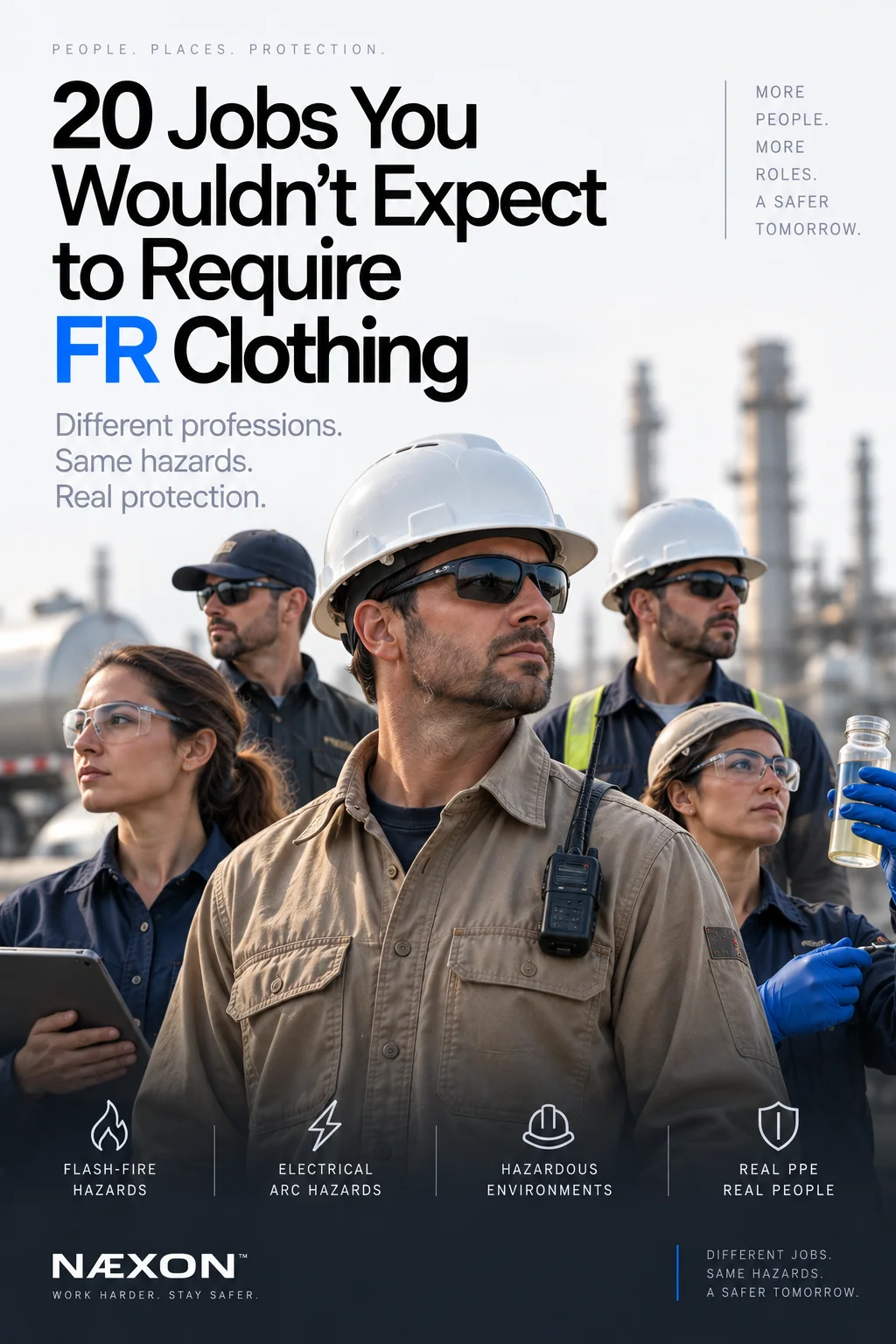
When most people think about flame-resistant clothing, they picture welders, pipefitters, refinery workers, linemen, or oilfield crews.
Those are obvious examples. But FR clothing reaches much further than the traditional industrial trades.
Engineers carrying tablets, surveyors setting up equipment, truck drivers making deliveries, environmental technicians collecting samples, inspectors checking welds, and project managers walking a facility can all find themselves in areas where flame-resistant or arc-rated clothing is required.
The important distinction is that FR requirements are generally driven by the hazard and work environment—not simply by the person’s job title.
Here are 20 professions and job functions where that can lead to some surprisingly serious FR requirements.
1. Engineers
An engineer may spend most of the day behind a computer, but entering an operating refinery, chemical plant, pipeline facility, electrical installation, or oil and gas production area can change the PPE requirements immediately.
Process engineers, mechanical engineers, reliability engineers, project engineers, and field engineers may all enter areas with potential flash-fire or electrical hazards.
A laptop doesn’t make someone exempt from the hazards around them.
2. Land Surveyors
Surveyors are an easily overlooked FR customer.
Industrial construction and maintenance projects require enormous amounts of layout, elevation verification, equipment positioning, and as-built surveying.
A survey crew working inside an operating refinery or petrochemical facility may therefore have to comply with the same site PPE requirements as many of the craft workers around them.
3. Safety Professionals
Safety coordinators, safety managers, inspectors, and other HSE personnel aren’t usually performing hot work themselves.
They’re often standing right where the work happens.
Walking operating units, observing maintenance activities, investigating incidents, conducting audits, and inspecting equipment can place safety personnel inside designated FR areas for much of their shift.
4. Project Managers
The project manager may have an office.
The project doesn’t.
PMs frequently walk jobsites to inspect progress, meet supervisors, verify field conditions, speak with customers, and review upcoming work.
On refinery, petrochemical, pipeline, power, and other industrial projects, those visits can require FR clothing even if the majority of the person’s job is administrative.
5. Construction Managers and Superintendents
Superintendents and construction managers can spend enormous amounts of time moving between field operations.
They’re inspecting installations, resolving conflicts, coordinating crews, reviewing drawings, and checking schedules.
Depending on the facility and hazards involved, FR clothing can effectively become their everyday uniform.
6. Tanker Truck Drivers
Driving the truck isn’t necessarily the biggest exposure.
Loading and unloading can be.
Drivers transporting petroleum products, fuels, or certain chemicals may work around transfer hoses, pumps, loading racks, storage tanks, terminals, and other equipment where flammable vapors may be present.
Depending on the operation and employer requirements, FR clothing can be an important part of the driver’s PPE.
7. Fuel-Delivery Personnel
Delivering gasoline, diesel, propane, or other fuels puts workers much closer to flammable materials than an ordinary delivery job.
Connections have to be made. Product has to be transferred. Equipment has to be handled.
A seemingly ordinary driving position can therefore involve industrial-level PPE requirements.
8. Environmental Technicians
Environmental work sounds far removed from welding and pipefitting until you consider where samples are collected.
Environmental technicians may work around tanks, process units, pipelines, wastewater systems, terminals, production facilities, and contaminated industrial areas.
When the sampling location is inside a designated hazardous area, appropriate FR clothing may be part of the required PPE.
9. Laboratory and Sampling Technicians
Some refinery and petrochemical samples come directly from operating process systems.
Technicians may collect or handle hydrocarbons and other materials capable of creating fire hazards.
Their work may look scientific rather than industrial, but the process doesn’t care what their job title says.
10. NDT/NDE Inspectors
Inspectors performing ultrasonic testing, radiography, magnetic particle testing, dye penetrant examinations, visual inspections, or other nondestructive examinations often work directly alongside operating equipment and maintenance crews.
They may inspect piping, pressure vessels, tanks, welds, structural components, and process equipment.
That frequently places them inside the same controlled work areas as the trades.
11. Quality-Control Inspectors
A QC inspector might spend part of the day reviewing paperwork and another part climbing through an industrial facility checking installed work.
Piping, welds, bolting, equipment alignment, materials, supports, and turnover inspections all require field access.
Where the facility requires FR, the clipboard doesn’t provide an exemption.
12. Instrumentation Technicians
Instrumentation and controls work is sometimes perceived as a cleaner, lighter-duty trade compared with mechanical construction.
The hazards can still be substantial.
Instrument technicians work around process equipment, electrical systems, control circuits, transmitters, analyzers, valves, and operating units. Depending on the task, both flash-fire and electrical hazards may have to be considered.
13. Industrial HVAC Technicians
Commercial HVAC and industrial HVAC can be very different environments.
A technician servicing equipment inside a refinery, chemical plant, power facility, manufacturing plant, or other industrial operation may encounter electrical hazards and facility-specific FR requirements.
The same technician who wears an ordinary work shirt on one job could need FR clothing on another.
14. Utility Meter and Substation Technicians
People tend to associate arc-rated clothing with electrical linemen, but electrical exposure isn’t limited to workers climbing poles.
Substation technicians, meter personnel, electricians, inspectors, and other utility employees may perform tasks where an electric arc hazard has been identified.
In these situations, appropriate arc-rated clothing can become a critical part of the PPE system.
15. Crane Operators
A crane operator may spend much of the shift inside a cab, but the crane itself can be working in the middle of a refinery turnaround, petrochemical facility, power plant, or other industrial operation.
Operators also leave their cabs for inspections, setup, coordination, and other tasks.
Facility requirements still apply.
16. Scaffold Inspectors
Scaffold inspectors aren’t necessarily performing process work, welding, or electrical work.
But they may have to inspect structures located directly around operating equipment.
Accessing those locations can mean entering areas where FR clothing is mandatory.
Once again, location and exposure matter as much as occupation.
17. Industrial Cleaning and Vacuum-Truck Crews
Hydroblasting, vacuum-truck operations, tank cleaning, exchanger cleaning, and industrial waste removal can put workers surprisingly close to hydrocarbons and process equipment.
These jobs are dirty, physical, and often performed during shutdowns and turnarounds.
Depending on the material, facility, and operation, FR clothing may be required as part of the site’s PPE program.
18. Railroad and Terminal Personnel
Railcars transport enormous quantities of petroleum and chemical products.
Workers involved in loading, unloading, switching, inspection, or terminal operations can work around flammable materials and transfer equipment.
The railroad environment may look completely different from a refinery, but some of the underlying hazards can be very similar.
19. Security and Emergency-Response Personnel
Industrial facilities employ people whose primary responsibilities aren’t construction or maintenance at all.
Security personnel, emergency-response teams, fire-watch personnel, and certain facility support employees may still need to enter process areas during normal operations or emergencies.
Their protective clothing has to reflect the environments they’re expected to enter.
20. Photographers, Drone Crews and Documentation Teams
This may be one of the most surprising examples.
Large industrial projects increasingly use photography, video, drones, laser scanning, and digital documentation to record construction progress and existing conditions.
A photographer may simply be there to take pictures.
But if getting those pictures requires entering an operating industrial area with an established FR requirement, the camera doesn’t change the PPE rules.
The Job Title Isn’t What Determines the Hazard
This is the key lesson.
A welder isn’t automatically required to wear the exact same clothing everywhere simply because they’re a welder. Likewise, an engineer isn’t automatically exempt because they’re an engineer.
Employers evaluate the hazards associated with the work.
For flash-fire exposure, flame-resistant clothing may be selected to reduce the severity of burn injuries by resisting ignition and limiting continued burning after the ignition source is removed.
For electrical work, arc-rated clothing is selected according to the electrical hazard and required level of protection. Although the terms are sometimes casually used interchangeably in the field, FR and arc-rated are not identical concepts.
Workers should follow their employer’s hazard assessment, PPE program, facility requirements, garment labeling, and applicable safety standards.
Why FR Clothing Matters Even When You’re Not Doing the Work
Imagine an engineer standing 20 feet away from a crew opening process equipment.
The engineer isn’t turning the wrench.
That doesn’t necessarily mean the engineer is outside the potential hazard.
The same principle applies to inspectors, supervisors, surveyors, photographers, and visitors.
Industrial PPE requirements frequently establish minimum protection for everyone entering a particular area because an unexpected release, ignition, electrical event, or process upset doesn’t distinguish between the worker performing the task and the person standing nearby.
FR Is Bigger Than the Trades
Welders, pipefitters, boilermakers, electricians, ironworkers, millwrights, operators, and oilfield workers will always be strongly associated with FR workwear.
But they’re only part of the picture.
Engineers need it.
Inspectors need it.
Drivers need it.
Surveyors may need it.
Safety professionals may wear it every day.
Managers who normally work behind a desk can suddenly need it the moment they walk through the gate.
That’s why one of the best questions isn’t:
“Does my profession require FR clothing?”
It’s:
“What hazards am I going to be exposed to where I’m working?”
That question gets much closer to how industrial PPE actually works.
Field Rules
- Never assume your job title exempts you from a facility’s FR requirements.
- Check the site’s PPE requirements before entering an operating area.
- Understand the difference between general flame-resistant clothing and clothing specifically rated for electrical arc hazards.
- Check garment labels and ratings instead of relying only on appearance or marketing terminology.
- Wear FR garments correctly; protection can be compromised when clothing is improperly worn, modified, contaminated, or combined with inappropriate layers.
- Follow the employer’s hazard assessment and PPE program for the actual task and location.
- When visiting an unfamiliar industrial facility, determine the clothing requirements before arriving at the gate.
The Bigger Picture
FR clothing isn’t really a “welder shirt,” a “refinery shirt,” or an “oilfield shirt.”
It’s protective workwear intended for specific hazards.
And those hazards exist across far more occupations than most people realize.
The person standing beside the pipefitter might be an engineer. The person climbing the structure might be an inspector. The person approaching the loading rack might be a truck driver. The person walking through the unit might be a project manager.
Different professions.
Same hazardous environment.
And sometimes, the same need for protection.