Flame-resistant clothing is strongly associated with refineries, pipelines, drilling rigs, and petrochemical plants.
But oil and gas doesn’t own the fire hazard.
Electrical arcs, combustible dust, molten metals, flammable chemicals, fuels, batteries, thermal hazards, and other ignition risks exist across industries that many workers would never immediately associate with FR workwear.
That means you can leave the refinery behind and still encounter workplaces where flame-resistant or arc-rated clothing is required.
The important point is that FR requirements are based on the hazard and the employer’s assessment of that hazard—not simply the name of the industry.
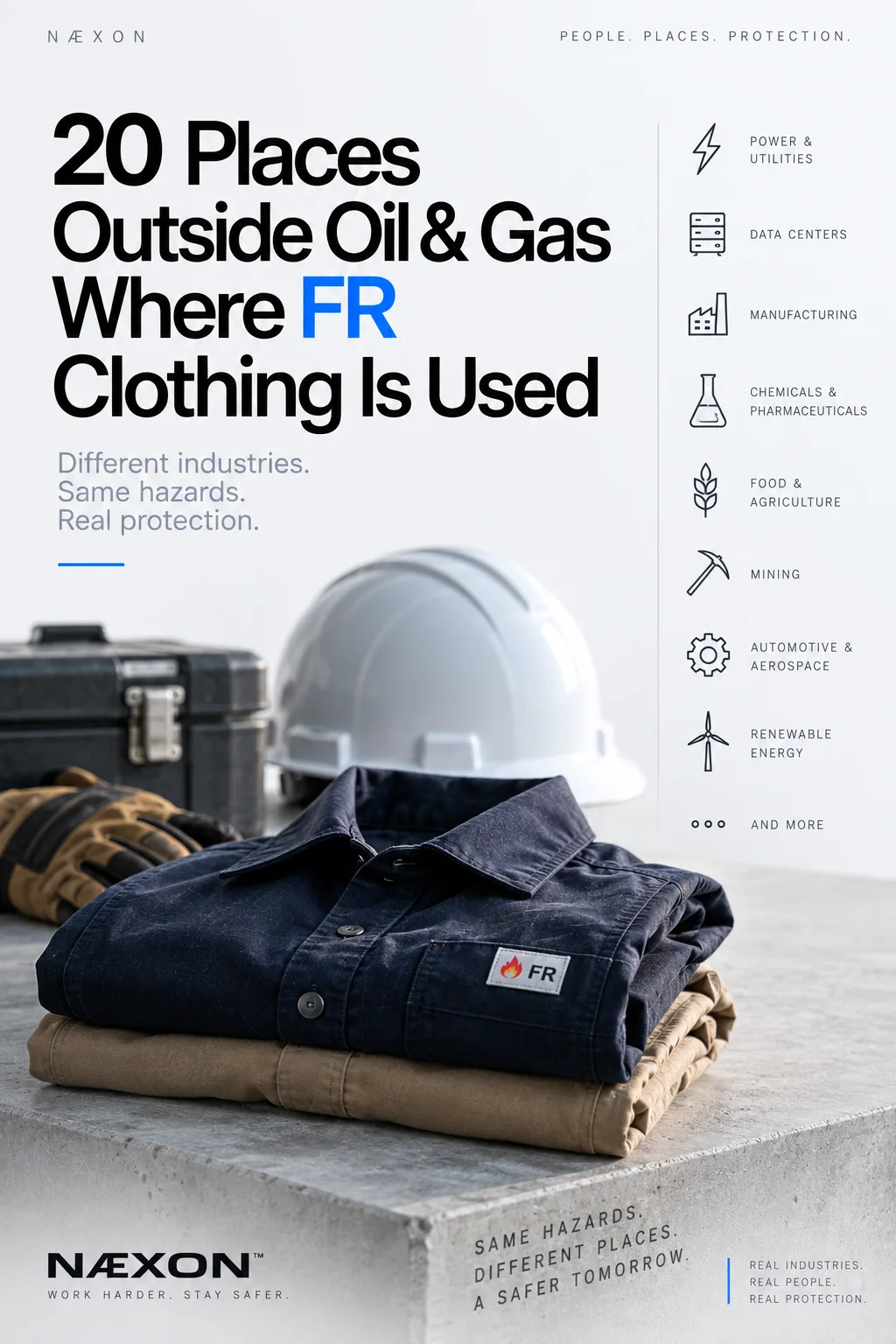
Here are 20 places outside traditional oil and gas operations where you may encounter FR or arc-rated clothing.
1. Electric Utility Facilities
Electric utilities are one of the biggest examples.
Linemen are obvious, but electrical exposure extends far beyond workers climbing poles.
Substations, switchyards, generating facilities, distribution systems, underground electrical systems, and other utility infrastructure can expose qualified workers to electric-arc hazards.
This is also where an important distinction matters:
Flame-resistant does not automatically mean arc-rated.
When protection against an electric arc is required, clothing must have the appropriate arc rating for the identified hazard.
2. Data Centers
A modern data center may look more like a laboratory than a traditional industrial facility.
Behind those rows of servers, however, is a serious electrical infrastructure.
Switchgear, transformers, generators, UPS systems, battery systems, busways, and electrical distribution equipment all support the enormous power demand.
Electricians and qualified electrical personnel performing certain energized tasks may therefore require arc-rated PPE.
The internet may live in the cloud.
The electricity powering it definitely doesn’t.
3. Steel Mills
Steel production involves extreme temperatures, molten metal, sparks, slag, furnaces, and numerous other thermal hazards.
Depending on the operation and exposure, workers may require specialized flame-resistant protective clothing designed for the particular hazard.
This is an important reminder that not every FR application involves petroleum.
Sometimes the heat source is obvious.
4. Foundries
Foundries melt and pour metals into molds to manufacture components.
That can put workers around molten material, radiant heat, sparks, furnaces, and hot surfaces.
Protective clothing requirements can therefore be significantly different from those of an ordinary manufacturing facility.
In some applications, specialized garments designed for molten-metal exposure may be necessary rather than assuming an ordinary FR work shirt is sufficient.
5. Aluminum Plants
Aluminum production and processing creates its own set of thermal and electrical hazards.
Workers can encounter molten aluminum, furnaces, casting operations, high-current electrical systems, and other dangerous energy sources.
Protective clothing must be selected for the actual exposure.
That’s an important theme throughout industrial safety:
FR isn’t one universal level of protection.
6. Chemical Manufacturing Plants
Remove petroleum refining from the picture and there are still thousands of chemicals capable of burning, reacting, releasing vapor, or creating dangerous process conditions.
Chemical manufacturing facilities can contain reactors, storage vessels, piping systems, pumps, loading areas, electrical equipment, and process units.
Many of the physical systems would look completely familiar to someone coming from a refinery.
So can some of the hazards.
7. Pharmaceutical Manufacturing Facilities
This one surprises people.
Pharmaceutical manufacturing can involve solvents, alcohols, powders, chemicals, process vessels, dryers, reactors, and other equipment that create potential fire or explosion hazards.
The finished product may be medicine.
The manufacturing process can still involve industrial hazards.
Depending on the process and work area, specialized protective clothing may therefore be required.
8. Grain Elevators
A grain elevator doesn’t look anything like a refinery.
But combustible dust can create an extremely serious fire and explosion hazard.
Fine particles suspended in air can behave very differently from a pile of grain sitting quietly on the ground.
Under the right conditions, an ignition source combined with dispersed combustible dust can produce rapid combustion and potentially devastating explosions.
Grain handling is one of the clearest examples of why something doesn’t need to look dangerous to deserve respect.
9. Food-Processing Plants
Food doesn’t immediately sound like a fire hazard either.
But some food-processing operations handle combustible powders and dusts such as flour, sugar, starches, and other finely divided materials.
Facilities can also contain boilers, electrical distribution systems, refrigeration equipment, processing machinery, ovens, and other industrial systems.
The required PPE depends on the particular operation and hazards present.
10. Paper and Pulp Mills
Paper mills combine heavy industrial machinery with chemicals, boilers, steam systems, electrical equipment, combustible materials, and large process systems.
Maintenance personnel working in these facilities can encounter many of the same types of mechanical and electrical hazards found in other heavy industries.
Pipefitters, millwrights, electricians, welders, instrumentation technicians, operators, and maintenance crews can all be found inside a large mill.
Different product.
Very familiar industrial environment.
11. Mining Operations
Mining involves much more than digging material out of the ground.
Modern mines can contain huge electrical systems, processing equipment, conveyors, crushers, maintenance shops, fuel systems, mobile equipment, and underground infrastructure.
Certain mining environments may also involve combustible gases or dust.
Protective clothing requirements therefore vary significantly depending on the mine, location, equipment, and work being performed.
12. Railroad Maintenance and Transportation Facilities
Railroads transport far more than passengers.
Industrial rail systems move chemicals, fuels, agricultural products, raw materials, and countless other commodities.
Workers may also maintain locomotives, electrical equipment, fueling systems, railcars, and terminal infrastructure.
Certain tasks and locations can therefore create fire, electrical, or chemical hazards requiring specialized PPE.
13. Aerospace Manufacturing
Aerospace manufacturing sounds technologically advanced—and it is.
But building aircraft, spacecraft, engines, and related systems still requires industrial processes.
Workers can encounter fuels, solvents, composite materials, electrical systems, welding, heat treatment, testing operations, and specialized manufacturing equipment.
High technology doesn’t eliminate industrial hazards.
Sometimes it creates entirely new ones.
14. Automotive Manufacturing Plants
Modern automotive factories contain massive electrical distribution systems, robotic welding cells, paint operations, furnaces, battery systems, maintenance shops, and extensive production machinery.
Maintenance electricians and other qualified personnel may perform tasks involving electrical arc hazards.
Workers performing hot work or specialized manufacturing operations can face entirely different exposures.
The vehicle rolling off the line may look polished.
The infrastructure building it is heavy industry.
15. Battery Manufacturing and Energy-Storage Facilities
Battery technology is becoming increasingly important as electric vehicles, grid storage, data centers, and renewable-energy systems expand.
But storing large amounts of energy introduces hazards that must be carefully controlled.
Battery manufacturing and large energy-storage installations can involve electrical energy, chemical exposure, fire hazards, and thermal events.
Protective clothing is only one part of a much larger safety system, but certain tasks can require specialized PPE selected for the specific hazard.
16. Solar Power Facilities
Solar panels themselves may appear relatively harmless.
A utility-scale solar installation, however, is an electrical generating facility.
Large arrays feed electrical collection systems, inverters, transformers, switchgear, and substations.
Qualified electrical workers maintaining or troubleshooting portions of those systems can encounter electrical hazards requiring appropriate arc-rated PPE.
Renewable energy is still energy.
17. Wind Farms
The same principle applies to wind turbines.
Inside and around a modern turbine are generators, transformers, electrical cabinets, power electronics, cables, and other electrical systems.
Technicians may perform troubleshooting and maintenance in extremely confined working environments.
Depending on the equipment, task, and electrical hazard assessment, arc-rated protective clothing may be required.
18. Waste-to-Energy Facilities
Some municipal waste isn’t simply buried.
It’s converted into energy.
Waste-to-energy plants can contain boilers, turbines, generators, electrical distribution systems, combustion equipment, conveyors, and pollution-control systems.
From a craft worker’s perspective, portions of these facilities can resemble conventional power plants.
That means many familiar industrial hazards come with them.
19. Manufacturing Plants With Combustible Dust
Wood.
Plastic.
Metal.
Sugar.
Flour.
Starch.
Many materials that seem harmless in solid form can behave very differently when reduced to sufficiently fine particles and dispersed in air.
Facilities that generate or handle combustible dust require careful control of ignition sources, housekeeping, ventilation, equipment design, and operating procedures.
Where a flash-fire hazard has been identified, protective clothing may become another layer in the overall protection strategy.
20. Power Plants
Power generation may be the clearest example of FR use outside oil and gas.
Coal, natural gas, nuclear, biomass, hydroelectric, and other generating facilities contain extensive electrical and mechanical infrastructure.
Switchgear, generators, transformers, boilers, turbines, pumps, piping, high-energy systems, and maintenance activities create multiple types of hazards.
Electrical workers in particular may require arc-rated clothing where an arc-flash hazard exists.
A power plant doesn’t need to process crude oil to be serious industrial work.
FR Isn’t an Oilfield Uniform
One of the biggest misconceptions about flame-resistant clothing is treating it like a uniform associated with a particular industry.
It isn’t.
FR clothing is part of a protective system intended to address particular hazards.
A refinery worker may need FR because of potential flash-fire exposure.
An electrician at a data center may need arc-rated clothing because of an electrical arc hazard.
A foundry worker may need specialized protection against heat or molten material.
A worker in a grain facility may face combustible-dust hazards.
The clothing can look similar while the reason for wearing it can be completely different.
FR and Arc-Rated Are Not the Same Thing
This distinction deserves special attention.
All arc-rated clothing is flame resistant, but flame-resistant clothing is not automatically arc-rated for electrical arc exposure.
Arc-rated garments have been evaluated for their performance when exposed to electric-arc energy and carry an arc rating.
That rating matters when an employer determines that arc-rated PPE is necessary for electrical work.
Simply seeing “FR” on a garment shouldn’t be treated as proof that it provides the required protection for every hazard.
Workers should verify the garment’s labeling, ratings, applicable standards, and their employer’s PPE requirements.
The Hazard Determines the Protection
Imagine two electricians.
One works on ordinary de-energized equipment under established safe work conditions.
The other performs a task involving equipment where an electric-arc hazard has been identified.
Same trade.
Different exposure.
Potentially different PPE.
Now imagine two engineers.
One never leaves the office.
The other spends half the week walking through manufacturing plants, substations, and operating industrial facilities.
Same profession.
Completely different work environment.
That’s why asking “Does this profession wear FR?” only tells part of the story.
A better question is:
“What hazards does this worker actually encounter?”
Field Rules
- Don’t assume FR clothing is only for oil, gas, welding, or refinery work.
- Follow the employer’s hazard assessment and PPE requirements for the specific task.
- Understand whether the hazard involves flash fire, electrical arc, molten material, combustible dust, heat, chemicals, or another exposure.
- Don’t assume a garment marked FR automatically provides the necessary electrical arc protection.
- Verify garment labels and ratings before relying on them as PPE.
- Wear protective clothing as intended and maintain it according to the manufacturer’s instructions.
- Remember that FR clothing is normally only one part of the PPE system.
- Never substitute clothing for proper engineering controls, safe work practices, isolation, de-energization, ventilation, or other required protections.
Industrial Work Is Bigger Than Oil & Gas
Walk through a refinery and you’ll find pipefitters, welders, electricians, millwrights, operators, engineers, and inspectors.
Walk through a steel mill and you’ll find many of them again.
Then visit a paper mill.
A chemical plant.
A power station.
A data center.
A battery facility.
A food-processing plant.
The products change.
The buildings change.
The equipment changes.
But energy, heat, electricity, chemicals, combustible materials, and ignition sources don’t disappear simply because you’ve crossed into another industry.
That’s the bigger lesson behind FR clothing.
It’s not about where you work.
It’s about what can happen where you work.