Electricians work around two electrical hazards that are often talked about as if they are the same thing:
electric shock and arc flash.
They are not.
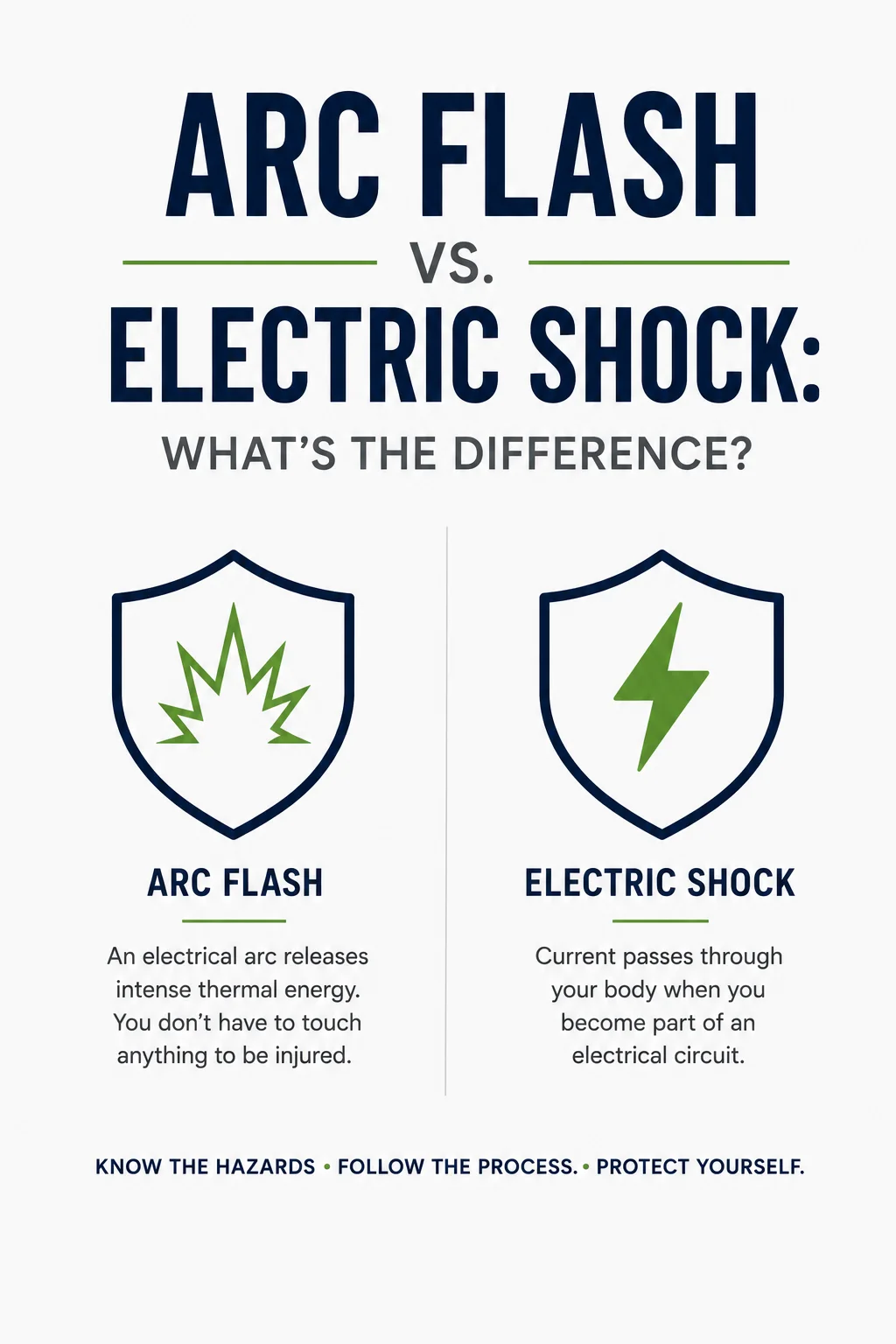
A worker can suffer a severe electrical shock without an arc flash occurring. A worker can also suffer catastrophic arc-flash injuries without directly touching an energized conductor.
That difference matters because the hazards are evaluated differently, the protective boundaries are different, and the PPE used to protect against one hazard does not automatically protect against the other.
For industrial electricians working around switchgear, motor control centers, disconnects, transformers, distribution panels, temporary power, control cabinets, and other electrical equipment, understanding the distinction is fundamental.
The simplest way to remember it is:
Shock = electrical current passing through the body.
Arc flash = thermal energy released by an electrical arc.
Both can be fatal.
But they hurt you in very different ways.
What Is Electric Shock?
Electric shock occurs when the human body becomes part of an electrical circuit and current passes through it.
For current to flow, there must be a voltage difference and a conductive path.
Imagine a worker simultaneously contacting an energized conductor and a grounded enclosure.
The body can become part of the path between those two electrical potentials.
Current may then flow through:
hand → arm → torso → legs → ground
or between two points of contact, such as:
hand → hand
The path matters because current traveling through the chest can affect the heart and respiratory system.
Electrical shock can produce effects ranging from tingling and involuntary muscle contraction to severe burns, respiratory arrest, cardiac disturbances, and death.
The seriousness of the injury depends on much more than voltage alone.
Voltage Is Only Part of the Story
People often describe electrical danger by voltage:
120 volts
277 volts
480 volts
4,160 volts
Voltage matters because it provides the electrical potential capable of driving current through a resistance.
But the injury to the body is closely related to the current that actually flows through it, the path that current takes, and how long exposure lasts.
A simplified relationship comes from Ohm’s law:
I = V ÷ R
where:
I = Current
V = Voltage
R = Resistance
Suppose the voltage stays constant while body resistance decreases.
Current increases.
That is one reason moisture can make electrical contact more dangerous. Wet or damaged skin can provide substantially less resistance than dry intact skin.
But human-body resistance is variable, and real electrical injuries are more complicated than a simple textbook resistor calculation. Ohm’s law helps explain the principle; it should not be used to decide that a particular exposure is “safe.”
It Does Not Take Huge Current to Be Dangerous
Industrial electrical systems can deliver enormous fault currents, but a shock injury does not require thousands of amps to pass through the body.
Human physiology can be affected by currents measured in milliamperes.
As current increases, a person may experience painful shock, involuntary muscle contraction, loss of muscular control, breathing difficulty, dangerous heart rhythms, burns, and other serious effects.
Exact physiological response varies considerably with current path, exposure duration, frequency, body condition, contact area, and other factors.
The practical lesson is more important than memorizing a single “dangerous current” number:
Never use a current threshold as permission to contact an energized circuit.
A voltage commonly encountered every day can still create a fatal shock under the wrong conditions.
What Is an Arc Flash?
An arc flash is different.
Instead of current intentionally or accidentally flowing through the worker’s body, electrical current travels through ionized air or another conductive path between energized components or from an energized component to ground.
That electrical arc can release tremendous energy extremely quickly.
The result can include:
extreme heat, intense light, molten metal, vaporized material, hot gases, pressure effects, and flying debris.
The worker does not necessarily need to touch the conductor.
That is the key distinction.
With shock, the body becomes part of the electrical circuit.
With an arc flash, the worker can be injured by the energy released from the electrical fault.
Think of It This Way
Imagine an energized electrical cabinet.
Shock hazard
Your hand contacts an energized conductor while another part of your body provides a path to a different electrical potential.
Current passes through your body.
Arc-flash hazard
A fault develops inside the equipment and creates an electrical arc.
You may never touch the conductor.
But the energy from the arc reaches you.
These are two different exposure mechanisms.
That is why electrical safety cannot be reduced to:
“Don’t touch the wires.”
Avoiding direct contact is critical for shock protection, but it does not by itself address arc-flash exposure.
What Can Start an Arc?
An electrical arc can result from many conditions.
A conductive object may bridge energized components.
A tool may slip.
Insulation may fail.
Equipment may be damaged.
Loose or deteriorated connections can contribute to electrical failures.
Animals, contamination, moisture, conductive dust, or foreign material can create unintended paths.
Equipment can also fail while being operated.
The important point is that an arc does not require someone to intentionally touch two energized conductors together.
Electrical equipment contains energy.
Under certain fault conditions, that energy can be released through an arc.
Why an Arc Can Become So Violent
Air normally acts as an electrical insulator.
Under sufficient electrical stress or fault conditions, however, the air can ionize.
Once ionized, the path can conduct electrical current.
A tremendous amount of electrical energy can then be released through a relatively small region.
Temperatures within an electrical arc can become extraordinarily high—high enough to melt and vaporize metal.
The danger to a nearby worker is not simply “electricity jumping.”
It is the conversion of electrical energy into intense thermal and mechanical effects.
This is why an arc flash can cause severe burns even when the worker never experiences a traditional electric shock.
Arc Flash and Arc Blast Are Related—but Not Identical
The terms arc flash and arc blast are sometimes used interchangeably in jobsite conversation, but they describe related aspects of an arcing fault.
Arc flash generally refers to the intense thermal energy associated with the arc.
Arc blast refers to pressure and mechanical effects that can accompany a high-energy arcing event.
Rapid heating can cause air and vaporized materials to expand violently.
The event may produce:
pressure waves, flying material, equipment fragments, molten metal, and intense sound.
The severity depends heavily on the electrical system and fault conditions.
An electrical arc should therefore never be thought of as simply a “big spark.”
Shock Protection Is About Preventing Current Through the Body
Shock protection focuses heavily on preventing the worker from contacting energized parts or otherwise becoming part of an electrical path.
That can involve:
de-energization, establishing an electrically safe work condition, approach boundaries, insulation, guarding, appropriate tools, work practices, and shock-protection PPE when required.
The Næxon Learning Center guide How to Verify Absence of Voltage: Test Before You Touch covers one of the most important protections: verifying that hazardous voltage is actually absent before beginning work under an electrically safe work condition.
When equipment is properly de-energized and the required safe-work condition is established, both shock and arc-flash exposure can often be dramatically reduced or eliminated for the work being performed.
That is why de-energization is such a fundamental electrical-safety strategy.
Arc-Flash Protection Is About Incident Energy
Arc-flash protection asks a different question:
If an arcing fault occurs, how much thermal energy could reach the worker at a particular distance?
This is where the concept of incident energy becomes important.
Incident energy is commonly expressed in:
cal/cm²
or calories per square centimeter.
An arc-flash risk assessment may determine the potential incident energy at a specified working distance.
That information helps determine appropriate protective measures and, where applicable, arc-rated clothing and equipment.
This is fundamentally different from measuring circuit voltage alone.
Two pieces of equipment operating at the same nominal voltage can present very different arc-flash conditions because many other factors influence the potential energy of an event.
Available Fault Current Matters
Imagine two 480-volt systems.
Both operate at the same voltage.
One is supplied through a system capable of delivering much more fault current than the other.
Their arc-flash hazards may not be identical.
Factors affecting an arc-flash analysis can include:
available fault current,
protective-device clearing time,
equipment configuration,
working distance,
system grounding,
and other characteristics.
This is why simply saying:
“It’s only 480.”
does not adequately describe the hazard.
Voltage is important, but it is not the entire arc-flash calculation.
Clearing Time Can Make a Major Difference
Protective devices are designed to interrupt fault current under specified conditions.
How quickly that happens can have a major effect on the amount of energy released.
Consider two otherwise similar arcing faults.
One is interrupted very quickly.
The other continues for longer before the protective device clears it.
The second event can release substantially more energy because the arc persists longer.
That is one reason electrical coordination, protective-device settings, and system maintenance matter.
Arc-flash risk is not just about how much current exists.
It is also about:
how long the energy is allowed to flow.
What Is the Arc-Flash Boundary?
The arc-flash boundary is associated with potential thermal exposure from an arc flash.
It is not simply the distance at which electricity can “jump” to someone.
Instead, it relates to the distance at which the incident energy from a potential arc flash reaches a defined threshold used for protection against thermal injury.
Inside that boundary, additional arc-flash protective measures may be required depending on the task and conditions.
This is different from shock approach boundaries.
Understanding that difference prevents one of the most common electrical-safety misunderstandings.
Shock Boundaries and Arc-Flash Boundaries Are Not the Same
Shock protection uses concepts such as the:
Limited Approach Boundary
and
Restricted Approach Boundary
where applicable.
These are associated with the risk of electrical shock from exposed energized conductors or circuit parts.
The:
Arc-Flash Boundary
addresses thermal exposure from a potential arc flash.
They are calculated or determined for different hazards.
That means the distances may be different.
You should never assume:
Arc-flash boundary = shock boundary.
They serve different purposes.
The Næxon Learning Center lesson Approach Boundaries Explained: Limited, Restricted, and Arc-Flash Boundaries covers these concepts in greater detail.
Can You Be Outside the Shock Boundary but Inside the Arc-Flash Boundary?
Depending on the equipment and hazard analysis, yes.
That is exactly why separating the two hazards matters.
A worker could be positioned far enough away that direct contact with exposed energized parts is not the primary concern while still being close enough to receive dangerous thermal energy if an arc flash occurs.
The opposite relationships can also depend on the equipment and electrical conditions.
There is no universal assumption that one boundary always controls.
The hazards must be evaluated individually.
Electrical Gloves Do Not Automatically Solve Arc-Flash Exposure
Electrical insulating gloves are primarily associated with shock protection when properly selected, tested, maintained, and used as required.
Arc-rated clothing addresses thermal exposure from an arc flash.
Those are different protective functions.
Likewise, an arc-rated shirt does not make it acceptable to contact an energized conductor.
This is one of the most important PPE principles in electrical work:
PPE must match the hazard.
Shock protection and arc-flash protection can overlap during a task, but they should not be confused.
FR and Arc-Rated Are Not Automatically the Same Thing
Another important distinction is between flame-resistant (FR) clothing and arc-rated (AR) clothing.
Arc-rated clothing has been evaluated for exposure to electric-arc thermal hazards and carries an arc rating.
A garment being described as flame resistant does not automatically establish that it has the arc rating required for a specific electrical task.
Electrical workers should use the PPE specified by the electrical-safety program, equipment labeling, hazard assessment, applicable standards, and employer requirements.
Never assume protection based solely on the appearance, thickness, or marketing name of a garment.
For electrical work, the actual rating matters.
Why Ordinary Clothing Can Make an Arc-Flash Injury Worse
Some clothing materials can ignite, melt, or continue burning when exposed to intense thermal energy.
That can extend the injury beyond the initial electrical event.
Properly selected arc-rated clothing is designed to reduce the severity of thermal injury within its intended performance limitations.
But PPE is still the last line of defense.
The better strategy remains to eliminate or reduce exposure whenever possible.
De-energization beats dressing for the accident.
PPE matters because some electrical tasks still involve exposure during activities such as verification, troubleshooting, testing, or justified energized work.
It should never become an excuse to perform unnecessary energized work.
The Face and Head Need Protection Too
An arc flash does not selectively strike a worker’s shirt.
The face, eyes, head, neck, and hands may all be exposed.
Depending on the hazard assessment and incident-energy level, protection may involve combinations of:
arc-rated clothing, face shields, balaclavas, arc-flash suits or hoods, eye protection, hearing protection, gloves, and other required PPE.
The exact equipment depends on the task and assessed hazard.
This is why copying another electrician’s PPE setup without understanding the equipment or task is not a safe approach.
The correct protection comes from the hazard assessment.
Why Opening Equipment Can Change the Exposure
Electrical equipment is designed with covers, doors, barriers, and enclosures for important reasons.
Removing covers or opening equipment can expose energized components that were previously guarded.
That can change the worker’s exposure to shock and arc-flash hazards.
Even before touching anything, the task may require a different risk assessment because the equipment’s protective enclosure is no longer providing the same separation.
This is why removing a panel cover should never be treated as casually as opening a toolbox.
The Næxon Learning Center lesson Electrical Panel Safety: What to Check Before Removing the Cover addresses this situation specifically.
Testing for Voltage Can Itself Be an Energized Exposure
This point connects directly to How to Verify Absence of Voltage: Test Before You Touch.
To prove that equipment is de-energized, a qualified worker may need to perform a voltage test.
But until absence of voltage has been verified, the worker must consider the possibility that the equipment is energized.
That means the verification process itself may involve shock and arc-flash exposure.
This apparent contradiction makes sense once you understand the sequence:
You do not assume equipment is dead while performing the test designed to prove that it is dead.
The appropriate protective measures remain in place until the required verification is completed.
Why “I’m Not Touching Anything” Is Not Enough
A worker standing in front of energized equipment may say:
“I’m not touching anything.”
That may reduce one particular type of shock exposure.
It does not automatically eliminate arc-flash risk.
If an arcing event occurs, thermal energy does not require the worker to be physically touching the fault.
That is one of the biggest differences between shock and arc flash.
For shock:
contact or another conductive path through the body is central to the hazard.
For arc flash:
proximity to the energy release can be enough to cause injury.
Why 120 Volts Still Deserves Respect
Industrial workers sometimes become comfortable around lower-voltage systems because they regularly work near 277-, 480-, or even medium-voltage equipment.
That can create dangerous complacency.
A 120-volt circuit can still produce serious or fatal shock under the right conditions.
Wet environments, damaged skin, conductive surfaces, poor contact conditions, current path through the torso, and exposure duration can all affect the outcome.
Lower voltage does not mean:
no electrical hazard.
The upcoming Næxon Learning Center lesson Why 120 Volts Can Kill You: Understanding Electrical Shock Current goes deeper into this subject.
Arc Flash Does Not Mean Every Energized Panel Will Explode
It is equally important not to exaggerate the hazard.
Not every energized electrical enclosure is moments away from producing a catastrophic arc flash.
Electrical safety should be based on actual hazard assessment, equipment condition, task, system characteristics, and established procedures—not fear.
The purpose of arc-flash analysis is precisely to move away from guessing.
Good electrical safety asks:
What hazard actually exists?
How severe could it be?
What exposure does this task create?
Can the hazard be eliminated?
If not, what controls are required?
That is professional risk management.
Shock vs. Arc Flash: The Core Difference
The distinction can be summarized simply.
Electric shock
The body becomes part of an electrical path.
Primary concern:
Current through the body.
Potential consequences include:
muscle contraction, burns, respiratory effects, cardiac effects, falls, and death.
Arc flash
An electrical arc releases intense energy.
Primary concern:
Thermal exposure and associated effects of the arcing event.
Potential consequences include:
severe burns, eye injury, ignition of clothing, molten-metal exposure, and other injuries.
An arcing event may also create mechanical and pressure hazards.
One incident can expose a worker to multiple hazards at the same time.
The Best Protection Starts Before PPE
When workers hear “arc flash,” the first thing they often picture is a heavy arc-flash suit.
That skips several important steps.
Electrical safety begins with eliminating the hazard where feasible.
Establishing an electrically safe work condition can remove the worker from exposure to hazardous electrical energy for many tasks.
Engineering controls, equipment design, protective-device coordination, remote operation where appropriate, maintenance, barriers, safe work practices, and administrative controls can further reduce exposure.
PPE addresses the remaining hazard.
Think of the hierarchy this way:
Eliminate what you can.
Control what remains.
Protect against the residual risk.
The suit is not the safety program.
Treat Shock and Arc Flash as Two Separate Questions
Before working around electrical equipment, a qualified worker should not ask only:
“Can this shock me?”
There is another question:
“Could this task expose me to an arc-flash hazard?”
Likewise, seeing an arc-flash label does not eliminate the need to consider shock protection.
Both hazards need to be evaluated.
This becomes especially important during troubleshooting, voltage testing, racking operations, switching, equipment opening, and other tasks where energized electrical components may be involved.
The Rule Worth Remembering
If you remember only one thing from this lesson, remember:
Shock requires a harmful electrical path through the body.
Arc flash can injure you without your body becoming that path.
That difference explains why electrical safety uses different boundaries, different assessments, and different forms of PPE.
It also explains why simply keeping your hands off the conductors does not address every electrical hazard.
A professional electrician does not just know that electricity is dangerous.
A professional electrician understands how the hazard can reach them.
That understanding changes how the work is planned, how equipment is approached, how voltage is verified, how PPE is selected, and when the safest decision is to de-energize the equipment before the work begins.
Shock and arc flash are different hazards. Respect both.