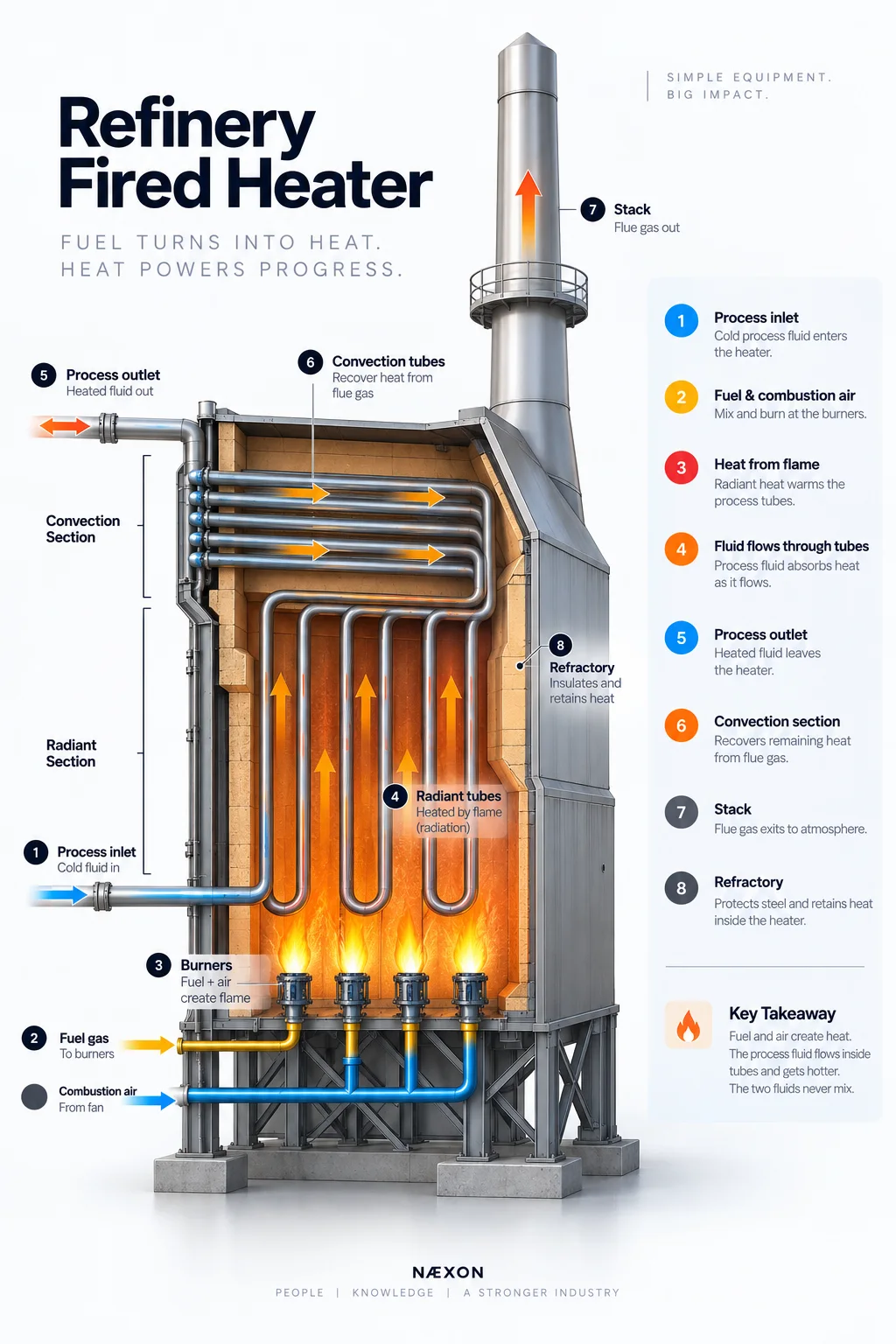
A fired heater, often called a process heater or furnace, is one of the most important—and potentially hazardous—pieces of equipment in a refinery.
Its job sounds simple: heat a process fluid.
But unlike a heat exchanger, which transfers heat from one process stream to another, a fired heater creates heat by burning fuel. Flames inside the heater can reach extremely high temperatures while process fluid moves through tubes positioned only a short distance away.
Fired heaters are commonly associated with crude units, vacuum units, hydrotreaters, hydrocrackers, reformers, cokers, and many other refinery processes.
For pipefitters, welders, boilermakers, operators, instrument technicians, electricians, inspectors, refractory workers, and maintenance personnel, understanding how a fired heater works is essential refinery knowledge.
What Is a Fired Heater?
A fired heater is industrial equipment that uses combustion to heat process fluid flowing through tubes.
The basic energy path is:
Fuel + Air → Combustion → Heat → Heater Tubes → Process Fluid
The process fluid never intentionally contacts the flame.
Instead, it flows inside tubes.
The fire is outside the tubes.
Heat passes through the tube wall and into the process stream.
That distinction is fundamental.
Why Refineries Need Fired Heaters
Heat exchangers can recover enormous amounts of energy, but eventually some refinery processes require more heat than heat recovery alone can provide.
That is where the fired heater comes in.
Depending on the unit, a heater may be used to:
- Raise feed to its required process temperature.
- Heat crude before atmospheric distillation.
- Heat atmospheric residue before vacuum distillation.
- Supply heat for reactor-feed systems.
- Vaporize part of a process stream.
- Maintain temperatures required for chemical reactions.
- Provide high-temperature process duty that exchangers alone cannot achieve.
A fired heater often represents one of the final major heating steps before the process enters another critical piece of equipment.
A Simple Example: Crude Unit Furnace
Consider a crude distillation unit.
Incoming crude does not go directly from storage into the distillation tower.
It typically passes through substantial heat recovery first.
Hot refinery streams transfer heat into the incoming crude through the crude preheat train.
The crude gets hotter and hotter.
Eventually it reaches the fired heater.
The furnace provides the remaining heat necessary before the crude enters the atmospheric distillation tower.
The simplified flow becomes:
Crude → Preheat Exchangers → Fired Heater → Distillation Tower
The heat exchangers save energy.
The fired heater provides the final high-temperature duty.
Major Parts of a Fired Heater
Although designs vary considerably, many refinery fired heaters contain several recognizable sections and components.
Understanding them allows you to visualize what is happening behind the casing.
1. Radiant Section
The radiant section is the area containing the burners and visible flame.
Process tubes line portions of this chamber.
These are called radiant tubes.
They receive a large portion of their heat directly through thermal radiation from the flame and hot combustion environment.
Think of this as the primary firebox.
The radiant section is usually the hottest part of the heater.
2. Radiant Tubes
Process fluid flows inside the radiant tubes.
The outside surfaces are exposed to intense heat.
The energy path is:
Flame → Tube Surface → Tube Wall → Process Fluid
The tube wall therefore lives between two very different environments.
Outside:
Extremely hot combustion gases
Inside:
Pressurized process fluid
Tube integrity is critical.
A tube failure can release hydrocarbons directly into the firebox.
3. Burners
The burners create the controlled flame.
Fuel and combustion air are introduced in a designed pattern that allows stable combustion.
Depending on the heater, burners may be located:
- In the floor
- Along the walls
- In other engineered arrangements
Modern refinery burners are designed around factors such as:
- Flame shape
- Heat distribution
- Fuel efficiency
- Emissions
- Combustion stability
- Required heater duty
A burner is much more than a nozzle shooting fire into a box.
4. Fuel Gas System
Many refinery heaters burn fuel gas.
The fuel system may contain:
- Fuel gas piping
- Pressure regulation
- Control valves
- Shutoff valves
- Burner piping
- Pilots
- Flame monitoring
- Safety interlocks
Because fuel is deliberately being delivered to an ignition source, the system includes multiple layers of control and protection.
Fuel-gas work requires strict adherence to refinery procedures.
5. Combustion Air
Fire requires oxygen.
Burners therefore require a controlled supply of combustion air.
Some heaters use natural draft, where chimney action pulls air into the furnace.
Others use fans.
Depending on the system, you may encounter:
- Forced-draft fans
- Induced-draft fans
- Air preheaters
- Dampers
- Ductwork
- Registers
Controlling air is essential.
Too little air can result in incomplete combustion.
Too much air can waste energy by heating unnecessary excess air and sending that heat out the stack.
6. Convection Section
Hot combustion gases leaving the radiant section still contain significant energy.
Instead of immediately exhausting them, many heaters route them through a convection section.
Additional process tubes are positioned there.
The hot flue gas flows around these tubes and transfers additional heat into the process.
The convection section therefore recovers heat that would otherwise leave through the stack.
7. Convection Tubes
Convection tubes may look different from radiant tubes.
Some designs use extended surfaces such as studs or fins to increase heat-transfer area.
The basic heat path is:
Hot flue gas → Tube → Process fluid
Unlike the radiant section, convection is a major heat-transfer mechanism here.
The process stream may travel through the convection section before entering the radiant section, depending on the heater design.
8. Crossover Piping
Some fired heaters have piping that connects different heater coil sections.
This is commonly referred to as crossover piping.
For example, process fluid may travel:
Convection section → Crossover → Radiant section
These lines can operate at significant temperature and must accommodate thermal expansion.
Their supports, guides, spring hangers, and connections deserve careful attention.
9. Refractory
The inside of the heater cannot simply expose its structural steel shell directly to firebox temperatures.
Refractory provides thermal protection.
Refractory materials line portions of the heater and help:
- Retain heat
- Protect structural components
- Control casing temperature
- Improve thermal efficiency
Damaged refractory can create localized hot spots on the heater casing.
This is why refractory condition matters far beyond appearance.
10. Stack
After combustion gases have transferred useful heat to the process, they leave through the stack.
The stack helps discharge flue gas safely and, in natural-draft systems, contributes to the draft that moves combustion gases through the heater.
From the outside, the stack is often the easiest feature for identifying a fired heater.
11. Dampers
Dampers help regulate flue-gas movement and draft.
Their position can affect combustion conditions inside the heater.
Draft control is important because furnace pressure must remain within the intended operating range.
A fired heater is not simply allowed to breathe however it wants.
Air entering and combustion gas leaving are carefully controlled.
How the Process Fluid Moves
The process fluid travels through an engineered coil.
It may enter the convection section first.
There, relatively cooler flue gases begin heating it.
The stream then travels toward the hotter radiant section.
Inside the radiant tubes, it receives much more intense heat.
Finally, the heated process stream leaves the furnace.
A simplified path might be:
Process Inlet
↓
Convection Tubes
↓
Crossover
↓
Radiant Tubes
↓
Process Outlet
The actual configuration depends on the heater.
Why There Are So Many Tubes
Heating one enormous pipe would create poor heat-transfer characteristics.
Instead, the process is divided among engineered tube circuits.
Multiple tubes provide greater surface area.
They also help control fluid velocity, pressure drop, temperature distribution, and heat flux.
The arrangement is carefully designed.
Changing tube geometry or process distribution can significantly affect heater performance.
Multiple Passes
A large heater may contain several parallel process passes.
For example, the feed might split:
Feed
↙ ↓ ↓ ↘
Pass 1 — Pass 2 — Pass 3 — Pass 4
Each stream travels through its own tube circuit.
The streams may recombine downstream.
Balanced flow through these passes is important.
If one pass receives substantially less flow, its tubes can experience different thermal conditions than the others.
Tube Skin Temperature
One of the most important fired-heater concepts is tube skin temperature.
This refers to the temperature of the tube metal itself.
The process fluid inside may be cooler than the outer tube surface.
If tube metal becomes excessively hot, material strength can deteriorate and damage mechanisms can accelerate.
Operators and engineers therefore pay close attention to tube-temperature conditions.
Flame Impingement
A burner flame should not improperly strike process tubes.
This is called flame impingement.
Direct flame contact can create localized overheating.
Instead of receiving reasonably distributed radiant heat, one tube section experiences an intense concentrated heat source.
Potential consequences include:
- Localized overheating
- Accelerated tube damage
- Coke formation inside certain hydrocarbon-service tubes
- Reduced tube life
- Eventual tube failure
Burner condition and flame pattern therefore matter directly to mechanical integrity.
Coking Inside Heater Tubes
Certain hydrocarbon services can develop coke deposits inside heater tubes.
The coke acts as insulation.
Now heat must travel:
Flame → Tube Wall → Coke Layer → Process Fluid
Because the deposit reduces heat transfer into the fluid, the tube metal may need to operate hotter to transfer the required duty.
This can create a damaging cycle.
More coke.
Higher tube temperature.
More thermal stress.
Potentially more coke formation.
Eventually the heater may require cleaning or decoking.
What Happens When a Heater Tube Fails?
A fired-heater tube failure is a serious refinery event.
Remember what is inside the tube:
Pressurized hydrocarbon process fluid.
And what is outside:
Fire.
If a tube ruptures, hydrocarbons can discharge directly into the firebox.
This can rapidly create:
- Large internal fire
- Abnormal furnace pressure
- Flames or smoke from openings
- Severe equipment damage
- Unit shutdown
- Potential personnel hazards
This is one reason heater tube inspection receives significant attention during turnarounds.
What Workers Inspect During a Turnaround
Once the heater is safely shut down and prepared for inspection, personnel may examine:
- Radiant tubes
- Convection tubes
- Tube supports
- Tube hangers
- Return bends
- Headers
- Crossover piping
- Burner components
- Refractory
- Casing
- Stack
- Dampers
- Structural components
Inspection may look for:
- Corrosion
- Erosion
- Bulging
- Bowing
- Cracking
- Oxidation
- Coke buildup
- Tube thinning
- Overheating
- Damaged supports
- Refractory failure
Tube Supports and Hangers
Heater tubes become extremely hot.
They expand.
They move.
They still need to remain properly supported.
Specialized tube supports and hangers are designed for this high-temperature environment.
Damaged supports can allow tubes to sag, bow, shift, or experience undesirable loading.
During shutdown inspections, support condition can be just as important as tube condition.
Thermal Expansion
A long heater tube can grow substantially as temperature increases.
Connected piping also moves.
That is why fired-heater systems may contain:
- Expansion loops
- Guides
- Sliding supports
- Spring hangers
- Engineered flexibility
A cold furnace during a turnaround may look very different geometrically from the same system at operating temperature.
Pipefitters should always remember:
Hot piping moves.
Refractory Hot Spots
Suppose refractory deteriorates behind one section of casing.
The firebox heat now has a more direct path toward the outer steel.
That area can become unusually hot.
Exterior hot spots may therefore indicate internal refractory problems.
Thermal monitoring can help identify these conditions while the heater is operating.
Draft
Draft describes the pressure relationship that helps move air and combustion gases through the heater.
Many heaters operate with the firebox slightly below atmospheric pressure.
This helps keep hot combustion gases from escaping through openings.
Draft that is too strong or too weak can affect:
- Burner performance
- Air infiltration
- Flame stability
- Efficiency
- Furnace pressure
Operators therefore monitor draft carefully.
What Is Excess Air?
Combustion requires enough oxygen to burn the fuel.
In practice, a controlled amount of air beyond the theoretical requirement is generally supplied.
This is excess air.
Too little oxygen can create poor combustion.
But excessive air wastes energy because the furnace heats additional air that eventually leaves through the stack.
Efficient heater operation requires balance.
Common Fired-Heater Problems
Problems workers may encounter include:
- Burner malfunction
- Poor flame pattern
- Flame impingement
- Tube coking
- Tube overheating
- Tube thinning
- Tube leaks
- Tube rupture
- Damaged refractory
- Failed tube supports
- Excessive stack temperature
- Draft problems
- Air leaks
- Fuel-gas problems
- Instrument failures
- Damper problems
- Uneven pass flow
A heater can still be burning while operating poorly.
Visible flame does not automatically mean healthy operation.
Why Stack Temperature Matters
Flue gas leaving the stack still contains heat.
If stack temperature becomes unnecessarily high, too much useful energy may be escaping.
This can indicate several possible performance issues depending on the heater and operating conditions.
Efficient heater operation tries to transfer as much useful energy as practical into the process before combustion gases leave.
Fired Heater vs. Heat Exchanger
These two pieces of equipment are closely related but fundamentally different.
Heat Exchanger
Transfers existing heat from one fluid to another.
Hot process stream → Cold process stream
Fired Heater
Creates thermal energy through combustion.
Fuel + Air → Fire → Process stream
A refinery uses both because energy recovery alone cannot satisfy every process heating requirement.
Fired Heater vs. Boiler
A fired heater heats a process stream.
A boiler is specifically designed to generate steam or hot water.
Both involve combustion and heat-transfer surfaces, but their process purposes and designs differ.
Knowing the equipment name alone is not enough.
Always understand what fluid is being heated and why.
What Pipefitters Commonly Encounter
Fired heaters can involve substantial piping work.
A pipefitter may work on:
- Heater inlet piping
- Heater outlet piping
- Crossover piping
- Fuel-gas piping
- Pilot-gas piping
- Steam connections
- Drain systems
- Purge connections
- Instrument piping
- Burner piping
- Headers
- Transfer lines
Some of these systems operate at extremely high temperatures.
Material identification, weld procedures, preheat, post-weld heat treatment requirements, supports, alignment, and cleanliness can be critical.
Important Terminology
Fired Heater — Equipment using combustion to heat a process fluid.
Firebox — Combustion chamber of the heater.
Radiant Section — High-temperature section where radiant heat transfer dominates.
Convection Section — Section recovering heat from flue gas primarily through convection.
Radiant Tube — Process tube exposed to radiant heat.
Burner — Device mixing and burning fuel with combustion air.
Refractory — Heat-resistant lining protecting heater structure.
Crossover — Piping connecting heater coil sections.
Draft — Pressure condition controlling movement of combustion air and flue gas.
Flue Gas — Combustion products traveling through and leaving the heater.
Stack — Structure through which flue gas is discharged.
Tube Skin Temperature — Temperature of the heater tube metal.
Flame Impingement — Undesired direct flame contact with a process tube or other surface.
Coking — Formation of carbonaceous deposits, including inside certain hydrocarbon-service heater tubes.
What Every Refinery Worker Should Visualize
When standing beside a fired heater, picture what is happening behind the casing.
At the burners:
Fuel + Air → Flame
Inside the radiant section:
Flame → Radiant Heat → Tubes
Inside the tubes:
Process Fluid → Getting Hotter
Above the firebox:
Hot Flue Gas → Convection Tubes
At the top:
Flue Gas → Stack
And throughout the process coil:
Feed In → Heat Added → Hot Process Out
That mental picture makes the surrounding piping and equipment much easier to understand.
Field Rules
When working around fired heaters:
- Treat fuel-gas systems with the seriousness they require.
- Never assume a heater is safe because burners appear to be off.
- Follow approved isolation, purge, gas-testing, line-opening, confined-space, and hot-work procedures.
- Never alter burners, tube supports, refractory, dampers, or heater coils without approved direction.
- Verify heater tube and piping materials before fabrication or repair.
- Understand that hot heater piping can move significantly due to thermal expansion.
- Do not restrain engineered movement with temporary supports or unauthorized modifications.
- Protect refractory from unnecessary mechanical damage.
- Keep foreign material out of opened process coils.
- Follow inspection hold points before closing heater access points.
- Treat abnormal flame behavior, visible hot spots, leaks, or unusual heater conditions as conditions requiring the appropriate site response—not casual field troubleshooting.
Knowledge Check
- What is the primary purpose of a fired heater?
- How is a fired heater fundamentally different from a heat exchanger?
- Where does the process fluid travel?
- What is the radiant section?
- What does the convection section recover?
- Why is refractory installed?
- What is tube skin temperature?
- Why is flame impingement dangerous?
- How can internal coke deposits affect tube temperature?
- Why must heater tubes be allowed to expand?
- What is draft?
- Why can a heater tube rupture become a serious refinery incident?
Practical Field Exercise
Find a fired heater on an approved refinery process drawing.
Trace the process stream from:
Heater Inlet → Heater Coil → Heater Outlet → Next Piece of Equipment
Then identify, where shown:
- Radiant section
- Convection section
- Heater passes
- Fuel-gas system
- Burners
- Stack
- Crossover piping
- Heater outlet or transfer line
Next, locate the heater in the field if your assignment and site rules permit.
Without approaching restricted areas, identify the external features you can recognize.
Then ask yourself:
Where is the process fluid?
Where is the fire?
Where is the combustion air entering?
Where are the flue gases leaving?
Where is the heat going?
If you can answer those five questions, you understand the basic operation of the heater.
Final Takeaway
A refinery fired heater is where combustion and process flow come extremely close together without intentionally mixing.
Fuel and air create fire.
The fire heats process tubes.
Process fluid travels through those tubes and absorbs the energy.
The hottest region is the radiant section.
Remaining flue-gas heat can be recovered in the convection section.
Finally, combustion gases leave through the stack while the heated process stream continues to the next stage of the refinery process.
For a tradesperson, the most important concept is simple:
Fire outside the tubes. Process inside the tubes. Heat moves through the metal between them.
Understand that relationship, and the burners, radiant tubes, convection section, crossover piping, refractory, stack, supports, and surrounding process piping begin to make sense as one complete system.