Walk through almost any refinery turnaround and you’ll see pipefitters everywhere.
They are breaking flanges, replacing valves, installing prefabricated spools, fitting temporary piping, working exchanger connections, modifying process lines and making thousands of small adjustments required to get piping systems back together correctly.
A refinery pipefitter may work on piping carrying steam, hydrocarbons, hydrogen, cooling water, nitrogen, fuel gas, chemicals or other process fluids. The systems can range from small-bore utility piping to enormous process lines.
The work changes constantly, but certain tools stay in the pipefitter’s pocket or tool bag almost every day.
Here are 10 tools every refinery pipefitter should carry.
1. Tape Measure
The tape measure is probably the most-used tool in a pipefitter’s possession.
Refinery work constantly requires checking dimensions.
A fitter may need to verify the distance between two flanges, determine a replacement spool length, establish a valve location, check pipe centers or compare field dimensions against an isometric drawing.
A 25-foot tape is usually enough for everyday personal use while remaining compact enough to carry.
But knowing how to read the tape isn’t enough.
A refinery pipefitter needs to understand exactly what is being measured.
Is the drawing dimension face-to-face?
Center-to-center?
Center-to-face?
Is the measurement being taken from an existing flange face or a theoretical centerline?
Those distinctions can determine whether the finished spool fits.
Field Rule
Always establish exactly where the dimension begins and ends before writing down the number.
2. Magnetic Torpedo Level
A good torpedo level belongs in nearly every refinery pipefitter’s pocket.
It helps establish level, plumb and angular references during fit-up and installation.
Pipefitters use levels when positioning flanges, checking vertical pipe, setting valves, aligning supports and verifying piping orientation.
A magnetic base is especially useful around carbon-steel piping because the fitter can attach the level directly to the work.
Many pipefitter-specific levels also provide additional angle references beyond ordinary level, plumb and 45 degrees.
Accuracy matters.
If a level has been dropped from a pipe rack several times, don’t automatically trust it.
Field Rule
Check your level against itself. Take a reading, rotate it 180 degrees and verify that the result agrees.
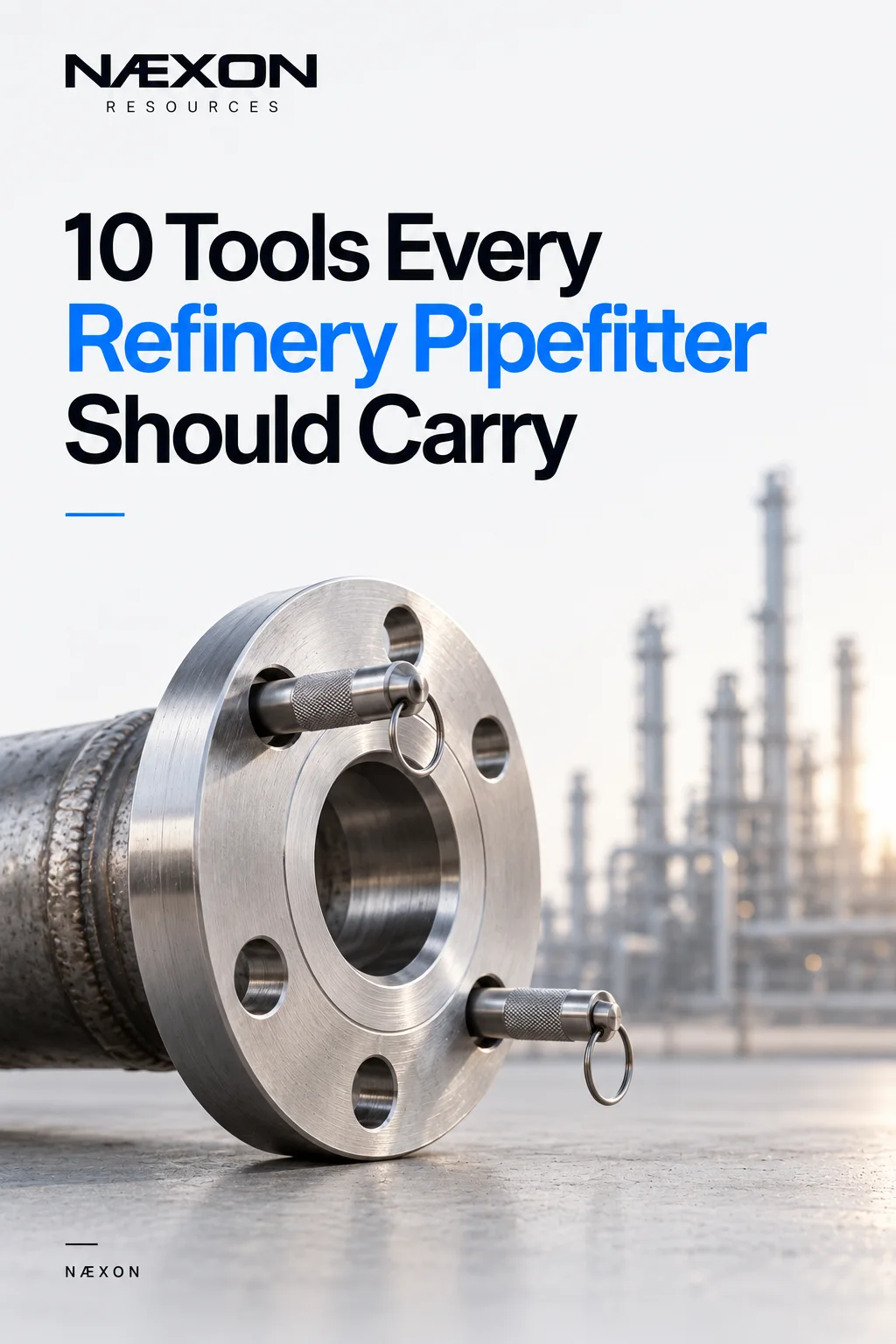
3. Two-Hole Flange Pins
Refineries contain an enormous number of flanged connections.
Two-hole pins make flange orientation much easier to establish.
The pins are inserted through two flange bolt holes, creating a reference that can be checked with a level.
This allows the fitter to position the flange correctly before tack welding or final installation.
Correct bolt-hole orientation becomes especially important when connecting to valves, pumps, exchangers, vessels and existing piping.
A flange can have the correct elevation and centerline and still be wrong because the bolt holes were positioned incorrectly.
Field Rule
Check flange orientation before the welder makes it permanent.
4. Flange Wedges
Turnaround pipefitters spend a lot of time around existing flanged connections.
Flange wedges can help create controlled separation between flange faces during approved maintenance activities such as gasket replacement, equipment work and piping removal.
They can also help during alignment when installing replacement components.
But refinery piping must always be treated differently from ordinary fabrication work.
A flange may contain pressure, temperature, chemicals or trapped hydrocarbons even when the system is believed to be isolated.
The wedge is only a positioning tool.
It does not make the line safe.
Field Rule
Never begin separating a refinery flange until the required isolation, permitting and line-opening procedures have been completed.
5. Combination Square
A combination square is one of those tools that doesn’t look particularly important until you start using it constantly.
It provides a reliable 90-degree reference and helps with small layout work, support fabrication, structural attachments and transferring measurements.
During refinery maintenance, field modifications frequently require fitters to fabricate something that wasn’t delivered perfectly ready for installation.
Having a reliable square makes those small fabrication jobs much easier.
Field Rule
Don’t eyeball a 90 when you have a square in your bag.
6. Pipe Wrap-Around
A wrap-around provides a simple way to establish a straight reference around the circumference of pipe.
This becomes useful when marking cut locations, weld joints and fabrication references.
Without a wrap-around, attempting to extend a straight line completely around large-diameter pipe can produce a surprising amount of error.
If the line doesn’t meet itself correctly, the cut probably won’t either.
The wrap should sit flat and tight against the pipe before the fitter begins marking.
Field Rule
A crooked reference line creates a crooked cut before the saw or torch ever touches the pipe.
7. Centering Head
Refinery pipefitters frequently need to establish true top center on round pipe.
A centering head makes that process much easier.
Once top dead center is established, the fitter has a reliable reference for locating branches, attachments and other components around the circumference.
This becomes particularly useful during fabrication and field modifications.
Accurate layout starts with accurate references.
If your original reference is wrong, every measurement based on it can also be wrong.
Field Rule
Establish your centerline first. Build the rest of the layout from known references.
8. Adjustable Wrench
A refinery contains an incredible variety of hardware.
An adjustable wrench handles many of the small jobs that appear throughout a shift: instrument connections, small valves, miscellaneous bolts, temporary equipment and general adjustments.
It isn’t intended to replace proper-sized wrenches for high-torque bolting.
But as a general-purpose tool, a quality adjustable wrench earns its place in the bag.
A poorly manufactured wrench with excessive jaw movement can damage fasteners and make simple jobs harder.
Field Rule
Use the adjustable wrench for versatility. Use the correct fixed-size wrench when serious torque is required.
9. Soapstone and Holder
Refinery fabrication still depends heavily on one of the simplest tools available.
Soapstone.
Pipefitters use it to mark cut locations, fitting positions, centerlines, weld joints, orientation references and temporary notes directly on steel.
A good holder keeps the soapstone from breaking in your pocket and makes it easier to control while wearing gloves.
Keep the marks precise.
If your layout line is 1/4-inch wide, you’ve already introduced uncertainty about where the actual measurement is supposed to be.
Field Rule
The thinner and clearer the layout mark, the easier it is for everyone downstream to understand exactly what you intended.
10. Pipefitter’s Calculator
A refinery pipefitter eventually encounters geometry.
Offsets.
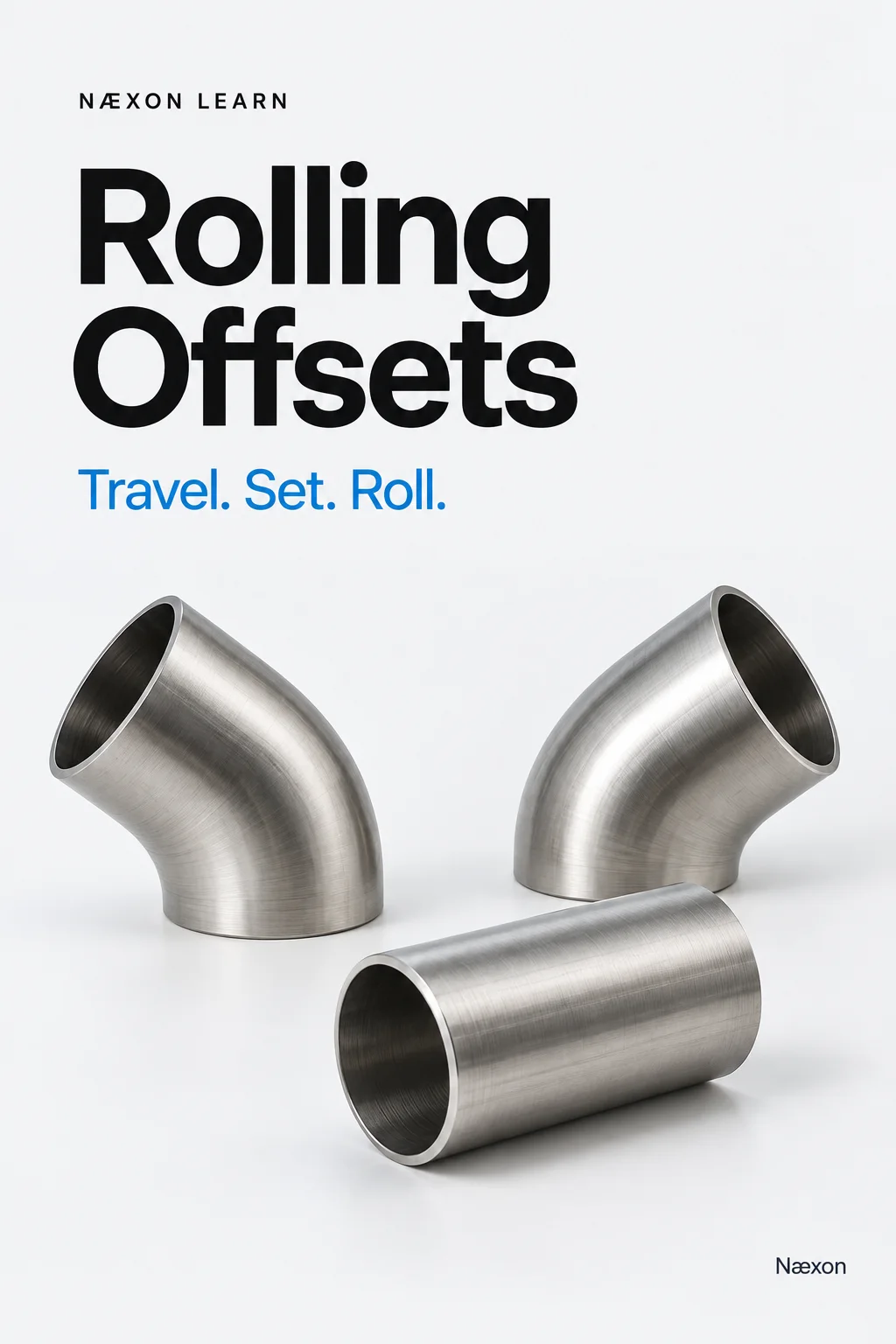
Rolling offsets.
45s.
Fitting takeoffs.
Travel dimensions.
Slope.
Fractions.
Angles.
Pipe dimensions.
Flange information.
Conversions.
Experienced fitters should understand the mathematics behind the work, but a calculator makes those calculations faster and provides another way to verify the result.
For example, a basic 45-degree offset uses:
Travel = Offset × 1.414
For a 12-inch offset:
12 × 1.414 = 16.968 inches
That gives the theoretical travel.
It does not automatically give you the finished cut length.
The fitter still has to account for the fittings, takeoffs and actual spool configuration.
Digital pipefitting tools such as NÆXON Numerus can also assist with offsets, fittings, spool calculations, flange information, geometry and conversions.
Field Rule
Never blindly trust a number just because a calculator produced it. Look at the actual piping and ask whether the answer makes sense.
The Most Important Tool Isn’t in the Bag
You could give an apprentice every tool on this list tomorrow.
That wouldn’t make them a journeyman pipefitter.
The most important tool is understanding the piping system.
A refinery fitter needs to know how to read isometric drawings, identify components, understand elevations, calculate fitting takeoffs, recognize pipe specifications and visualize how a spool exists in three-dimensional space.
They also need something even harder to teach:
Judgment.
An experienced fitter develops a feeling for when something isn’t right.
Maybe the dimension doesn’t make sense.
Maybe the flange orientation looks wrong.
Maybe the valve is facing the wrong direction.
Maybe the spool appears correct on paper but doesn’t match the field condition.
Good fitters investigate those warning signs before welding, bolting or cutting makes the problem more expensive.
Turnaround Work Changes Everything
Refinery turnaround work creates a different environment from ordinary new construction.
Thousands of workers may be performing maintenance simultaneously.
Scaffolders are building access.
Boilermakers are opening equipment.
Welders are making repairs.
Riggers are moving components.
Inspectors are examining equipment.
Operators are controlling isolations.
And pipefitters may be removing and replacing piping inside the middle of all that activity.
The work moves quickly, but speed cannot replace verification.
The fastest fitter on the job isn’t necessarily the person making the most cuts.
Sometimes it’s the person who avoids making the wrong cut in the first place.
Before You Make the Cut
Check the isometric.
Check the line number.
Check the pipe size.
Check the specification.
Check the material.
Check the fitting.
Check the orientation.
Check your takeoff.
Check the field measurement.
Then look at the entire assembly and ask:
Does this actually make sense?
If something feels wrong, find out why.
Five minutes spent verifying a questionable dimension can prevent hours of rework.
Field Rules
- Establish a reliable reference before taking measurements.
- Verify field dimensions instead of assuming existing piping matches the drawing perfectly.
- Check flange bolt-hole orientation before tack welding.
- Keep your level protected and periodically verify its accuracy.
- Understand fitting takeoffs instead of memorizing numbers without understanding them.
- Use proper tools when separating flanges.
- Follow refinery isolation and line-opening procedures every time.
- Keep layout marks thin and precise.
- Verify calculator results against the actual piping arrangement.
- Measure twice before making an irreversible cut.
Knowledge Check
1. What do two-hole flange pins help establish?
Correct flange bolt-hole orientation and a reference for leveling.
2. Why is a wrap-around useful?
It establishes a straight reference around the circumference of the pipe for layout and cutting.
3. What does a centering head help locate?
True center references such as top dead center on round pipe.
4. What is the theoretical travel for a 12-inch 45-degree offset?
Approximately 16.97 inches before fitting takeoffs are considered.
5. Why isn’t the travel dimension automatically the pipe cut length?
Because the actual cut length depends on the fitting takeoffs and configuration of the spool.
6. Why should a pipefitter verify an existing field dimension even when the isometric provides a dimension?
Because actual installed conditions can differ from drawings due to previous modifications, tolerances, equipment position or field changes.
Practical Exercise
Imagine you’re replacing a spool between two existing refinery flanges.
Before touching the old spool, identify the information you would need to fabricate the replacement.
Determine the flange-to-flange dimension, pipe size, schedule, material specification, flange rating, flange type and bolt-hole orientation.
Then identify every fitting in the spool and calculate the required takeoffs.
Establish the elevation and orientation of the existing connections.
Finally, compare your calculated spool against the actual field dimensions.
If the drawing and the field disagree, don’t choose whichever number is easier.
Find out why they disagree before fabrication begins.
That’s refinery pipefitting.
NÆXON — Built for the trades that build America.