Refinery welding is different from simply knowing how to run a bead.
A refinery welder may spend one shift welding carbon-steel process piping and the next working stainless, chrome-moly, an exchanger repair, a pressure vessel or a difficult tie-in buried inside an operating unit.
During a turnaround, conditions can become even more demanding. Access may be tight. Production schedules are aggressive. Inspection requirements are strict. And one rejected weld can affect far more than the welder who made it.
The best refinery welders understand that the arc is only part of the job.
Preparation, cleanliness, fit-up, procedure compliance and self-inspection all matter.
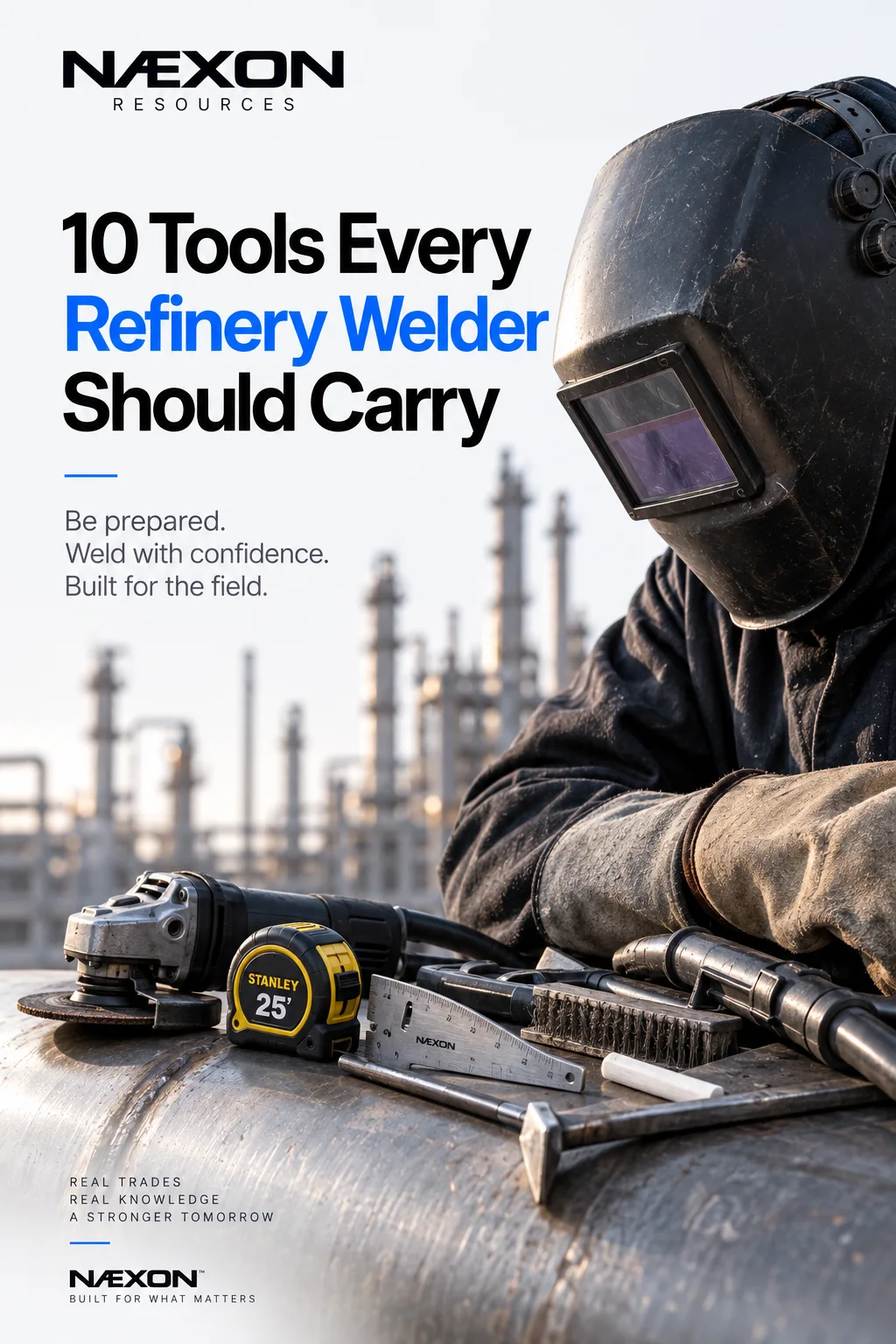
Here are 10 tools every refinery welder should carry.
1. Welding Hood
The welding hood is probably the most personal tool a welder owns.
Whether you prefer a passive lens or a quality auto-darkening lens, the purpose is the same: protect your eyes and face while giving you the clearest possible view of the puddle.
Visibility becomes especially important on refinery piping where position can be difficult. A welder may be working 6G around a pipe with limited access, welding from a scaffold or trying to see the bottom of a joint surrounded by existing piping.
A dirty cover lens makes all of that harder.
Keep spare cover lenses available and replace damaged ones before they interfere with your ability to see the puddle.
Field Rule
If you can’t clearly see the puddle, you’re already giving yourself a disadvantage.
2. Welding Gloves
The correct gloves depend on the welding process.
Heavy stick welding generally requires more heat protection. TIG welding often benefits from thinner gloves that provide better control of the torch and filler wire.
Many refinery welders therefore carry more than one pair.
Gloves also need to be kept in usable condition. Holes, moisture, contamination and excessive wear can reduce protection and make it harder to control the work.
Different materials and processes may also require greater attention to contamination.
Field Rule
Choose your gloves for the process you’re performing—not simply whichever pair happens to be closest.
3. Angle Grinder
The grinder may spend almost as much time in a refinery welder’s hands as the electrode holder or TIG torch.
It is used for joint preparation, cleaning tack welds, removing mill scale, blending starts and stops, preparing repairs and cleaning areas before welding.
But a grinder can also create problems quickly.
Aggressive grinding can change the bevel, reduce the root face, damage surrounding base material or remove more weld metal than intended.
Different abrasives should also be selected for the job being performed.
A grinding wheel, cutting wheel, flap disc and wire wheel are not interchangeable simply because they all fit the same grinder.
Field Rule
Use the grinder to prepare the weld—not redesign the joint.
4. Soapstone and Holder
One of the cheapest tools in the bag remains one of the most useful.
Soapstone allows a welder to mark starts, stops, repair locations, orientation points, measurements and fabrication references directly on steel.
A holder keeps the soapstone protected and provides better control when working with gloves.
Keep the marks narrow and deliberate.
A thick mark introduces uncertainty about exactly where the reference is supposed to be.
Field Rule
A precise weld begins with precise preparation and precise references.
5. Tape Measure
A refinery welder should know more than how to weld what gets placed in front of them.
Good welders pay attention to the entire assembly.
A tape measure lets you verify dimensions, fitting locations, attachments, spool lengths and miscellaneous fabrication before welding makes something permanent.
You aren’t necessarily replacing the pipefitter’s layout.
You’re providing another set of experienced eyes.
If something looks obviously wrong, check it.
A perfect weld on the wrong spool is still the wrong spool.
Field Rule
If the fit-up doesn’t look right, don’t assume somebody else already checked it.
6. Combination Square
A combination square gives the welder a reliable 90-degree reference.
That makes it useful for brackets, supports, plate work, structural attachments and miscellaneous fabrication encountered throughout a refinery.
It can also help verify layout before components are tack welded permanently.
During turnaround work, many repairs and modifications involve small fabrication tasks that don’t arrive perfectly prepared.
Having a square nearby makes those jobs considerably easier.
Field Rule
Don’t eyeball something that takes five seconds to verify.
7. Chipping Hammer
For SMAW and other slag-producing processes, a chipping hammer remains an essential tool.
Slag needs to be removed where required between passes so the weld surface can be properly cleaned and examined.
That examination matters.
Cleaning the previous pass gives the welder an opportunity to identify questionable areas before covering them with additional weld metal.
Finding a problem immediately is usually much easier than discovering it after the weld is finished.
Field Rule
Clean every pass like you’re about to show it to the inspector.
8. Dedicated Wire Brushes
Wire brushes are basic tools, but refinery welders need to understand contamination control.
A brush that has been used repeatedly on carbon steel should not automatically be used on stainless steel.
Carbon-steel particles can become embedded in stainless surfaces and contribute to contamination and corrosion problems.
Stainless work should have dedicated stainless-steel brushes and abrasives when required by the project’s procedures.
Keep them identified and separated.
The same principle extends beyond brushes.
Tools used during material preparation can matter just as much as the welding process itself.
Field Rule
If it’s dedicated to stainless, keep it dedicated to stainless.
9. Welding Inspection Gauge
A refinery welder shouldn’t have to wait for QC to discover an obvious dimensional problem.
Welding gauges allow welders to evaluate aspects of their own work before requesting formal inspection.
Depending on the gauge, this may include checking fillet size, reinforcement, undercut, misalignment and other weld-profile dimensions.
Bridge-cam-style gauges and other multipurpose gauges are particularly useful.
The gauge does not replace QC.
It gives the welder an opportunity to perform their own quality check first.
That habit matters in refinery work where welds may later undergo visual inspection, penetrant testing, magnetic-particle testing, radiography, ultrasonic examination or other NDE depending on the service and project requirements.
Field Rule
Your weld should pass your inspection before you ask somebody else to inspect it.
10. Flashlight or Inspection Light
This tool gets overlooked until you’re inside a refinery unit.
Refineries are full of poor viewing angles.
Pipe racks, exchangers, vessels, equipment connections, scaffolds and tightly packed piping can create areas where normal lighting simply isn’t enough.
A compact inspection light allows the welder to examine the joint before welding and inspect the finished work afterward.
It can help reveal contamination, incomplete cleaning, questionable fit-up or areas of the weld that are difficult to see from the normal working position.
A headlamp can also be useful where site rules allow it.
Field Rule
Never assume the side you can’t see looks like the side you can.
Inspect the Fitter’s Joint Before You Weld It
One of the most valuable habits a refinery welder can develop happens before the hood ever comes down.
Look at the joint.
Check the bevel.
Check the root face.
Check the root opening.
Check the alignment.
Check the cleanliness.
Check the tacks.
Check the material.
Then ask whether the joint matches the requirements of the welding procedure.
If something isn’t right, address it before welding.
Once you strike the arc, you’re beginning to take ownership of that joint.
An experienced pipefitter understands this too.
Good fitters don’t become offended when a welder checks their fit-up. Good welders don’t assume every joint placed in front of them is automatically ready to weld.
Both trades are trying to accomplish the same thing:
Make the joint right the first time.
Know the WPS
A Welding Procedure Specification isn’t paperwork somebody created to make the welder’s job harder.
It defines how the weld is supposed to be made.
Depending on the procedure, it can control variables such as welding process, base material, filler metal, position, electrical characteristics, preheat, interpass temperature and other essential requirements.
Refinery piping can operate under extreme pressure, temperature and service conditions.
A weld that looks beautiful isn’t necessarily acceptable if it was made outside the qualified procedure.
That becomes especially important with specialized materials and services.
Carbon steel, stainless steel and chrome-moly piping cannot simply be treated as though they are the same material with different colors.
Know what you’re welding.
Know the procedure.
Follow it.
The Root Tells You a Lot
Pipe welders know how much the root matters.
Poor root preparation can create problems that follow the weld all the way through completion.
The correct root opening, land, alignment and cleanliness depend on the procedure and joint configuration.
A welder who requests a specific fit-up should understand why they want it.
The answer shouldn’t simply be:
“That’s how I always weld it.”
The joint needs to satisfy the applicable procedure.
Experienced welders can often recognize immediately when a root opening, bevel or alignment is going to make the weld unnecessarily difficult.
That experience is valuable.
But procedure comes before preference.
Don’t Bury a Problem
One of the worst habits a welder can develop is seeing something questionable and deciding the next pass will fix it.
Sometimes it won’t.
If you find a questionable area after cleaning a pass, stop and evaluate it.
Grinding out a small problem now may take a few minutes.
Repairing a completed weld after inspection can take considerably longer.
And on a turnaround, that repair can affect more than one person.
The pipefitter may need to return.
Scaffolding may need to remain in place.
QC needs to reinspect the weld.
NDE may need to be rescheduled.
Insulation may be delayed.
Testing may be delayed.
Eventually, operations may be waiting for the system.
A small weld repair can become part of a much larger schedule problem.
Refinery Welding Is a Team Trade
The welder may make the weld, but refinery piping is rarely a one-person operation.
The pipefitter establishes the fit-up.
The welder makes the joint.
The inspector verifies the work.
The rigger may position the spool.
The scaffold builder provides access.
The operator controls the equipment and process isolation.
The planner coordinates the work.
Each person affects the next.
The best industrial craftsmen understand that.
They don’t simply finish their individual task.
They think about what happens after them.
Field Rules
- Keep your hood lenses clean and carry replacements.
- Use gloves appropriate for the welding process.
- Understand the WPS before striking the arc.
- Inspect the joint before accepting the fit-up.
- Keep stainless tools and abrasives properly dedicated where required.
- Use the correct abrasive for the task.
- Clean and inspect between passes.
- Never bury a questionable area beneath another pass.
- Check your own finished weld before requesting inspection.
- If something doesn’t look right, stop and determine why.
Knowledge Check
1. Why should a refinery welder inspect the joint before welding?
Because bevel geometry, root opening, alignment, cleanliness and other fit-up conditions can directly affect weld quality and must meet the applicable requirements.
2. Why shouldn’t a carbon-steel wire brush automatically be used on stainless steel?
It can transfer iron contamination to the stainless surface.
3. Does a good-looking weld automatically mean the weld complies with the procedure?
No. Appearance is only one part of weld quality. The weld must also comply with the applicable procedure and project requirements.
4. Why should welders inspect between passes?
Cleaning and inspection can reveal problems while they are still accessible instead of burying them beneath additional weld metal.
5. What is the purpose of carrying a welding inspection gauge?
It allows the welder to evaluate important dimensions and characteristics of their own work before formal inspection.
6. Why is a flashlight useful even on a well-lit refinery project?
Equipment and piping create shadows, confined spaces and difficult viewing angles that can hide portions of the joint.
Practical Exercise
Before welding your next practice pipe joint, don’t strike the arc immediately.
Inspect the complete joint first.
Verify the bevel, root face, root opening and alignment. Confirm that the joint is clean and examine every tack.
Then identify the welding procedure requirements that apply to the joint.
Complete the root.
Stop.
Clean it thoroughly.
Use a flashlight and inspect the entire circumference before continuing.
Repeat that process through the weld.
After completing the cap, inspect your own work using an appropriate welding gauge.
The exercise isn’t simply about producing a good weld.
It’s about developing the habit of finding problems before somebody else finds them for you.
That habit is worth carrying into every refinery you work.
NÆXON — Built for the trades that build America.