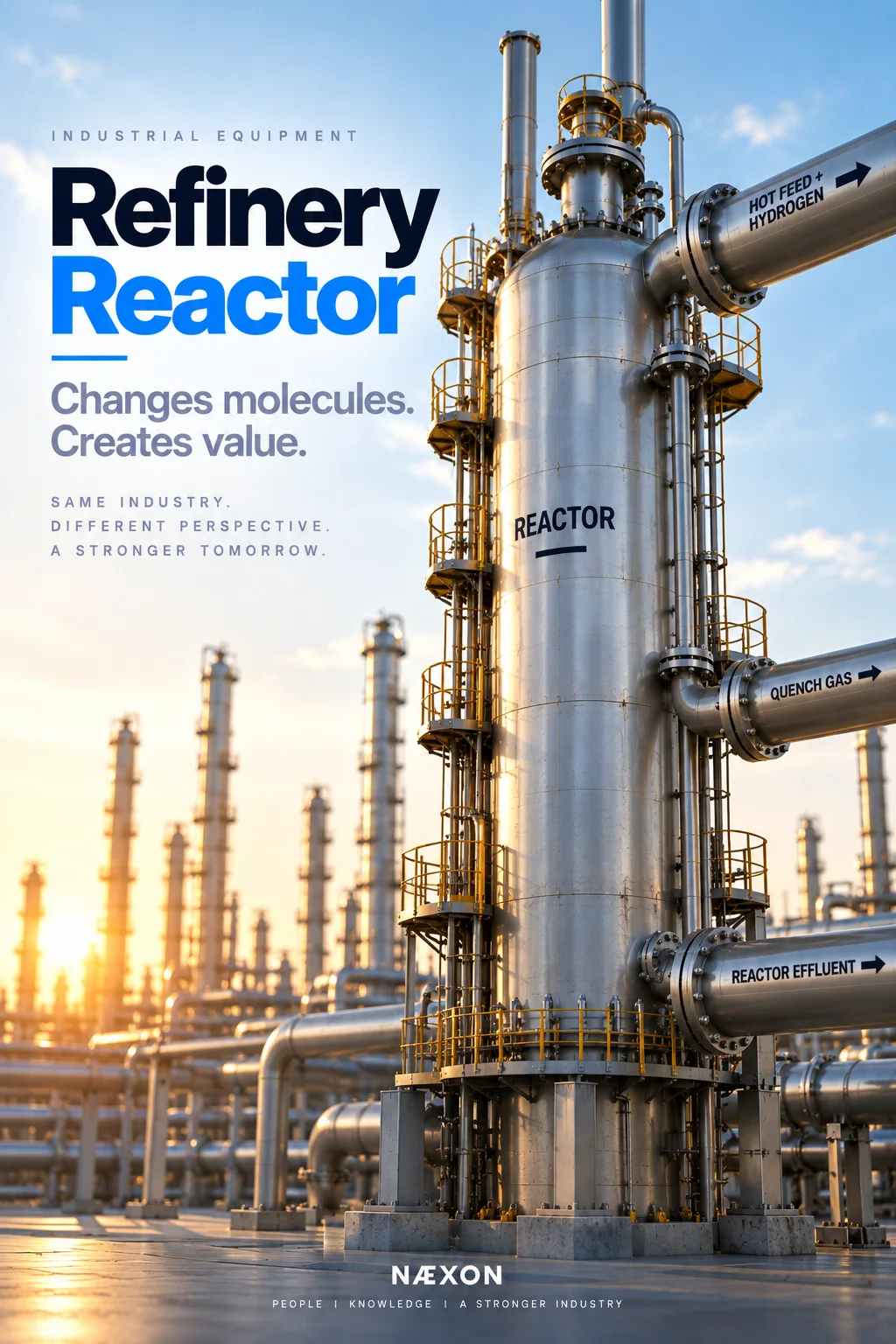
A reactor is one of the most important pieces of process equipment in a refinery.
A pump moves material. A heat exchanger transfers heat. A fired heater adds heat. A distillation tower separates materials.
A reactor does something fundamentally different:
It changes the chemical composition of the process stream.
Inside refinery reactors, hydrocarbons may be desulfurized, cracked into smaller molecules, rearranged into higher-value molecules, saturated with hydrogen, or converted into cleaner fuels.
The simplified process path is:
Feed → Heat → Reactor → Chemical Reaction → Separation → Products
For pipefitters, welders, boilermakers, operators, inspectors, instrument technicians, catalyst crews, and maintenance personnel, reactors are especially important because they frequently combine high pressure, high temperature, hydrogen, catalyst, heavy-wall construction, specialized metallurgy, and critical piping systems.
What Is a Refinery Reactor?
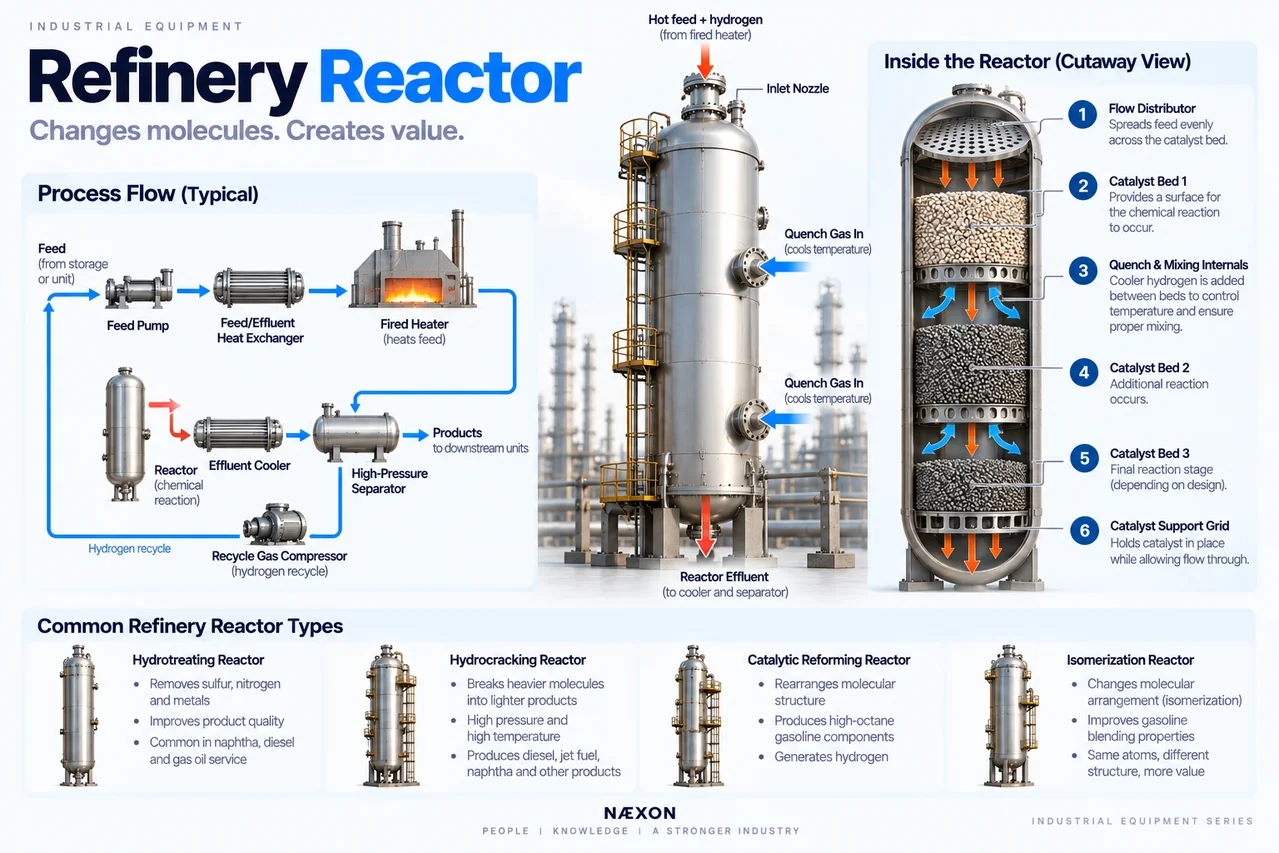
Figure: Refinery reactor system showing the typical process flow from feed heating through reaction, cooling, separation, and hydrogen recycle, with a cutaway view illustrating flow distribution, catalyst beds, quench and mixing internals, and the catalyst support grid.
A refinery reactor is a pressure vessel specifically designed to provide the controlled conditions necessary for chemical reactions to occur.
Depending on the process, those conditions may involve:
- High temperature
- High pressure
- Hydrogen
- Catalyst
- Controlled flow distribution
- Multiple catalyst beds
- Carefully controlled temperature profiles
The reactor provides the environment.
The catalyst, temperature, pressure, feed composition, hydrogen concentration, and residence time determine what happens to the molecules traveling through it.
Why Refineries Need Reactors
Crude oil naturally contains a complex mixture of hydrocarbons and contaminants.
Simply separating crude oil into different boiling ranges is not enough to produce all the fuels and products a modern refinery needs.
Some molecules must actually be changed.
Reactors allow refineries to:
- Remove sulfur.
- Remove nitrogen and other contaminants.
- Saturate olefins and other reactive compounds.
- Upgrade heavy hydrocarbons.
- Crack larger molecules.
- Improve fuel quality.
- Increase hydrogen content.
- Prepare streams for downstream processing.
- Protect sensitive downstream catalysts.
- Meet product specifications.
This is the difference between separation and conversion.
A distillation tower separates molecules.
A reactor changes molecules.
The Basic Reactor Process
A simplified refinery reactor system may look like:
Feed Pump
↓
Feed/Effluent Heat Exchangers
↓
Fired Heater
↓
Reactor
↓
Cooling / Heat Recovery
↓
Separator
↓
Downstream Processing
The reactor therefore sits inside a much larger process system.
Understanding what happens before and after the reactor is just as important as understanding the vessel itself.
1. Reactor Vessel
The reactor vessel forms the primary pressure boundary.
Many refinery reactors are tall vertical vessels constructed from extremely thick steel.
Depending on service, they may operate under severe combinations of:
Pressure + Temperature + Hydrogen + Corrosive Process Conditions
This can require specialized metallurgy and fabrication.
The reactor shell may consist of heavy-wall forged or rolled sections joined by highly controlled welds.
Why Reactor Walls Can Be Extremely Thick
A reactor may operate at significantly higher pressure than an ordinary process vessel.
Higher internal pressure creates greater stress in the vessel wall.
Engineering design determines the required thickness based on factors including:
- Design pressure
- Design temperature
- Vessel diameter
- Material properties
- Corrosion allowance
- Applicable code requirements
- Service environment
Some refinery reactors have walls many inches thick.
That creates unique challenges for fabrication, welding, heat treatment, inspection, transportation, rigging, and repair.
2. Reactor Inlet
Process feed enters through an engineered inlet nozzle.
Depending on the unit, the feed may already be:
- Pressurized
- Mixed with hydrogen
- Preheated through exchangers
- Heated further in a fired heater
By the time it reaches the reactor, the process stream may already be under severe operating conditions.
The inlet system must distribute that flow properly across the reactor internals.
3. Flow Distributor
Uniform flow through the catalyst is extremely important.
If feed enters one small portion of the catalyst bed instead of being distributed evenly, some regions may receive more flow than others.
This can create:
- Poor catalyst utilization
- Uneven reaction
- Temperature differences
- Increased pressure drop
- Hot spots
A flow distributor helps spread incoming material across the reactor cross-section.
Think:
One inlet stream → distributed across the entire catalyst bed.
4. Catalyst Bed
Many refinery reactors contain catalyst.
Catalyst promotes chemical reactions without being consumed in the same way as the feedstock.
The catalyst may consist of thousands or millions of small engineered particles loaded into the reactor.
Depending on the process, catalyst shapes may include:
- Extrudates
- Pellets
- Spheres
- Other engineered geometries
The feed flows through spaces between catalyst particles while chemical reactions occur on and within the catalyst.
What Does Catalyst Actually Do?
Many refinery reactions would occur too slowly—or require impractical conditions—without catalyst.
Catalyst provides a more favorable reaction pathway.
Think of it as making the chemical reaction easier to accomplish.
It can allow the refinery to achieve desired conversion at practical temperatures, pressures, and residence times.
Catalyst selection is highly process-specific.
5. Catalyst Support Grid
The catalyst cannot simply be dumped into the bottom of the vessel.
A support system holds the catalyst bed in position while allowing process fluid to pass.
This can include:
- Support grids
- Beams
- Screens
- Wire mesh
- Ceramic support material
These components may support enormous catalyst loads.
Their integrity is critical.
6. Multiple Catalyst Beds
Large reactors may contain several catalyst beds.
Conceptually:
Feed
↓
Bed 1
↓
Intermediate Mixing / Quench
↓
Bed 2
↓
Intermediate Mixing / Quench
↓
Bed 3
↓
Outlet
Why use several beds?
One major reason is temperature control.
Exothermic Reactions
Many refinery hydrogen-processing reactions release heat.
These are exothermic reactions.
As feed travels through the catalyst:
Reaction occurs → Heat is released → Process temperature rises
This creates an important operating challenge.
If temperature becomes excessive, the reaction rate can increase further.
That can create undesirable operating conditions and potentially damage catalyst or equipment.
Temperature must therefore be carefully controlled.
7. Quench System
In many multi-bed hydroprocessing reactors, cooler hydrogen-rich gas can be introduced between catalyst beds.
This is called quench gas.
Its purpose is to control the temperature entering the next catalyst bed.
Simplified:
Bed 1 → Temperature rises
↓
Quench Gas Added
↓
Temperature reduced / mixed
↓
Bed 2
The quench system is therefore an important reactor temperature-control feature.
Mixing Internals
Simply injecting cooler gas is not enough.
The gas must mix effectively with the process stream.
Reactors can contain specialized mixing internals between catalyst beds.
These help create a more uniform temperature and composition before the process enters the next bed.
Poor mixing can contribute to temperature maldistribution.
Temperature Monitoring
Reactor temperature is one of the most important variables operators monitor.
Multiple temperature measurements may be installed at different:
- Elevations
- Catalyst beds
- Radial positions
This allows operators to understand the reactor’s temperature profile.
One temperature measurement cannot always tell the whole story.
Reactor Hot Spots
A hot spot is a localized area operating significantly hotter than surrounding portions of the catalyst bed.
Potential contributors can include:
- Poor flow distribution
- Catalyst problems
- Uneven quench distribution
- Fouling
- Reaction abnormalities
Hot spots can accelerate catalyst deactivation and create undesirable thermal conditions.
This is why temperature instrumentation throughout the reactor is so valuable.
Pressure Drop Across the Reactor
Process fluid loses pressure as it travels through the catalyst bed.
This is called pressure drop.
Some pressure drop is expected.
But increasing pressure drop can indicate problems such as:
- Catalyst fouling
- Deposits
- Solids accumulation
- Damaged catalyst
- Flow restrictions
Operators monitor reactor differential pressure because changes can reveal what may be happening inside a vessel that cannot be visually inspected while operating.
Major Refinery Reactor Types
Different refinery units use reactors for very different chemical purposes.
Several are especially important.
Hydrotreating Reactor
A hydrotreater uses hydrogen and catalyst to remove contaminants and improve product quality.
Hydrotreating can remove or reduce:
- Sulfur
- Nitrogen
- Metals
- Certain unsaturated compounds
A simplified sulfur-removal concept is:
Sulfur-containing hydrocarbon + Hydrogen → Cleaner hydrocarbon + Hydrogen sulfide
The hydrogen sulfide is separated and treated downstream.
Hydrotreaters are extremely common throughout refineries.
Why Hydrotreating Matters
Modern fuels require very low sulfur levels.
Refineries therefore hydrotreat many streams, including:
- Naphtha
- Kerosene
- Diesel
- Gas oil
- Other intermediate streams
Hydrotreating also protects downstream catalysts from contaminants.
Hydrocracking Reactor
A hydrocracker combines:
Hydrogen + Catalyst + High Pressure + High Temperature
to break large hydrocarbon molecules into smaller, more valuable molecules.
Heavy feedstocks can be upgraded into products suitable for:
- Diesel
- Jet fuel
- Naphtha
- Other lighter products
Hydrocracking reactors are among the most severe-service vessels found in many refineries.
Catalytic Reforming Reactor
A catalytic reformer changes the molecular structure of naphtha-range hydrocarbons.
The goal includes producing higher-octane gasoline components and hydrogen.
Reforming reactions can create valuable hydrogen that may be used elsewhere in the refinery.
This demonstrates how refinery units are interconnected.
One unit’s byproduct can become another unit’s critical feed.
Isomerization Reactor
An isomerization unit rearranges hydrocarbon molecules into different structural forms.
The number of carbon atoms may remain the same, but the molecular arrangement changes.
This can improve gasoline blending properties.
Again:
Same atoms. Different molecular arrangement. Different value.
Guard Beds
Some reactor systems contain guard beds upstream of critical catalysts.
Their job is to capture contaminants before those contaminants reach more expensive or sensitive catalyst.
Think of a guard bed as:
Sacrificial protection for downstream catalyst.
Fixed-Bed Reactors
Many refinery hydroprocessing reactors are fixed-bed reactors.
The catalyst remains stationary inside the vessel while process fluid passes through it.
This differs from processes where catalyst continuously circulates.
Fixed-bed reactors are especially important for refinery workers because turnaround activities often involve catalyst removal and replacement.
Moving and Circulating Catalyst Systems
Not every refinery reactor keeps catalyst stationary.
Some processes continuously or periodically move catalyst.
The fluid catalytic cracking unit, for example, uses circulating powdered catalyst between reactor and regenerator sections.
That is a much different process and deserves its own dedicated equipment article.
For this article, the main focus is the heavy-wall fixed-bed reactor commonly encountered in hydrotreating and hydrocracking service.
Hydrogen Service
Many refinery reactors operate with hydrogen.
Hydrogen creates special engineering challenges.
Hydrogen molecules are extremely small, and high-temperature/high-pressure hydrogen can interact with steels in damaging ways under certain conditions.
This is why reactor materials, weld procedures, operating limits, inspection programs, and repair procedures are tightly controlled.
High-Temperature Hydrogen Attack
One important damage mechanism in certain high-temperature hydrogen services is high-temperature hydrogen attack, or HTHA.
Under susceptible combinations of:
Hydrogen partial pressure + Temperature + Material
hydrogen can contribute to internal degradation of carbon and low-alloy steels.
HTHA is a specialized mechanical-integrity concern.
The field lesson is straightforward:
Material selection in hydrogen service is not optional or interchangeable.
Reactor Metallurgy
Depending on service, reactors may use specialized materials or internal weld overlay/cladding.
Examples can include chromium-molybdenum steels and corrosion-resistant internal surfaces.
A vessel may therefore have:
Structural pressure-bearing base metal
plus
Internal corrosion-resistant layer
This makes repair welding especially controlled.
Weld Overlay
Some reactors have stainless-steel or other alloy weld overlay applied to internal surfaces.
The overlay protects the underlying pressure-vessel material from the process environment.
Damage to the overlay can expose the base metal.
During maintenance, inspectors pay close attention to its condition.
Reactor Effluent
After leaving the reactor, the process stream may contain:
- Converted hydrocarbons
- Unreacted hydrogen
- Hydrogen sulfide
- Ammonia
- Light gases
- Liquid hydrocarbons
The stream therefore usually requires additional cooling and separation.
A typical path might be:
Reactor → Feed/Effluent Exchanger → Cooler → High-Pressure Separator
Some hydrogen-rich gas may then be recycled.
Reactor Feed/Effluent Exchanger
Hot reactor effluent contains valuable thermal energy.
Instead of wasting that heat, the refinery can use it to preheat incoming reactor feed.
This creates:
Cold Feed ↔ Hot Reactor Effluent
The exchanger reduces fired-heater duty and improves energy efficiency.
This connects another equipment topic we have already covered.
Recycle Gas Compressor
Hydroprocessing units may recover hydrogen-rich gas from downstream separation and send it back toward the reactor.
A recycle gas compressor provides the pressure needed to circulate that gas.
Now several major pieces of equipment work together:
Separator → Recycle Compressor → Feed → Heater → Reactor
This is why a recycle compressor trip can have major consequences for reactor operation.
Reactor Pressure
Hydroprocessing reactors can operate at substantial pressure.
Pressure helps maintain hydrogen availability and supports the desired reaction conditions.
Because the vessel is highly pressurized, connected piping can also be severe service.
Reactor inlet and outlet lines deserve special attention.
Reactor Outlet Piping
The reactor outlet can be especially demanding because the fluid may be:
- Hot
- High pressure
- Hydrogen rich
- Chemically aggressive
- Multicomponent
Materials, weld procedures, heat treatment, supports, and thermal expansion must all match the engineered design.
Thermal Expansion
Reactors and their piping grow when heated.
A tall reactor can experience significant vertical thermal movement.
Connected piping must accommodate this movement.
Systems may use:
- Spring hangers
- Variable supports
- Constant-load supports
- Guides
- Sliding supports
- Engineered loops
Cold alignment must account for how the system will move when hot.
Why Spring Hangers Are Common
Imagine a hot reactor outlet line moving several inches as the equipment reaches operating temperature.
A rigid support could impose excessive loads.
A spring support allows controlled vertical movement while continuing to carry the piping load.
Never casually change a spring setting or lock/unlock a spring hanger without following the applicable engineering and commissioning procedure.
Reactor Internals
Depending on reactor design, internals can include:
- Inlet distributors
- Catalyst support grids
- Screens
- Quench distributors
- Mixing trays
- Thermowells
- Outlet collectors
- Support beams
These components may look relatively light compared with the reactor shell.
But their process importance is enormous.
A damaged distributor can affect the performance of the entire catalyst bed.
Catalyst Loading
During a turnaround, old catalyst may be removed and new catalyst loaded.
Catalyst loading is a specialized operation.
The goal is not simply to fill the reactor.
The catalyst must be loaded according to the specified procedure to achieve appropriate:
- Bed density
- Distribution
- Bed height
- Layering
- Support arrangement
Improper loading can contribute to flow maldistribution and pressure-drop problems.
Catalyst Unloading
Used catalyst can present serious hazards.
Depending on the service and catalyst condition, hazards may include:
- Hydrocarbon contamination
- Toxic contaminants
- Pyrophoric material
- Dust
- Oxygen-deficient atmospheres
- Confined-space hazards
Catalyst removal requires specialized procedures, atmospheric controls, PPE, and trained personnel.
What Does Pyrophoric Mean?
A pyrophoric material can ignite spontaneously when exposed to air under suitable conditions.
Some refinery deposits and spent catalysts can become pyrophoric.
Material that appeared harmless inside an oxygen-free process environment may react when exposed to air during shutdown.
This is one reason reactor opening and catalyst work are tightly controlled.
Nitrogen Hazards
Nitrogen is commonly used in refinery equipment for inerting and purging.
But nitrogen can create an atmosphere incapable of supporting human life.
You cannot smell oxygen deficiency.
You cannot see it.
A reactor or nearby opening can therefore present a fatal atmospheric hazard even when no toxic odor is present.
Always follow site atmospheric testing and confined-space controls.
Reactor Turnarounds
Reactor work can become a major part of refinery turnaround schedules.
Activities may include:
- Shutdown and isolation
- Depressurization
- Purging
- Catalyst unloading
- Internal cleaning
- Inspection
- NDE
- Internal repairs
- Catalyst support inspection
- Thermowell inspection
- Catalyst loading
- Closure installation
- Pressure testing where required
- Startup preparation
Because reactors can be critical-path equipment, schedule control is extremely important.
Heavy Reactor Flanges
Large reactor closures and nozzles can use extremely heavy flanges and bolting.
Workers may encounter:
- Large-diameter studs
- Hydraulic tensioning
- Hydraulic torque equipment
- Specialized gasket systems
- Controlled tightening sequences
Correct bolting is essential because these joints may contain high-pressure hydrogen-rich process fluid.
Reactor Manways
Reactor manways provide access for inspection and catalyst work.
Opening one is not simply removing bolts.
Before access, the vessel must be prepared according to site procedures.
Potential considerations include:
- Isolation
- Depressurization
- Draining
- Purging
- Atmospheric testing
- Temperature
- Catalyst condition
- Nitrogen
- Pyrophoric materials
- Confined-space requirements
The vessel’s operating status must be proven—not assumed.
Common Reactor Problems
Potential reactor-related issues include:
- Catalyst fouling
- Catalyst deactivation
- Excessive pressure drop
- Hot spots
- Poor flow distribution
- Quench-system problems
- Internal damage
- Corrosion
- Hydrogen-related damage mechanisms
- Thermowell problems
- Distributor damage
- Support-grid damage
- Insulation deterioration
- Flange leakage
- Piping-support problems
Many of these cannot be seen externally during operation.
Instrumentation provides the window into the reactor.
Catalyst Deactivation
Catalyst does not remain equally effective forever.
Performance can decline because of:
- Coke deposition
- Metals contamination
- Poisoning
- Fouling
- Thermal damage
- Other service-specific mechanisms
Eventually the unit may require catalyst regeneration or replacement depending on the process.
Why Reactor Temperatures May Increase During a Run
As catalyst activity declines, some processes may require progressively different operating conditions to maintain product specifications or conversion.
This can include increasing reactor inlet temperature within approved operating limits.
Eventually the catalyst reaches the end of its useful run.
The unit then requires the appropriate catalyst-management action.
What Workers Inspect During a Turnaround
Depending on the reactor and inspection plan, personnel may examine:
- Vessel shell
- Welds
- Cladding or overlay
- Nozzles
- Manways
- Distributor trays
- Catalyst supports
- Support beams
- Screens
- Quench systems
- Mixing devices
- Thermowells
- Outlet collectors
- Internal attachments
Inspection techniques can include specialized NDE selected for the expected damage mechanisms.
Reactor vs. Distillation Tower
These tall vessels can sometimes look similar from the outside.
Their jobs are very different.
Distillation Tower
Separates molecules based largely on volatility.
Reactor
Chemically changes molecules.
A tower contains trays or packing designed for vapor-liquid contact.
A fixed-bed reactor contains catalyst and flow-distribution internals designed for chemical reaction.
Reactor vs. Pressure Vessel
A reactor technically is a pressure vessel.
But its process purpose makes it special.
A simple separator primarily separates phases.
A reactor provides controlled conditions for chemical conversion.
So:
All refinery reactors are pressure-containing vessels.
But:
Not all pressure vessels are reactors.
What Pipefitters Should Recognize
When approaching a reactor system, identify:
- Reactor inlet
- Reactor outlet
- Feed heater
- Feed/effluent exchanger
- Hydrogen line
- Quench lines
- Recycle-gas piping
- Relief connections
- Drains
- Vents
- Thermowells
- Spring supports
- Manways
Then ask:
What is entering the reactor?
What reaction is occurring?
Where is hydrogen coming from?
Where does the effluent go?
How is temperature controlled?
Those questions turn the vessel into a process system you can understand.
Important Terminology
Reactor — Vessel providing controlled conditions for chemical reactions.
Catalyst — Material that promotes a chemical reaction.
Catalyst Bed — Packed section containing catalyst.
Distributor — Internal device spreading process flow across the reactor.
Quench Gas — Cooler gas introduced to control reactor temperature.
Exothermic Reaction — Reaction that releases heat.
Pressure Drop — Reduction in pressure as fluid travels through the reactor.
Hydrotreating — Hydrogen-based processing used to remove contaminants and improve streams.
Hydrocracking — Catalytic process using hydrogen to convert heavier hydrocarbons into lighter products.
Reforming — Catalytic molecular restructuring used to produce higher-octane components and hydrogen.
HTHA — High-temperature hydrogen attack.
Weld Overlay — Corrosion-resistant material deposited over base metal.
Pyrophoric — Capable of spontaneous ignition when exposed to air under appropriate conditions.
What Every Refinery Worker Should Visualize
When standing beside a hydroprocessing reactor, picture what is happening inside:
Hot Feed + Hydrogen ↓
Distributor
↓
Catalyst Bed 1
Reaction → Temperature ↑
↓
Quench Gas → Temperature controlled
↓
Catalyst Bed 2
More reaction
↓
Reactor Effluent
Then outside the vessel:
Effluent → Heat Recovery → Cooling → Separation → Hydrogen Recycle
That is the complete picture.
Field Rules
When working around refinery reactors:
- Treat reactor systems as potentially high-pressure, high-temperature severe service.
- Verify piping materials before fabrication or repair.
- Follow approved weld procedures and heat-treatment requirements.
- Never assume similar-looking alloy materials are interchangeable.
- Protect reactor internals during maintenance.
- Maintain strict foreign-material exclusion.
- Never modify distributors, catalyst supports, quench systems, or thermowells without approved engineering direction.
- Respect spring-hanger settings and engineered piping movement.
- Follow all confined-space, atmospheric-testing, isolation, depressurization, and purge requirements.
- Treat nitrogen as an asphyxiation hazard.
- Treat spent catalyst and deposits according to site-specific hazardous-material and pyrophoric controls.
- Verify reactor and piping temperature before beginning work.
- Follow inspection and quality-control hold points before closing the vessel.
Knowledge Check
- What makes a reactor different from a distillation tower?
- What does catalyst do?
- Why is flow distribution important?
- What is an exothermic reaction?
- Why might a reactor contain several catalyst beds?
- What does quench gas do?
- Why is reactor differential pressure monitored?
- What does a hydrotreater primarily accomplish?
- What is hydrocracking?
- Why is hydrogen service mechanically challenging?
- What does pyrophoric mean?
- Why can nitrogen around an opened reactor be extremely dangerous?
Practical Field Exercise
Find a hydroprocessing reactor on an approved refinery P&ID.
Trace the process from:
Feed → Heat Exchangers → Fired Heater → Reactor
Then continue:
Reactor → Heat Recovery → Cooler → Separator
Next locate:
- Hydrogen feed
- Recycle gas
- Quench connections
- Relief system
- Reactor inlet
- Reactor outlet
- Temperature instrumentation
Now sketch the inside of the reactor:
Inlet
↓
Distributor
↓
Catalyst Bed 1
↓
Quench / Mixing
↓
Catalyst Bed 2
↓
Outlet
Finally ask:
Why is cooler hydrogen introduced between the catalyst beds?
If your answer is to control the temperature rise created by exothermic reactions and establish suitable conditions for the next catalyst bed, you understand one of the most important operating principles of a hydroprocessing reactor.
Final Takeaway
A refinery reactor is where the process goes beyond simply moving, heating, cooling, or separating hydrocarbons.
It changes them.
Feed and hydrogen enter under controlled conditions.
Flow is distributed across catalyst.
Chemical reactions occur.
Temperature rises.
Quench systems help control that temperature.
The converted stream leaves and continues through heat recovery, cooling, and separation.
The field concept worth remembering is:
A distillation tower separates molecules. A reactor changes molecules.
And once you understand the path—
Feed → Heat → Hydrogen → Catalyst → Reaction → Cooling → Separation
—you begin to understand how some of the most important conversion processes in a modern refinery actually work.