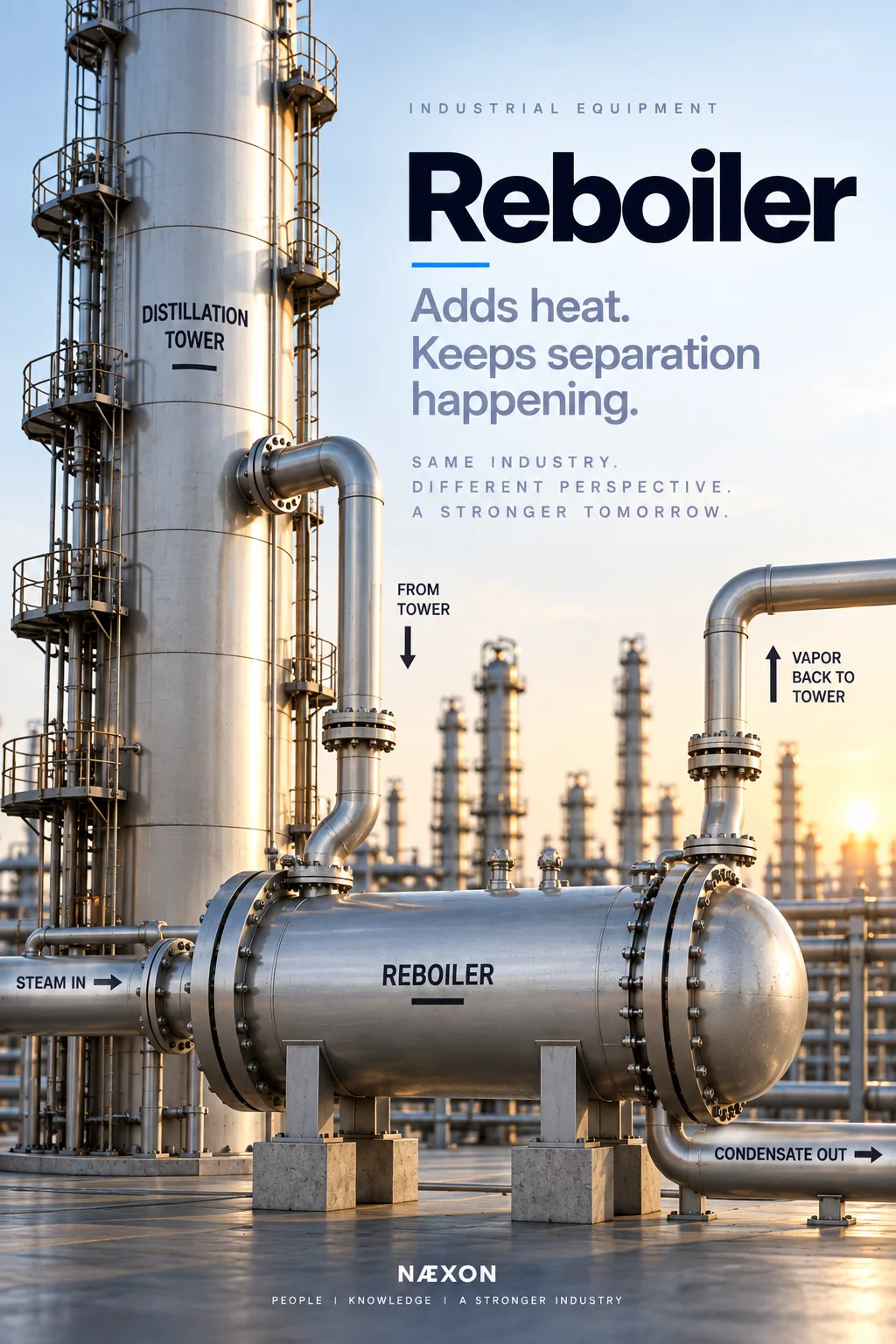
A reboiler is one of the most important heat exchangers connected to a refinery distillation tower.
Its purpose is simple:
Take liquid from the lower portion of a tower → add heat → generate vapor → return that vapor/liquid mixture to the tower.
That vapor rises through the column and provides the energy needed to continue separation.
Without sufficient reboiler duty, many distillation columns cannot maintain the vapor traffic and temperature profile required for proper separation.
For pipefitters, operators, welders, boilermakers, millwrights, inspectors, instrument technicians, and refinery maintenance personnel, understanding the relationship between the tower and reboiler is fundamental process knowledge.
What Is a Reboiler?
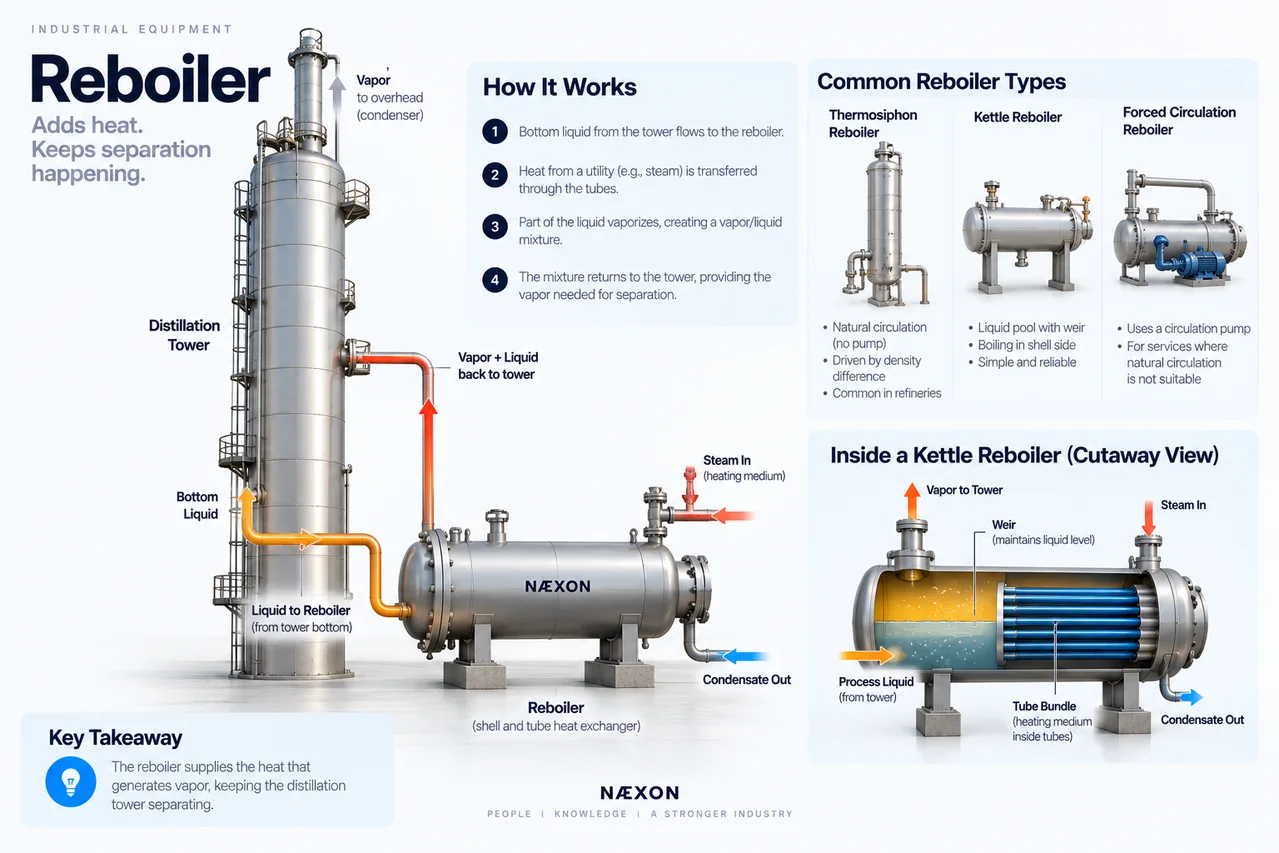
Figure: Reboiler system showing how liquid from the bottom of a distillation tower is heated, partially vaporized, and returned to the tower to provide the vapor needed for continued separation.
A reboiler is a heat exchanger that provides heat to the bottom section of a distillation column or similar process tower.
Liquid from the tower enters or circulates through the reboiler.
A hotter utility or process stream transfers heat through the exchanger surface.
Part of the tower liquid vaporizes.
That vapor-rich stream returns to the tower.
The basic process is:
Tower Bottom Liquid → Reboiler → Heat Added → Partial Vaporization → Return to Tower
The reboiler normally does not boil all of the liquid.
Only enough vapor is generated to provide the required process duty.
Why a Distillation Tower Needs a Reboiler
Distillation depends heavily on repeated contact between:
Rising vapor
and
Descending liquid.
Inside the tower, lighter components preferentially move toward the vapor phase while heavier components preferentially remain in the liquid phase.
The reboiler supplies much of the vapor entering the lower section of the tower.
Think of the column as having two major energy ends:
Condenser at the top → removes heat
Reboiler at the bottom → adds heat
Together, they help establish the tower’s internal vapor-liquid traffic.
The Basic Tower-Reboiler Loop
Imagine liquid collecting near the bottom of a distillation tower.
A portion travels toward the reboiler.
Inside the reboiler, heat crosses a metal surface and enters the process liquid.
Part of that liquid vaporizes.
The resulting vapor/liquid mixture returns to the tower.
Inside the column:
Vapor rises ↑
Liquid falls ↓
This continuous circulation is central to many distillation systems.
Reboiler Duty
You will frequently hear operators and engineers discuss reboiler duty.
Reboiler duty is essentially the rate at which heat is transferred into the process by the reboiler.
More duty generally means more heat is being supplied.
But simply adding more heat is not automatically better.
Reboiler duty influences:
- Vapor generation
- Tower temperatures
- Internal vapor traffic
- Product separation
- Tower pressure behavior
- Energy consumption
The correct duty depends on what the process needs.
Major Reboiler Types
There are several reboiler designs.
Three especially important types to recognize are:
- Thermosiphon reboiler
- Kettle reboiler
- Forced-circulation reboiler
Their purpose is similar.
Their circulation methods are different.
1. Thermosiphon Reboiler
The thermosiphon reboiler is one of the most important refinery designs.
It can circulate process liquid without a dedicated circulation pump.
Instead, circulation is driven by differences in fluid density and the hydraulic relationship between the tower and exchanger.
The simplified path is:
Tower Liquid ↓
Reboiler → Heat Added
Vapor/Liquid Mixture ↑
Back to Tower
That natural circulation is the key concept.
How Thermosiphon Circulation Works
Liquid entering the reboiler is relatively dense.
As it absorbs heat, some of it vaporizes.
The heated two-phase mixture becomes less dense than the liquid feeding the exchanger.
With the correct equipment elevations and piping arrangement, this density difference helps drive circulation.
Conceptually:
Dense liquid down → heated lighter mixture up
No circulation pump is necessarily required.
Gravity, pressure relationships, density change, and vapor generation work together.
Why Elevation Matters
A thermosiphon reboiler cannot simply be installed wherever convenient.
Its elevation relative to the tower affects available liquid head and circulation.
That means equipment layout directly affects process performance.
This is an important lesson for tradespeople:
Equipment elevation is often part of the process design.
Moving a nozzle, changing piping geometry, or modifying a reboiler installation can affect much more than fit-up.
Vertical Thermosiphon Reboiler
A vertical thermosiphon reboiler typically has the exchanger oriented vertically.
Tower liquid enters the exchanger.
Heat is added.
Vapor forms.
The vapor/liquid mixture moves upward and returns to the column.
Vertical thermosiphons are common in refinery and petrochemical service.
Their tall orientation makes them easy to recognize in some units.
Horizontal Thermosiphon Reboiler
Thermosiphon circulation can also be used with horizontal exchanger arrangements.
The exact flow paths and shell/tube assignments vary with design.
The important principle remains:
Natural circulation is generated without relying on a dedicated process circulation pump.
Always use the applicable drawings to determine the actual flow arrangement.
2. Kettle Reboiler
A kettle reboiler looks somewhat like a large shell-and-tube heat exchanger with an enlarged shell.
Process liquid enters the shell side and forms a liquid inventory around the tube bundle.
Heating medium flows through the tubes in many common arrangements.
As heat transfers through the tubes, part of the process liquid boils.
Vapor rises into the vapor space above the liquid.
The vapor then leaves and returns to the tower.
Why It Is Called a Kettle
The concept resembles heating liquid in a kettle.
There is a pool of liquid.
Heat is applied.
Vapor boils off from that pool.
A simplified view is:
Liquid In → Pool Around Bundle → Boiling → Vapor Out
A weir commonly helps maintain liquid level around the tube bundle while allowing heavier liquid product to leave.
Kettle Reboiler Weir
The weir is an important internal feature of many kettle reboilers.
Its job is to help maintain an appropriate liquid level over the tube bundle.
Liquid flows over the weir into a separate section before leaving the exchanger.
This helps keep the heating surface submerged as intended.
Think:
Tube Bundle → Keep Covered
Vapor → Separate Above
Liquid Product → Over Weir → Outlet
3. Forced-Circulation Reboiler
A forced-circulation reboiler uses a pump to move process liquid through the exchanger.
Instead of relying entirely on natural density-driven circulation:
Pump → Reboiler → Tower/System
This can be useful where natural circulation is unsuitable or where process conditions require controlled high circulation.
The pump becomes a critical part of the reboiler system.
Reboiler vs. Ordinary Heat Exchanger
A reboiler is fundamentally a heat exchanger.
What makes it a reboiler is its process function.
An ordinary exchanger may simply:
Heat Liquid A using Hot Fluid B
A reboiler specifically supplies heat associated with vapor generation for a tower or process system.
So:
Every reboiler is a heat exchanger.
But:
Not every heat exchanger is a reboiler.
Heating Medium
The reboiler requires a hotter energy source.
Depending on the process, this may be:
- Steam
- Hot oil
- Hot process fluid
- Other suitable heating medium
Heat passes through the exchanger wall.
The two fluids normally remain physically separated.
For steam-heated service:
Steam → Condenses → Releases Heat
That heat passes through the tube wall into the process.
Steam-Heated Reboilers
Steam is a common refinery heating utility.
Steam enters the exchanger and condenses as it gives up latent heat.
The condensate must then leave through the condensate system.
Simplified:
Steam In → Heat Released → Condensate Out
Meanwhile:
Process Liquid In → Heat Absorbed → Partial Vaporization
The streams do not intentionally mix.
Why Condensate Removal Matters
If condensate does not drain properly from a steam-heated exchanger, heat-transfer performance can suffer.
Potential problems can include:
- Flooding of steam space
- Reduced effective heat-transfer area
- Poor temperature control
- Unstable operation
- Water hammer under certain conditions
Steam and condensate piping therefore deserve careful installation.
Correct slope, traps, valves, and drainage arrangements matter.
Vaporization Inside the Reboiler
One of the biggest differences between many reboilers and ordinary liquid-to-liquid exchangers is that the process stream changes phase.
Liquid enters.
Heat is absorbed.
Some liquid becomes vapor.
The outlet can therefore be two-phase flow:
Liquid + Vapor
Two-phase piping behaves differently from ordinary single-phase liquid piping.
Flow distribution, elevation, pressure drop, piping geometry, and supports can all matter.
Why the Return Line Can Be Large
Vapor occupies far more volume than the same mass in liquid form.
As liquid partially vaporizes, volumetric flow can increase dramatically.
That is one reason reboiler return piping can be relatively large.
The return line must transport the vapor/liquid mixture without creating excessive pressure drop that interferes with circulation.
Reboiler Supply Piping
The line supplying liquid from the tower to a thermosiphon reboiler is extremely important.
Unnecessary restrictions can reduce circulation.
Potential issues include:
- Partially closed valves
- Fouling
- Incorrect piping modifications
- Excessive pressure drop
- Vapor pockets
- Poor geometry
A thermosiphon system depends on relatively small driving-pressure differences.
That makes piping design especially important.
Reboiler Return Piping
The return line carries the heated two-phase stream back to the tower.
This line should not be casually modified.
Changes to:
- Diameter
- Elevation
- Length
- Fittings
- Routing
can affect pressure drop and circulation.
The piping is part of the thermosiphon system—not simply a connection between two pieces of equipment.
What Happens Inside the Tower?
The reboiler return enters the lower region of the column.
Vapor separates and rises.
That vapor contacts descending liquid on trays or packing.
As vapor moves upward, its composition changes.
The reboiler therefore does more than heat tower bottoms.
It generates the vapor that participates in the separation process.
Bottoms Product
Not all tower-bottom liquid goes through the reboiler indefinitely.
A portion normally leaves as the bottoms product.
The basic balance is:
Liquid reaches tower bottom
↓
Some circulates through the reboiler.
↓
Some leaves as bottoms product.
The exact arrangement varies by tower.
Reboiler Temperature
The reboiler operates near the lower-temperature region appropriate to the column’s boiling system, often among the hottest process temperatures associated with that tower.
Temperature depends on:
- Composition
- Pressure
- Required separation
- Reboiler duty
- Heating-medium conditions
Operators monitor these variables together.
Reboiler Pressure Drop
Pressure drop is especially important in thermosiphon systems.
Natural circulation exists because a limited driving force is available.
If resistance becomes too high, circulation can deteriorate.
This can happen through:
- Fouling
- Restrictions
- Incorrect valve position
- Poor piping changes
- Exchanger blockage
Less circulation can then alter boiling and heat transfer.
Loss of Circulation
A thermosiphon reboiler requires adequate process circulation.
If circulation becomes poor while heat continues to be supplied, portions of the exchanger may experience undesirable thermal conditions.
Potential effects can include:
- Poor heat transfer
- Unstable boiling
- Reduced tower performance
- Fouling
- Local overheating in susceptible services
This is why natural-circulation systems must be treated as complete hydraulic systems.
Fouling
Reboilers can foul over time.
Deposits can form on heat-transfer surfaces.
Fouling creates an insulating layer.
Instead of:
Heating Fluid → Metal Wall → Process
you now have:
Heating Fluid → Metal Wall → Deposit → Process
Heat transfer becomes less effective.
The unit may require more heating-medium duty to achieve the same process result.
Eventually the exchanger may need cleaning.
Coke Formation
Certain high-temperature hydrocarbon services can experience coke or heavy deposit formation.
Deposits can:
- Reduce heat transfer
- Restrict flow
- Increase pressure drop
- Reduce circulation
- Create hot areas
- Shorten operating runs
Controlling temperature and circulation can therefore be critical.
Tube Leaks
A tube leak allows the heating medium and process fluid to communicate.
What happens depends on the pressure relationship.
For example, with higher-pressure steam:
Steam/condensate may enter the process side.
In another arrangement:
Process material may enter the utility system.
Either condition can create significant operating and safety concerns.
A tube leak is not simply a loss of efficiency.
How Workers May Recognize a Tube Leak
Depending on service, indicators can include:
- Unexpected contamination
- Changes in condensate quality
- Process changes
- Pressure changes
- Abnormal level
- Reduced exchanger performance
Operators and engineers evaluate the complete process behavior.
During a shutdown, tubes may be inspected or tested to locate leaks.
Reboiler Level
Liquid level is particularly important in kettle reboilers.
The tube bundle needs the intended liquid coverage.
Too little liquid can expose heat-transfer surface incorrectly.
Too much liquid can affect vapor disengagement and operation.
The weir and level-control arrangement help maintain the required inventory.
Thermosiphon Reboiler Does Not Need a Pump
This concept is worth repeating because it is one of the most useful field lessons.
A thermosiphon system can circulate because:
Cold/dense liquid goes toward the exchanger.
Heating produces a lighter vapor/liquid mixture.
Density difference + elevation + pressure relationship drive circulation.
No dedicated process circulation pump is necessarily needed.
Once you understand that, the piping arrangement begins to make much more sense.
Why Reboiler Piping Is Often Short
Look at many thermosiphon installations and you may notice that the exchanger is located close to its tower.
There is a reason.
Short, properly sized piping helps minimize pressure loss.
The system does not have a powerful pump forcing liquid through the circuit.
Natural circulation must overcome the piping resistance.
Therefore:
Less unnecessary resistance = better circulation potential.
Why Pipe Size Matters
Increasing or decreasing line size changes velocity and pressure drop.
In a thermosiphon loop, those changes can affect circulation.
This means a field modification that appears harmless—such as changing fittings or reducing a line—can alter process performance.
Always follow engineered piping drawings.
Thermal Expansion
Reboilers can operate at substantial temperatures.
Their connected piping expands.
The tower moves.
The exchanger moves.
The piping between them must accommodate those movements.
This can involve:
- Guides
- Sliding supports
- Spring supports
- Engineered flexibility
- Expansion loops
A thermosiphon line must simultaneously satisfy:
Hydraulic requirements
and
Mechanical flexibility requirements.
That can make reboiler piping deceptively complex.
Supports Matter
Reboiler piping supports are not randomly placed steel.
They may control:
- Equipment nozzle loads
- Thermal movement
- Line slope
- Vibration
- Two-phase flow effects
- Equipment alignment
Never relocate or remove supports without approved engineering direction.
Common Reboiler Problems
Workers may encounter:
- Fouling
- Tube leaks
- Poor circulation
- Excessive pressure drop
- Steam-side problems
- Condensate backup
- Level problems
- Coke deposits
- Plugged tubes
- Corrosion
- Erosion
- Damaged supports
- Incorrect valve position
- Insulation damage
- Gasket leakage
- Two-phase flow instability
The exchanger itself may not always be the root cause.
The surrounding piping and tower conditions matter.
What Workers Inspect During a Turnaround
Depending on the design and maintenance scope, inspection may include:
- Tube bundle
- Tubesheets
- Channel head
- Shell
- Nozzles
- Baffles
- Weir
- Gaskets
- Flange faces
- Tube-to-tubesheet joints
- Supports
- Reboiler piping
- Steam and condensate systems
Inspection may look for:
- Corrosion
- Erosion
- Fouling
- Cracking
- Tube thinning
- Leaks
- Deposits
- Mechanical damage
Bundle Pulling
Many shell-and-tube reboilers have removable tube bundles.
During a turnaround, the bundle may be pulled for cleaning and inspection.
This can require:
- Bundle-pulling equipment
- Rigging
- Crane coordination
- Exchanger access
- Laydown area
- Tube cleaning
- Inspection
Bundle pulls are major maintenance activities and require careful planning.
What Pipefitters Should Recognize
When standing beside a reboiler, identify:
- Tower
- Reboiler
- Process inlet
- Reboiler return
- Heating-medium inlet
- Heating-medium outlet
- Condensate system, if steam heated
- Bottoms line
- Control valves
- Drains
- Vents
- Supports
Then determine:
Which fluid is providing the heat?
Which fluid is boiling?
Where does the generated vapor go?
Those three questions explain most of the system.
Reboiler vs. Fired Heater
Both add heat to refinery process streams.
But they do it differently.
Fired Heater
Uses combustion.
Fuel + Air → Flame → Process Tubes
Reboiler
Transfers heat from another fluid through a heat-transfer surface.
Heating Medium → Tube Wall → Process
There is normally no flame inside a conventional reboiler.
Reboiler vs. Condenser
These two often sit at opposite ends of a distillation system.
Reboiler
Adds heat
Liquid → Partial vaporization
Condenser
Removes heat
Vapor → Partial or complete condensation
Together they help control the energy balance of the tower.
Important Terminology
Reboiler — Heat exchanger supplying heat to a tower-bottom system.
Reboiler Duty — Rate of heat transferred into the process.
Thermosiphon — Natural circulation driven by density and hydraulic differences.
Kettle Reboiler — Reboiler maintaining a boiling liquid inventory around a tube bundle.
Forced Circulation — Reboiler system using a pump for process circulation.
Two-Phase Flow — Simultaneous vapor and liquid flow.
Weir — Internal barrier used to maintain liquid level in applicable kettle designs.
Heating Medium — Fluid supplying heat to the process.
Condensate — Liquid formed when heating steam condenses.
Fouling — Deposit buildup reducing heat transfer or flow.
Tube Bundle — Collection of tubes providing heat-transfer surface.
What Every Refinery Worker Should Visualize
When you see a reboiler beside a tower, picture this:
Tower liquid ↓
Into reboiler
Heat enters →
Some liquid boils
Vapor + liquid ↑
Back into tower
Then inside the column:
Vapor ↑
Liquid ↓
That is the fundamental process.
Field Rules
When working around refinery reboilers:
- Verify process and utility sides using approved drawings.
- Never assume which fluid is on the shell side or tube side.
- Maintain engineered thermosiphon line sizes, routing, and elevations.
- Do not introduce unauthorized restrictions into natural-circulation piping.
- Maintain specified line slopes.
- Preserve engineered supports, guides, and spring hangers.
- Never force exchanger or tower nozzles into alignment with flange bolts.
- Treat steam and condensate systems as pressurized hot systems.
- Protect flange faces and tube bundles during maintenance.
- Maintain strict foreign-material exclusion after cleaning.
- Verify correct gaskets, bolting, and materials before assembly.
- Follow approved isolation, draining, depressurization, lockout/tagout, and line-opening procedures.
- Respect inspection and quality-control hold points before closing the exchanger.
Knowledge Check
- What is the main purpose of a reboiler?
- Why does a distillation tower need vapor generated near its bottom?
- What is reboiler duty?
- What drives circulation in a thermosiphon reboiler?
- Why does elevation matter?
- How does a kettle reboiler differ from a thermosiphon reboiler?
- What does the weir do in many kettle reboilers?
- Why can thermosiphon return piping be relatively large?
- What happens when exchanger surfaces foul?
- Why can condensate backup reduce steam-reboiler performance?
- What can happen if a reboiler tube leaks?
- Why should thermosiphon piping never be casually modified?
Practical Field Exercise
Find a distillation tower and its reboiler on an approved refinery P&ID.
Trace:
Tower Bottom → Reboiler Inlet → Reboiler → Return to Tower
Then trace the heating side:
Heating Medium In → Reboiler → Heating Medium/Condensate Out
Identify:
- Tower nozzle
- Reboiler inlet
- Reboiler return
- Heating-medium connections
- Control valve
- Drains
- Vents
- Supports
- Bottoms product line
If it is a thermosiphon system, look at the equipment elevations.
Ask yourself:
What is making this process fluid circulate if there is no pump?
The answer is the key to understanding the entire system:
Density difference, vapor generation, available liquid head, and the engineered hydraulic arrangement create natural circulation.
Final Takeaway
A refinery reboiler provides the heat that helps keep a distillation tower separating.
Liquid leaves the lower portion of the tower.
Heat enters through the exchanger surface.
Part of the liquid vaporizes.
That vapor returns to the column and rises through the trays or packing.
For a thermosiphon reboiler:
Dense liquid moves toward the exchanger.
Heating creates a lighter vapor/liquid mixture.
The density and hydraulic difference drives circulation.
No dedicated circulation pump may be necessary.
That leads to the most important field lesson:
A reboiler is not just an exchanger connected to a tower. The tower, exchanger, elevations, piping, pressure drop, heat source, and vapor return form one operating system.
Understand that loop, and you understand the heart of reboiler operation.