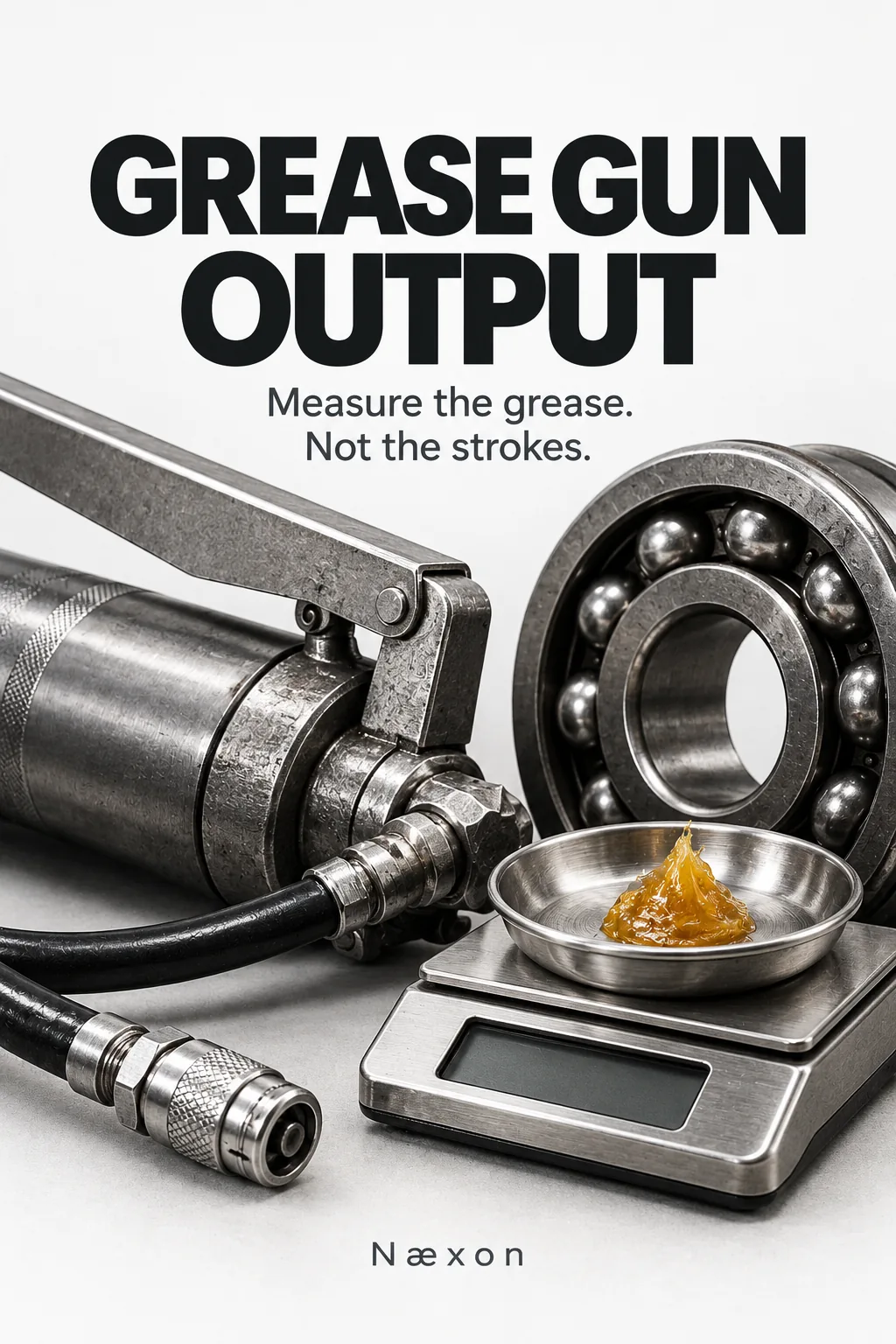
A maintenance instruction says to add 12 grams of grease. One worker reaches for a lever gun; another uses a different gun from the tool room. Giving both workers the same stroke count does not establish that both bearings receive 12 grams.
A stroke is a movement of a particular tool. Grams measure mass. Connecting those two requires a known output and a sound lubrication procedure.
Start with the lubrication point
Before working out a stroke count, identify the machine and the exact point. Confirm the specified lubricant, replenishment quantity, interval, application method, and required equipment condition from the approved lubrication plan and manufacturer instructions.
Keep an initial bearing fill separate from a routine replenishment dose. The amount required when assembling a bearing is not automatically the amount to add on every route. Some bearings are not intended for field relubrication at all.
If the instruction says only “grease bearing,” ask the responsible maintenance or reliability person to clarify it. A guessed dose becomes harder to defend each time it is repeated.
Why the tool changes the answer
Manufacturer data show that grease guns can have different outputs per stroke. Some tools also have selectable operating modes. A count established for one gun or mode should not be transferred automatically to another.
There is another common unit trap: a manufacturer may specify volume per stroke, while the route calls for grams. Milliliters and grams are not interchangeable. Converting volume to mass requires the relevant grease density; do not assume that one milliliter of grease weighs one gram.
For a mass-based route, an approved weighing check can establish a practical mass-per-stroke value. A suitable grease meter may be another option where the lubrication program specifies it. Neither method determines how much grease the bearing needs. The approved plan supplies that quantity.
Work through a controlled output check
The following is an illustrative workshop measurement exercise, not a universal calibration standard. Use the gun manufacturer's instructions and the site's approved check method.
With the gun in sound condition and correctly primed, use a clean collection container and a suitable verified scale. Follow the gun's safe discharge instructions. Tare the container, collect a known number of complete strokes, and record the net mass. Keep hands away from the outlet. Collected grease is test material; do not return it to the clean supply.
Suppose 10 complete strokes produce 8.0 grams:
Output = 8.0 grams ÷ 10 strokes = 0.80 gram per stroke.
If the approved replenishment dose for a particular point is 12 grams:
Required strokes = 12 grams ÷ 0.80 gram per stroke = 15 strokes.
Now suppose another gun produces 12.0 grams in the same 10-stroke check. Its output is 1.20 grams per stroke. Fifteen strokes from that gun would deliver 18 grams in the check conditions, 6 grams more than the intended dose.
That difference comes from the tool, even though both workers counted correctly.
Check repeatability before trusting the count
Repeat the check using the same grease, gun mode, and stroke technique. Inconsistent results may indicate incomplete strokes, trapped air, a priming problem, leakage, or another tool condition that needs attention.
A free-discharge weighing check is not proof that the same quantity reaches a bearing through a pressurized line. Leakage, a blocked passage, or grease retained in an unfilled remote line can break that assumption. Use the site's verification method for the actual delivery arrangement.
Record the gun identity, lubricant, mode, date, output result, and method. Recheck as required by the program and when the tool, lubricant, mode, or output behavior changes. Do not round a calculated stroke count upward without considering the allowed dose and the approved delivery method.
More grease is not a troubleshooting diagnosis
Excess grease can generate heat in a bearing arrangement. Wrong or incompatible grease can also cause lubrication problems. A hot or noisy bearing needs evaluation; repeated pumping is not a reliable way to identify the cause.
Clean the fitting and coupler before connecting. Protect stored grease from contamination and keep lubricant identity clear. Do not decide compatibility from color alone. If the specified grease is unavailable, obtain an approved substitution or changeover procedure.
For related rotating-equipment diagnosis, see the Næxon guide to belt wear and sheave alignment. Lubrication, mounting, alignment, and drive condition deserve separate checks rather than one assumed cure.
Control pressure and moving-equipment hazards
Follow the machine's required isolation and lockout procedure. Do not reach through guards or approach moving shafts to apply grease. Running-equipment lubrication requires a specifically approved safe arrangement and procedure; this article does not authorize it.
Grease guns can retain hazardous pressure. Stop if a point will not accept grease; do not keep raising pressure to force a blockage through. Follow the manufacturer's pressure-release instructions before servicing a hose or coupler, and never search for a pressurized leak with a hand. Suspected injection through the skin requires immediate emergency medical attention, even if the puncture looks small.
Close the route with a useful record
Record the point identification, grease used, quantity delivered by the approved method, tool identity, date, and abnormal observations. Report a blocked point or uncertain delivery as an unresolved condition rather than marking it complete.
A good lubrication record answers three practical questions: what went in, how much went in, and where it went. A stroke count becomes useful only when it helps answer those questions.
Related measurement lessons
For a different application of measured rates, read welding arc energy and travel speed calculations.