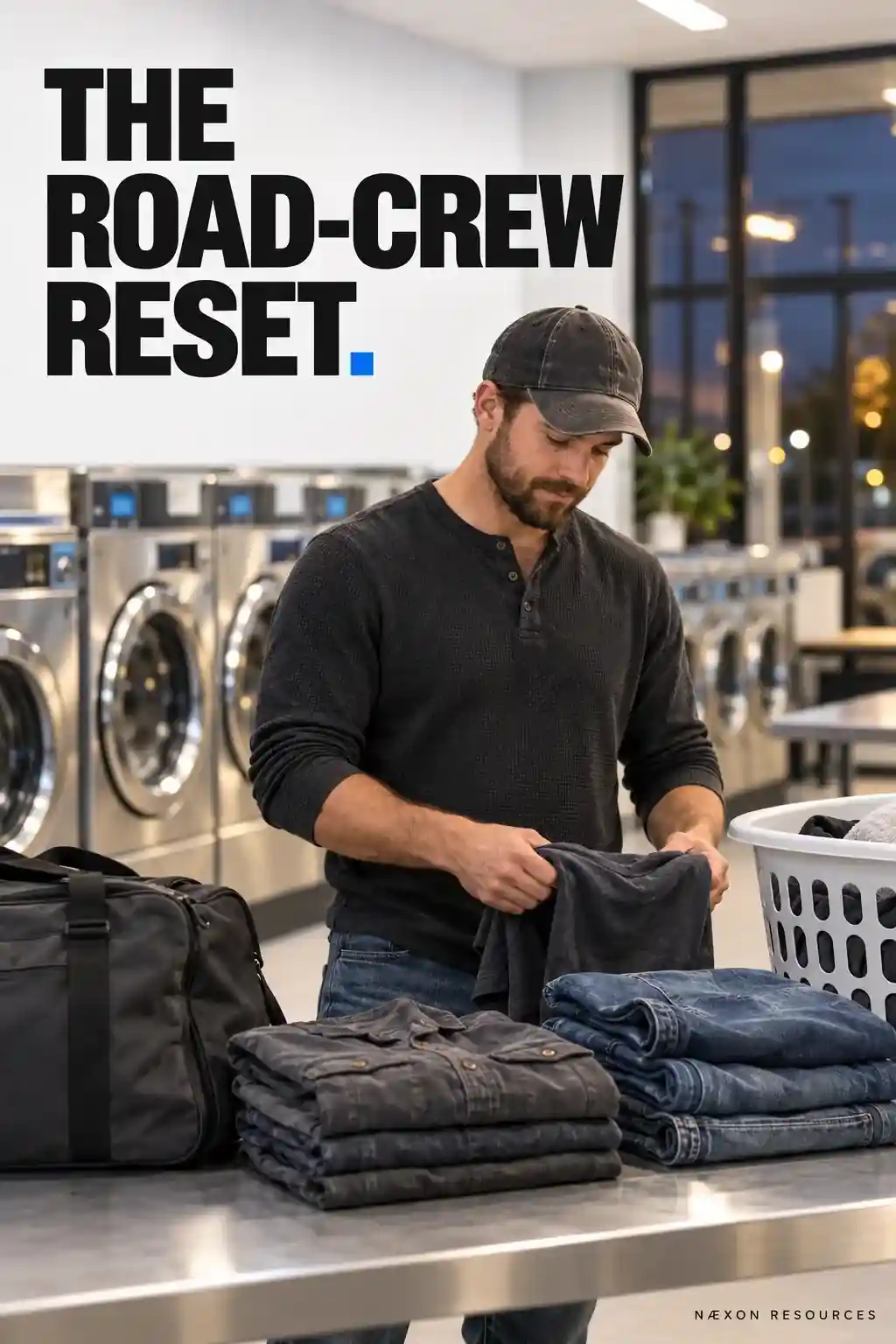
Picture a Sunday night at the laundromat: it has its own shift change.
One crew is loading dryers. Another is folding shirts on a stainless table. Somebody is guarding the only machine that does not shake like it is trying to leave town. In the corner, a traveler studies a lonely sock with the same focus usually reserved for a drawing revision.
For people working away from home, laundry night is rarely just about clean clothes. It is the moment when the past week finally gets emptied out of pockets and the next one starts to look manageable.
The pocket check tells the story
Before the washer starts, every pocket has evidence.
A receipt from the gas station. Two earplug wrappers. A bent grocery list. The pen that disappeared on Tuesday. A hotel key card that stopped working on Thursday and somehow still made it through Friday.
This is where the week gets sorted into three piles: keep, throw away and somehow return to the person who owns it. The process is not glamorous, but neither is hearing a loose marker knock around the dryer for forty minutes.
A small tray or zip pouch helps. Empty the pockets there, deal with the receipts and put tomorrow's essentials back where they belong. The same logic makes a road-job room easier to live in: ordinary things stop becoming a daily search when they have a regular place.
One load can reset more than clothing
The machines give you a little waiting time. That is the useful part.
While the washer runs, refill the lunch supplies, check the alarm, charge the power bank and look at the week ahead through the crew's agreed channel. Not every detail needs a spreadsheet. The goal is simply to make Monday morning less dependent on luck.
This is also a good time to check what needs replacing. A missing button, a worn sock or a split seam is easier to notice under laundromat lights than at the edge of the bed before dawn. Follow the garment's care label and the employer's requirements for work clothing. If the job has a process for contaminated garments, use it; a public laundromat is not a substitute for the site's required handling or decontamination procedure.
NIOSH warns that workplace chemicals can travel on clothing and shoes and recommends keeping dirty work clothes separate from clean items while following workplace controls. The practical rule is simple: do not treat every dirty garment as ordinary laundry just because it fits inside the machine.
The folding table is a planning board
A pile of warm clothes does not look like a schedule, but it can become one.
Put together the basics for the first few mornings. Shirts in one stack. Socks paired instead of thrown into a duffel where they will begin separate careers. One clean off-shift outfit kept away from the work pile. If you share a room, keep your folded laundry on your side instead of expanding across every chair.
You do not need to fold like a retail display. You need to be able to find Tuesday without unpacking Thursday.
Experienced travelers know that small road expenses and small inconveniences accumulate together. Our guide to the real cost of traveling for work includes laundry among the expenses that can quietly eat into a road budget. A repeatable routine will not make the machines free, but it can reduce emergency purchases and the late-night scramble caused by discovering every work shirt is still dirty.
Every laundromat has a crew
You start recognizing people.
The traveler who arrives with three identical black bags. The coworker who brings enough quarters to finance a small project. The person who claims a machine, disappears for dinner and returns seven minutes after everyone has started discussing their absence.
There is usually an unofficial adviser, too. They know which dryer runs hot, which change machine has been broken for a month and exactly how long you have before the attendant locks the door.
The best etiquette is simple. Stay close enough to move your load when it finishes. Leave the folding table usable. Clean up what you spill. Ask before touching another person's clothes. A shared laundromat works a lot like a shared jobsite space: most problems shrink when people remember they are not the only ones using it.
Clean clothes are not the whole reset
Road work can make time feel like a long line of alarms, gates and receipts. Laundry night creates a small boundary between one week and the next.
You sit down. You call home. You answer the message you have been meaning to answer. Maybe you eat something that did not come through a drive-through window. For an hour, the loudest equipment in your life is a row of dryers.
That does not make the road easy. It just gives the week a hinge.
When the last load is done, the duffel closes differently. The room has fewer piles. Monday has a clean shirt. The missing pen has been found, even if nobody remembers borrowing it.
You carry the basket back to the truck and feel, for a moment, unusually prepared.
Then one sock falls out in the parking lot.