
Næxon Resources | Careers, Industrial Construction & Skilled Trades
Louisiana has spent generations building some of the largest refineries, chemical plants, LNG facilities, pipelines, offshore platforms and power plants in America. Now that same industrial workforce may be preparing to build something completely different: a spaceport.
SpaceX has announced plans for a massive Starbase Louisiana development in Pecan Island, Vermilion Parish. The proposed investment is approximately $100 billion, and the project could eventually become one of the largest industrial construction developments Louisiana has seen in decades. For welders, pipefitters, electricians, millwrights, ironworkers, riggers, crane operators and other skilled tradesmen across the Gulf Coast, the most interesting part of the announcement may not be the rockets themselves. It may be everything that has to be built underneath them.
This Is Much More Than a Launch Pad
When people hear “spaceport,” it is easy to imagine a rocket sitting on a concrete launch pad. Starbase Louisiana is planned on a much larger scale. The development is expected to cover approximately 125,000 acres, with plans that could eventually include multiple launch complexes and launch pads, propellant infrastructure, power generation, vehicle-processing facilities, transportation systems and other supporting infrastructure.
Think about that from an industrial construction perspective. Propellant has to be produced, stored, transferred and controlled. That requires piping systems, valves, pumps, tanks, instrumentation, electrical systems, controls and structural supports. Power-generation infrastructure requires mechanical equipment, electrical distribution, structural construction and instrumentation. Launch facilities require massive foundations, structural steel, mechanical systems, utilities, fire protection and controls. Then there are roads, drainage, buildings, marine infrastructure, material yards, warehouses and all the temporary facilities required to support construction.
Before a Starship ever leaves Louisiana, an enormous amount of conventional industrial construction could have to happen on the ground.
Louisiana Already Has the Workforce
One reason this project deserves serious attention is its location. Louisiana and the surrounding Gulf Coast already have one of America’s most experienced heavy-industrial workforces. For decades, workers throughout the region have constructed and maintained refineries, chemical plants, LNG terminals, pipelines, offshore facilities and power-generation infrastructure.
Many of those skills transfer directly into the type of construction a large aerospace-industrial complex could require. SpaceX leadership has already discussed the need for builders, technicians and welders as the Louisiana operation develops. As construction packages are defined, the potential workforce could extend far beyond those positions.
Pipefitters, welders, boilermakers, millwrights, ironworkers, industrial electricians, instrumentation technicians, riggers, crane operators, scaffold builders, heavy-equipment operators, carpenters, concrete crews, insulators, QA/QC inspectors, safety professionals, foremen, general foremen, superintendents, planners and project-controls personnel could eventually have roles in a development of this scale.
That does not mean all of those positions are currently open. The project is still in its early stages, and that distinction is important. But the infrastructure being discussed makes this a project worth watching across virtually every major industrial construction craft.
The Construction Workforce Could Be Massive
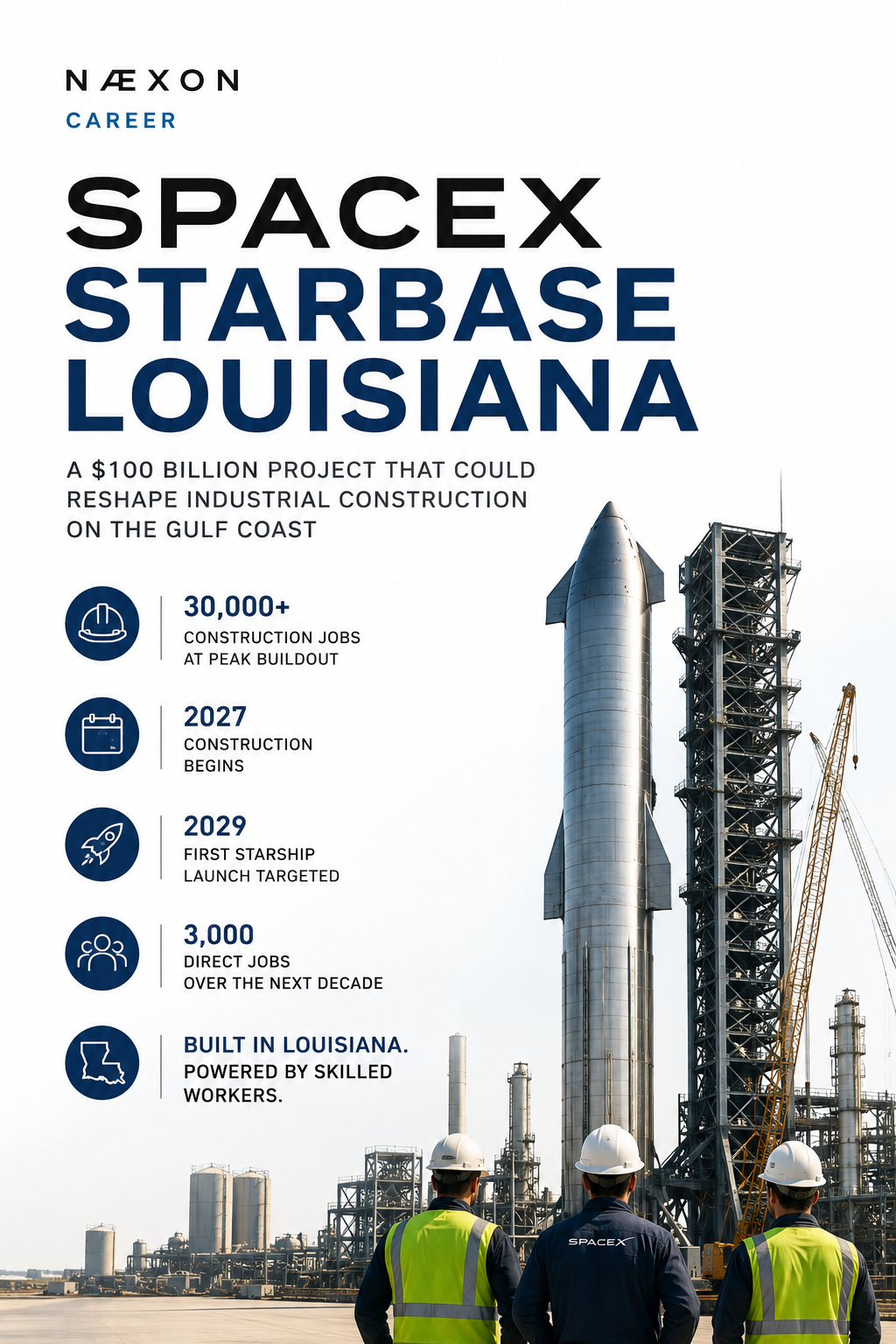
SpaceX expects the Louisiana development to create approximately 3,000 direct jobs over the next decade, with thousands of additional indirect opportunities associated with contractors, suppliers and supporting businesses.
For tradesmen, however, the construction phase may be even more interesting. Estimates surrounding the project have indicated that peak construction employment could reach more than 30,000 workers as the development progresses.
That does not mean tens of thousands of jobs are available today. They are not. Construction is expected to begin in 2027, and the first Starship launch from Louisiana has been targeted for as early as 2029. Engineering, permitting, procurement, infrastructure planning and contractor selection still have to progress before the project reaches full construction mobilization.
The important takeaway is the potential scale. A project capable of supporting tens of thousands of construction workers at peak activity would create opportunities extending far beyond SpaceX’s permanent workforce.
The Biggest Question Now: Who Is Going to Build It?
For industrial workers, this may be the most important part of the entire Starbase Louisiana story. The major EPC, construction-management and specialty construction packages have not all publicly emerged yet.
Most craftsmen working on a project like this may not necessarily be hired directly by SpaceX. The major employment opportunities could come through the contractors and subcontractors selected to construct the facility.
That is how enormous industrial projects typically develop. The owner advances engineering and project planning. Major construction packages are awarded. Mechanical, electrical, civil and structural contractors mobilize. Those contractors bring in specialty subcontractors, and recruiting begins accelerating as construction approaches.
That is when workers start seeing the information that actually determines whether they are interested in taking the job: hourly pay, per diem, schedule, overtime, start date, project duration, required certifications and hiring contacts.
Starbase Louisiana is not fully at that stage yet, which means the next major contractor announcements could be more important to tradesmen than the original project announcement itself.
Watch the Contractors, Not Just SpaceX
Industrial workers interested in Starbase Louisiana should not only watch SpaceX. They should watch the companies SpaceX selects to build the project.
When major civil contractors begin appearing, pay attention. When structural steel packages are awarded, pay attention. When mechanical and piping contractors emerge, pay attention. The same applies when electrical and instrumentation packages, fabrication work, crane and heavy-lift contracts, scaffolding, insulation, commissioning and specialty construction packages begin moving.
Each major contract can create another layer of employment opportunities. One mechanical package alone can involve pipefitters, welders, riggers, equipment operators, QA/QC personnel, safety professionals and supervision. A major electrical package can create demand for electricians, instrumentation technicians, controls specialists and commissioning personnel. Structural work can bring ironworkers, welders, crane operators and rigging crews.
Following the contractor chain is often how experienced traveling craftsmen find large projects before mass hiring begins.
The Opportunity Could Extend Beyond the Spaceport
The economic impact may also extend well beyond the Starbase property. A development of this size requires transportation, utilities, electrical generation and transmission, logistics, material handling and supporting services. Roads and bridges may require improvements to accommodate construction traffic and oversized equipment. New electrical infrastructure may have to be constructed. Warehouses, fabrication facilities, laydown yards, equipment-maintenance operations and logistics companies could emerge around the project.
That means some workers may eventually work on infrastructure supporting Starbase Louisiana without ever setting foot on a launch pad.
Large industrial developments create secondary construction, and that secondary work can continue for years as the surrounding region adapts to the project.
From Refineries to Rockets
Perhaps the most interesting part of Starbase Louisiana is that Louisiana does not need to create an industrial workforce from scratch. It already has one.
There are Gulf Coast welders who have spent their careers building high-pressure process piping. Pipefitters who understand complicated industrial systems. Electricians accustomed to large industrial facilities. Instrumentation technicians who understand process controls. Millwrights who install and align rotating equipment. Ironworkers who erect massive structures. Riggers and crane operators accustomed to moving equipment weighing hundreds of tons. Supervisors who know how to organize large crews during shutdowns, turnarounds and major construction projects.
Those skills were developed building America’s energy and industrial infrastructure. Some of those same skills may eventually help build America’s next generation of space infrastructure.
A Project Worth Watching Now
There is still an important reality check. Starbase Louisiana is an early-stage project. Engineering must advance, permits and environmental reviews must progress, infrastructure has to be developed, contracts must be awarded and contractors must mobilize. Schedules on projects of this magnitude can also change.
So this is not the time for thousands of craftsmen to pack their welding hoods and start driving toward Pecan Island.
It is the time to start paying attention.
A planned $100 billion investment, approximately 125,000 acres, major launch infrastructure, propellant systems, power generation, vehicle-processing facilities and potentially tens of thousands of construction workers at peak development make Starbase Louisiana too significant for the industrial workforce to ignore.
The announcement itself was only the beginning. For welders, pipefitters, electricians, millwrights, ironworkers, riggers, crane operators and other industrial tradesmen, the real story begins when the construction contracts start being awarded.
That is when we find out who is actually going to build Starbase Louisiana—and where the jobs will be.
Næxon Career | Industrial Jobs, Major Projects & Skilled Trades
Leave a Reply