
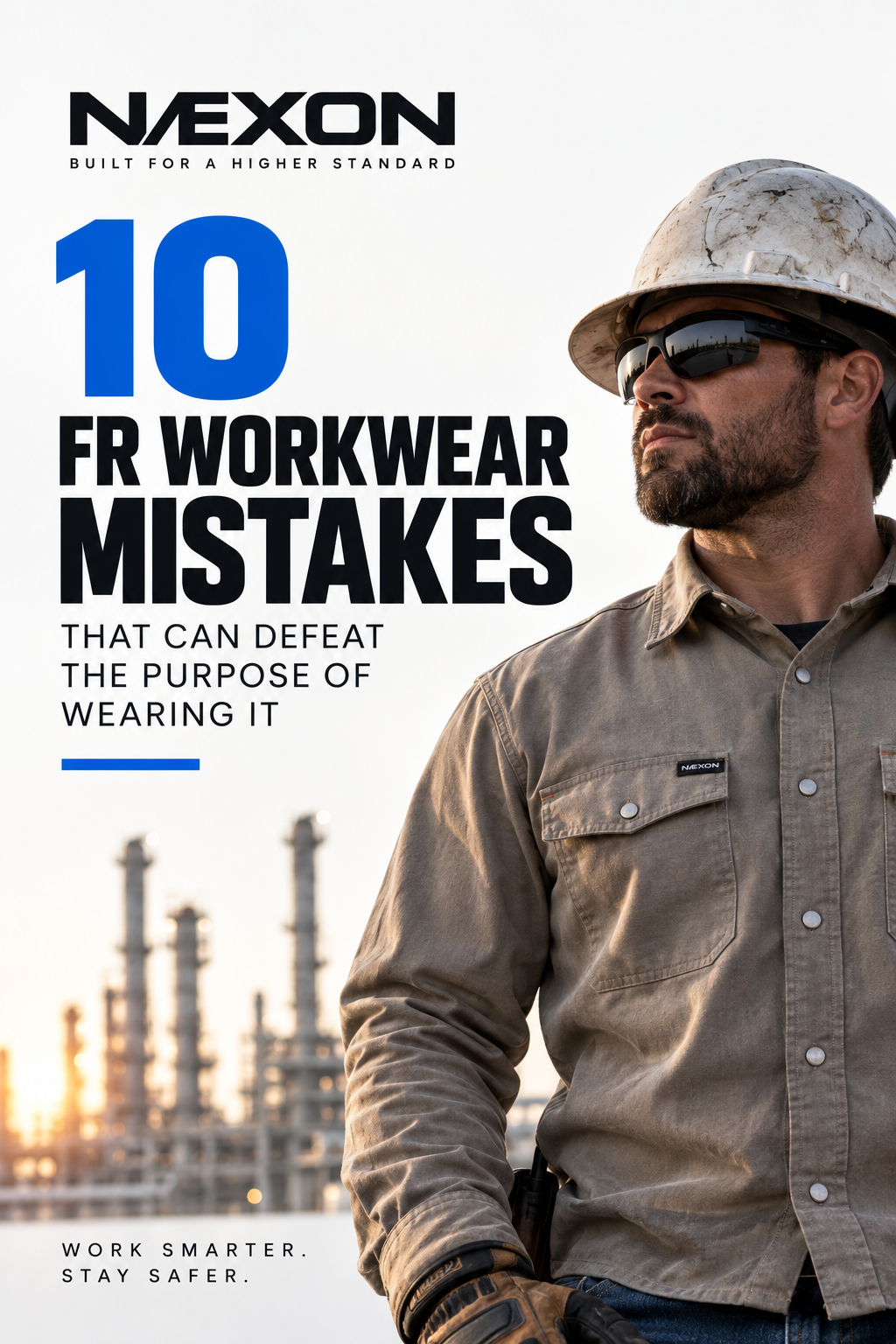
Flame-resistant clothing is standard equipment for thousands of workers in refineries, petrochemical plants, pipelines, oil and gas operations, utilities, power plants, and industrial construction. But simply owning an FR shirt does not mean you are automatically getting the protection the garment was designed to provide.
How the clothing is selected, worn, layered, maintained, and inspected matters.
A worker can spend good money on legitimate FR workwear and then unknowingly compromise its intended protection by wearing it incorrectly. Some of the most common mistakes are surprisingly simple: rolling up sleeves because it is hot, leaving the front of a shirt open, wearing inappropriate layers underneath, continuing to wear contaminated clothing, or keeping an old shirt in service long after it should have been retired.
If you’re new to industrial protective clothing, start with Næxon’s Complete Guide to FR Shirts and Ultimate Guide to Industrial Workwear. Both provide a foundation for understanding how FR clothing fits into the larger industrial PPE system.
1. Wearing an FR Shirt Open
This is one of the easiest mistakes to spot on an industrial jobsite.
The temperature climbs, the worker gets hot, and half the shirt gets unsnapped or unbuttoned.
The problem is coverage.
Protective clothing is intended to provide coverage between the worker and the hazard. Opening the garment can expose the chest or clothing underneath and defeat part of the reason the worker is wearing long-sleeve protective clothing in the first place.
If the job or facility requires the garment to be properly closed, wear it that way.
This is also why comfort matters when selecting industrial workwear. A shirt that becomes unbearable halfway through a twelve-hour shift encourages workers to modify the way they wear it.
Good FR workwear needs to provide the protection required for the job while remaining practical enough to wear correctly throughout the shift.
2. Rolling Up Your Sleeves
Everyone who has worked a Gulf Coast summer understands why somebody would want to roll their sleeves.
Unfortunately, doing so removes coverage from exactly the areas the sleeves are intended to cover.
Your forearms and wrists become exposed.
There can also be a dangerous assumption behind the habit: I’ll roll them back down if something happens.
Industrial incidents rarely provide that kind of warning.
A flash fire, equipment failure, electrical event, or unexpected release can develop extremely quickly.
If long-sleeve FR clothing is required for the area or task, wear the sleeves and cuffs as intended.
Workers who regularly perform welding, grinding, fitting, or other work that puts their forearms close to the work can also read Næxon’s Your Arms Take More Abuse Than You Think: Why Industrial Workers Wear FR Sleeves for a closer look at additional arm protection.
3. Wearing the Wrong Clothing Underneath Your FR
One of the biggest misconceptions about FR clothing is that only the outside layer matters.
Workers sometimes put an FR shirt over whatever T-shirt happens to be clean that morning without considering how that material may behave during thermal exposure.
The layers underneath protective clothing matter.
Certain synthetic materials can melt when exposed to sufficient heat. Clothing systems should therefore be selected according to the employer’s requirements, hazard assessment, and the instructions associated with the protective garments being used.
This becomes especially important during winter.
Putting properly selected FR clothing underneath an ordinary outer garment does not magically make the outer garment flame resistant.
Think of your protective clothing as a system, not a collection of unrelated pieces.
4. Assuming Every FR Garment Provides the Same Protection
“FR” does not describe one universal protection level for every industrial hazard.
A refinery worker potentially exposed to flash-fire hazards and an electrician working around electrical arc hazards may have different protective clothing requirements.
Never assume that because one FR shirt is acceptable for one facility or task, it automatically satisfies the requirements of another.
Check the garment.
Understand its ratings and intended use.
Know the site requirements.
Know the task.
Follow the employer’s hazard assessment and PPE program.
Næxon’s What Every Welder Should Know About Flame-Resistant Apparel explores this subject specifically from the perspective of welders working around sparks, slag, radiant heat, and other thermal hazards.
5. Buying FR Clothing Way Too Big
For years, industrial workwear developed an almost unwritten rule:
Buy it oversized.
Sometimes very oversized.
Workers understandably need room to climb, bend, reach, kneel, weld, fit pipe, operate equipment, and work overhead. But mobility and excessive bagginess are not the same thing.
Extremely loose clothing can create unnecessary material around tools, ladders, structures, equipment, and other obstacles. It can also bunch underneath harnesses and other PPE.
At the opposite extreme, excessively tight clothing can restrict movement and may not provide the fit and coverage intended by the garment manufacturer.
The goal is functional industrial fit.
Næxon goes much deeper into this subject in Your FR Shirt Is Not Supposed to Fit Like a Parachute and The Importance of Proper Fit in Workwear and How It Improves Productivity on the Jobsite.
A properly designed industrial shirt should create mobility through intelligent construction—not simply by adding enormous amounts of material.
6. Wearing Contaminated FR Clothing
This one deserves far more attention than it receives.
Industrial workers routinely encounter oil, grease, fuel, chemicals, process materials, solvents, and other contaminants.
FR clothing does not magically neutralize everything that gets on it.
A garment contaminated with combustible material can present a different hazard than the clean garment originally issued to the worker.
If FR clothing becomes significantly contaminated, follow your employer’s procedures and the garment manufacturer’s instructions for cleaning, inspection, or removal from service.
Do not assume one trip through the washing machine automatically fixes every contamination problem.
If you do not know what substance is on the clothing, determine what it is before deciding how the garment should be handled.
A dirty FR shirt may still look like FR clothing.
Its condition matters.
7. Washing FR Clothing Like Ordinary Laundry
Buying expensive protective workwear and then ignoring its care instructions makes little sense.
Different FR garments can have different laundering requirements, so the manufacturer’s instructions should always control.
Workers should pay attention to recommended washing and drying procedures, detergents, prohibited additives, stain treatment, and any other garment-specific requirements.
Do not rely on jobsite folklore.
“My buddy has washed his this way for ten years” is not a care instruction.
Read the label.
Proper care is not only about keeping the shirt looking good. It is part of maintaining workwear intended to serve a protective function.
8. Continuing to Wear Damaged FR Clothing
Tradesmen are notoriously good at keeping work clothes alive.
A favorite shirt can survive shutdown after shutdown.
Eventually, however, there is a difference between broken in and worn out.
Before putting on FR clothing, inspect its condition. Look for significant holes, tears, excessive abrasion, damaged seams, missing or broken closures, badly worn cuffs, thinning areas, contamination, and other deterioration.
Damage can affect coverage and garment integrity.
Companies may also have specific requirements for repairing or retiring protective garments. Follow them.
Do not improvise repairs with random material simply because a patch fits over the hole. Repairs to protective clothing may need to preserve the characteristics required of the original garment.
Sometimes the correct repair is replacement.
9. Assuming FR Means Fireproof
This misunderstanding can create dangerous confidence.
FR means flame resistant.
It does not mean fireproof.
An FR shirt does not make someone safe to stand in a fire. It does not prevent every burn. It does not eliminate heat transfer. It does not automatically replace welding PPE, electrical PPE, chemical protection, respiratory protection, or any other equipment required for a particular task.
Protective clothing works within a much larger safety system.
That system can include engineering controls, isolation, lockout/tagout, gas testing, permits, barriers, safe-work procedures, training, and additional PPE.
FR clothing can be an important layer of protection.
It is not permission to ignore the hazards around you.
For a broader explanation of how workwear, PPE, and jobsite hazards fit together, continue to Næxon’s Ultimate Guide to Industrial Workwear.
10. Choosing FR Based Only on Price
Nobody wants to overpay for work clothes.
But the cheapest FR shirt is not automatically the best value, and the most expensive shirt is not automatically the best either.
Workers should evaluate what they are actually receiving.
Is the garment appropriate for the hazard? Does it meet the requirements of the job? How is it constructed? Does it allow normal industrial movement? Can you comfortably wear it for an entire shift? How well does it survive repeated laundering? Are the seams and closures durable? How long is its realistic service life?
Price matters.
But value is price measured against performance and service life.
A shirt you can comfortably wear and properly maintain through demanding industrial work can provide substantially different value from one that quickly becomes uncomfortable or unusable.
The Mistake Nobody Talks About: Buying FR You Hate Wearing
This deserves its own discussion because it affects nearly everything above.
Protective clothing only performs as intended when workers wear it correctly.
If a shirt is extremely hot, stiff, restrictive, poorly fitted, or uncomfortable, workers naturally start finding ways to make themselves more comfortable.
The collar gets opened.
The sleeves get rolled.
The shirt gets untucked.
A random jacket gets thrown over it.
The worker buys the next size up because the current shirt binds across the shoulders.
Now a comfort problem has become a workwear problem.
That is why comfort should not be dismissed as purely cosmetic.
Industrial clothing should be designed around actual industrial movement.
A pipefitter reaching overhead to bolt a flange should still have appropriate coverage.
A welder crouching underneath a spool should not have to fight the shirt across his back.
A millwright kneeling beside a pump should be able to move naturally.
A worker climbing a scaffold ladder should not be dealing with excessive material everywhere.
Protection and usability have to coexist.
That philosophy is central to Næxon’s approach to industrial workwear: gear should work with the worker instead of becoming another obstacle during the shift.
Perform a 30-Second FR Check Before Work
Workers already inspect numerous pieces of equipment before using them. Protective clothing deserves similar attention.
Before beginning work, take a few seconds to look at what you are wearing.
Confirm that you have the correct garment for the work and site requirements. Check its general condition. Make sure closures work. Look for significant damage or contamination. Make sure your layers are appropriate. Confirm that the clothing provides the intended coverage while you bend, reach, and move.
That inspection does not need to become complicated.
It needs to become habitual.
The best workers develop small habits that prevent large problems.
New Workers Should Learn This Early
Apprentices and workers entering refineries, petrochemical plants, pipelines, power plants, and oil and gas facilities are often handed a list of PPE requirements without receiving much explanation about why those requirements exist.
They learn that they need FR.
They buy FR.
They put it on.
But understanding why protective clothing is required changes how someone treats it.
Once a worker understands that clothing is part of the protective system, rolling sleeves, wearing inappropriate layers, ignoring contamination, or continuing to wear severely damaged garments starts looking very different.
Knowledge creates better habits.
That is why the Næxon Resources Center and Næxon Learning Center go beyond simply telling workers what equipment exists. The goal is to explain how industrial equipment, workwear, field practices, and craft knowledge actually apply to the work being performed.
Field Rule
If the job requires FR, wear the correct FR garment completely, maintain it correctly, and treat it like protective equipment—not ordinary clothing.
The letters on the tag cannot protect an area of your body the garment is no longer covering.
The Bottom Line
Buying FR workwear is only the beginning.
Proper use means selecting clothing appropriate for the hazard, wearing it correctly, maintaining coverage, using appropriate layers, following laundering instructions, inspecting garments for damage or contamination, and replacing them when necessary.
Some of the biggest FR mistakes do not look dramatic.
An open shirt. Rolled sleeves. An inappropriate base layer. An old hole. A contaminated garment. The wrong protection for the hazard. An oversized shirt constantly getting in the way.
Small decisions become important when the reason you are wearing protective clothing is an event that may happen without warning.
Good industrial workers take care of their tools.
Your workwear is part of your equipment. Treat it the same way.
Leave a Reply