
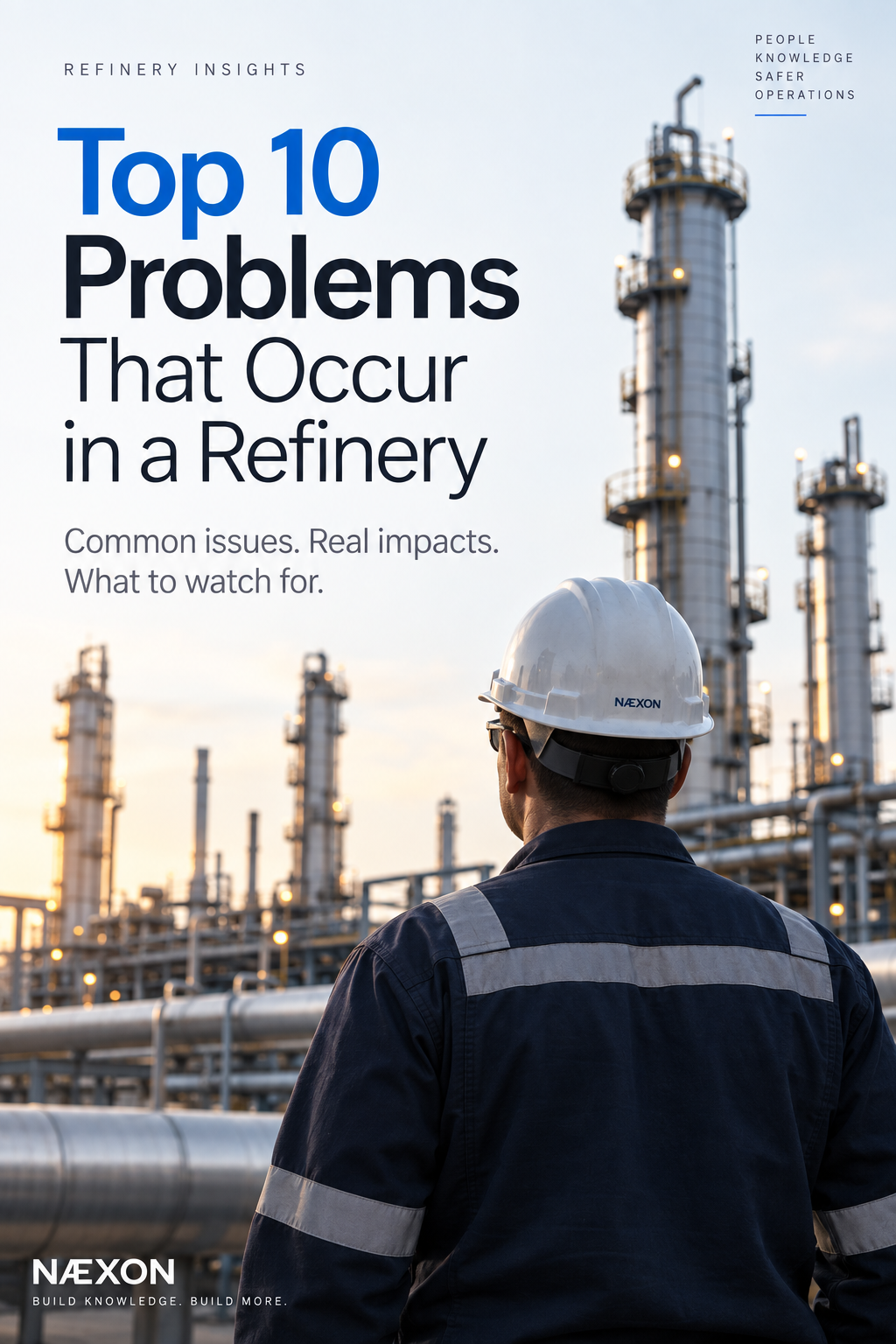
A refinery is an enormous interconnected system operating under combinations of pressure, temperature, flow, chemical exposure and continuous mechanical stress. Thousands of feet of piping connect pumps, compressors, vessels, furnaces, heat exchangers, reactors, columns and storage systems. Instruments constantly measure and control the process while operators and maintenance crews work to keep everything within safe operating limits.
When something goes wrong, the problem rarely exists in isolation. A leaking flange can become a process interruption. Fouling in a heat exchanger can increase furnace duty. A failed instrument can contribute to unstable operation. Corrosion that develops unnoticed for years can eventually become a loss-of-containment event.
Understanding these problems is useful not only for operators and engineers, but also for the pipefitters, welders, boilermakers, millwrights, electricians, instrument technicians, scaffold builders, riggers and other crafts responsible for constructing and maintaining these facilities.
Here are ten of the most important problems encountered in refinery operations.
1. Leaks
Leaks are among the most visible refinery problems, but their significance depends heavily on what is escaping and where.
A leak can involve hydrocarbons, steam, hydrogen, process chemicals, cooling water or other refinery services. Potential leak locations include flange joints, valve packing, threaded connections, instrument connections, tubing, equipment seals, welds and damaged piping.
A small leak should never automatically be considered insignificant. Hydrocarbons may create fire or vapor hazards, hydrogen can escape through extremely small leak paths, steam can cause severe burns, and certain process chemicals can present toxic or corrosive hazards.
From a maintenance perspective, finding liquid on the ground is only the beginning. The important question is why containment was lost.
Was a gasket damaged? Was the flange improperly assembled? Did thermal cycling loosen the joint? Has the pipe wall deteriorated? Is a pump mechanical seal failing? Is vibration damaging a connection?
Fixing the visible leak without identifying its cause can allow the same failure to return.
2. Corrosion
Corrosion is one of the refinery industry’s most persistent integrity challenges because it can occur internally, externally and beneath insulation.
Internal corrosion depends on the process environment. Temperature, water content, contaminants, chemical composition, velocity and metallurgy can all influence deterioration. External corrosion can develop when piping or equipment is exposed to moisture and environmental conditions.
One particularly difficult problem is corrosion under insulation (CUI). The outside of the pipe may be hidden by insulation and jacketing while moisture trapped underneath contributes to deterioration.
Corrosion does not necessarily attack a component uniformly. Localized thinning or pitting can create severely weakened areas while surrounding material still appears relatively sound.
This is why refinery mechanical-integrity programs rely on inspection history, thickness measurements, corrosion monitoring, material verification and knowledge of expected damage mechanisms rather than appearance alone.
3. Fouling
Fouling is the accumulation of unwanted material inside process equipment and piping.
Heat exchangers are particularly sensitive. Deposits accumulating on heat-transfer surfaces act like insulation between the hot and cold fluids. Heat transfer decreases, pressure drop can increase and the refinery may have to compensate elsewhere in the process.
Furnaces, reactors, piping and other equipment can experience various forms of deposition as well.
Fouling may develop gradually, making it easy to overlook. The unit continues operating, but efficiency slowly deteriorates. Temperatures change, pressures shift, flow becomes restricted and energy consumption can increase.
Eventually, equipment may have to be taken out of service for cleaning, inspection or repair.
For tradespeople working turnarounds, fouling is one reason equipment that looks straightforward on a drawing can become a much more difficult field job once it is opened.
4. Overheating
Refinery equipment is designed for defined operating envelopes. Excessive temperature can damage materials, accelerate degradation and upset the process.
Overheating can result from restricted flow, burner problems, inadequate cooling, fouling, instrumentation failures, abnormal reactions or process-control problems.
Fired heaters deserve particular attention because tubes are exposed to intense heat while process fluid flows through them. If flow is inadequate or heat distribution becomes abnormal, tube-metal temperature can rise significantly.
High temperature also affects piping mechanically. As piping heats, it expands. Supports, guides, anchors and flexibility arrangements are designed to accommodate that movement.
A temperature problem therefore isn’t necessarily confined to the process fluid. It can affect equipment metallurgy, piping movement, gaskets, bolted joints and surrounding systems.
5. Overpressure
Pressure-containing equipment has defined design limitations. When process pressure moves outside the intended operating range, protective systems become critical.
Overpressure can result from blocked outlets, thermal expansion of trapped liquid, process reactions, equipment failure, control-system problems or other abnormal conditions.
Refineries therefore use pressure-relief devices and relief systems to provide a controlled path when pressure exceeds specified limits.
In many refinery applications, relieved hydrocarbons are routed into a flare system, where material can be handled and burned under controlled conditions rather than released directly at the equipment.
For field personnel, this is why relief valves, flare headers and associated piping should never be treated as unimportant secondary piping. They form part of the facility’s protection strategy.
6. Equipment Failure
Refineries depend on both rotating and stationary equipment.
Pumps move liquids. Compressors move and pressurize gases. Heat exchangers transfer heat. Furnaces provide process heat. Towers separate components. Reactors provide environments for chemical conversion. Valves control and isolate process streams.
Failure of one critical machine can affect an entire unit.
A pump, for example, can develop bearing problems, seal leakage, cavitation, vibration or alignment issues. A compressor problem may force a significant reduction in unit throughput. A damaged exchanger can create cross-contamination between process streams.
Maintenance therefore involves more than repairing equipment after failure. Condition monitoring, vibration analysis, lubrication, alignment, inspection and preventive maintenance are used to identify deterioration before it develops into a larger problem.
For millwrights, pipefitters and other crafts, equipment reliability also depends on installation quality. Misaligned piping, excessive nozzle loads, poor supports or improper fit-up can contribute to problems after startup.
7. Contamination
Refining depends on controlling what enters each process stream.
Water, solids, corrosion products, incompatible chemicals or material from another process stream can interfere with operations. Some contaminants can damage catalysts, contribute to corrosion, reduce product quality or interfere with downstream equipment.
This makes cleanliness especially important during maintenance and construction.
When piping is opened during a turnaround, foreign material must be kept out. Welding debris, grinding particles, dirt, rainwater, rags, tools and temporary materials can become serious problems if accidentally left inside a system.
Experienced crews understand that housekeeping is therefore more than appearance. Clean construction is part of process reliability.
8. Instrument and Control System Problems
A modern refinery cannot operate effectively without instrumentation.
Pressure transmitters, temperature elements, flowmeters, level instruments, analyzers, control valves and distributed control systems continuously provide information and make adjustments.
A failed or inaccurate instrument can create misleading information about what is actually happening inside the process.
For example, a level indication may show a normal condition while the actual vessel level is abnormal. A control valve may fail to respond correctly. An analyzer may produce an inaccurate reading. An impulse line can plug or leak.
This is why experienced operators do not necessarily treat one instrument indication as absolute truth. They compare related process variables and look for whether the overall process behavior makes sense.
Instrumentation is effectively the refinery’s nervous system. When information becomes unreliable, operating the process becomes considerably more difficult.
9. Fires and Explosions
Refineries process large quantities of combustible materials, often at elevated temperatures and pressures. Preventing loss of containment and controlling ignition sources are therefore fundamental refinery safety objectives.
A serious event generally requires multiple conditions to align. Fuel must be present, oxygen must be available and an ignition source must exist.
That is why refinery safety uses multiple layers of protection rather than depending on a single safeguard. Gas detection, firewater systems, emergency shutdown systems, relief systems, operating procedures, equipment inspection, hot-work controls and hazardous-area electrical requirements all contribute.
For craft workers, activities that may appear routine elsewhere can require much tighter control inside an operating refinery. Welding, grinding, opening process piping and working around operating equipment can introduce hazards that must be evaluated before work begins.
10. Safety Incidents
Not every serious refinery incident begins with process equipment.
Workers can be exposed to falls, dropped objects, confined spaces, moving equipment, electrical energy, stored pressure, hot surfaces, chemicals, heavy lifts and simultaneous operations involving multiple crafts.
Shutdowns and turnarounds can make the environment especially demanding because large numbers of workers may be performing different jobs in a relatively concentrated area.
Good safety performance therefore depends heavily on planning and communication.
Permits, lockout/tagout, line-opening procedures, atmospheric testing, confined-space controls, barricades, lift planning and personal protective equipment are tools used to control hazards. Their effectiveness ultimately depends on people understanding the hazards they are intended to address.
A procedure that becomes nothing more than paperwork loses much of its value.
The Problems Are Usually Connected
One of the most important lessons about refinery reliability is that these ten problems don’t exist independently.
Imagine an exchanger gradually fouling.
Heat transfer decreases, so operating conditions are adjusted to compensate. Furnace duty increases. Temperatures rise. The hotter conditions accelerate a corrosion mechanism somewhere else in the system. Eventually piping becomes thinner. A process upset then increases pressure and the weakened piping begins leaking.
What appears at first to be a simple leak may actually be the final visible result of several interacting problems.
This interconnected behavior is why troubleshooting requires understanding the process rather than simply replacing the component that failed.
What Craft Workers Can Learn From This
A pipefitter doesn’t need to operate the refinery to benefit from understanding how it works.
Knowing that a particular line carries hydrogen changes how seriously you view flange integrity. Understanding pump suction conditions explains why reducer orientation and piping geometry matter. Knowing how thermal expansion works explains why guides and anchors cannot simply be relocated because they’re inconvenient.
The same principle applies across the trades.
A welder benefits from understanding why material identification matters. A millwright benefits from understanding piping loads on rotating equipment. An electrician benefits from understanding hazardous locations. An instrument technician benefits from understanding the process represented by a transmitter signal. A rigger benefits from knowing why certain equipment cannot tolerate uncontrolled nozzle or shaft loading.
The better you understand the system, the better you understand why the work has to be done a certain way.
Field Rules
Treat every process leak as something requiring evaluation rather than assuming its severity from size alone. Never alter piping, supports, relief systems or equipment arrangements simply because the original configuration appears inconvenient. Maintain material identification and cleanliness whenever process systems are opened. Verify isolation before breaking containment, and recognize that temperature, pressure and chemical hazards can remain even when equipment appears inactive.
Most importantly, learn what the equipment and piping around you actually do. A refinery becomes much easier to understand once individual components are viewed as parts of a connected process.
Knowledge Check
1. Why can a small refinery leak still be dangerous?
The escaping material may be flammable, toxic, corrosive, extremely hot or under significant pressure.
2. What is CUI?
Corrosion under insulation—external deterioration that develops beneath insulation systems and may remain hidden from normal visual inspection.
3. Why does exchanger fouling matter?
It can reduce heat transfer, increase pressure drop and force other equipment to work harder to maintain process conditions.
4. Does a relief valve prevent the process from ever exceeding normal operating pressure?
No. It is a protective device intended to relieve pressure under specified abnormal conditions.
5. Why can poor piping installation affect a pump?
Misalignment, excessive nozzle loading, poor supports and unfavorable suction piping arrangements can contribute to mechanical or hydraulic problems.
6. Why is cleanliness important when refinery piping is opened?
Foreign material introduced during maintenance can contaminate the process, damage equipment, restrict flow or create downstream problems.
7. Why shouldn’t operators rely entirely on one instrument reading?
Instruments can fail, plug, drift or provide misleading indications, so related process conditions should be evaluated together.
8. What three basic elements are associated with fire?
Fuel, oxygen and an ignition source.
9. Why are refinery problems often difficult to troubleshoot?
Because one problem can cause or amplify another, making the visible failure only the final symptom of a larger chain of events.
10. Why should tradespeople understand refinery processes?
Because understanding what the system does provides context for drawings, specifications, materials, equipment requirements and safety controls.
Practical Exercise
Choose one refinery system you have worked around—such as a pump and suction line, heat exchanger, fired heater, compressor or distillation tower.
Trace the system from its incoming process connection to its outgoing connection. Identify where a leak, corrosion, fouling, overheating, overpressure, equipment failure, contamination or instrumentation failure could occur.
Then ask one additional question at every point:
“If this component fails, what happens next?”
That question begins to transform a collection of pipes and equipment into something much more useful: an understanding of the refinery as a complete operating system.
Leave a Reply