
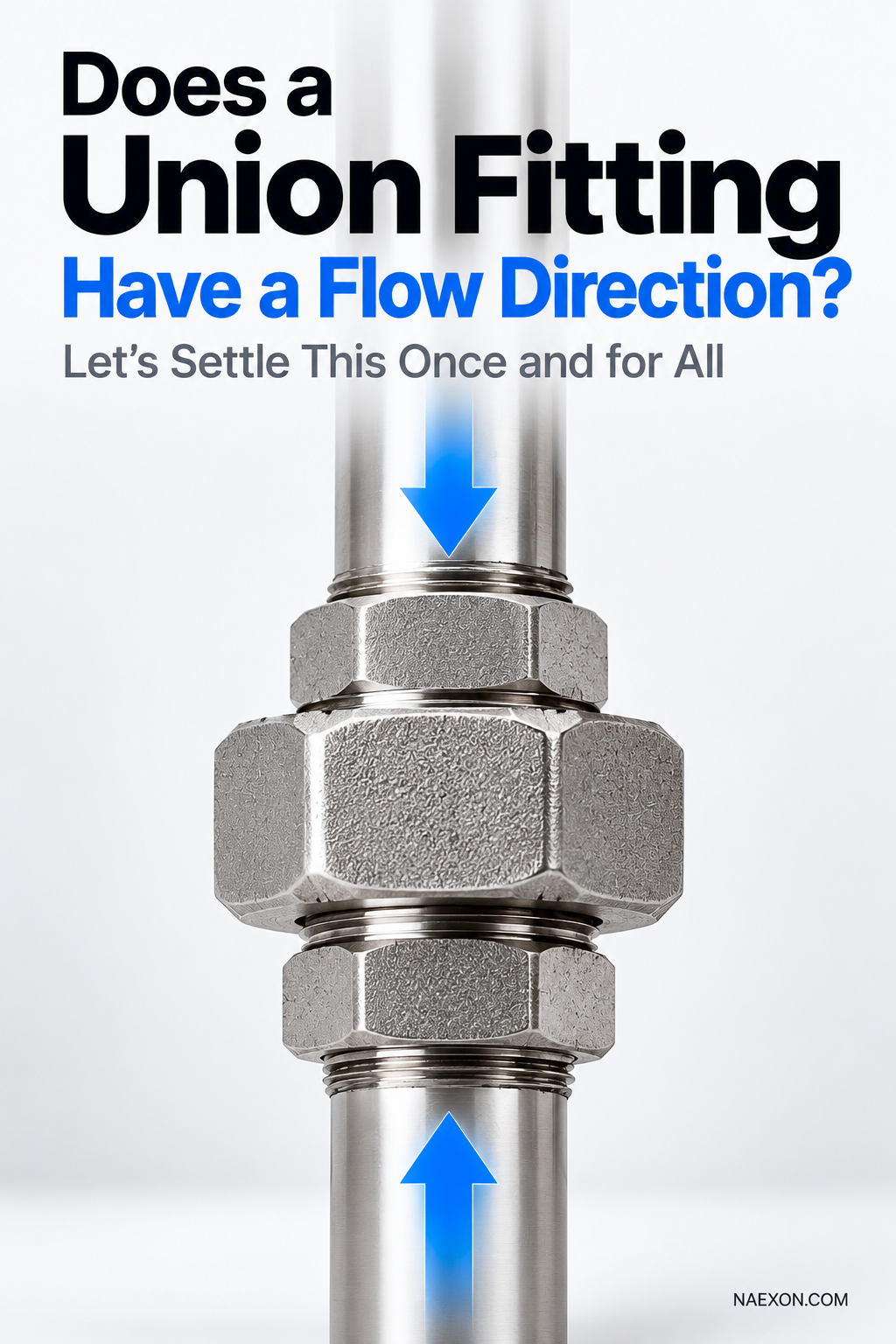
Ask a group of pipefitters which way a union should face and you might get several different answers.
“Flow goes toward the nut.”
“Flow goes away from the nut.”
“Put the male half upstream.”
“No, put the female half upstream.”
Then somebody who has been fitting pipe for thirty years walks over and says:
“It’s a union. It doesn’t care.”
So who is right?
For an ordinary, symmetrical threaded pipe union with no directional internal component, there is normally no hydraulic flow direction.
Fluid can travel through it either way.
But that does not mean orientation never matters.
What a Union Actually Does
A pipe union is a mechanical fitting designed to let two sections of pipe be connected and disconnected without rotating long sections of pipe.
A typical threaded union consists of three primary pieces:
1. Male half
2. Female half
3. Union nut
The two halves are installed on the adjoining piping. The union nut draws the mating faces together and creates the seal.
That is fundamentally different from a component such as a check valve, where the internal mechanism is specifically designed around one direction of flow.
A standard union has no flapper, disc, swing mechanism, directional seat, or other device whose operation depends on fluid moving from one particular side to the other.
So Does the Union Nut Have to Be Upstream?

Figure 1. Standard pipe unions are generally bidirectional and can carry flow either way, while check valves are directional components that must be installed according to their designated flow arrow.
Not simply because it is the union nut.
There is a long-running field belief that the union should always be installed with a particular half facing the direction of flow.
For a conventional union, however, the presence of the nut, male half, or female half does not automatically establish an upstream and downstream side.
If you took a normal union installed in a straight run and reversed the direction of the process fluid, the union would not suddenly stop functioning because the fluid was traveling through it “backward.”
That is the simplest way to understand the issue.
A standard union connects pipe. It does not direct flow.
Why Do Pipefitters Still Care Which Way It Faces?
Because flow direction and installation orientation are two different questions.
There can be very good reasons to consistently orient unions a particular way even when hydraulically they can flow in either direction.
Maintenance
A union exists largely to make future disassembly easier.
The fitter should think about what equipment will eventually need to be removed.
For example, consider a union installed near a pump, regulator, instrument, valve, strainer, burner, or other serviceable component.
The useful question isn’t:
“Which way is the fluid flowing?”
It is:
“When somebody breaks this union five years from now, which section of piping needs to come apart?”
Good piping layout considers maintenance before the wrench ever touches the fitting.
Accessibility Matters
The union nut needs enough room for a wrench.
Installing a union technically correctly but burying the nut against steel, equipment, another pipe, or a wall defeats much of the reason for having the union.
Experienced fitters look at:
- Wrench clearance
- Equipment removal
- Pipe movement
- Nearby valves
- Structural interference
- Drainage
- Future maintenance
- The sequence in which the piping will be dismantled
That is fitting with the next mechanic in mind.
Why the Confusion Exists
Part of the confusion comes from other piping components that absolutely do have a flow direction.
Check valves are the obvious example.
Many regulators, strainers, meters, control valves, backflow devices, specialty valves, traps, and other inline components may also require a specific orientation or flow direction.
Manufacturers commonly cast, stamp, engrave, or print an arrow on directional equipment.
That creates a useful field habit:
Look for the arrow.
But that habit sometimes gets transferred to fittings that don’t inherently perform a directional function.
What About Ground-Joint Unions?
A typical ground-joint union seals by pulling accurately machined mating surfaces together.
The nut supplies the force necessary to seat those surfaces.
Again, the sealing action comes from the mechanical engagement of the union faces—not from process flow traveling through the fitting in one particular direction.
That is why simply identifying one side as the male or female half does not establish a universal flow direction.
But There Is an Important Exception
Never turn “unions don’t have a flow direction” into a rule that overrides the actual component in your hand.
Specialty products exist.
A fitting that looks like a union may be incorporated into an assembly containing a check mechanism, regulator, strainer, meter, valve, trap, or other directional component.
There may also be manufacturer-specific installation requirements.
Therefore:
If the manufacturer provides a flow arrow or installation instructions, follow them.
The manufacturer’s requirements beat jobsite folklore.
A Better Rule for the Field
Instead of memorizing:
“Nut goes with flow.”
or
“Male side goes upstream.”
Use this:
Standard union: orient for installation and maintenance.
Directional component: orient according to its flow arrow and manufacturer requirements.
That distinction solves most of the argument.
An Example
Imagine a piece of equipment connected between two threaded piping runs.
You install a union next to the equipment so it can eventually be removed.
Process flow happens to travel:
Left → Right
Years later, operations change and the system is modified so flow travels:
Left ← Right
Would an ordinary union now need to be cut out and reversed?
No.
Provided it is an ordinary bidirectional union suitable for that service, its basic function remains unchanged.
A check valve in that same line would be a completely different story.
Reverse the flow through a check valve and its operating function changes dramatically.
That comparison makes the difference clear.
One More Thing: Don’t Confuse Orientation With Assembly
Saying a standard union has no required hydraulic flow direction does not mean you can assemble it carelessly.
The union still has to be:
- The correct material and pressure class
- Appropriate for the service
- Properly aligned
- Properly threaded or otherwise connected
- Clean at the mating surfaces
- Assembled without damaging the seat
- Tightened appropriately
- Installed without unacceptable piping strain
A crooked union is still a bad installation regardless of which direction the fluid travels.
The Final Answer
Does a standard pipe union have a flow direction?
Generally, no.
An ordinary union without directional internals is fundamentally a bidirectional connection. There is no universal piping rule saying that process flow must always enter through the male half, female half, or union-nut side.
However, the way a fitter orients the union can still matter enormously for accessibility, equipment removal, maintenance, and good piping layout.
And if a particular union or union-containing assembly has a manufacturer’s flow arrow or directional instructions, those requirements should be followed.
So the next time the crew starts arguing about which way the union “flows,” separate the two questions:
Does it have a required hydraulic flow direction?
Usually not.
Does it have a smart way to be installed?
Absolutely.
That is the difference.
Næxon — Learn the trades. Master the work.
Leave a Reply