Evening Edition · Industrial safety professionals · Apprentice to intermediate · Field Skill · 10-minute read
What you will learn: Distinguish a bump test from a calibration check and full calibration, understand what a fresh-air zero changes, evaluate an illustrative response calculation, and know when a portable gas monitor must be removed from service.
The four-gas monitor powers up, flashes its lights, sounds its horn, and shows numbers on the screen. That does not prove the sensors can detect the gases they are supposed to detect. A blocked inlet, exhausted sensor, expired test-gas cylinder, damaged alarm, or incorrect zero can leave an instrument looking normal while its protection is unreliable.
This lesson focuses on the pre-use verification decision: what each check proves, what it does not prove, and how to react to a failed result. It is not a substitute for the exact detector manual, the employer's written gas-detection program, the confined-space permit, or qualified supervision. Perform testing in the designated safe area with the approved gas, regulator, tubing, adapter, and procedure. Never use this lesson to enter or remain in a hazardous atmosphere.
Four checks that answer different questions
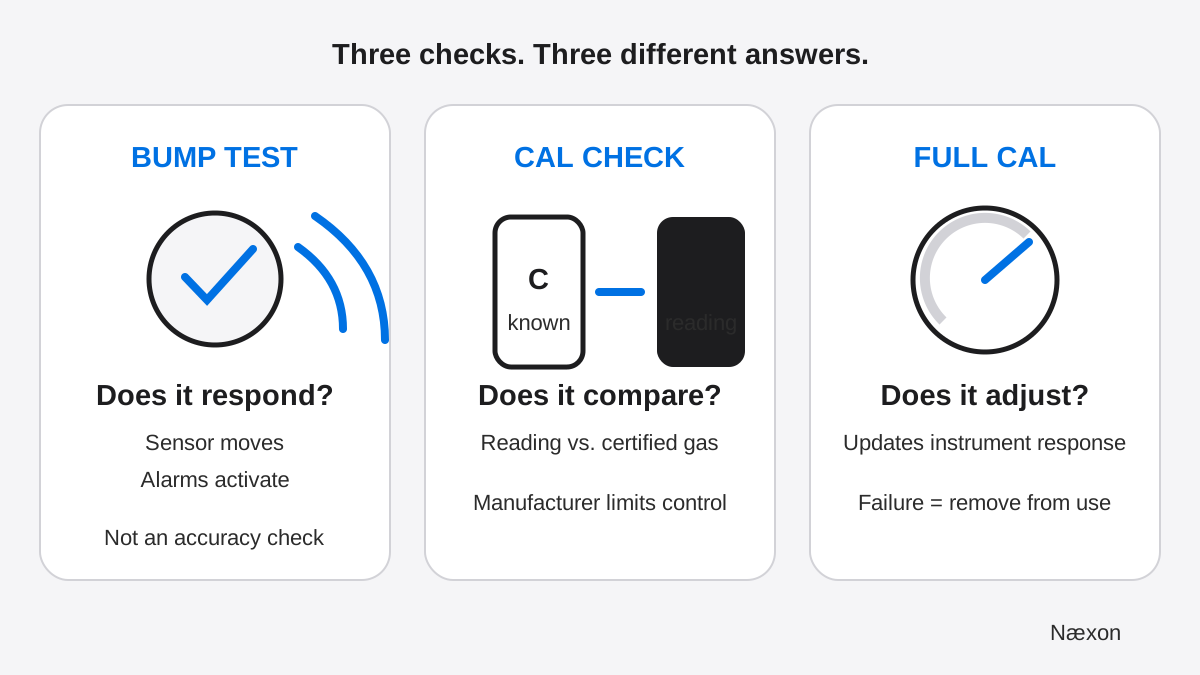
A startup self-test checks functions the instrument can evaluate internally, such as electronics, battery condition, memory, and alarm indicators. The exact scope depends on the model. A self-test cannot prove that gas reaches a sensor or that the sensor responds correctly to its target gas.
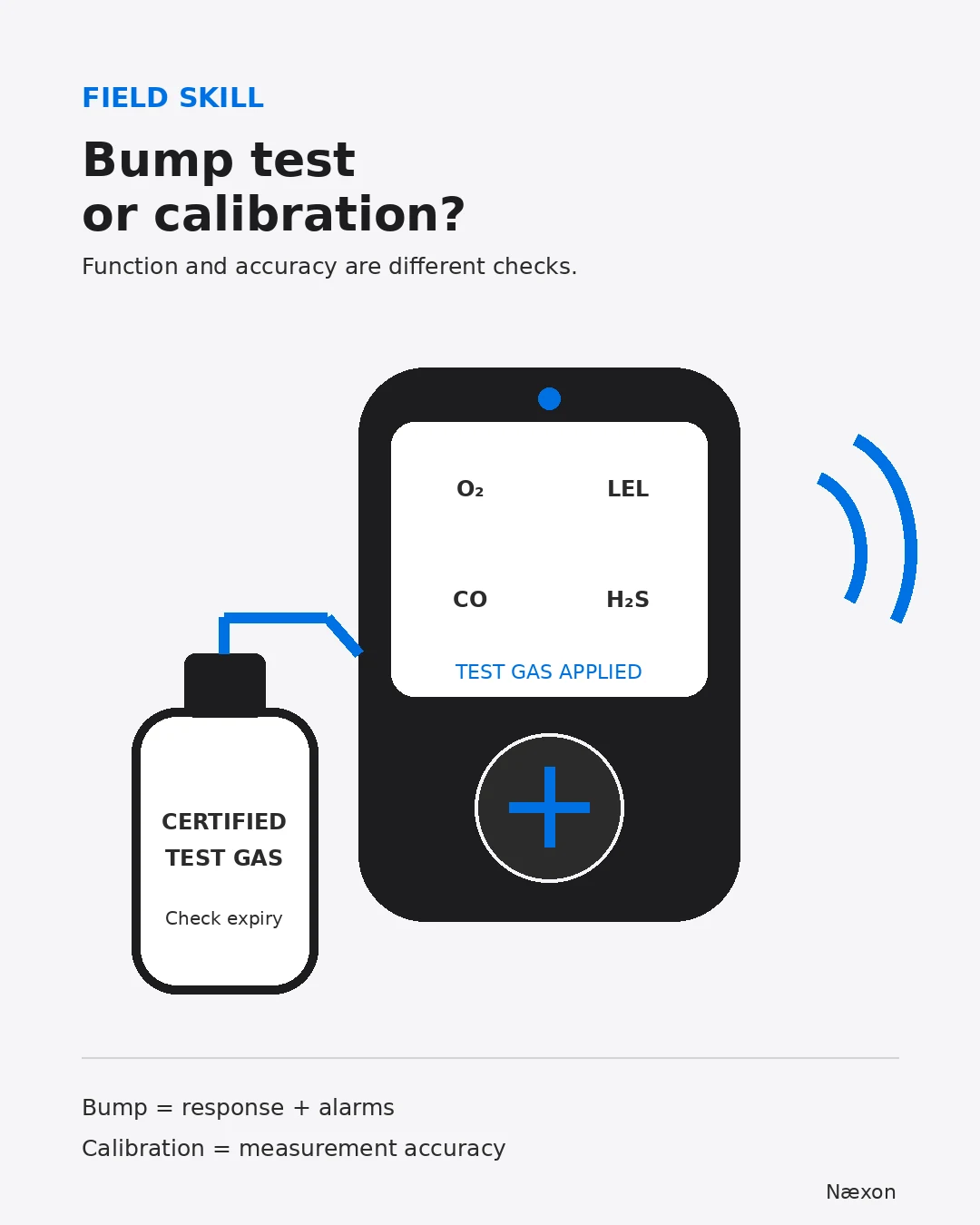
A bump test, also called a function check, briefly exposes the installed sensors to the correct challenge gas in a manner specified by the manufacturer. The expected result is sensor response and activation of the required audible, visual, and vibrating alarms. A bump test answers, “Can the gas reach the sensor, and does the detector respond and alarm?” It does not establish numerical accuracy.
A calibration check exposes the detector to certified gas with a known concentration and compares the displayed value with that known value. The manufacturer's stated tolerance controls the pass or fail decision. A full calibration goes one step further: it adjusts the instrument so its response corresponds to the known test-gas concentration. If the detector cannot complete a required calibration, it is removed from service and handled under the employer's and manufacturer's repair process.
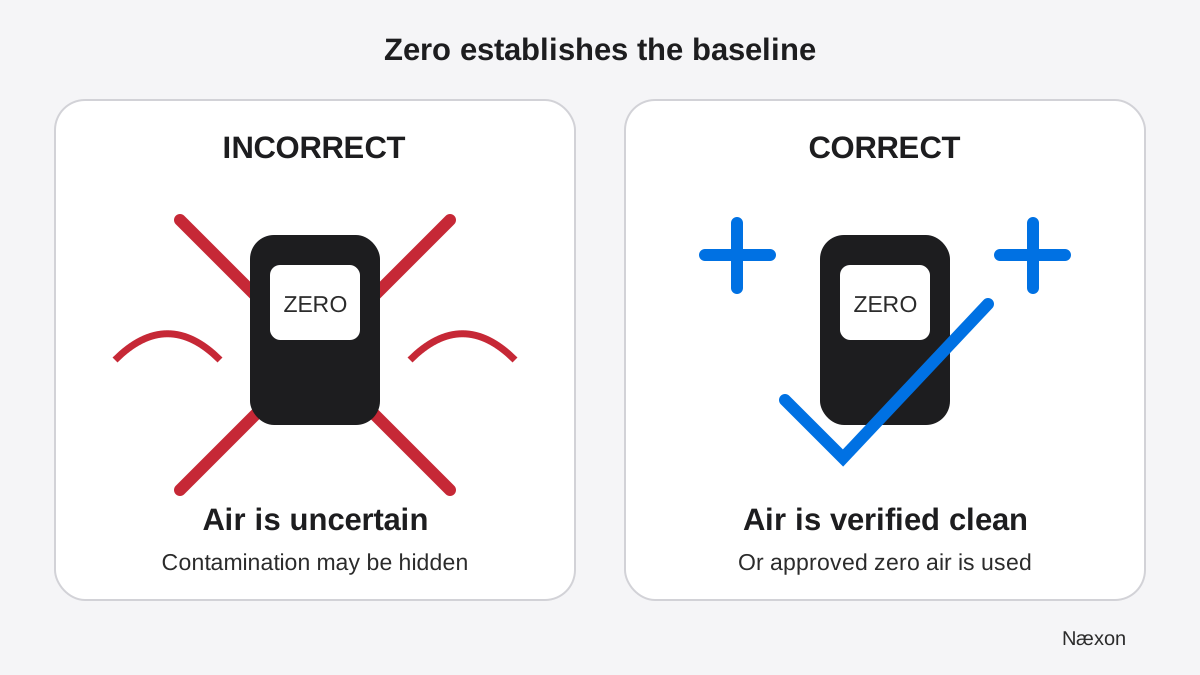
A fresh-air zero establishes the baseline the detector treats as clean air. Zeroing does not test the sensor with target gas and does not replace a bump test or calibration. It must be done only where the air is known to be clean, or with the specified zero-air source, following the detector instructions. If a toxic gas is present while the instrument is zeroed, the detector may subtract that contamination from later readings and display a falsely low value.
Why “it passed yesterday” is not enough
Portable detector sensors drift and can be affected by age, environmental conditions, physical shock, water, heavy contamination, over-range exposure, and chemicals that interfere with or poison a sensor. The inlet, filter, tubing, and calibration cap can also block the test gas before it reaches the sensing element.
OSHA's current direct-reading-monitor guidance says operational capability should be verified before each day's use, at minimum, in accordance with manufacturer instructions, with additional testing when conditions justify it. The exact interval, gas mixture, concentration, flow, exposure time, acceptance range, and recordkeeping method are instrument- and program-specific. A crew cannot safely replace those instructions with a universal shortcut.
For permit-required confined-space work, a calibrated direct-reading instrument is used to test for oxygen, then flammable gases and vapors, then potential toxic contaminants. Detector response time also matters: a remote sample is not complete until the manufacturer's required response and sampling time has elapsed. Passing a bump test prepares an instrument for its approved use; it does not declare a space safe for entry.
Worked example: calculate response error without inventing a pass limit
Assume a supervised training check uses a certified cylinder labeled 25 ppm hydrogen sulfide, the cylinder is unexpired, the detector is configured for that gas, and the display stabilizes at 23 ppm. These values are illustrative. The detector manual, employer program, cylinder certificate, environmental conditions, and approved procedure control the real check.
Let C be the certified concentration and R be the detector reading. Here, C = 25 ppm and R = 23 ppm. The absolute response difference is |R − C| = |23 ppm − 25 ppm| = 2 ppm.
Percent error = |R − C| ÷ C × 100%. Substituting the values gives 2 ppm ÷ 25 ppm × 100% = 8%. The ppm units cancel in the ratio, leaving 8%.
Independently check the arithmetic by converting the reading into a response percentage: 23 ppm ÷ 25 ppm × 100% = 92%. The difference from 100% response is 8 percentage points, matching the first method. A reasonableness check reaches the same conclusion: 2 is a little less than one-tenth of 25, so an 8% difference is plausible.
This calculation does not establish that the monitor passes. Compare the result with the exact manufacturer's acceptable range and the employer's written procedure. If that information is missing or conflicting, stop and obtain the controlling instruction rather than borrowing a tolerance from another detector.
A practical pre-use verification sequence
- Confirm the instrument and assignment. Match the detector model, installed sensors, operating mode, and accessories to the hazards identified by the permit or work plan. Check the service label, required test status, battery, inlet, filter, housing, and alarm openings.
- Read the controlling instructions. Use the current manufacturer procedure and site program for test frequency, gas, concentration, regulator, tubing, adapter, flow, exposure time, tolerances, records, and environmental limits.
- Verify the test equipment. Confirm that the cylinder contains the gases required for the installed sensors, the concentration is correct for the procedure, the gas is certified and unexpired, and the regulator, tubing, and cap are compatible and undamaged.
- Zero only when authorized. If the procedure requires a zero, use air known to be clean or the specified zero-air cylinder. Do not assume a shop, trailer, process area, or outdoor location is clean merely because no odor is noticed.
- Apply the challenge gas exactly as directed. Seat the correct adapter, establish the specified flow, expose the sensors for the required time, and observe every installed sensor plus audible, visual, and vibration alarms. Do not improvise the connection or cover an alarm opening.
- Record the actual result. Document pass or fail, instrument identity, date and time, gas-cylinder identification or concentration as required, and the person performing the check. Clear test peaks only when the approved procedure calls for it.
- Respond to failure. Stop using the detector. Check for correct test setup under the procedure, then perform the required calibration or send the instrument to qualified service. If it fails full calibration, remove it from service. Do not repeat bumps until a marginal response appears acceptable.
- Restore monitoring condition. Close the cylinder, remove the adapter, allow the readings to clear as the manual directs, and verify the detector is ready before field sampling. A calibration cap left in place can obstruct normal diffusion.
The dangerous zeroing mistake
The common incorrect approach is to press “zero” wherever the crew happens to be standing. If carbon monoxide, hydrogen sulfide, or another target gas is already present, the instrument may treat that concentration as its new baseline. Later, the display can understate the actual concentration by approximately the amount hidden during the zero.
The correct approach is to confirm a genuinely clean atmosphere using the employer's method or use the specified zero-air cylinder. If clean air cannot be established, do not zero there. Move to the approved location or escalate. A worker's nose is not a substitute for an atmospheric determination.
Troubleshooting failed or suspicious results
One sensor does not respond: verify that the challenge cylinder actually contains that sensor's target gas, then check the expiration date, valve, regulator, tubing, cap seating, inlet, filter, and required exposure time. If the setup is correct, remove the detector from use and follow the calibration or service process.
The reading rises but an alarm does not activate: stop. A bump test requires the specified alarm response, not merely movement on the display. Verify the approved alarm configuration and test concentration without changing protected settings casually. Escalate a failed alarm function.
All readings respond slowly: inspect the gas-delivery path and confirm the correct flow, tubing length and material, adapter, filter, and environmental conditions. Reactive gases can require particular tubing and handling. Never shorten the required response time because the crew is waiting.
The unit passes a bump but drifts in the field: a bump is not an accuracy check. Review calibration status, recent shock, water or over-range exposure, temperature and humidity limits, cross-interferences, sensor life, and maintenance history. Substitute a verified detector and escalate when reliability is uncertain.
The cylinder is expired or unlabeled: do not use it to approve the detector. The instrument can only be compared with a reliable known concentration. Quarantine or replace uncertain test gas under the site program.
Common mistakes
Treating the startup beep as a bump test ignores whether gas reaches the sensors. Calling every gas application a “calibration” hides whether the instrument was merely challenged, compared, or adjusted. Using the wrong gas mixture may leave one installed sensor untested. Zeroing in uncertain air can create a false baseline. Using an expired cylinder makes the reference unreliable. Passing the monitor from worker to worker without recording its identity and result breaks traceability.
Another mistake is using a passed bump test as permission to enter. Entry depends on the permit, hazard evaluation, acceptable-entry criteria, sampling location, response time, continuous-monitoring requirements, ventilation, rescue provisions, and the authorized entry supervisor—not on the bump result alone.
Field Rules
- A self-test checks internal functions; it does not expose the sensor to gas.
- A bump test proves response and alarms, not numerical accuracy.
- A calibration check compares; a full calibration adjusts.
- Zero only in verified clean air or with the specified zero-air source.
- Use the exact approved gas, equipment, timing, and manufacturer limits.
- A failed bump or calibration removes the detector from use until properly resolved.
- Passing a pre-use check does not declare an atmosphere safe.
Knowledge Check
- A detector completes its startup self-test, but no challenge gas has been applied. What important capability remains unproven?
- Certified gas is 50 ppm, and the stable detector reading is 46 ppm. What is the percent error, and can you declare a pass from that number alone?
- A worker zeros a CO monitor in a running-equipment area because the display shows only a small value. What is wrong with this approach?
- During a bump test, the H2S reading rises, but the vibration alarm never operates. Is the test acceptable?
Answers
1. It remains unproven that gas can reach the installed sensors, that the sensors respond to target gas, and that the full required alarm sequence operates. Use the prescribed bump or calibration-check procedure.
2. The difference is |46 − 50| = 4 ppm. Percent error is 4 ÷ 50 × 100% = 8%. You cannot declare a pass without the exact manufacturer's acceptance range and site procedure.
3. The air has not been established as clean. Zeroing may hide existing CO by making it part of the baseline. Zero only in verified clean air or with the specified zero-air source.
4. No. The required alarm function did not complete even though the sensor responded. Stop using the detector and follow the approved failure, calibration, or service process.
Practical Exercise
Use a paper worksheet—not a live detector. Create four columns labeled Check, Question answered, Evidence observed, and Failure response. Add rows for startup self-test, fresh-air zero, bump test, calibration check, and full calibration. Your work is correct when the bump row says “sensor response and alarms,” the calibration-check row says “comparison with certified gas,” the full-calibration row says “adjustment,” and every unresolved failure ends with removal from use or escalation under the approved procedure.
Related learning
For a prerequisite on why an apparently harmless gas can change an atmosphere, review how nitrogen purging works in industrial piping. To understand who maintains and interprets many plant instruments, continue with what instrumentation and controls technicians do. For broader hazard-recognition context, study common refinery problems and why they matter.