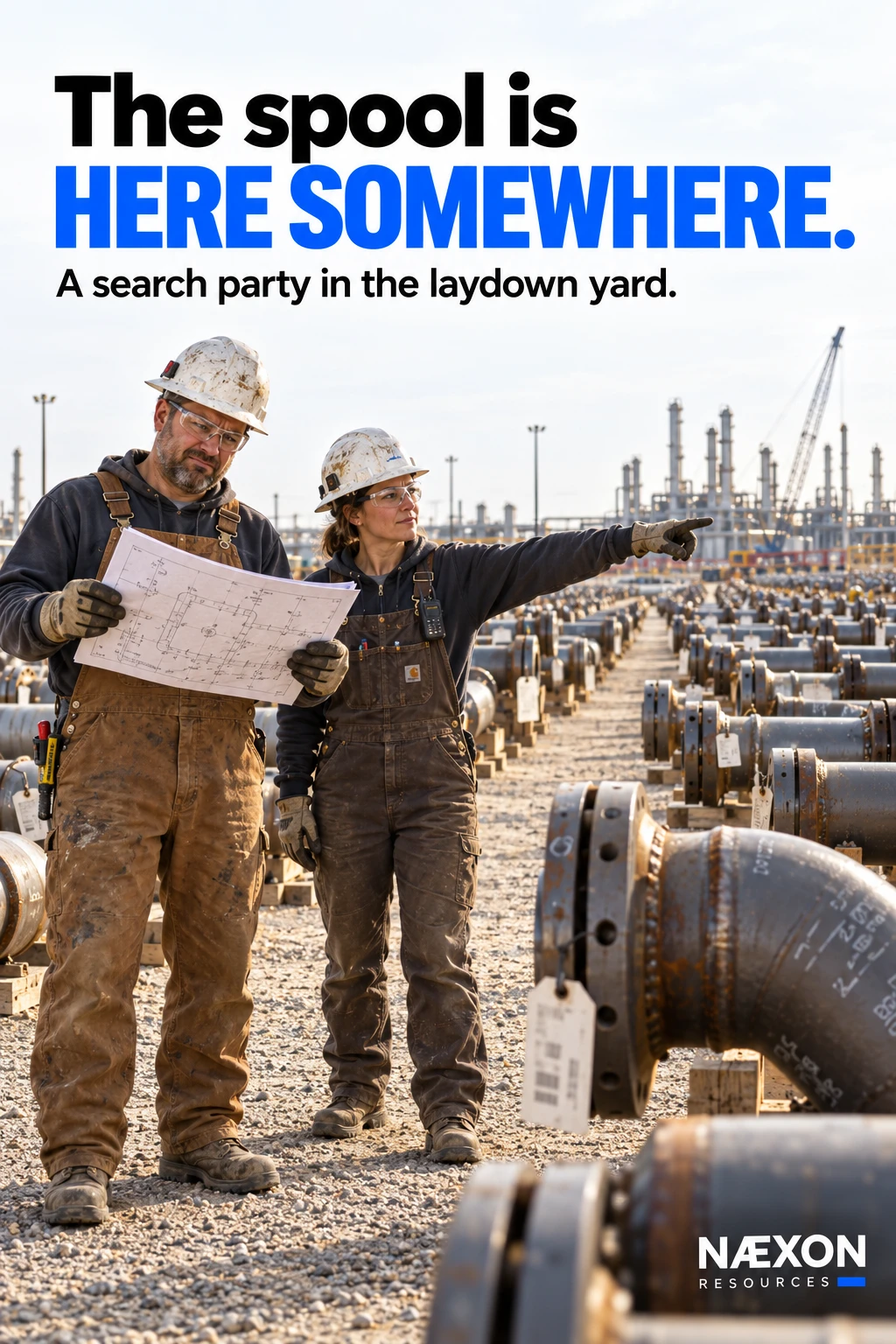
“The spool's in the laydown yard.”
That's good news.
The laydown yard contains enough pipe to make that statement almost completely useless.
“Which row?”
“Over by the other spools.”
Excellent. We've narrowed it down to the pipe department.
What follows is a fictional search, assembled from the kind of directions that can turn a simple material pickup into a guided tour nobody requested.
The directions begin with something that moved
“Go past the blue forklift.”
The forklift has wheels. It has used them.
“Okay, where was it?”
“Beside the trailer.”
There are several trailers. None has volunteered to be the trailer.
The man giving directions looks offended that the yard didn't remain exactly as he left it. He was very clear when he said “right there.”
He points again. From this distance, his finger covers about two acres.
The eyewitness was absolutely there
“I saw it yesterday.”
That sounds promising.
“What did it look like?”
“Had a flange on it.”
So do a few other candidates.
He remembers the general shape, the general area, and a conversation he had while walking past it. He can tell you who was with him and what they were complaining about.
The spool number is the one detail that escaped.
He isn't making anything up. He probably did see a spool. It may even have been an excellent spool.
Unfortunately, yours needs to be a particular one.
Everybody recognizes a different piece
One person points left.
Another is certain it's on the next row.
A third says the piece everyone wants already went to the unit.
Now the search has branches.
The crew has produced three locations, two delivery histories, and a surprising amount of confidence. Nobody has matched the actual identification yet.
This is where “looks about right” becomes expensive language. Similar shape is not the same thing as the correct piece. The approved drawing and material-identification system still get a vote, even when five people would very much like the search to be over.
The whole trip from fabrication to installation is covered in the life of an industrial pipe spool. Finding the correct one is a small part of that trip with an impressive ability to occupy the afternoon.
The radio wants a simpler answer
“Have you got it?”
“Looking for it.”
“Should be right there.”
You look around. It remains several places.
A minute later, the radio asks again. The additional inquiry has not made the identification easier to read.
“Any luck?”
“We've found a lot of pipe.”
That answer is accurate. It is not popular.
Somewhere else, somebody is trying to plan the next task. They need an honest status, not a promise invented to end the radio conversation. “Still locating the correct spool” may be irritating, but it's better than “got it” when you've only found something with the right number of bends.
One person brings something more useful than confidence
The breakthrough is usually less dramatic than the search.
Someone arrives with the current location record. Or checks the delivery information with material control. Or notices that the reference everyone is repeating isn't the one on the request.
Now the conversation contains a specific identifier and a location that can actually be checked.
No speech. No announcement about being the smartest person in the yard.
Just useful information.
It might come from the material handler, a fitter, or the helper who keeps the job moving. The job title matters less than the fact that this person checked instead of adding another guess.
Nobody needs to climb stored material, disturb supports, move a load without authorization, or alter identification to turn this into a successful search. If the marking can't be safely read or the record doesn't match, get the responsible people involved.
Finding it is not a separate contest with a prize for doing something stupid.
Found it. Obviously.
The right piece is located through the site's normal material-control process.
Somebody immediately says, “That's where I told you.”
It isn't. But arguing would add another department to the search.
The eyewitness examines it and nods. He knew all along.
The person who said it had already gone to the unit announces that he was talking about a different one.
Everybody's record remains perfect.
Before the next step, the responsible crew confirms the actual identification and follows the project's handling and installation requirements. A successful search doesn't make every other check disappear.
And when the location record needs updating, somebody does it while the information is still useful.
That's the part nobody will retell at lunch. It doesn't have much of a punchline. It just keeps the next crew from repeating the tour.
The search isn't over
The radio comes back.
“Good. Need the next spool now.”
“Where is it?”
“Same place.”
Of course it is.