Morning Edition · Welders and boilermakers · Apprentice · Equipment · 10-minute read
What you will learn: Read a welding power source duty-cycle rating as a percentage-and-current pair, calculate allowable weld and cooling time on a stated 10-minute basis, recognize a thermal-protection event, and choose safe checks before restarting.
The machine has welded without complaint all morning. Then the output stops, a temperature symbol appears, and someone says the welder is too small. Another person points to “60%” on the data plate and argues that it should run continuously because the arc was not on for a full hour. Both conclusions skip the most important part of the rating.
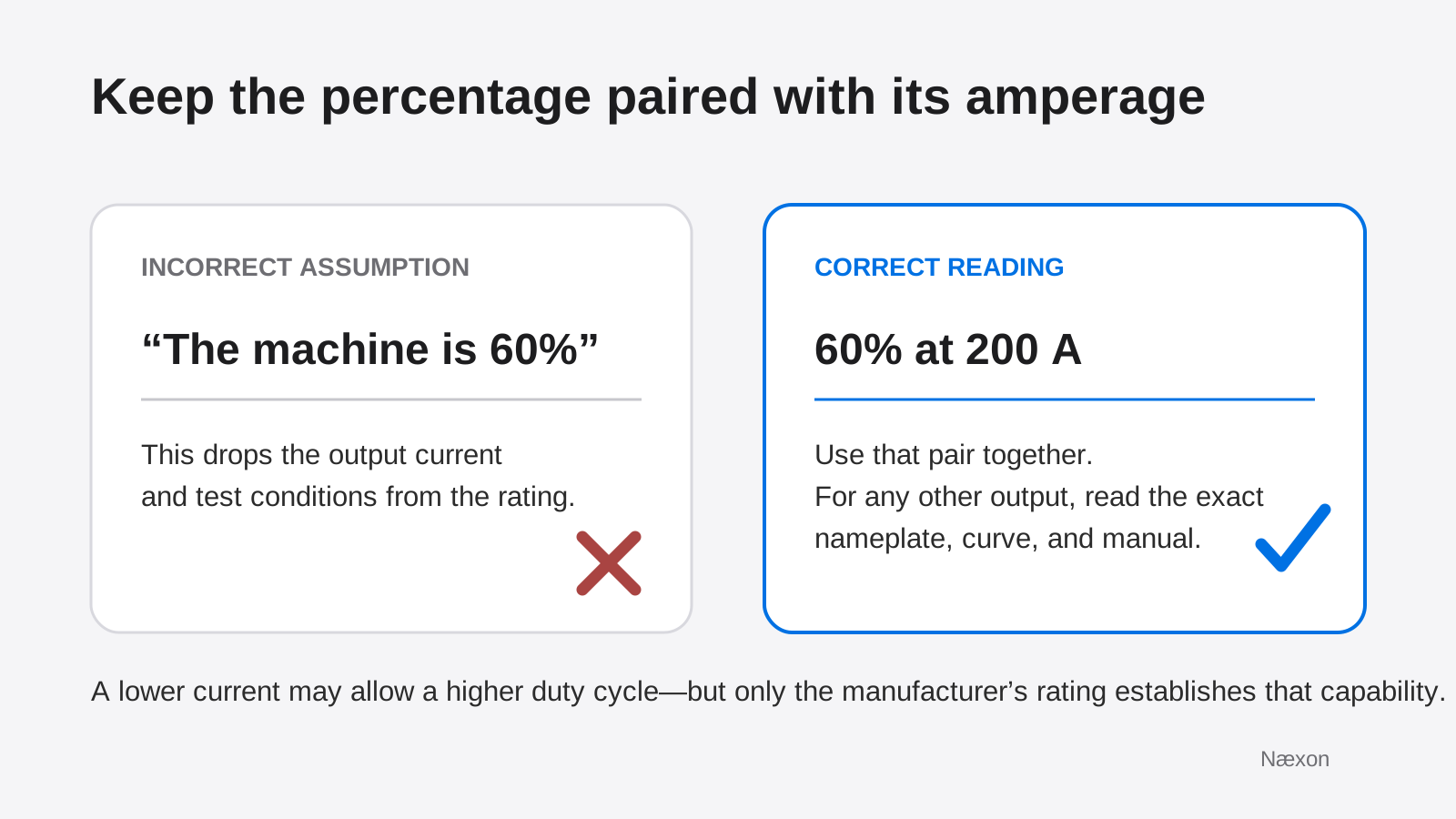
Duty cycle describes how long a welding power source can deliver a stated output during a specified test period without exceeding its thermal limit. A rating such as 60% at 200 A is one complete statement: the percentage belongs to that amperage and to the manufacturer’s stated test conditions. It is not a universal percentage for every current, process, ambient condition, or installation.
This lesson explains the equipment concept; it does not authorize a setting or production procedure. The exact nameplate, owner’s manual, approved welding procedure specification (WPS), input-power requirements, site controls, and qualified supervision govern the real job. If the process names or basic machine connections are unfamiliar, first review how MIG, TIG, and stick welding differ.
Read the entire rating
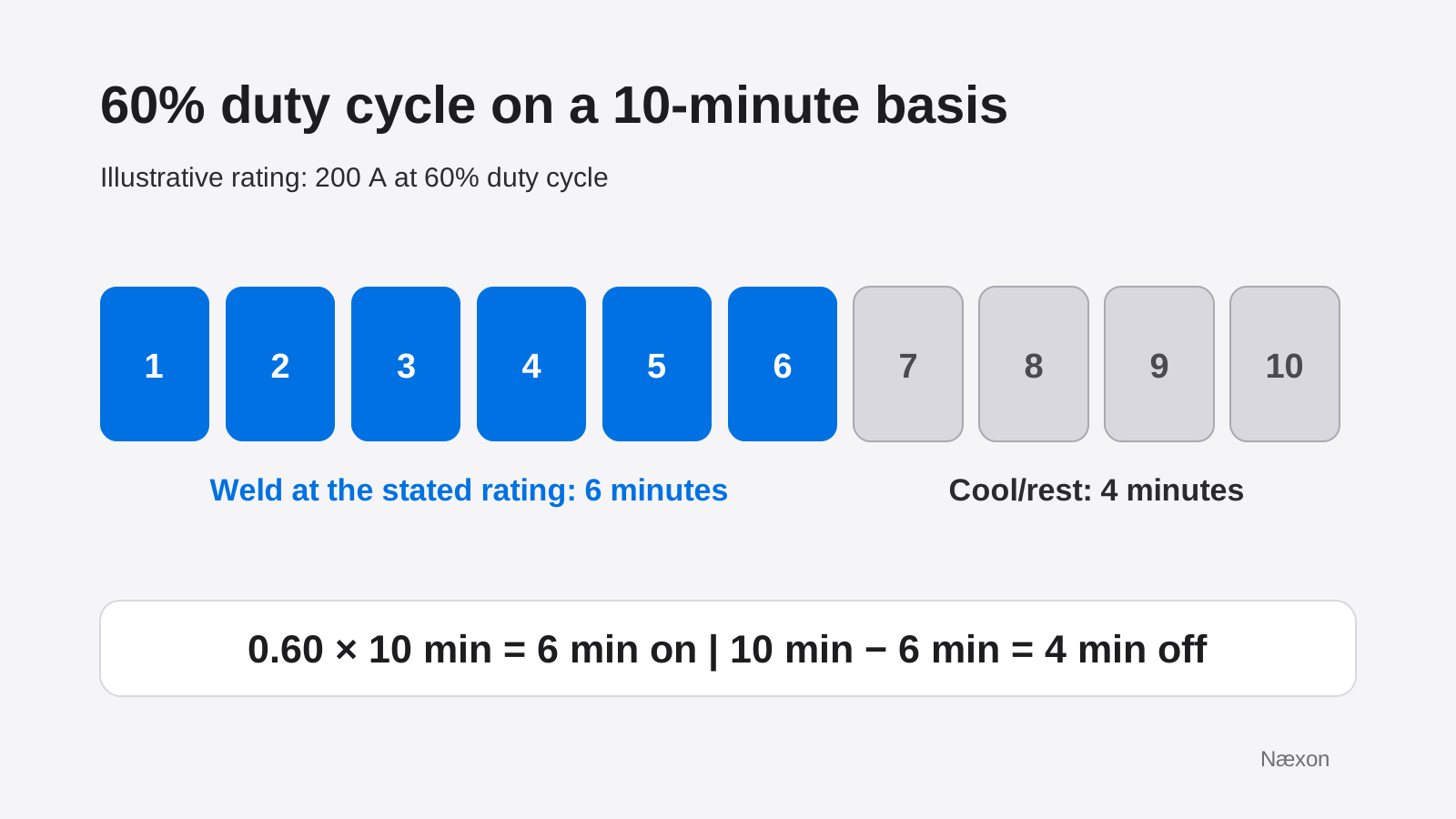
Many welding-machine manuals express duty cycle as a percentage of a 10-minute period. Under that basis, 60% means six minutes at the stated rated load followed by four minutes without welding so the unit can cool. A 20% rating means two minutes at the stated load and eight minutes of cooling. Always confirm the period in the exact manual instead of assuming every product, jurisdiction, or standard uses the same basis.
Current is inseparable from the percentage. “60% at 200 A” does not mean the machine is always limited to six welding minutes at every setting. Many power sources can operate at a higher duty cycle at a lower output, and some manuals provide a curve or additional rating points. It also does not mean a lower current automatically guarantees continuous operation. Only the manufacturer’s published rating for that machine establishes its capability.
Manufacturers establish ratings under defined conditions. Ambient temperature, airflow, input supply, process, and the machine’s own thermal condition can affect field performance. A machine sitting in direct sun, surrounded by hot work, packed with dust, or pressed against an obstruction may not shed heat like a clean unit in the stated test environment. That does not justify inventing a derating rule. It tells you to compare the actual installation and use with the manual.
Worked example: 60% at 200 A
Assume a training machine’s manual states 60% duty cycle at 200 A on a 10-minute basis. Assume the machine begins the interval within the manufacturer’s normal operating conditions and that no other limitation applies. These values are illustrative, not a setting recommendation or a substitute for a specific machine’s rating.
Define D = 60% = 0.60 and T = 10 min. The allowed welding time at the stated 200 A rating is:
tweld = D × T = 0.60 × 10 min = 6 min.
The remaining cooling time in that interval is:
tcool = T − tweld = 10 min − 6 min = 4 min.
The units stay in minutes throughout. Independently check the answer by dividing the welding time by the total interval: 6 min ÷ 10 min = 0.60 = 60%. A second check confirms that 6 min + 4 min = 10 min. The result is reasonable because 60% is slightly more than half of the interval, so the welding portion must be longer than five minutes but shorter than ten.
The calculation is a rating interpretation, not a production clock that overrides the job. Real arc-on time may be broken into shorter welds, fit-up checks, cleaning, repositioning, and electrode changes. The thermal system responds to accumulated heat, cooling, and operating conditions rather than to a welder’s memory of one uninterrupted bead.
What happens when the machine gets too hot
Many modern power sources use temperature sensors and a thermal-protection circuit. When the unit exceeds its allowed internal temperature, welding output may stop and a thermal indicator or message may appear while the fan continues to run. The exact response, indicator, cooling period, and reset behavior are model-specific. Read the manual before interpreting a symbol or attempting a restart.
Thermal protection is a safeguard, not a production control to test repeatedly. Do not bypass a thermostat, defeat an interlock, cover a warning, add an unapproved fan, open energized covers, or repeatedly cycle input power to force output back on. Let the unit follow its documented cooling sequence. If the manual calls for the power to remain on so the fan can run, follow that instruction; if it calls for shutdown, follow that instead.
Duty cycle also does not judge weld quality. A machine can remain below its thermal limit while the WPS variables are wrong, or it can reach a thermal limit while the weld itself is otherwise within the procedure. For the relationship among current, voltage, and travel speed, continue with welding arc energy and travel-speed calculations. Equipment capacity and procedure compliance are separate checks.
A practical duty-cycle check
- Identify the exact machine. Record the model, serial or asset identifier, input connection, process, and any remote or feeder that affects output.
- Read the data plate and manual together. Find the duty-cycle percentage, paired output current and voltage if stated, test-period basis, input requirement, ambient condition, and any separate process or supply-voltage ratings.
- Compare the actual output. Use authorized machine displays, settings, or recorded procedure data. Do not estimate amperage from knob position when the equipment requires another method.
- Track the interval correctly. On a documented 10-minute basis, include all arc-on time at the relevant output within the interval. Do not convert 60% into “36 minutes per hour” and then weld for 36 minutes continuously; that ignores the shorter thermal cycle used by the rating.
- Inspect cooling conditions safely. From outside the closed equipment, check for blocked vents, restricted clearance, accumulated contamination, unusual fan behavior, direct heat, and damage. De-energize and follow lockout/tagout and the manual before any internal inspection or service.
- Respond to protection, do not fight it. Record the indicator, output, timing, environment, and sequence. Allow documented cooling, correct verified external causes, and escalate repeated trips to qualified maintenance or the manufacturer’s support path.
Troubleshooting repeated thermal shutdowns
The unit trips only at high output: compare the actual amperage and voltage with the exact duty-cycle rating or curve. The machine may be operating above the point whose percentage someone remembered. If the WPS requires that output, the solution may involve work planning or correctly sized equipment—not an unapproved reduction that changes the welding procedure.
The unit trips sooner than expected: confirm that the test period was interpreted correctly, then inspect the permitted external conditions. Blocked air inlets, poor clearance, dust loading, high ambient heat, a fan problem, low or incorrect input supply, damaged leads, or an internal fault may contribute depending on the model. Use the manual’s troubleshooting order and qualified electrical support. Do not open covers or probe energized equipment without the required authorization and controls.
The thermal light stays on after a normal cool-down: stop resetting. Record the code or indicator, verify the documented cooling conditions, and escalate. A temperature sensor, fan, control circuit, or power component may require service. Thermal protection that will not clear is not permission to bypass it.
The arc is unstable without a thermal indication: duty cycle may not be the cause. Verify the process, polarity, work connection, consumable, shielding, leads, WPS range, and input supply. The lesson on DCEP, DCEN, and AC polarity provides a separate setup check.
Common mistakes
The most common error is quoting the percentage without the output: “This is a 60% machine.” The correct statement keeps the pair together: “The manual rates this condition at 60% at 200 A,” followed by the relevant supply and test conditions. Another error is assuming 60% means 60% of an hour or of an entire shift. When the published basis is ten minutes, the calculation must use that interval.
Some crews treat a cooling fan as proof that the machine can weld continuously. A fan is part of the designed cooling system; it does not erase the rating. Others lower the current simply to keep the machine running, even when that change leaves the WPS range. Production pressure never turns an equipment workaround into an approved welding variable.
Finally, do not confuse a thermal shutdown with proof of abuse. A correctly operating protector may be responding to output and environment, or it may be exposing a cooling or equipment problem. Diagnose from recorded conditions and the manual, not from blame.
Field Rules
- Read duty cycle as a percentage, output, test period, and stated condition—not as a percentage alone.
- On a confirmed 10-minute basis, multiply the decimal duty cycle by 10 minutes to find rated arc-on time.
- Do not assume a lower current means 100% duty cycle unless the manufacturer publishes that rating.
- Keep vents and required clearances unobstructed; use only approved cleaning and service methods.
- Never bypass thermal protection or change WPS variables merely to avoid a trip.
- Record repeated shutdown conditions and escalate unresolved or abnormal behavior.
Knowledge Check
- A manual states 40% duty cycle at 250 A on a 10-minute basis. How many minutes of welding and cooling does that rating describe?
- A coworker says a machine rated 60% at 200 A can weld continuously at 150 A. What evidence is missing?
- A machine reaches thermal protection sooner on a hot afternoon with material stacked near its intake. What should be checked before blaming the rating?
- The WPS requires 220 A, but reducing current stops the thermal trips. Is the lower setting automatically acceptable?
Answers and explanations
1. Welding time is 0.40 × 10 min = 4 min; cooling time is 10 min − 4 min = 6 min. Check: 4 ÷ 10 = 40%. 2. The exact manufacturer rating or duty-cycle curve at 150 A is missing, along with its stated conditions. A lower current often increases allowable duty cycle, but the published data—not assumption—establishes whether it reaches 100%. 3. Compare the actual ambient condition, required clearance, and unobstructed airflow with the manual, then inspect permitted external conditions and record the thermal indication. Do not service inside energized equipment. 4. No. Current is a welding-procedure variable. The approved WPS and welding supervision control whether a change is allowed; equipment capacity does not authorize leaving the procedure range.
Practical Exercise
On paper, create a 10-block timeline for a training machine rated 50% at 180 A on a 10-minute basis. Shade the permitted welding portion blue and the cooling portion gray. Then write the calculation, identify the current paired with the percentage, and list three conditions you would verify in the exact manual before applying the result.
Your expected arithmetic is 0.50 × 10 min = 5 min welding and 10 min − 5 min = 5 min cooling. The current must remain attached to the statement: 50% at 180 A. Suitable manual checks include the stated ambient condition, input supply, process-specific rating, output voltage, clearance, and thermal-indicator behavior. This is a paper exercise; supervised equipment operation remains under the WPS, manual, and site rules.
For the next step, review welding preheat and temperature control. Machine temperature and base-metal temperature are different problems, but both demand that the crew measure the right condition and follow the governing procedure instead of relying on feel.