Learning Center · Industrial safety professionals · Intermediate · Safety · 9-minute read · Evening practical edition
What you will learn: how to test a permit space in the required oxygen, combustible-gas and toxic-gas order; how to allow for remote-sampling delay; and how to decide whether a reading supports entry, demands more investigation or requires the work to stop.
The manway is open, the blower is running and the crew is ready. Someone lowers a sampling hose into the vessel, watches the numbers settle for a few seconds and says, “It looks good.” That sentence is not an atmospheric-testing method.
A confined-space test is useful only when the instrument is suitable, the sample represents the space, the operator allows the complete system to respond and the results are compared with the approved entry conditions. One normal-looking number cannot clear a space by itself.
Testing and monitoring are different jobs
Pre-entry testing evaluates conditions before entry is authorized. Monitoring checks whether acceptable conditions continue while the entry is underway. Work, ventilation changes, residue, leaks and chemical reactions can change an atmosphere after the first sample, so a good pre-entry result is a starting point—not a permanent guarantee.
This lesson assumes a permit-required confined-space program is already in place. The entry supervisor, competent or qualified personnel, written permit, hazard assessment, rescue provisions and site procedures control the work. An apprentice should never improvise a permit-space entry or enter a space merely to obtain a reading.
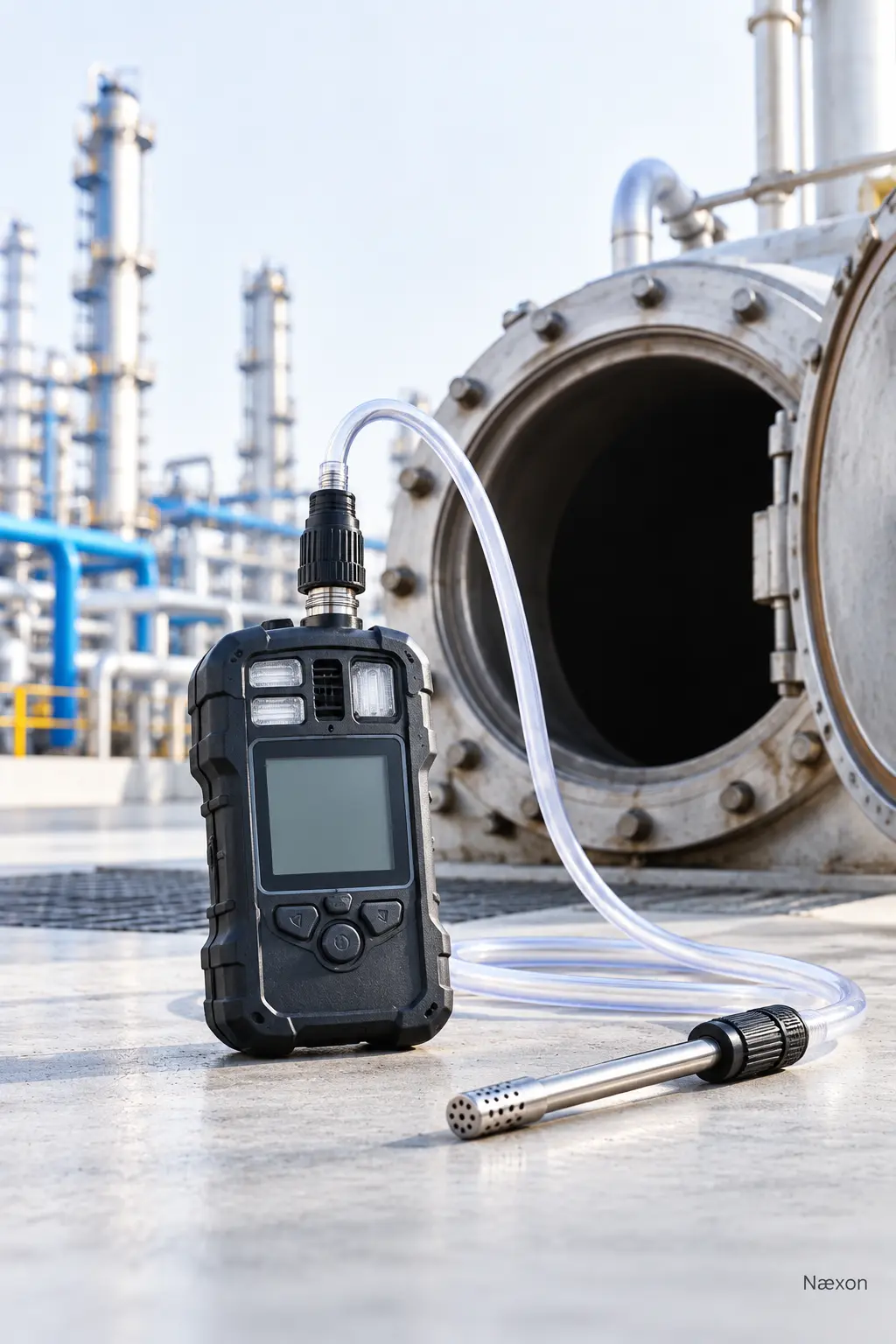
Before using any reading, verify that the instrument is configured for the hazards identified by the assessment. A common four-gas meter does not detect every possible contaminant. The selected sensors, range, calibration status, accessories and sampling line must match the job and the manufacturer’s instructions. Review what a bump test proves and how it differs from calibration before treating the display as trustworthy.
The required order: oxygen, combustible, toxic
OSHA’s permit-space procedure specifies this sequence: test oxygen first, combustible gases and vapors second, and toxic gases and vapors third. The order matters. Many combustible-gas meters depend on oxygen and may not give a reliable combustible reading in an oxygen-deficient atmosphere. Combustible hazards are checked next because fire and explosion can present an immediate life-threatening condition. The toxic substances identified for the space are checked after that.
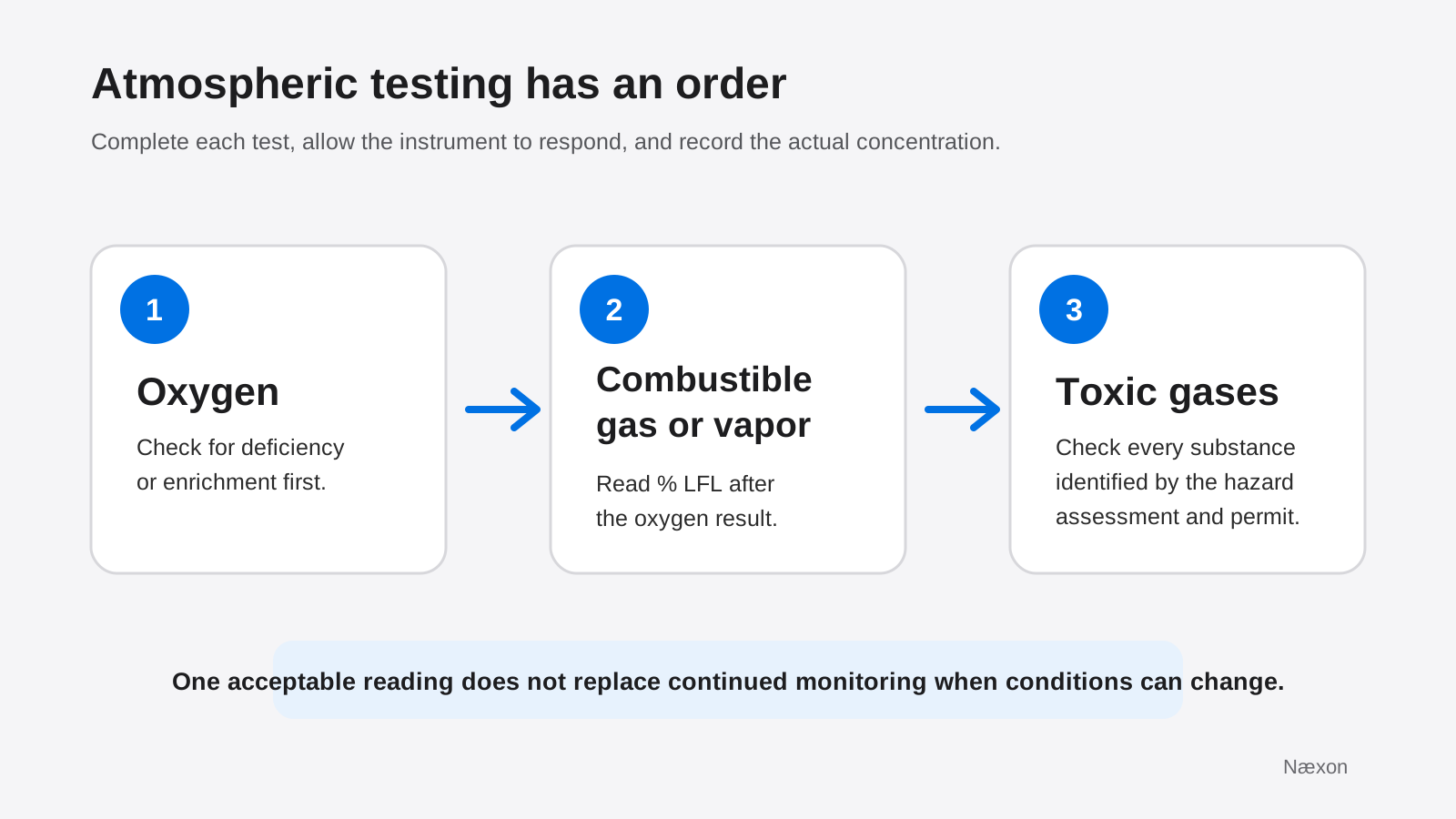
For general-industry permit spaces, an atmosphere below 19.5% oxygen or above 23.5% oxygen is hazardous. A flammable gas, vapor or mist above 10% of its lower flammable limit is also a hazardous atmosphere. Toxic limits depend on the substance and the applicable exposure limit or the more protective approved project criteria. Those regulatory thresholds do not replace a site permit that sets stricter conditions.
Do not let a normal oxygen value create false confidence. A space can show approximately normal oxygen and still contain a toxic gas or vapor. It can also contain a contaminant that the installed sensors do not measure. The hazard assessment determines what must be tested; the display shows only what that particular instrument can detect.
Remote sampling has a clock attached to it
A pumped monitor does not instantly know what is at the end of a long hose. The pump must move the sample through the tubing, and then the sensor needs time to respond. The operator must use the instrument manufacturer’s transport-time and response-time instructions for the gas, tubing and accessories in use. Moving the probe and reading the display too soon can assign the previous sample to the next location.
Sample locations must represent the space identified by the hazard evaluation. Some atmospheres are not uniform, and vessel shape, openings, connected piping, residue, work activity and ventilation can create different conditions in different areas. “Top, middle and bottom” may be a useful plan for some layered spaces, but it is not a substitute for the actual hazard assessment.
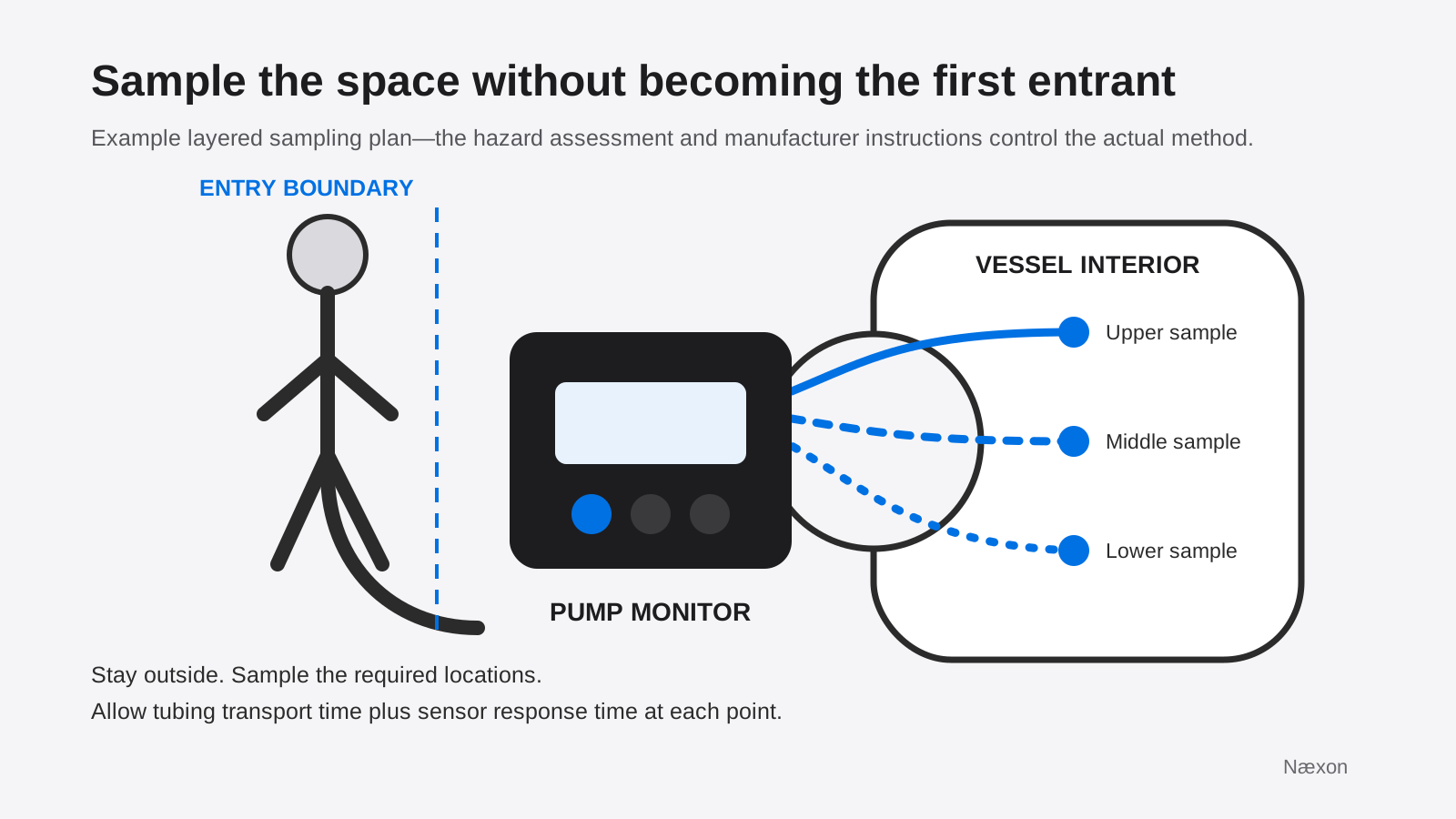
The person testing remains outside the space unless the complete entry requirements have already been met. Leaning the head or upper body through an opening can cross the entry boundary and expose the tester before the atmosphere is characterized. The correct tool is a suitable remote-sampling system used from a safe position.
A worked permit-reading example
Assume a training permit lists these illustrative acceptable conditions: oxygen from 19.5% through 23.5%, combustible gas below 10% LFL, and hydrogen sulfide below 10 ppm. The actual project permit, employer procedure and applicable limits always control; these numbers are not permission to enter a real space.
After the required sampling and response time, the operator records 20.9% oxygen, 0% LFL and 2 ppm H₂S at each required point. These readings are within the example permit conditions. The reasonableness check is also important: the oxygen value is near ordinary atmospheric concentration, the combustible channel is at zero and the toxic reading is low but not assumed nonexistent.
Thirty minutes later, continuous monitoring shows 20.8% oxygen, 3% LFL and 7 ppm H₂S. The values are still inside the example limits, but both hazard channels are rising. A weak approach says, “They have not reached the alarm yet.” A correct approach recognizes a changing atmosphere, follows the permit’s response requirements, checks ventilation and work conditions, and escalates before the trend becomes an emergency. If an alarm sounds or acceptable entry conditions are lost, entrants follow the established exit procedure; nobody silences the warning and continues.
A practical testing sequence
- Confirm the plan. Identify the space, expected contaminants, acceptable entry conditions, required sample locations, monitoring frequency and response actions from the approved permit and hazard assessment.
- Confirm the instrument. Verify the correct sensors and accessories, current calibration status, required function check, battery condition, pump operation and clean sampling path under the manufacturer’s instructions.
- Test from outside. Place the probe at the first approved location without crossing the entry boundary. Allow the full tubing transport time and sensor response time.
- Read in order. Evaluate oxygen, then combustible gas or vapor, then every required toxic channel. Record the actual values, location and time.
- Repeat for the plan. Move to each required location, clear or purge the sampling system as instructed, and again allow the full response time.
- Compare and decide. Compare every result with the approved entry conditions. A failed channel, unexplained trend, instrument fault or incomplete sample stops authorization until the responsible person resolves it.
- Monitor the entry. Continue testing or monitoring as required. Conditions that change require the planned response, not an improvised exception.
Troubleshooting readings that do not make sense
If the reading never changes when the probe moves, check for a blocked filter, kinked hose, loose fitting, failed pump or insufficient transport time. Do not prove flow by putting the probe or tubing in your mouth. Use the manufacturer’s approved pump and flow checks.
If oxygen looks reasonable but combustible or toxic channels behave unexpectedly, stop and verify the instrument configuration, sensor status and known cross-sensitivities in the manufacturer documentation. A zero can mean no detected target gas, but it can also reflect the wrong sensor, an inhibited or failed sensor, a blocked sample path or a contaminant the instrument cannot detect.
If values vary by location, treat the difference as information. Confirm that the locations and wait times were correct, then evaluate possible stratification, ventilation patterns, connected equipment, residue or ongoing work. Averages do not erase a hazardous pocket.
If H₂S is among the identified hazards, continue with the practical H₂S monitor lesson. For entry-team roles and communication, review how industrial safety-watch assignments differ.
Common mistakes
Testing only at the opening: the sample may not represent remote areas of the space. Follow the approved location plan.
Rushing the hose: moving the probe before transport and response time expires can produce a misleading location record.
Calling normal oxygen an all-clear: normal oxygen does not rule out combustible or toxic hazards.
Using a four-gas meter for every hazard: an instrument cannot measure a contaminant without a suitable sensor and configuration.
Recording “pass” instead of values: actual concentrations reveal trends and allow the entry supervisor to compare results with the permit.
Ignoring upward movement below an alarm: a developing trend deserves action under the entry procedure before a limit is exceeded.
Field Rules
- Test oxygen first, combustible gases second and required toxic gases third.
- Stay outside the space for pre-entry sampling.
- Allow tubing transport time plus sensor response time.
- Record actual readings, locations and times.
- Use only sensors and accessories approved for the identified hazards.
- Treat alarms, faults and unexplained trends as stop-and-escalate conditions.
Knowledge Check
- A monitor shows 20.9% oxygen. What must be checked before anyone calls the atmosphere acceptable?
- Why is oxygen evaluated before the combustible-gas channel?
- A probe is moved from the top of a vessel to the bottom, and the reading is recorded immediately. What is wrong with the method?
- The example readings rise from 0% to 3% LFL and from 2 ppm to 7 ppm H₂S while remaining below the example limits. What is the correct response?
Answers
1. The operator must still evaluate combustible gases and every toxic substance required by the hazard assessment, at all approved sample locations, using a suitable functioning instrument. Normal oxygen alone is not an all-clear.
2. Oxygen is first because many combustible-gas meters depend on oxygen and may not provide reliable combustible readings in an oxygen-deficient atmosphere.
3. The operator has not allowed the sample to travel through the tubing and the sensor to respond. The displayed value may still represent the previous location.
4. Recognize the changing atmosphere and follow the permit response: reassess the work and ventilation, notify the responsible person and stop or exit when the procedure requires. Do not wait casually for an alarm.
Practical Exercise
On paper, draw a vessel with four sampling locations selected by a fictional hazard assessment. Beside each point, create columns for time, oxygen, % LFL, H₂S and operator initials. Add the required transport-plus-response wait from a sample manufacturer instruction provided by your instructor. Your completed sheet should show the oxygen → combustible → toxic sequence, actual readings rather than pass/fail words, and a clear stop/escalate action for an alarm, instrument fault or lost acceptable condition. A qualified instructor should be able to trace every reading to one location and one time without guessing.
This exercise is planning practice only. Do not use it to enter, test or authorize a real confined space without the employer’s complete program, approved permit, trained personnel and required rescue arrangements.