
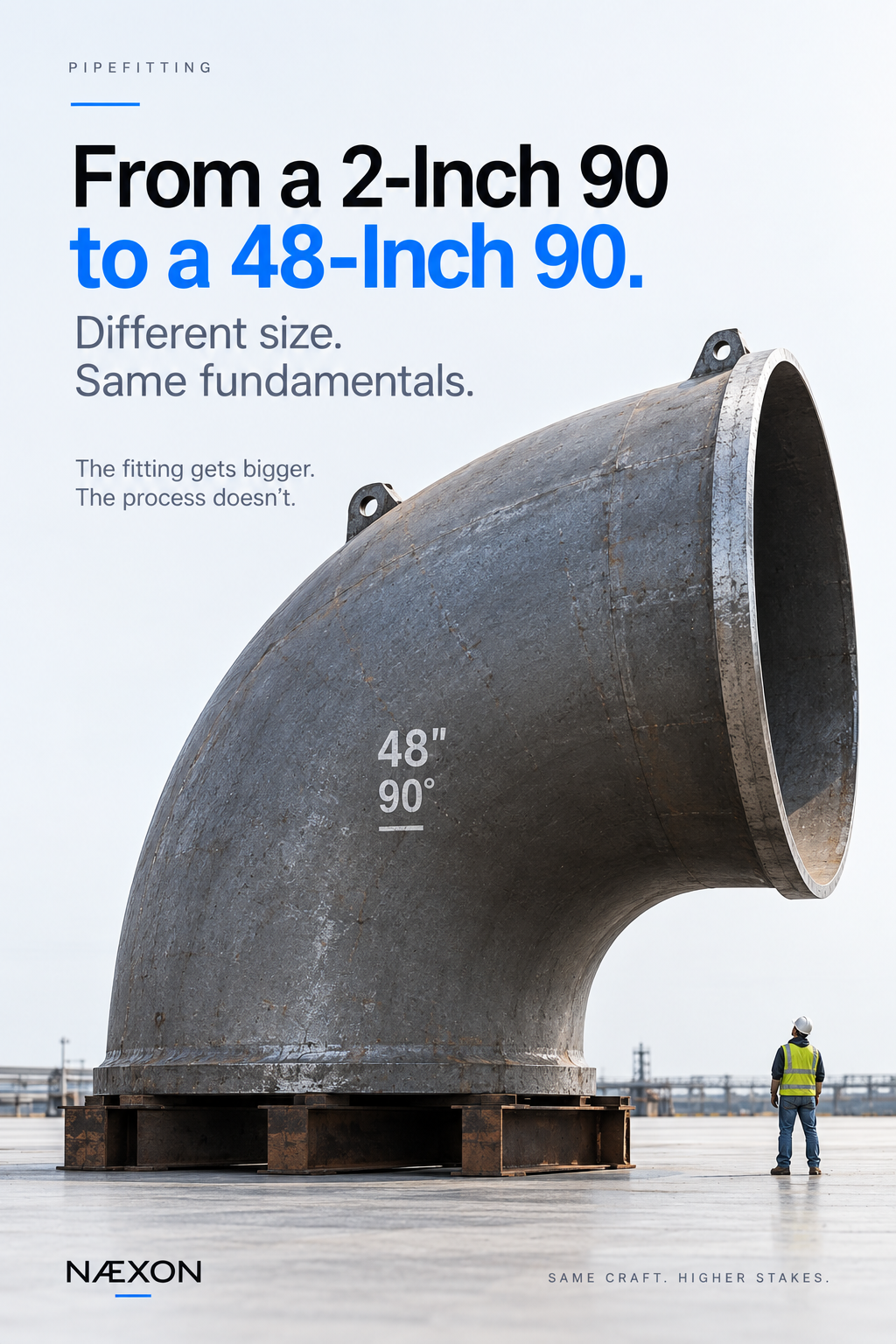
Put a 2-inch 90 on a fit-up table and a pipefitter can pick it up, rotate it, adjust the gap, establish the roll, and move it into position by hand.
Put a 48-inch 90 in front of the same fitter and almost everything about handling it changes. Now you may be dealing with a crane, chain falls, come-alongs, wedges, stands, rigging points, tag lines, and several people just to accomplish movements that your hands performed on the 2-inch fitting.
But once you strip away the weight and equipment, the craft hasn’t changed nearly as much as it appears.
You still have to establish the roll. You still have to control the first tack. You still have to check level and squareness. You still have to verify your dimensions. You still have to check what moved after the tack.
A 48-inch fitting may require dramatically different equipment to manipulate.
It does not require different fundamentals to fit correctly.
Your Hands Get Replaced by Rigging
This may be the simplest way to understand the transition from small-bore to large-bore fitting.
On a 2-inch 90, your hands control the fitting.
Need it slightly higher? Lift it.
Need a little more roll? Rotate it.
Need to close the gap slightly on one side? Adjust it.
With a 48-inch 90, those same corrections may require a chain fall, come-along, crane, jack, wedge, or another controlled method of movement.
The equipment has effectively become an extension of the fitter’s hands.
But the equipment isn’t deciding where the fitting belongs.
The fitter still is.
The crane operator can move the fitting. The rigger can control the load. The chain fall can pull it. None of them can determine whether the outlet centerline is where the spool drawing requires it unless the fitting has been properly laid out, measured, positioned, and checked.
The First Tack Still Matters
Whether you’re fitting a 2-inch 90 or a 48-inch 90, that first tack changes everything.
Before the tack, the fitting is free.
After the tack, you have established a point of restraint.
That first tack can now become a controlled point around which additional adjustments are made.
But a common mistake is assuming that because the fitting was correct immediately before the tack, it must still be correct immediately afterward.
Experienced fitters know better.
Tack it. Then check it again.
Check the roll.
Check your level.
Check squareness.
Check the gap.
Check alignment.
Check the dimension that determines where the outlet is actually going.
A tack can pull. The fitting can move. The gap can change. An adjustment on one side can affect another reference.
The larger the fitting becomes, the more important it is to know exactly what changed.
Level Is Still Level
A 2-inch pipe doesn’t have one definition of level and a 48-inch pipe another.
Level is level.
Square is square.
Plumb is plumb.
Forty-five degrees is still forty-five degrees.
Ninety degrees is still ninety degrees.
A centerline remains a centerline.
That sounds elementary, but it explains why strong fitting fundamentals transfer so effectively into large-bore work.
Large pipe introduces major handling problems. It does not rewrite geometry.
If the 48-inch fitting needs a particular roll, elevation, or orientation, the challenge is figuring out how to physically move that enormous component until it satisfies the same geometric conditions a fitter would establish on smaller pipe.
Getting the Roll Is Still Getting the Roll
Suppose the 90 isn’t going straight up or straight out. The elbow needs to be rolled.
With a 2-inch fitting, you might rotate it with your hands while watching your layout and measurements.
With a 48-inch fitting, “give me a little more roll” becomes a coordinated movement.
One point may need to rise while another is controlled. The heel may move. The gap may change. Another chain fall may need to hold the fitting while an adjustment is made somewhere else.
This is where large-bore fitting rewards a strong understanding of fundamentals.
An inexperienced fitter may chase whichever measurement currently looks wrong.
An experienced fitter understands the relationship between the measurements.
Move one thing and ask what else you just moved.
The goal isn’t simply to make one reading correct.
The goal is to put the entire fitting in the correct position.
Don’t Check Only What You’re Adjusting
This is one of the habits that separates careful fitting from chasing dimensions.
Suppose the roll is wrong.
You adjust the roll.
Now check more than the roll.
Did the gap change?
Did the fitting move out of square?
Did the centerline move?
Did the elevation change?
Did your overall dimension change?
The same principle applies when correcting the gap, elevation, or alignment.
A fitting exists in three dimensions. Moving it to correct one condition can change another.
This is true on a 2-inch 90.
It becomes painfully obvious on a 48-inch 90.
A Tack Is a Checkpoint, Not Permission to Stop Measuring
Once the first tack is installed and the fitting is corrected, another tack can be placed to gain additional control.
Then check again.
As additional tacks are installed, continue verifying the references that matter.
The purpose isn’t to measure endlessly for no reason. The purpose is to catch movement while the fitting can still be corrected without turning a small problem into major rework.
With large-bore piping, this discipline becomes especially valuable because every correction becomes more difficult once the assembly gains weight and rigidity.
By the time several large fittings and pipe sections are connected, you’re no longer casually repositioning the spool.
Squareness Becomes More Important as the Spool Grows
Imagine starting a spool with a 48-inch 90.
The first fitting is slightly out of square.
Not enough that someone immediately notices it.
Then a long section of pipe is fitted from that 90.
Now another fitting is installed from that pipe.
Then another section.
By the time you reach the final connection, the error that looked insignificant at the first fitting may have translated into a significant problem at the other end of the spool.
Everyone starts measuring the final connection.
But the problem may have started with the first 90.
This is why good fitters don’t think only about the fitting directly in front of them.
They think about where that fitting is sending everything that comes after it.
The Bigger the Pipe, the More Expensive “Close Enough” Becomes
A small fitting mistake can cause rework.
A large-bore fitting mistake can involve considerably more.
Now you may be dealing with additional crane time, rigging, cutting, bevel preparation, welding, inspection, scaffold access, schedule impacts, engineering involvement, and multiple crafts waiting for the correction.
That doesn’t mean large-bore pipe must be approached with fear.
It means fundamentals become more valuable as the consequences increase.
The fitter who develops disciplined habits on 2-inch pipe is developing the same habits needed when the fitting eventually becomes 48 inches.
Don’t Let the Size of the Fitting Intimidate You
Standing beside a 48-inch elbow for the first time can make it look like an entirely different kind of work.
Break the problem down.
Where is the centerline?
Where does the outlet need to land?
What is the required roll?
What is the elevation?
What establishes square?
What dimension controls the next fitting?
Where should the first tack go so the fitting can still be controlled?
What needs to be checked immediately after that tack?
Once those questions are answered, the massive fitting becomes much less mysterious.
It’s still fitting.
Large Bore Exposes Weak Fundamentals
Small pipe can sometimes allow a fitter to compensate physically for poor planning.
You can grab the fitting. Twist it. Push it. Lift it. Break the tack. Move it again.
Large pipe removes much of that luxury.
When every movement requires equipment and coordination, you begin to appreciate the value of knowing exactly why you’re moving something before you move it.
That’s why large-bore fitting can expose weaknesses in fundamentals very quickly.
If you don’t understand roll, square, centerlines, fitting takeoffs, orientation, elevations, and dimensional relationships on smaller piping, increasing the diameter isn’t going to solve the problem.
It magnifies it.
The Fitter Still Controls the Job
A 48-inch fitting may require machinery that makes a 2-inch fit-up look almost unrelated.
But look more closely.
On the 2-inch fitting, your hand moves the elbow.
On the 48-inch fitting, the crane moves it.
On the 2-inch fitting, your hand holds the roll.
On the 48-inch fitting, rigging holds it.
On both fittings, the pipefitter determines where it needs to go.
That is the part of the trade that doesn’t scale with diameter.
The judgment remains with the fitter.
Field Rules
- Establish reliable references before fitting.
- Get the roll where it belongs before locking the fitting down.
- Treat the first tack as the beginning of verification, not the end.
- Recheck level, square, gap, alignment, orientation, and critical dimensions after adjustments.
- When correcting one condition, verify what else the movement affected.
- Never let difficult handling become an excuse for accepting incorrect geometry.
- Think beyond the fitting you’re working on and consider where it sends the rest of the spool.
- Use rigging to control the fitting; don’t let the fitting control the rigging.
- Verify important dimensions while corrections are still practical.
- Never replace measurement with “it looks good.”
Knowledge Check
You’re fitting a 2-inch 90. You establish the roll, check the gap and alignment, place the first tack, then verify that the fitting stayed where you wanted it.
Now you’re fitting a 48-inch 90.
What fundamentally changes?
The way you physically manipulate the fitting.
What doesn’t?
The need to establish the roll, control the joint, tack it intelligently, check level and squareness, verify dimensions, watch for movement, and prove that the fitting is actually where it belongs.
Practical Exercise
Take a simple spool containing a 90, straight pipe, another fitting, and a final flange.
Imagine fabricating it first in 2-inch pipe.
Now imagine exactly the same centerline arrangement in 48-inch pipe.
Ignore the handling equipment for a moment and write down the fitting sequence you would use to keep the spool controlled from the first tack through the final connection.
Then identify which parts actually changed when the diameter increased.
You’ll quickly notice something.
Most of the thinking stayed the same.
What changed was how you physically accomplished it.
From 2 Inches to 48 Inches, Fundamentals Still Win
A 2-inch 90 might be sitting on your fit-up table.
A 48-inch 90 might be hanging from a crane.
Don’t let that difference distract you from what actually makes either one fit correctly.
Get your roll. Check your gap and alignment. Establish the fitting. Put in the first tack. Check it again. Verify level. Verify square. Watch your dimensions. Add control. Check it again.
The larger fitting requires heavier equipment, better communication, more planning, and greater respect for what can happen when something goes wrong.
But underneath all of that is the same craft.
The fitting got bigger.
The fundamentals didn’t.
Leave a Reply