
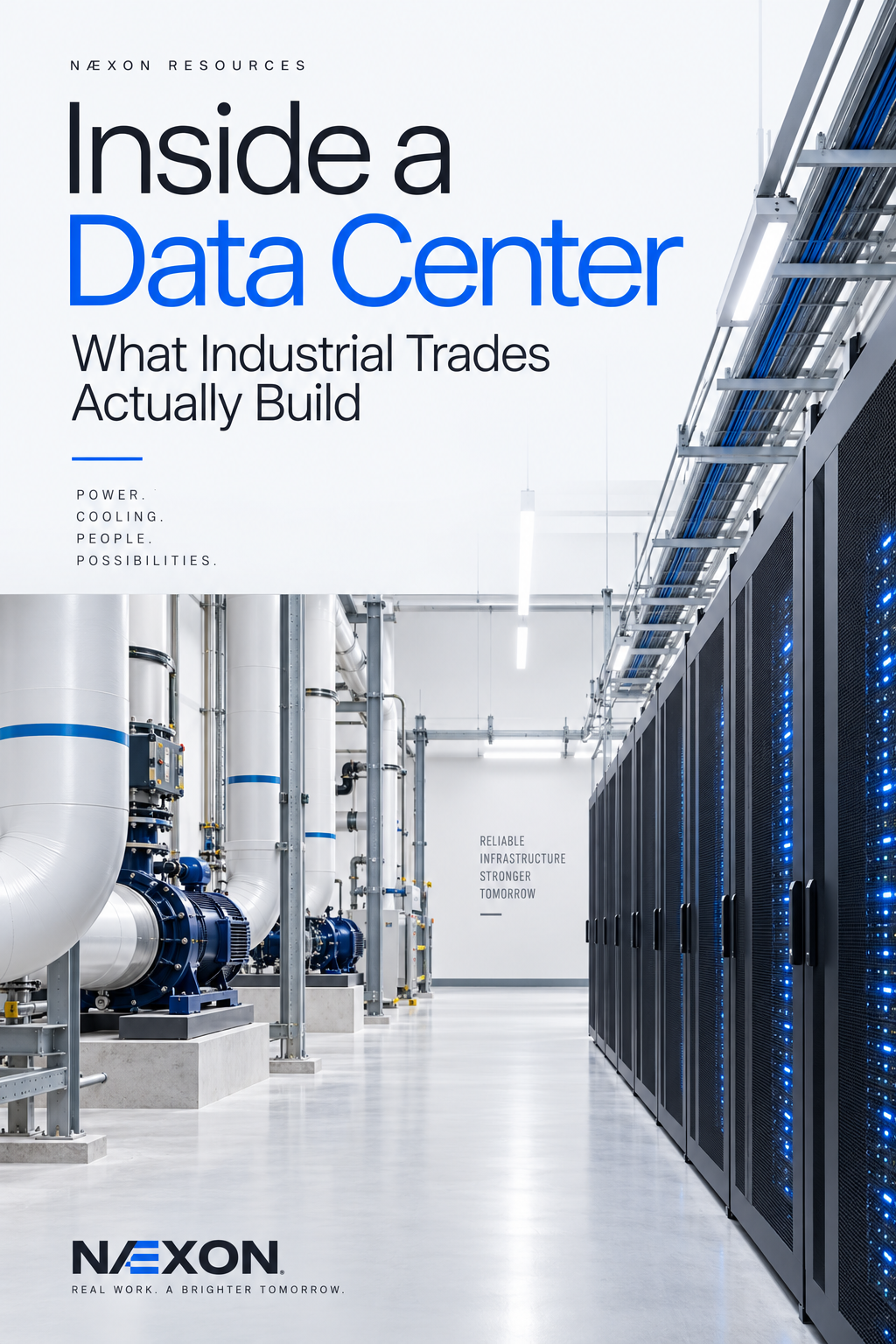
When most people hear the words data center, they picture rows of computers, blinking lights, servers, and people working behind monitors. From the construction side, that picture is incomplete.
A modern data center is a massive industrial facility built around three fundamental requirements: power, cooling, and reliability. Behind every server rack is an enormous amount of electrical distribution, mechanical piping, structural steel, controls, backup generation, fire protection, ventilation, and supporting infrastructure. Before a single server begins processing data, skilled trades may spend months or years building the systems that keep that equipment alive.
For pipefitters, electricians, welders, millwrights, ironworkers, operators, instrumentation technicians, riggers, and other industrial workers, understanding what is actually inside a data center makes the facility much easier to understand.
The Server Is Only the Final Load
A useful way to understand a data center is to stop thinking about computers and start thinking about loads.
Servers consume electrical power. Nearly all of that electrical energy ultimately becomes heat. That heat must continuously be removed. The equipment also cannot simply shut down every time the utility grid experiences a disturbance.
This creates a chain of supporting infrastructure.
Electrical power must enter the property, be transformed to usable voltages, distributed throughout the building, conditioned where required, backed up during interruptions, and finally delivered to the computing equipment. At essentially the same time, heat generated by that equipment must be captured, transferred through cooling equipment, transported away from the servers, and ultimately rejected outside the facility.
The building therefore becomes an engineered machine surrounding the computing load.
1. Utility and Substation Infrastructure
Long before power reaches a server rack, it may enter the site through high-voltage utility infrastructure and substations. Depending on the size and design of the campus, the electrical infrastructure itself can resemble that of a major industrial plant.
Electricians, electrical technicians, operators, civil crews, ironworkers, equipment operators, and specialized high-voltage contractors may be involved with switchyards, transformers, switchgear, underground duct banks, cable systems, grounding grids, protection equipment, and electrical buildings.
The fundamental flow can be simplified as:
Utility Grid → Substation → Transformers → Switchgear → Facility Distribution → IT Equipment
Large facilities may contain multiple electrical paths because losing one component should not necessarily shut down the computing operation.
2. Emergency Generators
Walk around a large data center campus and one of the most recognizable pieces of equipment may be the generators.
Data centers are designed around uptime. If utility power disappears, critical computing loads cannot simply wait several hours for the grid to return. Backup generators provide another source of electrical power.
These installations create work well beyond electrical connections. Depending on the design, trades may encounter fuel systems, exhaust systems, ventilation, cooling components, structural supports, pumps, valves, instrumentation, controls, and associated piping.
A large generator installation is essentially another mechanical system within the overall facility.
3. UPS and Battery Systems
Generators are important, but they generally do not assume the load instantaneously.
That gap is one reason data centers use uninterruptible power supply systems, commonly called UPS systems. UPS equipment and energy-storage systems can maintain critical loads during disturbances and provide continuity while the facility transitions between power sources.
A simplified sequence might look like:
Utility Power → UPS → IT Load
During an outage:
Stored Energy → IT Load → Generators Start → Generator Power Becomes Available
Actual configurations can be considerably more sophisticated because redundancy is a central part of data center design.
4. The Cooling Plant
This is where data centers begin looking especially familiar to workers coming from industrial mechanical construction.
Servers generate enormous amounts of heat. If that heat is not continuously removed, equipment temperatures can rise rapidly and threaten reliability. As a result, cooling infrastructure can represent a major portion of a data center’s mechanical construction.
Depending on the facility, workers may encounter chillers, pumps, heat exchangers, cooling towers, dry coolers, air-handling equipment, water-treatment systems, expansion tanks, strainers, separators, control valves, isolation valves, instrumentation, and large networks of piping.
To a pipefitter walking through the mechanical plant, portions of a data center may look less like a technology building and more like a large central utility plant.
5. Chilled-Water Piping
Many data centers use chilled-water systems somewhere in their cooling architecture.
In a simplified arrangement, chilled water absorbs heat from equipment serving the data halls and carries that heat toward the cooling plant. Pumps maintain circulation while valves and controls regulate flow through different portions of the system.
A basic concept is:
Cooling Plant → Cold Supply Water → Cooling Equipment → Warmer Return Water → Cooling Plant
That cycle operates continuously while the computing equipment is running.
For pipefitters and welders, the work can involve large-diameter carbon steel piping, stainless systems depending on application, grooved piping, welded connections, flanges, valves, strainers, pumps, equipment connections, supports, expansion provisions, testing, flushing, and insulation.
The exact materials and configurations vary by project, but the fundamentals of industrial piping construction still apply.
6. Pumps and Mechanical Equipment
Water does not circulate through thousands of feet of piping by itself.
Pump systems move cooling water throughout the facility. Depending on the design, there may be primary pumps, secondary pumps, condenser-water pumps, distribution pumps, redundant pumps, or other specialized pumping arrangements.
Millwrights, pipefitters, electricians, riggers, controls technicians, and other trades can all become involved.
Equipment installation demands familiar industrial fundamentals: correct elevation, alignment, nozzle orientation, accessibility, support, vibration control, proper piping connections, and accurate installation according to drawings and specifications.
A pump installed incorrectly can create problems far beyond the pump itself.
7. Heat Rejection
Moving heat away from the server does not eliminate it. Eventually, that heat has to leave the facility.
Depending on the design and climate, this can involve cooling towers, fluid coolers, dry coolers, evaporative equipment, air-cooled chillers, or combinations of technologies.
Think of the cooling system as a transportation network for heat.
The server produces heat. Cooling equipment captures it. Water or another medium transports it. Mechanical equipment transfers it. Heat-rejection equipment finally releases it to the outdoor environment.
Understanding that path makes many complicated cooling diagrams easier to follow.
8. The Data Hall
The data hall is the portion most people associate with a data center.
This is where racks of computing equipment are installed. But even here, construction extends far beyond placing server cabinets on a floor.
Workers may encounter overhead electrical distribution, cable tray, busway, containment systems, cooling equipment, piping, structural supports, fire-protection systems, sensors, controls, and extensive monitoring equipment.
Modern facilities may use different approaches to cooling the computing equipment, including traditional air cooling and increasingly specialized liquid-cooling systems for high-density computing.
As computing density increases, the mechanical infrastructure serving the racks becomes even more important.
9. Liquid Cooling and High-Density Computing
Artificial-intelligence workloads and other high-performance computing applications can create extremely concentrated heat loads.
This is pushing portions of the industry toward more direct forms of liquid cooling.
Instead of relying exclusively on large quantities of conditioned air, some systems bring cooling liquid much closer to the computing hardware. Facilities may use coolant distribution units, heat exchangers, manifolds, secondary cooling loops, flexible connections, controls, sensors, and carefully engineered piping networks.
For mechanical trades, this development is important.
The future data center may require more specialized piping knowledge, not less.
Workers who understand hydronic systems, heat exchangers, pumps, valves, pressure testing, flushing, cleanliness, instrumentation, and mechanical commissioning already possess skills that can transfer directly into this environment.
10. Fire Protection
Data centers also require extensive fire-detection and fire-protection systems.
Depending on the area and facility design, systems can include sprinkler piping, preaction arrangements, detection equipment, fire pumps, valves, supervisory devices, and specialized suppression strategies.
The challenge is straightforward: protect people and the building while also protecting extremely expensive and sensitive equipment.
Installation quality, testing, inspection, and system reliability are therefore critical.
11. Structural Steel and Equipment Supports
All this equipment needs somewhere to go.
Ironworkers, welders, fabricators, riggers, and structural crews install steel supporting mechanical and electrical systems throughout the facility.
Pipe racks, equipment frames, platforms, access structures, housekeeping supports, cable-tray supports, rooftop structures, equipment dunnage, and miscellaneous steel can become substantial scopes of work.
A data center may look clean and architectural when finished, but underneath that appearance is an enormous amount of structural support.
12. Controls and Instrumentation
A modern data center is heavily monitored.
Operators need to know temperatures, pressures, flow rates, equipment status, electrical conditions, valve positions, alarms, and countless other operating parameters.
Sensors and instrumentation feed information into control and monitoring systems that allow equipment to respond automatically to changing conditions.
A temperature change might cause a control valve to reposition. A pressure condition might trigger another pump. Failure of one piece of equipment may automatically transfer operation to redundant equipment.
For instrumentation and controls technicians, the facility can be extremely sophisticated.
13. Redundancy Changes the Way Everything Is Built
One of the biggest differences between an ordinary commercial building and a mission-critical data center is the amount of redundancy engineered into the facility.
A normal building may tolerate temporary loss of cooling or electrical power. A major data center may be designed so that a single equipment failure does not interrupt critical operations.
That means there may be multiple pumps where one could theoretically handle the load, multiple electrical feeds, multiple UPS systems, multiple generators, multiple cooling units, isolation valves that allow sections to be maintained, and alternate paths for critical utilities.
Workers will frequently hear terms such as N, N+1, 2N, and 2N+1. These describe different redundancy philosophies.
The important field lesson is simple: equipment that appears duplicated may be duplicated intentionally.
14. Commissioning Is a Major Part of the Job
Completing installation does not mean the facility is ready.
Mission-critical systems must prove that they work.
Piping systems may require pressure testing, flushing, cleaning, balancing, leak checks, valve verification, equipment startup, instrumentation checks, and functional testing. Electrical systems undergo their own extensive testing.
Commissioning teams may intentionally simulate failures.
What happens if this pump stops?
Does the standby pump start?
What happens if utility power disappears?
Do the UPS systems carry the load?
Do generators start correctly?
What happens if a cooling unit fails?
Does another unit assume the load?
The facility is tested not only to determine whether it works normally, but whether it continues working when something goes wrong.
Industrial Skills Transfer Better Than Many Workers Realize
A journeyman arriving from a refinery, power plant, semiconductor facility, pharmaceutical plant, or other industrial project may initially believe data-center construction is an entirely different world.
Much of the physical work says otherwise.
Pipe is still pipe. A flange still needs correct alignment. Pumps still need proper installation. Valves still require correct orientation and accessibility. Supports still carry loads. Welds still require quality. Systems still require testing. Drawings still have to be interpreted correctly. Rigging still has to be planned. Equipment still needs to be set safely and accurately.
The process being supported has changed, but many of the fundamentals have not.
That is why industrial experience can be extremely valuable on mission-critical projects.
Field Rules
- Understand the system before concentrating only on your individual spool, conduit run, support, or piece of equipment.
- Never assume duplicated equipment is unnecessary; redundancy is fundamental to data-center reliability.
- Treat cleanliness seriously, especially on cooling systems serving sensitive equipment.
- Verify valve orientation, flow direction, accessibility, equipment connections, elevations, and support locations before final installation.
- Expect extensive testing and commissioning after physical construction is complete.
- Remember that electrical and mechanical systems are interconnected. A cooling failure can eventually become a computing failure just as easily as an electrical failure can.
- Workers coming from heavy industrial construction should not underestimate how much of their existing knowledge transfers to data-center work.
The Bigger Picture
The internet may feel invisible. Cloud computing may sound like software. Artificial intelligence may appear to exist entirely inside computers.
Physically, none of it works without infrastructure.
Someone pours the foundations. Someone erects the steel. Someone installs the switchgear. Someone pulls the cable. Someone welds the pipe. Someone sets the pumps. Someone installs the valves. Someone rigs the equipment. Someone wires the instruments. Someone tests the systems.
Behind the digital economy is an enormous physical industrial system.
And skilled trades build it.
Leave a Reply