
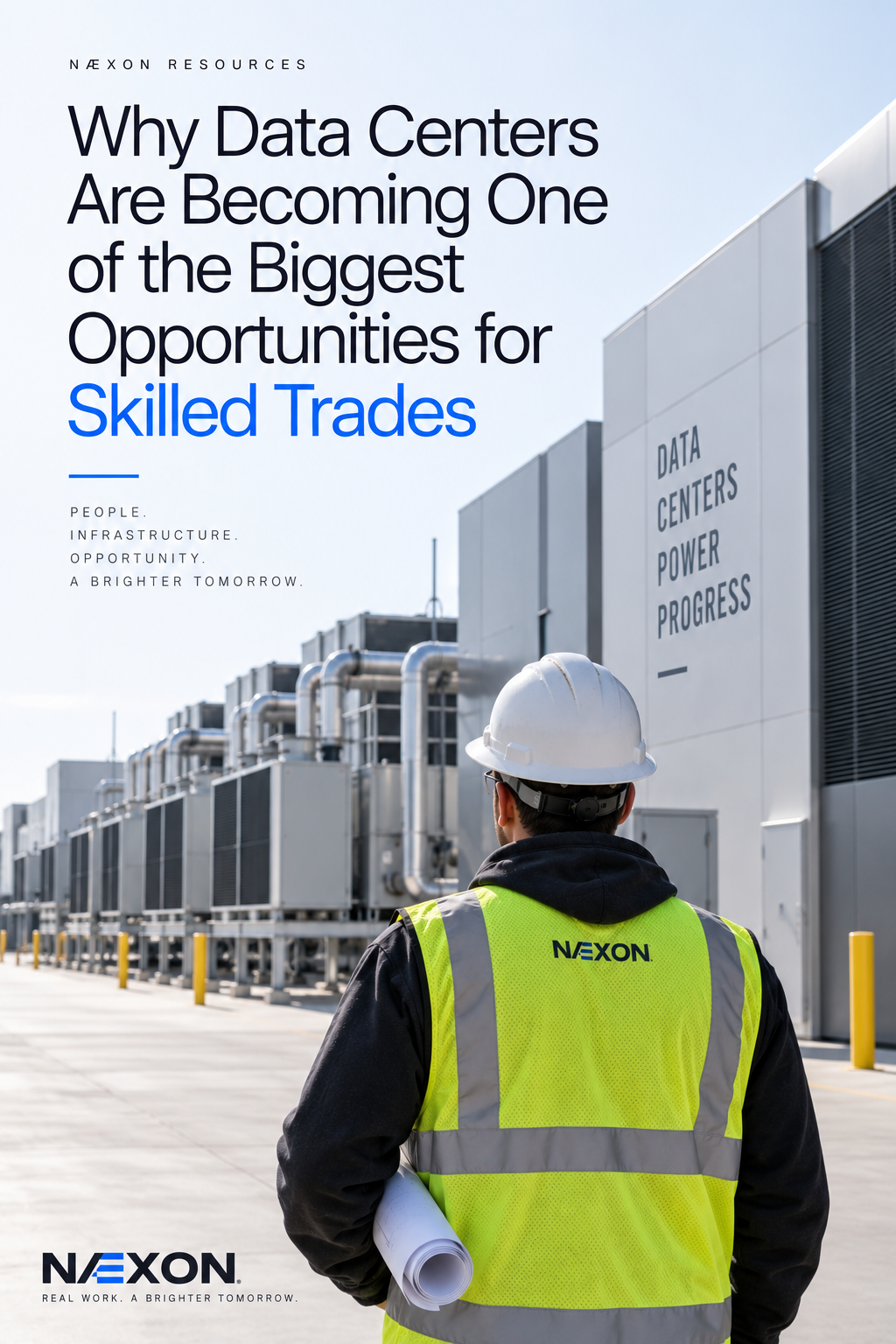
For decades, some of the best large-scale opportunities for skilled trades came from refineries, chemical plants, power stations, steel mills, pipelines, manufacturing facilities, and major commercial construction. Those industries are not disappearing, but another category of industrial construction is rapidly becoming impossible to ignore: data centers.
To the public, a data center is where computers and internet infrastructure live. To a tradesman, it is something very different. It is a massive concentration of electrical power, cooling equipment, piping, structural steel, controls, emergency generation, fire protection, and mechanical systems—all built around equipment that cannot afford to stop operating.
The growth of cloud computing, artificial intelligence, streaming, online commerce, digital banking, telecommunications, and virtually every other part of the digital economy means increasingly more physical infrastructure must be constructed to support it.
And that infrastructure requires skilled labor.
The Digital Economy Still Has to Be Physically Built
Terms such as “cloud computing” can make technology sound almost weightless. Nothing could be further from the truth.
The cloud has foundations.
It has concrete slabs, structural steel, electrical substations, transformers, switchgear, generators, chillers, pumps, valves, piping, cooling equipment, cable tray, ductwork, controls, fire-protection systems, and miles of electrical infrastructure.
Before a data center can process a single piece of information, construction crews have to build the physical systems supporting it.
That creates opportunities for electricians, pipefitters, welders, plumbers, millwrights, ironworkers, sheet-metal workers, instrumentation and controls technicians, riggers, crane operators, equipment operators, laborers, insulators, fire-protection specialists, commissioning technicians, supervisors, and many other crafts.
Technology may create the demand.
The trades build the capacity.
AI Is Changing the Scale of Data Center Construction
Artificial intelligence is especially important because AI computing can require enormous amounts of electrical power and cooling capacity.
Traditional computing already created significant infrastructure requirements. High-density AI computing can push those requirements considerably further.
More computing power means more electricity.
More electricity means more heat.
More heat means more cooling.
More cooling means more mechanical infrastructure.
That can mean larger electrical systems, additional transformers, substations, generators, cooling plants, pumps, heat exchangers, piping systems, and supporting equipment.
The result is that the AI boom is not exclusively a technology story. It is increasingly an industrial construction story.
Data Centers Are Starting to Look Like Industrial Plants
Some workers entering their first major data-center project are surprised by the scale of the mechanical and electrical infrastructure.
A hyperscale campus can contain large mechanical yards, generator installations, electrical buildings, cooling equipment, pump systems, extensive piping networks, structural support systems, and enormous electrical distribution systems.
Walk into certain portions of the facility without seeing the server racks and you could easily believe you were inside a central utility plant.
That matters because workers coming from refineries, chemical plants, power generation, semiconductor plants, pharmaceutical facilities, LNG projects, and heavy industrial construction may already understand many of the fundamentals.
The product being produced is different.
The construction principles often are not.
Pipefitters Have a Major Role
Data centers have to move heat, and moving heat frequently means moving fluids.
Depending on the facility design, pipefitters may work on chilled-water systems, condenser-water systems, equipment cooling loops, glycol systems, make-up water, equipment drains, fuel systems, fire protection interfaces, water-treatment systems, and increasingly specialized liquid-cooling infrastructure.
The systems may contain pumps, valves, strainers, heat exchangers, expansion tanks, separators, instrumentation, flexible connections, flanges, grooved fittings, welded fittings, supports, and other components familiar to industrial pipefitters.
A worker who understands piping drawings, elevations, offsets, equipment connections, valve orientation, flange alignment, supports, hydrotesting, flushing, and commissioning already possesses knowledge that transfers well.
The application changes.
The fundamentals remain.
Electricians Are at the Center of the Industry
If cooling is one half of the data-center infrastructure equation, electricity is the other.
Data centers consume substantial amounts of power and require extremely reliable electrical distribution. That creates extensive work involving substations, transformers, switchgear, generators, UPS equipment, batteries, busway, cable tray, grounding, controls, distribution panels, monitoring systems, and connections to computing equipment.
Reliability requirements can multiply the infrastructure.
Instead of having one path supplying critical equipment, a facility may have multiple independent or redundant paths. That means more equipment, more cable, more terminations, more controls, more testing, and ultimately more skilled labor.
For industrial electricians, data centers represent one of the most technically demanding environments in modern construction.
Millwrights and Riggers Are Needed Wherever Equipment Moves
Data-center equipment does not magically appear in place.
Large pumps, generators, chillers, transformers, heat exchangers, cooling equipment, electrical gear, and other components have to be received, moved, rigged, positioned, aligned, and installed.
That brings millwrights, riggers, crane operators, ironworkers, equipment operators, and specialized installation crews into the project.
The fundamentals remain familiar: know the weight, understand the center of gravity, determine the rigging configuration, protect the equipment, control the load, establish the travel path, communicate clearly, and set the equipment accurately.
Expensive technology does not eliminate traditional rigging fundamentals.
It makes getting them right even more important.
Ironworkers Build the Infrastructure Behind the Infrastructure
Mechanical and electrical equipment requires support.
Data centers can contain substantial structural steel associated with equipment platforms, pipe supports, rooftop systems, cable infrastructure, mechanical yards, equipment frames, access platforms, and miscellaneous support steel.
Large campuses also require extensive building structures and equipment-support systems.
Ironworkers and structural crews therefore become another important part of data-center construction.
The finished facility may eventually look exceptionally clean and simple, but much of that appearance is possible because an enormous supporting structure exists behind the visible systems.
Instrumentation and Controls Are Everywhere
A data center has to know what its systems are doing continuously.
Operators need information about temperatures, pressures, flows, equipment status, electrical loads, valve positions, alarms, environmental conditions, and countless other variables.
Instrumentation and controls technicians install and commission the devices that make this possible.
Pressure transmitters, temperature sensors, flow instruments, control valves, switches, actuators, monitoring equipment, and automated control systems allow the facility to react to changing operating conditions.
If one pump fails, another may need to start.
If temperature rises, cooling capacity may need to increase.
If utility power disappears, backup systems must respond.
The facility is constantly watching itself.
Redundancy Creates More Construction
One of the most important concepts for tradespeople entering data-center work is redundancy.
Many industrial systems are designed around reliability, but mission-critical computing facilities can take redundancy to another level.
Workers may hear terms such as N, N+1, 2N, or 2N+1.
At the field level, the important idea is straightforward: critical systems may have additional equipment or completely separate infrastructure so operation can continue when something fails or requires maintenance.
That can mean additional generators, pumps, cooling units, electrical feeds, UPS systems, transformers, valves, controls, piping paths, and distribution equipment.
From a construction standpoint, redundancy can dramatically increase the amount of infrastructure required to support the same final computing load.
Commissioning Creates Another Layer of Skilled Work
Installing equipment is only part of a data-center project.
The facility must prove that its systems work.
That can require hydrostatic testing, flushing, cleaning, balancing, equipment startup, electrical testing, instrumentation calibration, controls verification, functional performance testing, and integrated systems testing.
Commissioning teams may intentionally create failure scenarios.
A pump may be shut down to verify that another pump responds correctly.
Utility power may be simulated as lost to verify UPS and generator operation.
Cooling equipment may be taken offline to confirm redundant capacity responds as designed.
The objective is not merely to prove that the facility works when everything is perfect.
The objective is to prove that it keeps working when something fails.
Workers who understand startup, troubleshooting, testing, turnover, and commissioning can therefore become extremely valuable.
Data Center Construction Rewards Precision
Data centers may not contain the same process hazards as a refinery, but they demand exceptionally high construction quality.
A slightly misaligned flange is still misaligned.
A valve installed backward is still wrong.
A poorly supported pipe can still create problems.
Contamination inside a sensitive cooling loop can still damage equipment.
Incorrect instrumentation can still send bad information to the control system.
A bad electrical termination can still cause failure.
And when the equipment being protected may represent enormous financial and operational value, seemingly small construction mistakes can become expensive problems.
Journeyman-level craftsmanship matters.
Industrial Experience Transfers
A pipefitter who has spent years building refinery piping may know nothing about server architecture on the first day of a data-center project.
That does not mean the worker is starting from zero.
They already understand how to read drawings, plan work, verify dimensions, fabricate piping, install valves, make equipment connections, work around other trades, perform testing, solve field problems, and recognize when something does not look right.
The same principle applies to electricians, millwrights, ironworkers, welders, riggers, and instrumentation technicians.
Industrial experience teaches something extremely valuable that cannot be learned from a specification alone:
how systems actually get built in the field.
The Work Is Bigger Than the Data Hall
Workers considering data-center construction should understand that employment opportunities are not limited to the building containing the servers.
Supporting infrastructure can extend across an entire campus.
Projects may require utility connections, substations, electrical yards, generator areas, fuel infrastructure, mechanical plants, cooling yards, underground utilities, water systems, roads, structural buildings, warehouses, administrative areas, and eventually additional data-center buildings.
One campus can therefore become an ecosystem of construction projects rather than a single building.
And successful campuses frequently expand in phases.
A New Industrial Career Path Is Emerging
For decades, tradespeople have traveled from refinery turnaround to power-plant outage, pipeline spread to chemical plant, or one major construction project to another.
Data centers are adding another destination to that map.
A young apprentice entering the trades today could potentially build an entire career around mission-critical infrastructure. An experienced journeyman from heavy industry can bring decades of field knowledge into a rapidly expanding sector. Foremen and supervisors who understand large crews, complex schedules, safety, quality, testing, and turnover may find their experience equally transferable.
Workers do not necessarily need to abandon industrial construction to enter the data-center industry.
Data centers are becoming part of industrial construction.
Field Rules for Tradespeople Considering Data Center Work
- Do not assume data centers are simply commercial buildings. Large facilities can contain serious industrial-scale mechanical and electrical infrastructure.
- Learn the basic relationship between computing load, electrical power, heat generation, and cooling.
- Understand redundancy. Duplicate equipment may be essential to the design rather than unnecessary extra equipment.
- Take cleanliness seriously, particularly when working with sensitive cooling systems.
- Expect extensive quality control, documentation, testing, and commissioning.
- Learn how your trade interacts with electrical, mechanical, controls, and structural systems around it.
- Bring your industrial fundamentals with you. Good layout, proper installation, accurate fabrication, safe rigging, quality welding, and careful testing remain valuable regardless of the facility.
The Workers Behind Artificial Intelligence
Artificial intelligence may be one of the most advanced technologies humans have created, but the physical infrastructure supporting it still depends on something much older:
People who know how to build.
Someone has to install the transformer.
Someone has to pull the cable.
Someone has to weld the pipe.
Someone has to set the pump.
Someone has to erect the steel.
Someone has to rig the chiller.
Someone has to install the instruments.
Someone has to test the system.
Someone has to troubleshoot it when it does not work.
The digital economy may be changing what America builds, but it is not eliminating the need for skilled trades.
In many ways, it may be creating an entirely new generation of industrial work.
Leave a Reply