
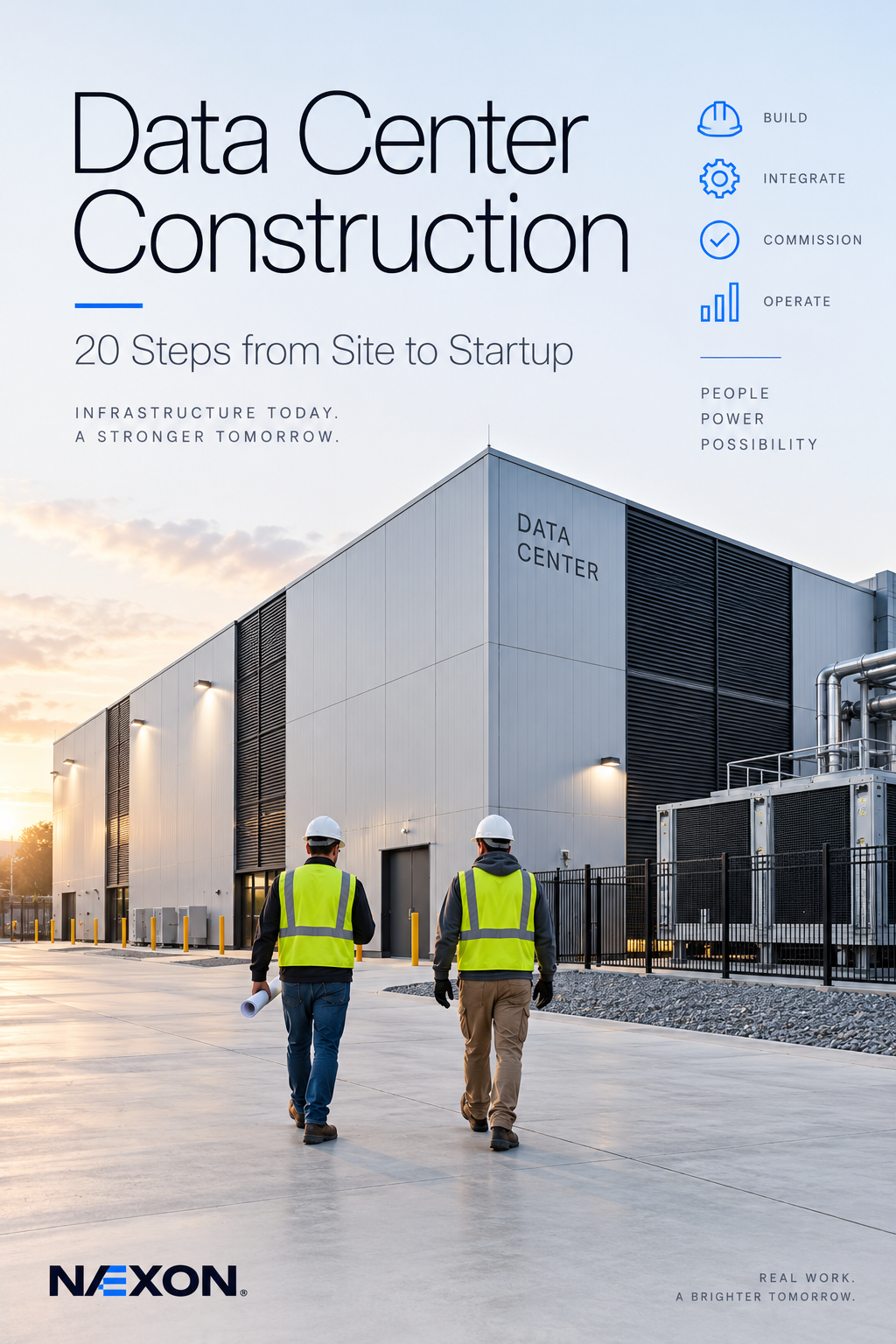
A finished data center can look deceptively simple. Clean exterior walls surround rows of servers while mechanical equipment, generators, electrical systems, and cooling infrastructure operate quietly in the background.
Getting to that point is anything but simple.
Building a modern data center requires civil construction, structural steel, enormous electrical capacity, industrial-scale cooling, mechanical piping, emergency power, controls, fire protection, testing, and coordination between dozens of specialized trades. On major campuses, construction can continue in phases for years as additional buildings and infrastructure are added.
For someone entering data-center construction from a refinery, power plant, chemical facility, or other industrial project, understanding the overall construction sequence makes the entire job easier to understand.
Step 1: Selecting and Preparing the Site

Figure 1. The first four stages of data center construction: site selection and preparation, underground infrastructure, establishment of the electrical backbone, and construction of foundations and structural steel.
Construction begins long before the first foundation is poured.
A data-center site needs more than available land. Developers have to consider access to electrical power, transmission infrastructure, fiber connectivity, water availability where applicable, environmental conditions, permitting, transportation access, natural hazards, and the ability to expand.
Power is particularly important. A large data-center campus can require substantial electrical capacity, and the availability of that power can influence where projects are built and how quickly they can grow.
Once the site is selected, civil construction begins.
Crews clear and grade the property, establish drainage, build access roads, excavate foundations, install underground utilities, prepare equipment yards, and construct underground electrical duct banks.
At this stage, an empty field begins turning into industrial infrastructure.
Step 2: Building the Underground Infrastructure
Some of the most important parts of a data center disappear before the building ever rises.
Underground systems may include electrical duct banks, grounding systems, stormwater infrastructure, sanitary systems, domestic water, fire water, mechanical utilities, equipment drainage, communication pathways, and other buried services.
This phase demands careful coordination.
Once concrete slabs, roads, buildings, and equipment are installed above these systems, correcting an underground conflict becomes much more difficult.
Survey control, elevations, coordinates, sleeve locations, penetrations, and utility crossings matter enormously.
A mistake underground can follow the project all the way through construction.
Step 3: Constructing the Electrical Backbone
A data center cannot exist without power.
Large projects may require new substations, transmission connections, transformers, switchgear, electrical buildings, grounding grids, underground distribution, and other high-voltage infrastructure before the computing equipment can ever be energized.
The simplified electrical path might begin as:
Utility Grid → Substation → Transformer → Switchgear → Facility Distribution
But mission-critical facilities rarely depend on one simple electrical path.
Redundancy may require additional transformers, switchgear, distribution equipment, UPS systems, generators, and independent electrical paths.
This is one reason the electrical scope of a data center can become enormous.
Step 4: Foundations and Structural Construction
While electrical and underground work progresses, the physical building begins taking shape.
Concrete crews install foundations, equipment pads, slabs, housekeeping pads, walls, and structural bases. Ironworkers then erect structural steel and supporting frameworks.
The structure has to support much more than the roof.
Large mechanical and electrical equipment may be installed inside, outside, or on top of the building. Pipe supports, cable systems, air-handling equipment, busway, ductwork, cooling equipment, and other infrastructure can create substantial structural loads.
Equipment locations must therefore be considered from the beginning.
Step 5: The Building Envelope Goes Up

Figure 2. Data center construction stages 5–8: enclosing the building, installing mechanical and cooling systems, rigging and setting major equipment, and completing electrical distribution throughout the facility.
Once the main structure is established, crews begin enclosing the building.
Exterior walls, roofing systems, doors, louvers, penetrations, and weatherproofing transform the structural frame into an enclosed facility.
Getting the building weather-tight is an important milestone because sensitive electrical and mechanical equipment can then be installed in a more controlled environment.
But while the exterior may begin looking finished, much of the hardest work is still ahead.
Inside, the facility is about to become extremely crowded.
Step 6: Mechanical Systems Begin Filling the Facility
Data centers generate heat continuously, which means cooling infrastructure becomes one of the largest mechanical systems on many projects.
Depending on the design, equipment may include chillers, cooling towers, dry coolers, fluid coolers, heat exchangers, pumps, air-handling equipment, coolant distribution units, expansion tanks, separators, strainers, water-treatment equipment, and associated piping.
Pipefitters and welders begin installing the piping networks connecting this equipment.
Large mains may run through mechanical rooms, utility corridors, exterior yards, pipe racks, or overhead distribution systems before branching toward individual cooling loads.
A simplified cooling loop can be understood as:
Cooling Plant → Supply Piping → Data Hall Cooling Equipment → Return Piping → Cooling Plant
The actual system may contain several interconnected loops, redundant equipment, bypasses, control valves, isolation points, and heat exchangers.
Step 7: Equipment Is Rigged Into Position
A chiller weighing thousands of pounds does not simply get carried through the door.
Neither does a transformer, generator, pump skid, large air-handling unit, switchgear lineup, or other major equipment.
Riggers, crane operators, millwrights, ironworkers, pipefitters, electricians, and equipment vendors coordinate equipment setting.
Before a lift begins, crews may need to verify equipment weight, center of gravity, lifting points, crane capacity, rigging arrangement, travel path, final orientation, foundation readiness, anchor locations, and surrounding construction.
On congested projects, timing becomes critical.
Install something too early and other trades cannot access their work.
Install it too late and there may no longer be a practical way to move it into position.
Construction sequencing matters.
Step 8: Electrical Distribution Expands Through the Building
Once the major electrical infrastructure is established, distribution begins spreading throughout the facility.
Electricians install switchgear, UPS systems, battery systems, transformers, busway, conduit, cable tray, feeders, grounding, control wiring, distribution equipment, and connections serving mechanical and computing loads.
Electrical redundancy makes coordination even more complicated.
Two systems that appear identical may actually represent completely separate power paths designed so one can continue operating if the other fails.
Keeping those systems correctly separated and identified becomes essential.
Step 9: Emergency Generators Are Installed

Figure 3. Data center construction stages 9–12: installing emergency generation, building out the data hall, delivering cooling to server racks, and integrating controls and instrumentation for reliable facility operation.
Backup generation is one of the defining features of mission-critical construction.
Generators are installed so critical systems can continue operating when utility power is unavailable.
But installing the generator itself is only part of the job.
The generator may require fuel piping, exhaust, ventilation, cooling systems, electrical connections, controls, instrumentation, structural supports, sound attenuation, and extensive testing.
Large campuses may contain many generators arranged in dedicated yards or buildings.
Each one becomes another system that must integrate correctly with the rest of the facility.
Step 10: The Data Hall Takes Shape
Eventually, construction reaches the area most people recognize as the actual data center.
Server racks or computing cabinets are arranged into organized rows. Electrical distribution reaches the equipment while cooling systems are positioned to remove the heat generated during operation.
Overhead spaces can become extremely congested.
Cable tray, busway, piping, ductwork, fire protection, lighting, controls, and structural supports may all compete for limited space.
Coordination drawings and precise layout become increasingly important.
One trade moving several inches can create a conflict for another trade hundreds of feet down the building.
Step 11: Cooling Reaches the Computing Equipment
The closer cooling gets to the servers, the more carefully controlled the system becomes.
Traditional facilities may use computer-room air-handling equipment or similar systems to circulate conditioned air through the data hall.
Higher-density computing is increasingly introducing liquid cooling closer to the hardware.
These systems may involve coolant distribution units, secondary cooling loops, heat exchangers, manifolds, flexible connections, control valves, sensors, and specialized piping.
For pipefitters, this represents an important change.
The piping system is no longer merely cooling the building.
In some designs, it is becoming increasingly integrated with the computing equipment itself.
Step 12: Controls Connect Everything Together
A modern data center needs to know what is happening throughout the facility.
Instrumentation and controls technicians install sensors, transmitters, actuators, control valves, switches, monitoring devices, panels, and communication systems.
These devices allow operators and automated systems to monitor temperatures, pressures, flows, equipment status, electrical conditions, alarms, and other operating parameters.
The controls system effectively becomes the nervous system of the facility.
Mechanical equipment provides the muscle.
Electrical infrastructure provides the energy.
Controls tell everything when and how to respond.
Step 13: Piping Systems Are Tested and Cleaned

Figure 4. Data center construction stages 13–16: testing and cleaning piping systems, energizing electrical infrastructure, starting major equipment, and balancing system flow and performance before final commissioning.
Completing a piping installation does not mean it is ready for service.
Systems may require pressure testing, flushing, cleaning, chemical treatment, leak checks, valve verification, balancing, and inspection before equipment can operate reliably.
Cleanliness can be particularly important.
Debris left inside piping can damage pumps, clog strainers, interfere with valves, contaminate heat exchangers, or create problems in sensitive cooling equipment.
Workers accustomed to industrial turnover will recognize the principle immediately:
The inside of the system matters just as much as the outside.
Step 14: Electrical Systems Are Energized
Energization is one of the most important milestones on the project.
Transformers, switchgear, UPS equipment, distribution systems, mechanical equipment, and eventually computing loads begin receiving power.
This changes the work environment.
Areas that were previously construction zones now contain energized systems, and access, procedures, boundaries, and coordination become increasingly controlled.
Construction is gradually transitioning into operation.
Step 15: Equipment Startup Begins
Pumps turn.
Fans start.
Chillers operate.
Generators run.
Valves stroke.
Control systems begin receiving real information from field devices.
This is when construction quality starts revealing itself.
Incorrect rotation, reversed valves, air trapped in systems, blocked strainers, miswired controls, leaks, incorrect instrumentation, vibration, alignment problems, and other installation issues may become visible.
Startup teams troubleshoot these problems before the facility advances into deeper commissioning.
Step 16: Systems Are Balanced
A system can operate without operating correctly.
Cooling-water flow must reach the intended equipment. Pressure relationships have to remain within design requirements. Pumps must operate in appropriate ranges. Control valves need authority over the systems they regulate.
Testing and balancing teams work with mechanical contractors, controls technicians, engineers, and commissioning personnel to establish the intended operating conditions.
Small adjustments across a large system can have major consequences.
Step 17: Commissioning Tests Individual Systems

Figure 5. Data center construction stages 17–20: integrated systems testing, final commissioning and turnover, operations readiness, and the transition to ongoing operation, maintenance, optimization, and future capacity growth.
Commissioning verifies that equipment actually performs according to the design intent.
Individual systems are tested under different operating conditions.
Does the pump start correctly?
Does the control valve respond?
Does the temperature sensor read accurately?
Does the generator start?
Does the UPS carry the required load?
Does cooling equipment respond when demand increases?
Instead of assuming installation equals performance, commissioning requires proof.
Step 18: The Facility Is Intentionally Made to Fail
This is one of the most interesting stages of data-center commissioning.
Engineers may deliberately simulate failures.
A pump is shut down.
A cooling unit is disabled.
Utility power is interrupted.
A generator is forced to respond.
A section of electrical distribution is removed from service.
The purpose is not to damage the facility. The purpose is to verify redundancy.
If one system disappears, another should respond exactly as designed.
This is where the concepts of N+1 and 2N become real rather than simply lines on engineering drawings.
Step 19: Integrated Systems Testing
Individual equipment can work perfectly while the complete facility still fails.
Integrated systems testing examines how electrical, mechanical, controls, emergency power, cooling, and other systems interact during realistic operating scenarios.
For example, loss of utility power may trigger several events almost simultaneously.
UPS equipment must maintain critical loads.
Generators must start.
Switchgear must transfer correctly.
Cooling systems must continue operating.
Controls must recognize the new operating condition.
Alarms must reach the correct locations.
Backup equipment must remain available.
The data center has to behave as one coordinated machine.
Step 20: The Servers Finally Take the Load
After months or years of engineering, construction, installation, testing, troubleshooting, and commissioning, the computing equipment can finally begin doing what the facility was built to support.
Server racks are populated and computing loads increase.
Electrical demand rises.
Cooling demand follows.
Pumps circulate more water.
Cooling equipment removes more heat.
Electrical distribution carries greater loads.
Controls continuously adjust equipment operation.
The building has transitioned from a construction project into an operating data center.
The Construction Sequence in One View
The complete process can be simplified into:
Site → Underground → Power → Foundations → Structure → Building → Mechanical → Electrical → Equipment → Data Hall → Controls → Testing → Startup → Commissioning → Operation
Real projects overlap many of these phases. Electrical work may be underway while mechanical systems are installed. One building may be commissioned while another building on the same campus is still structural steel.
That overlap is one reason data-center construction requires so much coordination.
Why Field Workers Should Understand the Entire Sequence
A tradesman does not need to know every engineering detail of the facility.
But understanding the construction sequence helps explain why certain decisions are made.
Why does this spool have to be installed today?
Because electrical equipment will block access next week.
Why does this valve need to remain accessible?
Because operators may need it during maintenance or failure isolation.
Why does the system have to be exceptionally clean?
Because sensitive cooling equipment is downstream.
Why are there two nearly identical pumps?
Because one may be the redundant unit.
Why are crews spending so much time testing something that already ran successfully?
Because running once is not the same as proving reliability.
Understanding the system turns individual tasks into part of a much larger picture.
Field Rules
- Study the surrounding systems instead of concentrating only on your individual scope.
- Verify elevations, coordinates, penetrations, and underground locations before concrete makes corrections difficult.
- Understand equipment installation sequence before permanently closing access routes.
- Treat redundant systems as independent critical infrastructure.
- Protect system cleanliness throughout fabrication and installation.
- Expect extensive documentation, inspections, testing, and turnover requirements.
- Remember that construction completion and operational readiness are two different milestones.
- Pay attention during startup and commissioning. Few opportunities teach you more about how the system actually works.
From Dirt to Digital Infrastructure
Stand on an undeveloped data-center site before construction begins and there may be nothing except dirt, survey stakes, equipment, and temporary roads.
Months later, foundations appear.
Steel rises.
Transformers arrive.
Generators are set.
Pipe begins filling mechanical spaces.
Cable tray spreads through the building.
Pumps are aligned.
Valves are installed.
Controls come alive.
Cooling water begins circulating.
Switchgear is energized.
Systems are deliberately tested and failed.
Then eventually, servers begin operating.
What appears to the outside world as “the cloud” is actually the final product of an enormous physical construction effort.
Before data can move through it, skilled trades have to build it.
Leave a Reply