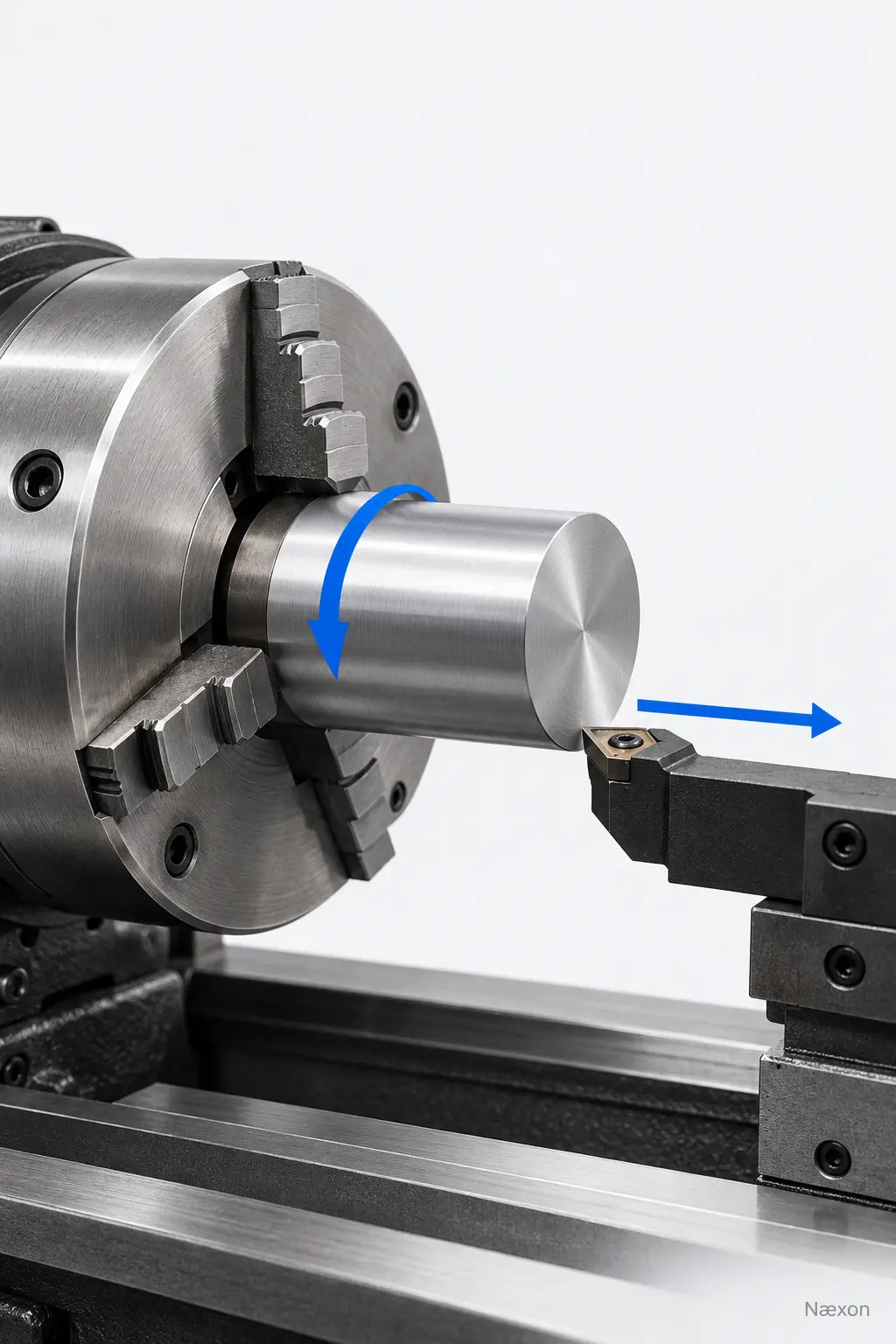
Morning Edition · Machinists · Apprentice · Fundamentals · 8-minute read
What you will learn: Distinguish feed per revolution from feed per minute, convert between them with units intact, predict what an RPM change does in each feed mode, and verify the active mode before a cut.
A lathe program shows an F value of 0.010. Is the tool moving ten thousandths of an inch every spindle revolution, or ten thousandths of an inch every minute? Those two commands would describe radically different motion. The number is incomplete until the machinist knows the feed mode and the unit system.
This lesson builds on surface speed and spindle RPM, but it teaches a different relationship. Surface speed describes how fast the work surface passes the cutting edge. Feed describes how far the tool advances. On a turning operation, the two motions happen together, yet they are not interchangeable.
The examples below are paper calculations, not recommended cutting data. Actual feed, speed, depth of cut, workholding, tooling, coolant, machine limits, and safe setup come from the approved process, machine manual, tooling data, material condition, and qualified supervision.
Two ways to describe tool advance
Feed per revolution is the linear distance the tool advances during one complete spindle revolution. It is commonly written as inches per revolution (in/rev) or millimeters per revolution (mm/rev). In formulas, this lesson uses fn for feed per revolution.
Feed per minute is the linear distance the tool advances during one minute. It is commonly written as inches per minute (in/min) or millimeters per minute (mm/min). This lesson uses vf for that feed rate and n for spindle speed in revolutions per minute (rev/min or rpm).
The relationship is:
vf = fn × n
The units show why the equation works: inches per revolution multiplied by revolutions per minute leaves inches per minute. The revolutions cancel. To solve for feed per revolution, rearrange the same relationship:
fn = vf ÷ n
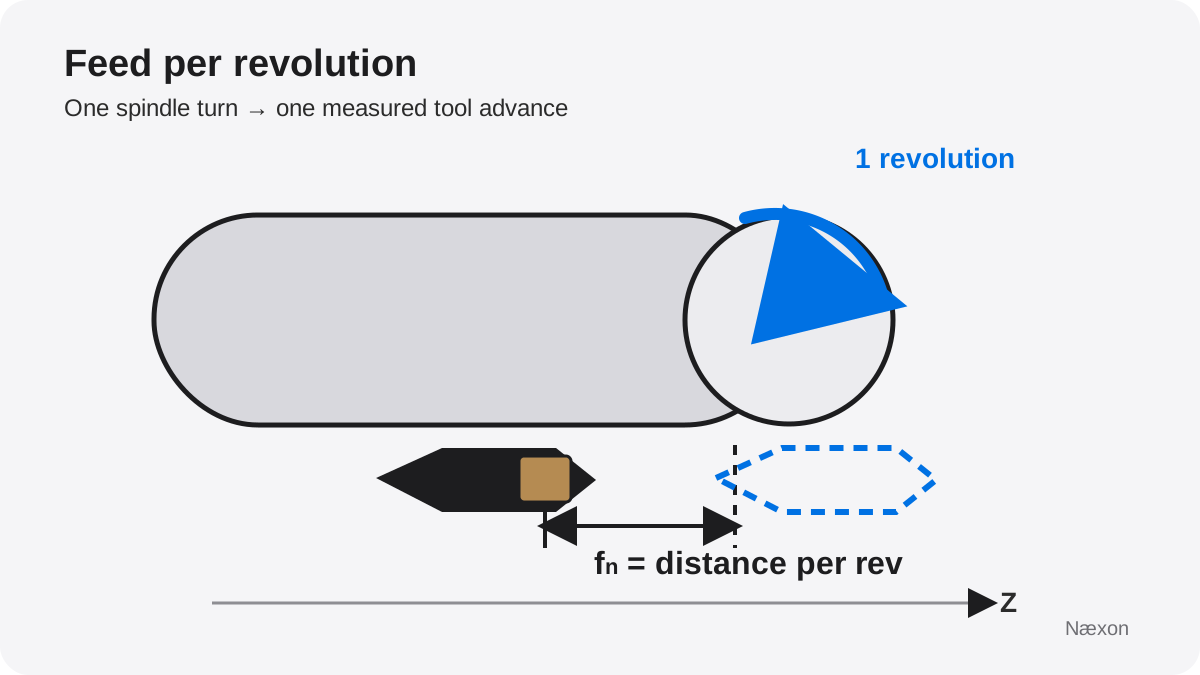
Figure 1 isolates the idea. If the command is 0.010 in/rev, the tool advances 0.010 inch while the spindle completes one turn. That statement does not yet tell us how far the tool travels in a minute. RPM supplies the missing time relationship.
What an RPM change does
In feed-per-revolution mode, the commanded advance per turn remains the same while the spindle speed changes. If RPM doubles, the spindle completes twice as many revolutions each minute, so the tool also travels twice as far per minute. The spacing of the theoretical feed marks per revolution remains tied to the same feed value, but the operation progresses faster in time.
In feed-per-minute mode, the commanded linear travel each minute remains the same while RPM changes. If RPM doubles but the in/min command does not change, each revolution receives only half as much tool advance. The conversion makes the difference visible.
Control words are not universal across every machine. On a Haas lathe, for example, G99 makes the F address feed per revolution and G98 makes it feed per minute. Another control family, machine option, or operating mode may use different codes or conventions. Always verify the exact machine's programming manual and the active modal state rather than transferring a code from memory.
Worked example: the same feed at two spindle speeds
Assume an illustrative straight-turning calculation uses fn = 0.010 in/rev. First let n = 600 rev/min. Substitute the values and carry the units:
vf = 0.010 in/rev × 600 rev/min = 6.0 in/min
Now keep the same feed per revolution and increase spindle speed to 1,200 rev/min:
vf = 0.010 in/rev × 1,200 rev/min = 12.0 in/min
No unit conversion is needed because inches and minutes are already consistent. The first result can be checked in reverse: 6.0 in/min ÷ 600 rev/min = 0.010 in/rev. The second check gives 12.0 ÷ 1,200 = 0.010 in/rev. Both return the starting feed.
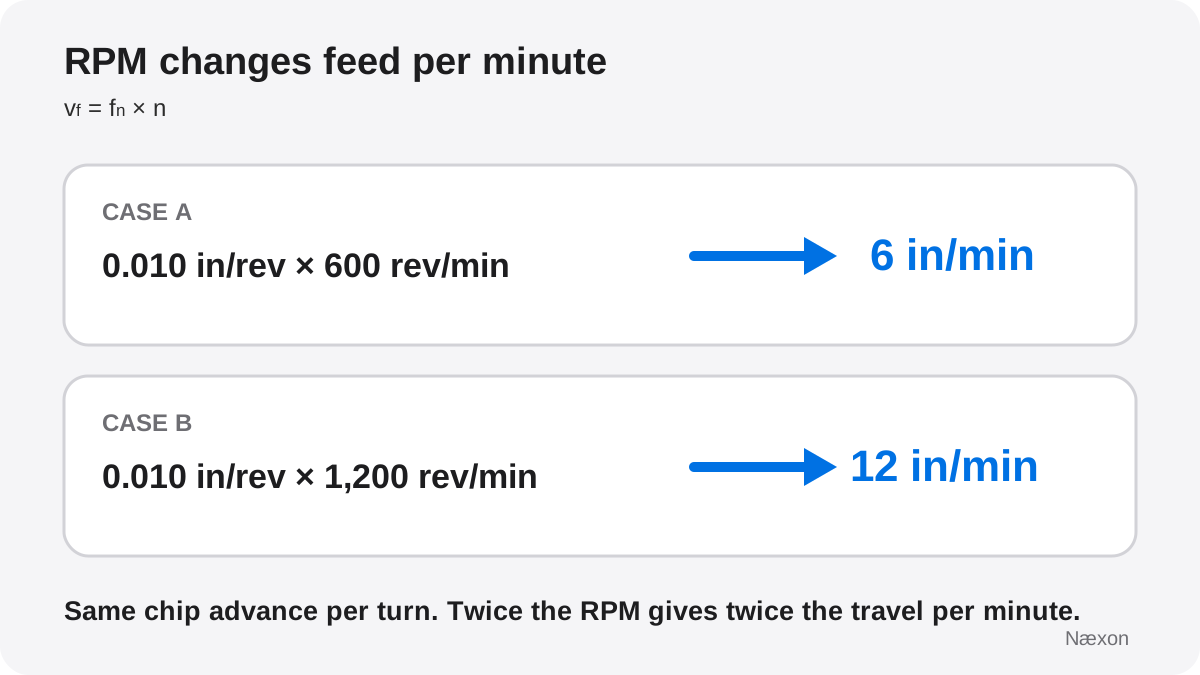
A reasonableness check reaches the same conclusion without detailed arithmetic: 1,200 rpm is twice 600 rpm. If the tool advances the same distance each turn, twice as many turns per minute must create twice the distance per minute.
These numbers only demonstrate the relationship. They are not permission to run a particular material, insert, diameter, or workholding setup at either condition.
The common wrong approach
The incorrect approach reads the F number alone and assumes its meaning. A machinist may see F0.010 and think “ten thousandths per revolution” even though the control is in feed-per-minute mode. The opposite error is equally serious: a value intended as in/min can become an enormous per-revolution command if the wrong modal state is active.
The correct approach reads three things together: the active feed mode, the unit system, and the F value. Then the machinist predicts the expected linear motion before cutting. A setup sheet or program comment can help, but the control state and approved program remain the final check.
A practical verification method
- Identify the operation. Confirm whether the tool is turning, facing, boring, drilling, threading, or performing another motion. Do not assume one feed convention fits every cycle.
- Read the approved process information. Verify the intended feed, units, spindle mode, and any control-specific requirements on the setup sheet, program, or procedure.
- Find the active feed mode. Check the program's modal commands and the control display. On restart or mid-program entry, confirm the state that will actually be active.
- Write the units beside F. State in/rev, mm/rev, in/min, or mm/min. A bare decimal is not a complete feed description.
- Calculate the expected motion. For feed per revolution, multiply by rpm to predict feed per minute. For feed per minute, divide by rpm to predict feed per revolution.
- Compare with approved tooling and machine information. Do not invent a value when the insert, material, workholding, rigidity, or machine limit is uncertain.
- Use the authorized prove-out method. Follow the shop's simulation, single-block, dry-run, offset, door, guarding, and supervised prove-out procedures. Keep clear of rotating work and never reach into an operating machine.
Troubleshooting motion that looks wrong
The tool barely appears to move: verify that a feed-per-minute value was not entered when feed per revolution was intended, then check unit mode, overrides, spindle state, and the exact program block. Do not compensate by multiplying the F value until the mode is known.
The feed becomes much faster when RPM rises: that is expected mathematically in feed-per-revolution mode because vf equals fn times n. The important question is whether the RPM and feed remain within the approved cutting and machine limits.
The finish changes after an RPM edit: confirm whether the control is holding feed per revolution or feed per minute. In per-minute mode, changing RPM changes the advance per revolution. Also check insert condition, nose radius, built-up edge, chatter, workholding, deflection, coolant, and material; feed mode is one possible cause, not the only diagnosis.
A restart begins with unexpected motion: stop using the approved control method. A modal feed command may have been established earlier in the program, and restarting below that block can leave the machine in a state the operator did not expect. Reestablish all required modal conditions according to the machine and shop procedure.
Escalate when the program and setup sheet disagree, the feed mode cannot be positively identified, the control displays an unexpected modal state, the machine behaves differently from the prediction, or safe prove-out requires access or actions outside your authorization.
Common mistakes
Frequent errors include leaving the units off a handwritten calculation, confusing feed per revolution with surface speed, treating rpm as a linear speed, mixing millimeters and inches, transferring G codes between control families, and assuming the previous program left the machine in the needed mode.
Another mistake is rounding too early. Keep enough digits through the calculation to understand the relationship, then round only as the approved process and control resolution require. A final display value does not make an unsupported cutting parameter acceptable.
Field Rules
- An F number is incomplete until its feed mode and unit are known.
- Feed per revolution is distance per spindle turn.
- Feed per minute is distance traveled in one minute.
- Use vf = fn × n and keep the units visible.
- In per-revolution mode, doubling RPM doubles feed per minute.
- Verify the exact control manual and active modal state before a cut.
Knowledge Check
- A lathe runs at 800 rpm with a feed of 0.012 in/rev. What is the calculated feed per minute?
- The control is holding 8 in/min while spindle speed changes from 500 to 1,000 rpm. What happens to feed per revolution?
- A program contains F0.008, but the feed mode is unknown. Is the feed command fully defined?
- On one control, a familiar code means feed per revolution. Can you assume the same meaning on a different control?
- The calculated motion matches your arithmetic but exceeds approved tooling data. Which value controls the job?
Answers
- 9.6 in/min. Calculate 0.012 in/rev × 800 rev/min; revolutions cancel.
- It is cut in half. At 500 rpm, 8 ÷ 500 = 0.016 in/rev. At 1,000 rpm, 8 ÷ 1,000 = 0.008 in/rev.
- No. The machine must know whether 0.008 means distance per revolution or distance per minute, and whether the units are inches or millimeters.
- No. Verify the programming manual and displayed modal state for the exact machine and control.
- The approved process and tooling limits. Correct arithmetic only describes the commanded relationship; it does not authorize the cutting condition.
Practical Exercise
On paper, create a three-column table labeled feed per revolution, rpm, and feed per minute. Use 0.006 in/rev at 500, 1,000, and 1,500 rpm. Your expected feed-per-minute results are 3, 6, and 9 in/min.
Then reverse the exercise. Hold feed per minute at 6 in/min and divide by the same three spindle speeds. Your expected feeds are 0.012, 0.006, and 0.004 in/rev. Check each row by multiplying the final in/rev value by rpm. Keep the exercise paper-based or use only an approved training simulator under supervision.
Related learning
Use surface speed and spindle RPM as the prerequisite for selecting and understanding spindle speed. Continue with precision measurement with calipers, micrometers, and dial indicators to verify the part rather than judging a cut by appearance. For additional unit-aware arithmetic practice, use Næxon Numerus as a calculator while keeping the formula, units, and approved input values visible.