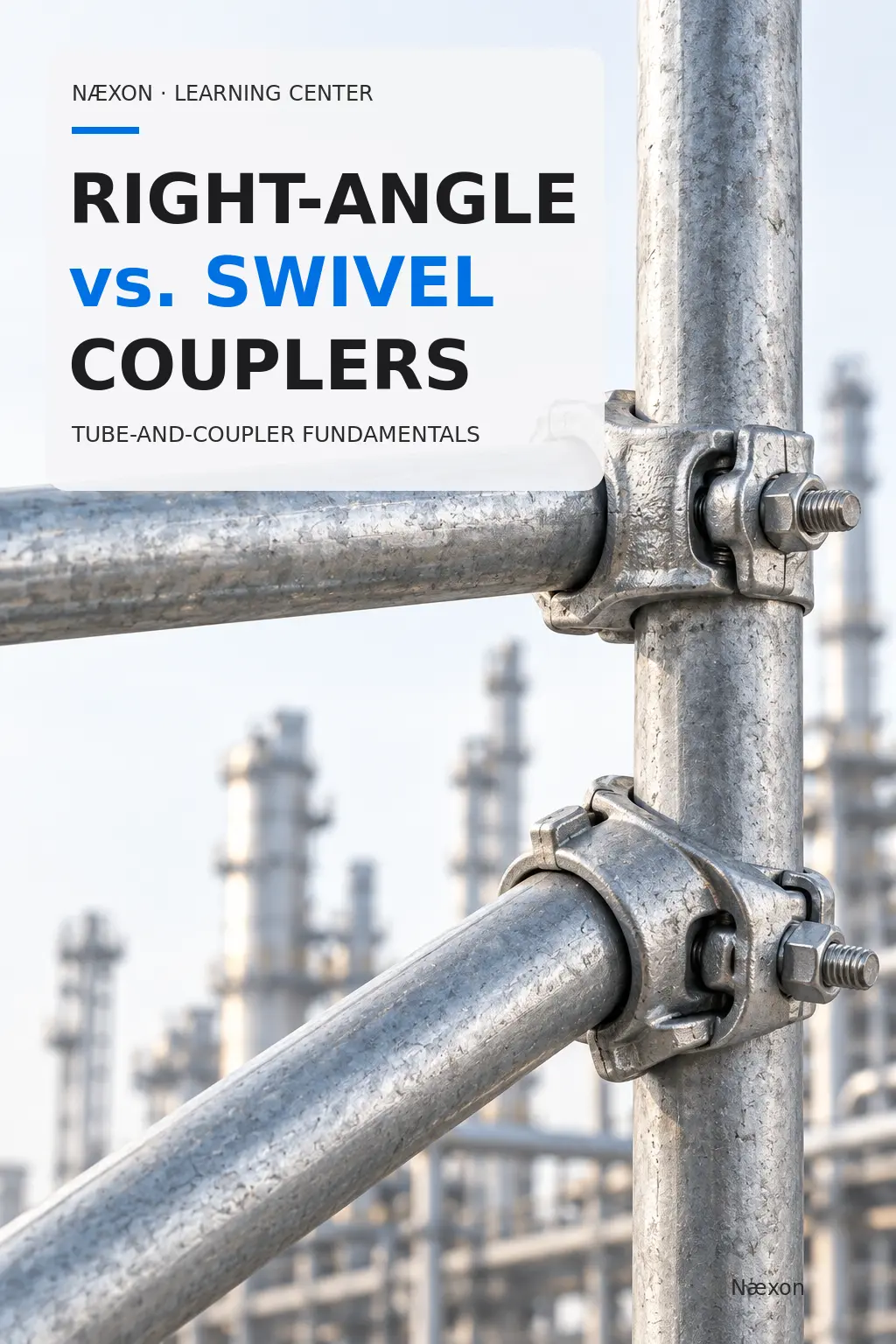
Primary trade: Scaffold builders and carpenters · Skill level: Apprentice · Lesson classification: Fundamentals · Estimated reading time: 10 minutes
What you will learn: Identify a right-angle coupler and a swivel coupler, explain the connection each one is intended to make, inspect basic fit and condition, and recognize when a mismatch must stop the build for competent-person review.
A scaffold builder reaches an intersection with two clamps in the bucket. One clamp locks two tubes across each other at a true 90 degrees. The other pivots so a diagonal brace can meet a post at the angle the bay requires. They may look similar at a glance, but they do different jobs. Choosing by what is closest instead of by connection geometry can leave a runner, bearer, or brace doing work the assembly was not designed to do.
This lesson is about recognition and inspection, not a substitute for the scaffold plan, the component manufacturer's instructions, site rules, or the competent person. Do not assemble, alter, load, or use a scaffold outside the authorized erection process.
The connection decides the coupler
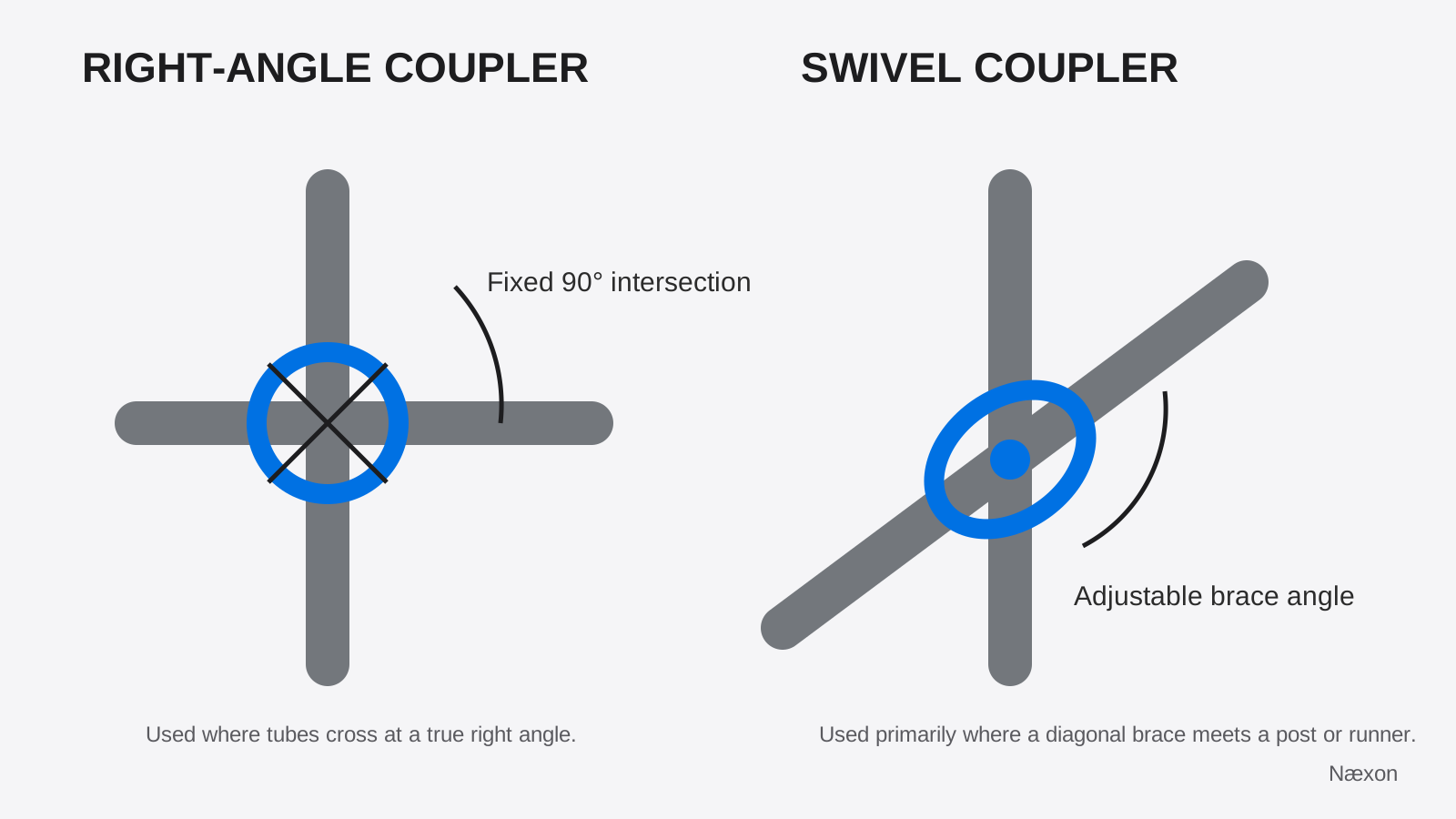
A tube-and-coupler scaffold uses round tubes connected by couplers. A right-angle coupler makes a rigid perpendicular connection. It is commonly used where a horizontal runner or bearer crosses a vertical post at 90 degrees. A swivel coupler has a pivot between its two halves. That pivot lets it capture tubes meeting at another angle, most notably a diagonal brace.
The difference is not that one clamp is universally stronger or better. The difference is whether its geometry matches the connection shown by the approved arrangement. Manufacturer data, component compatibility, tightening requirements, and the scaffold design control the final selection.
Right-angle coupler: a fixed perpendicular joint
At a normal post-and-runner intersection, the horizontal and vertical tube centerlines cross at 90 degrees. A right-angle coupler is shaped to keep that relationship. When properly selected, seated, and tightened under the approved procedure, it resists the joint rotating away from square.
This makes the right-angle coupler appropriate for many primary horizontal connections. OSHA's tube-and-coupler requirements also describe how runners, bearers, posts, bracing, and coupler locations work together. For example, bearers coupled to runners must be located as close to the posts as possible, and a bearer must extend past the post and runner enough to make full coupler contact. The clamp does not erase those placement rules.
Swivel coupler: an adjustable angled joint
A diagonal brace rarely meets a post or runner at exactly 90 degrees. The swivel coupler rotates until both clamp halves sit naturally around their tubes. Once secured, it holds that selected angle. Manufacturer guidance commonly identifies swivel clamps primarily for diagonal bracing.
The word swivel does not mean the connection should remain loose or continue moving in service. It describes the adjustment available during placement. A correctly completed connection is secured according to the approved system procedure. If the brace forces the clamp to sit crooked, the tube is not fully captured, or the pivot is damaged, stop instead of using bolt force to pull the parts into place.
Incorrect approach vs. correct approach
Incorrect: use a swivel coupler at a normal runner-to-post intersection merely because it closes around both tubes, or force a rigid right-angle coupler onto a diagonal brace. The first choice can introduce an unintended movable geometry during erection; the second can leave the clamp cocked, reduce full contact, and distort the intended brace line.
Correct: identify the member functions, confirm the intended angle, select the compatible coupler specified for that connection, and verify full seating before tightening. If the arrangement does not match the drawing or the manufacturer's instructions, the competent person resolves it before the scaffold advances.
A practical inspection sequence
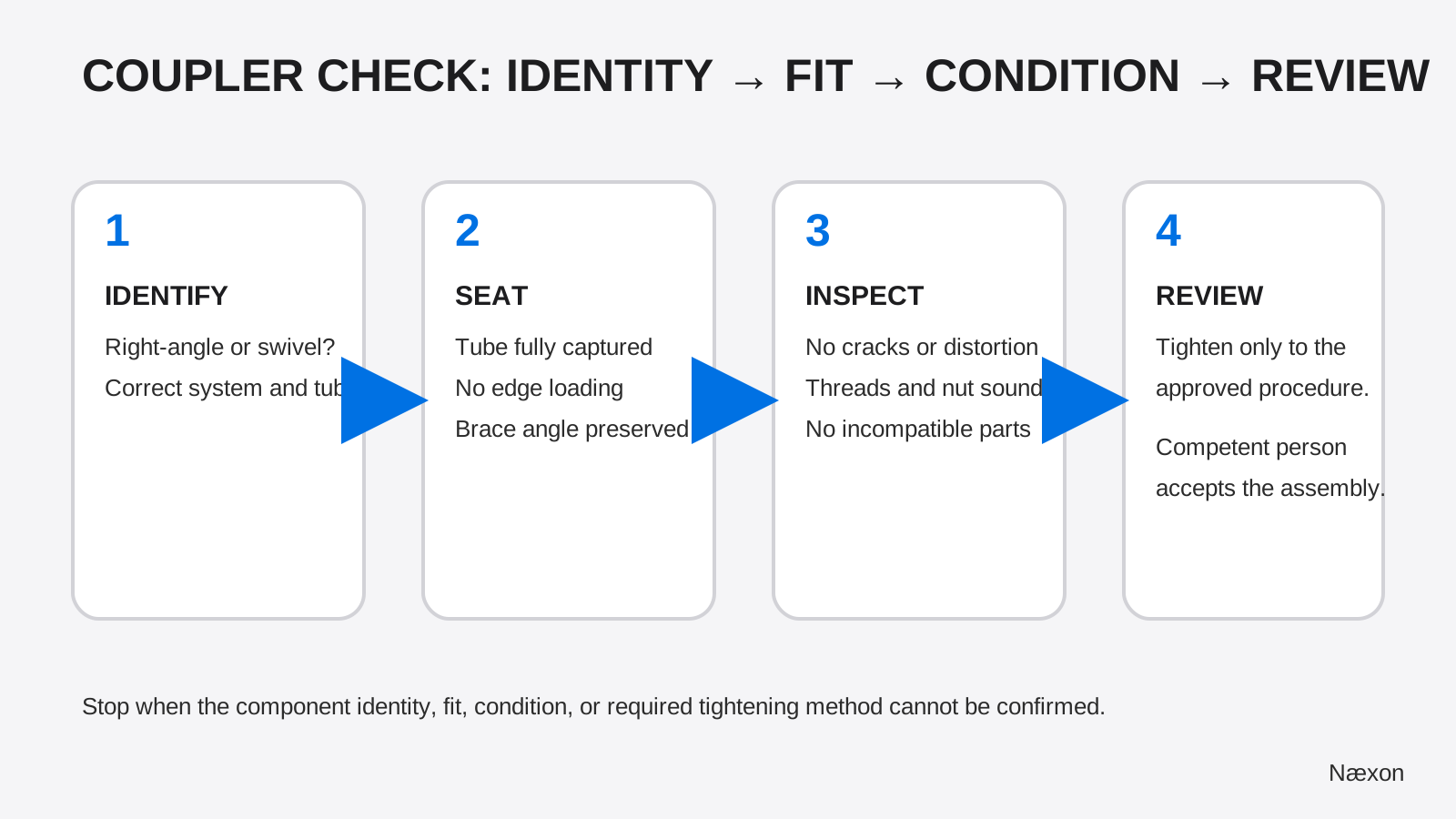
Start with identity. Confirm the coupler type, the tube system, and any markings or manufacturer-specific compatibility requirements. Mixed-looking parts are not automatically compatible simply because they can be placed together.
Next, inspect seating. Both clamp halves should capture their tubes as designed, without a tube riding on an edge, a cap hanging open, or the body twisting to overcome misalignment. At a right-angle joint, the tube centerlines should match the intended perpendicular layout. At a brace, the swivel should follow the brace angle without forcing the brace out of line.
Then inspect condition. Look for cracked or distorted bodies, damaged hinge areas, missing hardware, bent bolts, poor threads, or nuts that will not travel normally. OSHA requires tube-and-coupler scaffold couplers to be structural metal and prohibits gray cast iron. Component condition and material identity are reasons to stop when they cannot be confirmed.
Finally, follow the approved tightening method. Do not invent a universal torque. Coupler model, tube size, manufacturer instructions, project procedure, and component condition matter. The competent person must oversee the scaffold's erection, alteration, and inspection under the applicable site program.
Worked example: classify two intersections
Assume a training sketch shows one vertical post, one horizontal runner crossing the post at 90 degrees, and one diagonal brace rising from the lower runner to the next post. No load rating or erection authorization is implied by this example.
Intersection A is the runner-to-post connection. The centerlines are perpendicular, so the geometry calls for the compatible right-angle coupler identified by the approved system. Intersection B is the diagonal brace-to-post connection. Because the included angle is not 90 degrees, the geometry calls for the compatible swivel coupler.
The reasonableness check is visual: the rigid coupler should not need to bend to follow a diagonal, and the brace should not need to move away from its intended line to make the clamp close. The example classifies connection type only; it does not establish spacing, capacity, torque, or acceptance.
Troubleshooting common symptoms
If a right-angle joint will not sit square, check whether the tubes are actually perpendicular, whether another member is pulling the bay out of alignment, whether the coupler matches the tube, and whether debris or damage prevents full seating. Do not use the nut to drag a distorted bay into square.
If a swivel coupler reaches the end of its travel or sits hard against the pivot, verify the brace endpoints and the specified brace angle. A wrong brace length, misplaced connection, bent tube, or incorrect clamp can create the symptom. Stop if correcting it would require moving an approved tie, runner, bearer, or brace location.
If a nut tightens but the clamp still shifts, remove the component from the work sequence and have it evaluated. Possible causes include mismatched tube diameter, damaged threads, a deformed body, contamination, or an incorrect part. Tightening harder without the approved limit can damage the coupler and does not prove the connection is acceptable.
Common mistakes
One mistake is naming every clamp a swivel because its separate halves can move while open. Identify the actual pivot between the clamp halves. Another is assuming a right-angle coupler can correct tubes that are not laid out square. It should secure correct geometry, not manufacture it through force.
A third mistake is mixing systems by appearance. Tube outside diameter, clamp design, hardware, coatings, and published compatibility all matter. A fourth is treating the completed clamp as the entire inspection. The location of runners, bearers, braces, ties, platforms, and foundations still controls the scaffold's load path. Review how scaffold foundations carry the load and how racking appears in a scaffold bay for connected fundamentals.
Field Rules
- Choose the coupler from the connection geometry and approved system—not convenience.
- Use a right-angle coupler for a true perpendicular intersection when specified.
- Use a swivel coupler for a diagonal or other approved non-90-degree connection.
- Full seating, sound hardware, and compatible tubes come before tightening.
- Never invent torque, capacity, spacing, or acceptance criteria.
- Stop for competent-person review when the parts or layout do not match.
Knowledge Check
- A horizontal runner crosses a vertical post at 90 degrees. Which coupler geometry fits the intersection?
- A diagonal brace meets a post at about 45 degrees. Why is forcing a right-angle coupler incorrect?
- A swivel coupler closes, but one tube rests on the clamp edge. What is the next step?
- A clamp looks correct but its manufacturer and tube compatibility cannot be confirmed. May appearance alone authorize its use?
Answers
1. A compatible right-angle coupler, because it is intended to secure perpendicular tube centerlines. The approved scaffold arrangement and manufacturer instructions still control.
2. Its fixed geometry does not match the brace angle. Forcing it can leave poor contact, distort the brace line, or damage components.
3. Stop. Release the work sequence under authorized supervision and identify the cause; an edge-loaded or incompletely seated clamp is not a correct result.
4. No. Confirm the component identity, tube system, and published compatibility through the employer's approved procedure and competent person.
Practical Exercise
On paper, draw a vertical post, two horizontal runners, and one diagonal brace. Circle each intersection and label it right-angle or swivel. Under every label, write one fit check and one stop condition. A correct result labels the perpendicular runner intersections as right-angle connections, the diagonal-brace intersections as swivel connections, and includes full seating plus an identity, damage, or mismatch stop condition. This is a drawing exercise only—not authorization to erect or alter scaffold.
Related learning
Continue with field formulas for scaffold builders to connect component recognition with layout and measurement. The approved drawing, manufacturer instructions, competent person, and site scaffold program remain the controlling sources for field work.