Morning Edition • Primary trade: Carpenters and scaffold builders • Skill level: Apprentice • Classification: Fundamentals • Estimated reading time: 9 minutes
What you’ll learn: how a supported scaffold transfers load through the upright, base plate, mud sill, and foundation; why contact area matters; how to recognize warning signs; and where the competent person’s approval controls the work.
The scaffold looks plumb when the crew leaves, but after rain one leg has settled and a platform no longer feels level. The cause often begins at the bottom, where the scaffold load enters the ground.
This lesson explains the principle, not a site-specific design. Scaffold erection, alteration, movement, and dismantling must remain under competent-person supervision and direction. The approved design, manufacturer instructions, site rules, and engineering requirements control actual components, sill dimensions, jack limits, loads, and inspection decisions.
Start with the four foundation parts
If the component names are new, begin with Scaffolding Basics: Parts, Components, and Terminology. The foundation lesson becomes much easier once you can identify an upright, base plate, screw jack, ledger, and brace.
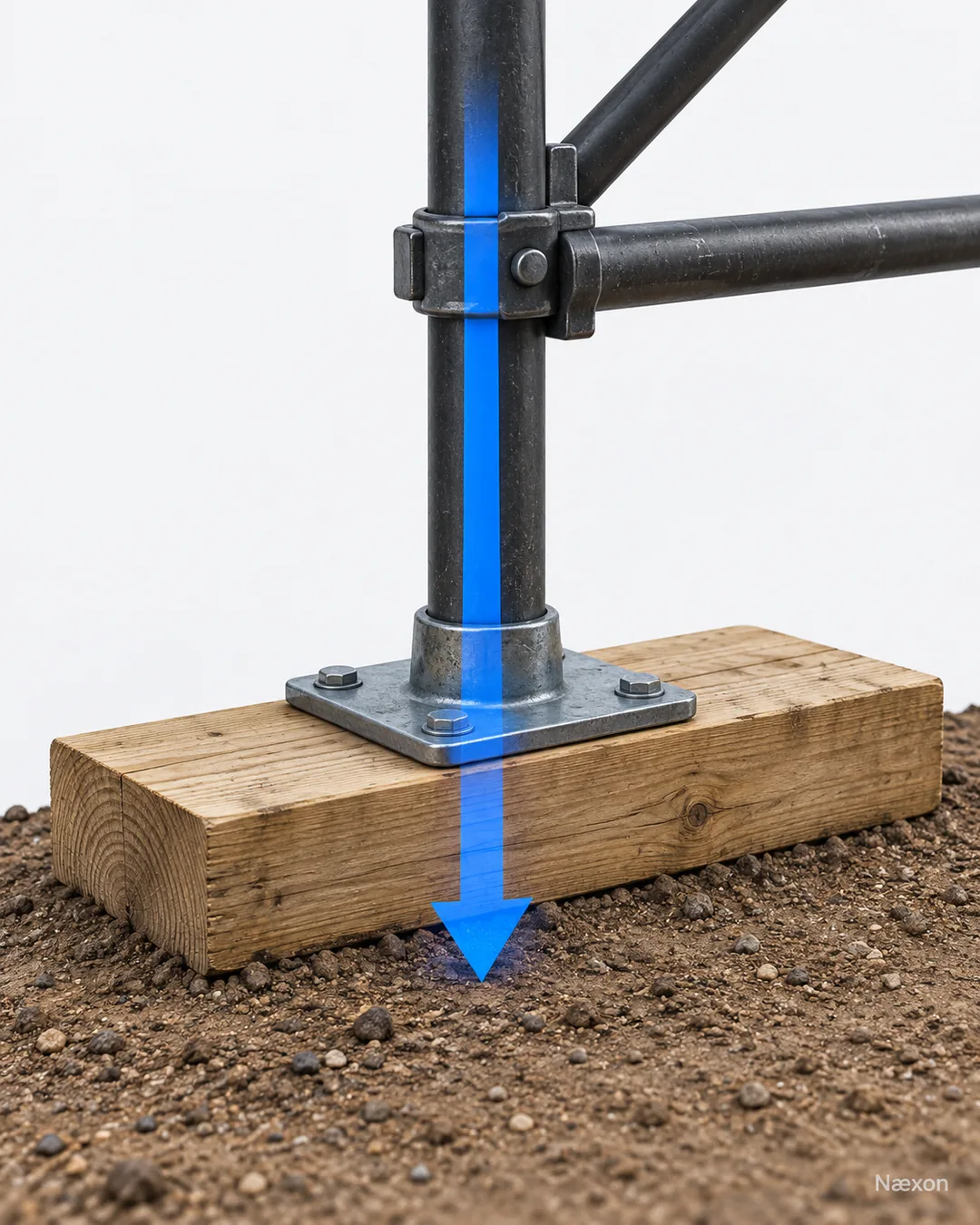
The upright, sometimes called a post, standard, frame leg, or pole depending on the system, carries a vertical reaction toward the ground. That reaction includes the scaffold’s own weight and the portion of workers, tools, materials, and environmental loads that reaches that leg.
The base plate provides a stable bearing surface between the leg or base jack and what is beneath it. It helps keep a narrow tube or leg from punching directly into the support surface. The plate must be correctly seated and in firm contact with the leg and supporting surface.
A mud sill spreads that force over more area. The sill does not make weak soil strong. It reduces average pressure by increasing contact area, provided the sill is sound, supported, and lying flat.
The foundation carries the entire assembly. It must be level, sound, rigid, and able to support the loaded scaffold without settlement or displacement. Frozen, saturated, disturbed, eroded, or voided ground may behave differently from its surface appearance.
Follow the load path
Figure 1 shows the sequence. The leg reaction moves from the upright into the base plate, through the mud sill, and across the foundation. A good-looking component above a weak layer does not repair the layer below it.
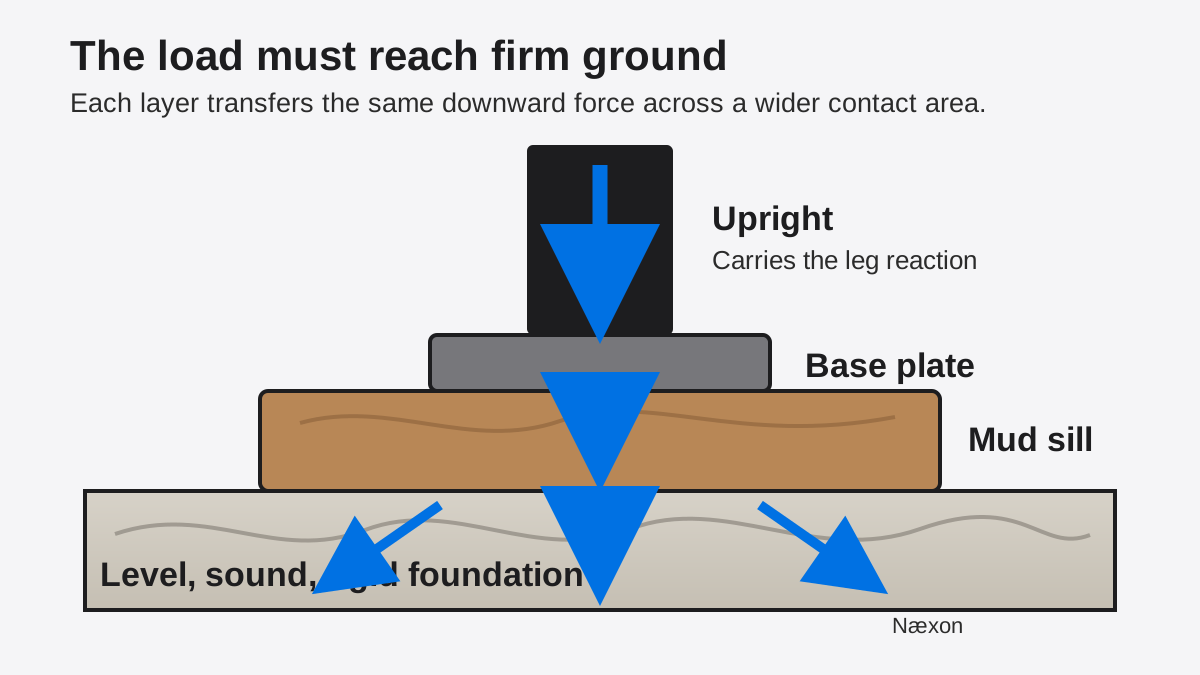
The arrows spread outward because the same leg reaction is carried across more ground area. More effective bearing area means less average pressure for the same force, but it does not prove a particular sill is adequate.
Worked example: why area changes ground pressure
Assume an illustrative case in which one leg delivers 2,400 pounds-force to its support. Compare a 6-inch by 6-inch contact footprint with a 12-inch by 24-inch sill in full ground contact. These are training values, not approved field sizes or universal acceptance criteria.
Average bearing pressure is:
p = F ÷ A
where p is average pressure in pounds-force per square inch (psi), F is leg reaction in pounds-force (lbf), and A is effective contact area in square inches (in²).
For the smaller footprint, area is 6 in × 6 in = 36 in². Pressure is 2,400 lbf ÷ 36 in² = 66.67 lbf/in², rounded to 66.7 psi.
For the sill, area is 12 in × 24 in = 288 in². Pressure is 2,400 lbf ÷ 288 in² = 8.333 lbf/in², rounded to 8.33 psi.
The sill area is eight times larger: 288 in² ÷ 36 in² = 8. With force unchanged, pressure should fall to one-eighth. The check is 66.67 psi ÷ 8 = 8.334 psi, agreeing with the direct calculation apart from rounding.
The result is reasonable, but it does not authorize an installation. The competent person must use actual leg loads, configuration, foundation conditions, manufacturer requirements, and approved design. Continue with scaffold load capacity and duty ratings, which explains why platform rating and foundation bearing are related but different checks.
A practical foundation check
A scaffold builder does not approve soil capacity by appearance alone. Trace each contact surface and report anything interrupting the load path.
- Confirm the controlling plan. Identify the system, intended use, approved configuration, manufacturer instructions, and competent person directing the work.
- Look below the surface. Check for disturbed fill, edges, trenches, drains, voids, slopes, water, ice, or softened soil.
- Check every leg. Verify the specified base component is seated and the plate is centered in firm contact with the sill or approved foundation.
- Check each sill. Look for splits, severe damage, rocking, bridging, edge overhang, or partial ground contact.
- Check plumb, level, and bracing. Foundation problems can appear as an out-of-level lift, leaning standard, distorted bay, or loose component.
- Stop when conditions change. Settlement, washout, impact, nearby excavation, or freeze-thaw movement requires competent-person evaluation before continued use.
Correct contact versus a makeshift stack
Figure 2 compares the principle. The correct side has a centered plate, full contact, and a continuous bearing surface. The incorrect side uses an offset plate and stacked scrap. That stack can shift, crush, rotate, or concentrate load. It is a warning example only—do not build or test it.
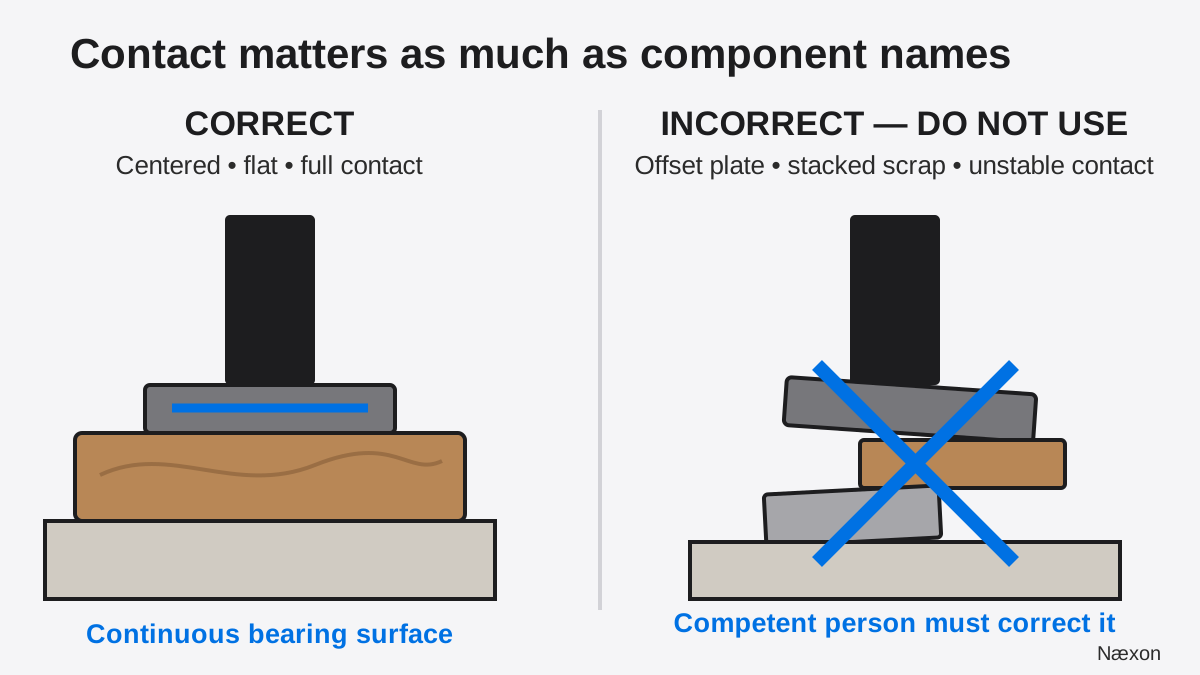
Uneven ground is handled with approved adjustable components, such as screw jacks where the design allows—not loose bricks, blocks, barrels, or improvised wedges. Extension limits and capacity effects are system-specific.
Troubleshooting settlement and movement
An out-of-level platform may indicate settlement, but a loose connection, displaced brace, damaged component, impact, or changed loading can look similar. Stop using the affected area and have the competent person inspect the full system.
Daylight under one edge of a plate suggests incomplete contact, an uneven sill, rotation, or settlement. Do not hammer scrap beneath a loaded scaffold. The corrective principle is to control the condition, identify the cause, and restore the approved arrangement under competent supervision.
A rocking sill is not using its full apparent area. The worked example counted 288 in² only because full contact was assumed. If less area actually touches, local pressure rises.
Water around a leg, pumping soil, a spreading crack, tilted jack, or fresh gaps at braces and connections are escalation signs. Restrict the affected scaffold as site procedures require and notify the competent person.
Common mistakes
A mud sill spreads load but cannot bridge an unknown void or turn saturated fill into a verified foundation. Do not count its full area when part is unsupported.
A screw jack provides approved adjustment; it does not replace foundation preparation or make unstable objects acceptable. Checking only the scaffold’s top is also a mistake: foundations belong in pre-shift inspection and need rechecking after events that may affect integrity.
Field Rules
- Trace the load path all the way to the supporting surface.
- Keep base plates centered, seated, and in firm contact.
- Do not use loose bricks, blocks, scrap stacks, or improvised wedges.
- Do not confuse larger area with proof of adequate soil.
- Treat settlement, rocking, washout, and loss of plumb as stop-and-report conditions.
- Follow the competent person, approved design, site rules, and manufacturer instructions.
Knowledge Check
- A 2,400 lbf leg reaction bears over 288 in². What is the average pressure, and what assumption must be true for that area to count?
- Two sills have the same dimensions, but one lies flat while the other bridges a depression. Which has the more dependable effective area, and why?
- You find daylight under one edge of a plate. Should you pack the gap with scrap, continue until break, or stop and notify the competent person?
- After heavy rain, the platform is slightly out of level and soil is pumping near one leg. Name two parts of the load path needing inspection.
- Why does doubling effective bearing area cut average pressure in half when force stays constant?
Answers
- 8.33 psi. Calculate 2,400 lbf ÷ 288 in². The full area counts only with effective supported contact; the value is illustrative, not an approval.
- The flat sill. Its footprint is more likely to act as bearing area. A bridged sill concentrates force at limited contact points.
- Stop and notify the competent person. Scrap packing is an unauthorized alteration and may create another unstable interface.
- At minimum, the foundation and sill/base-plate interface. The competent person should also examine plumb, level, braces, connections, and loading.
- Because p = F ÷ A. With the same numerator and twice the denominator, the quotient becomes one-half.
Practical Exercise
On paper, draw one leg carrying an illustrative 1,800 lbf reaction. Compare a 6 in × 6 in footprint with a 12 in × 18 in sill. Label the upright, plate, sill, and ground; calculate both pressures; then explain why the result does not select an approved sill.
Your check should be 1,800 lbf ÷ 36 in² = 50.0 psi and 1,800 lbf ÷ 216 in² = 8.33 psi. The second area is six times larger, so pressure is one-sixth as large. Complete this only on paper or in supervised training—never alter an in-service scaffold to test the numbers.
Related learning
Use Field Formulas for Scaffold Builders to practice force, area, and load-distribution calculations. Then return to the load-capacity lesson to connect foundation reactions with platform duty and the complete approved design.